📊 Full opportunity report: Change-order risk detector for landscaping contractors on IdeaNavigator AI — validation score, market gap, and execution plan.

Prime made for students and young adults
- Fast, free delivery for dorm and study essentials
- Prime Video and Amazon Music included
- Member-only deals
TL;DR
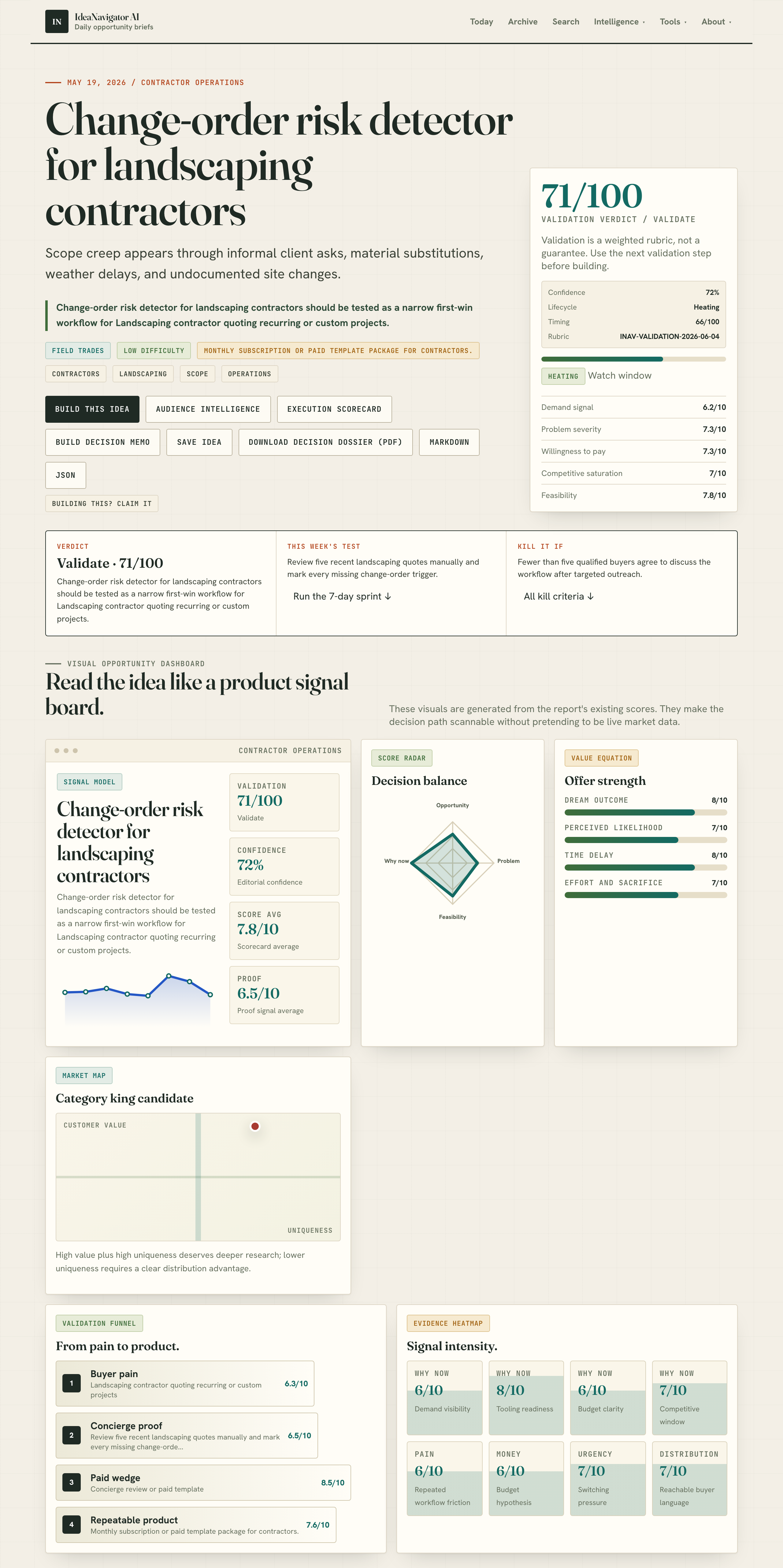
A new change-order risk detector tool is in testing for landscaping contractors, focusing on identifying scope creep risks during quoting. This aims to help small contractors manage margins more effectively amid ongoing project uncertainties.
Landscaping contractors are beginning to test a new change-order risk detector designed to identify scope creep risks during project quoting, aiming to improve margin control amid persistent project uncertainties.
The proposed workflow involves a quote and job-note checker that flags missing exclusions, change-order triggers, and approval language. It is targeted at contractors handling recurring or custom projects, where scope creep often leads to budget overruns.
The initial testing involves reviewing five recent landscaping quotes manually to identify missing change-order triggers, with the goal of refining the tool before wider deployment. The developers plan to offer the risk detector as a monthly subscription or as part of a paid template package for contractors.
This initiative addresses the common problem of scope creep, which can occur through informal client asks, material substitutions, weather delays, and undocumented site changes, all of which threaten project margins.
Impact of Automated Scope Creep Detection on Small Contractors
This development could significantly improve margin control for small landscaping contractors by providing a systematic way to identify and manage scope changes early in the quoting process. By reducing unforeseen costs, contractors can better protect profitability in an environment of high labor, material, and scheduling uncertainties.
Implementing such a tool may also standardize quoting practices, reduce disputes over scope, and improve project planning accuracy, ultimately contributing to more stable contractor operations.
Popular right now

Dyson V8 Cyclone Cordless Vacuum

KitchenAid Artisan 5-Quart Tilt-Head Stand Mixer, Almond Cream

Shark HydroVac MessMaster Cordless Wet-Dry Vacuum and Mop Combo, AW261
As an affiliate, we earn on qualifying purchases.
Growing Need for Margin Control in Landscaping Projects
Small landscaping contractors face increasing pressure from rising labor and material costs, coupled with unpredictable weather and client demands. Scope creep has long been a challenge, often leading to unanticipated expenses and reduced profit margins.
While some larger firms have adopted formal change management processes, smaller contractors typically rely on informal methods, which can be inconsistent. The proposed risk detector aims to fill this gap by providing an accessible, automated solution to flag potential issues during the quoting stage.
“The change-order risk detector could serve as a valuable first step in helping small contractors control margins more effectively.”
— an anonymous researcher
Uncertainties in Implementation and Effectiveness
It is not yet clear how accurately the tool will identify all relevant change-order triggers or how contractors will adopt and integrate it into their existing workflows. The effectiveness of the tool in real-world scenarios remains to be validated through broader testing.
Next Steps for Pilot Testing and Market Adoption
The developers plan to complete the initial review of five landscaping quotes, refine the tool based on findings, and then expand testing to a larger group of contractors. If successful, a wider rollout as a subscription service or template package could follow within the next few months.
Key Questions
How does the change-order risk detector work?
The tool reviews quotes and job notes to identify missing exclusions, change-order triggers, and approval language that could signal scope creep risks.
Who is the target user for this tool?
Small landscaping contractors handling recurring or custom projects who want to better control project margins.
When will the tool be available for wider use?
If initial testing is successful, a broader rollout as a subscription or template package could occur within the next few months.
What are the main benefits of using this risk detector?
It aims to reduce scope creep, improve margin control, standardize quoting practices, and decrease project disputes.
Are there any limitations or risks associated with the tool?
Its accuracy in detecting all scope changes is still unproven, and integration into existing workflows may vary among contractors.
Source: IdeaNavigator AI