📊 Full opportunity report: Set Up An Empty Trust Tracker For Probate Preparation on IdeaNavigator AI — validation score, market gap, and execution plan.

Prime made for students and young adults
- Fast, free delivery for dorm and study essentials
- Prime Video and Amazon Music included
- Member-only deals
TL;DR
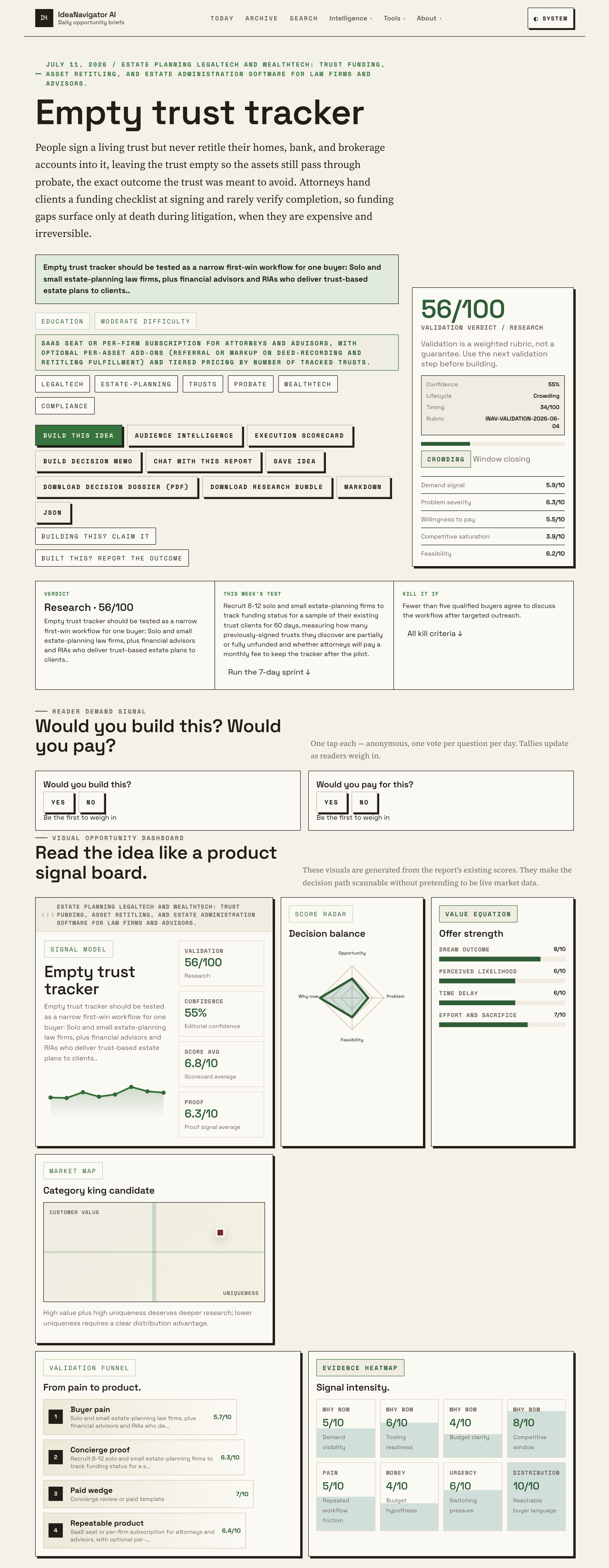
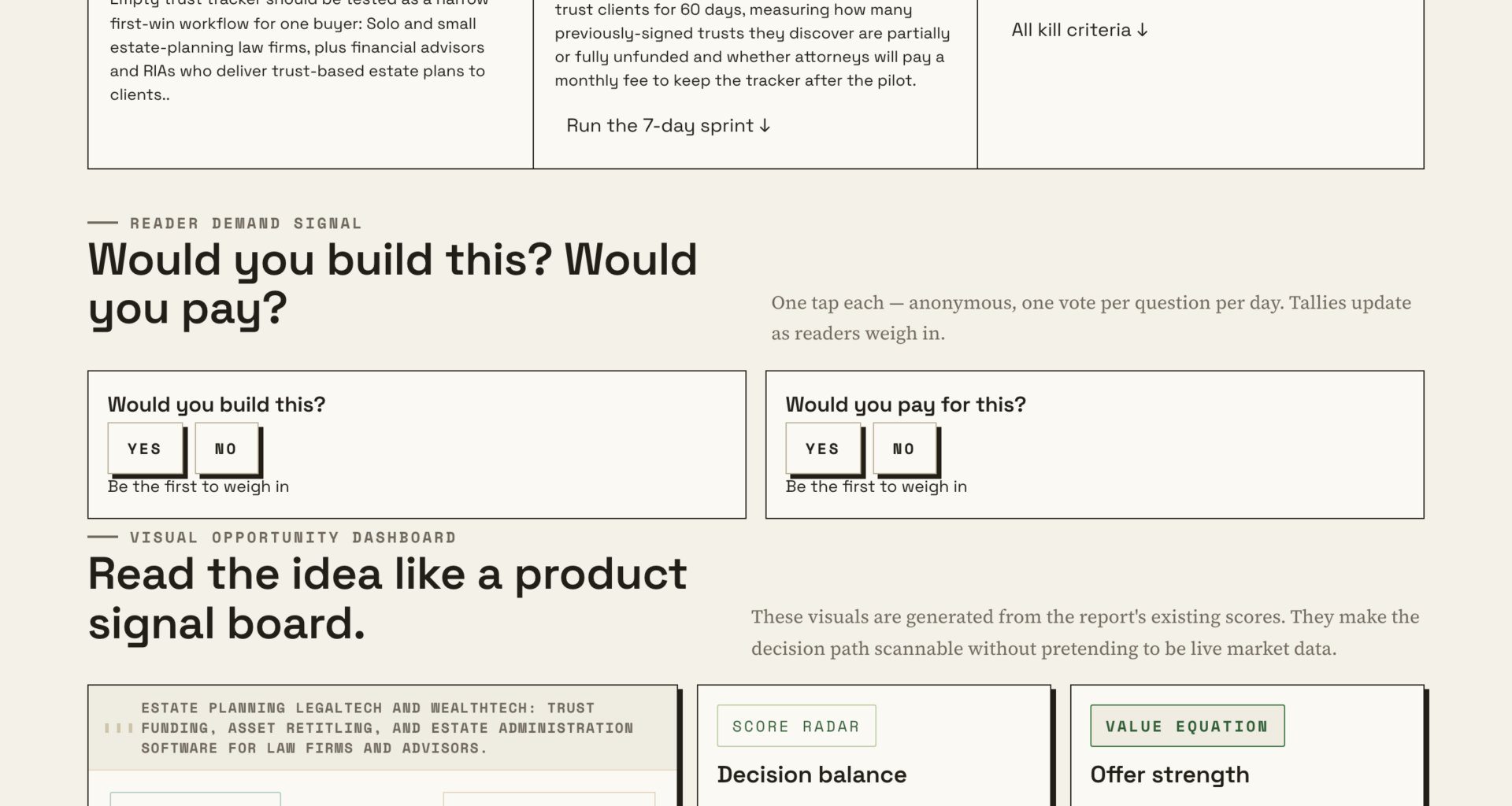
A product concept from IdeaNavigator AI proposes a client-by-client trust funding tracker that would let estate-planning attorneys and advisors verify whether trusts are actually funded before clients die. The proposal includes a 60-day validation pilot with 8-12 small firms.
A newly published product proposal from IdeaNavigator AI lays out a plan for an “empty trust tracker” — a software tool that would let estate-planning attorneys and financial advisors verify, asset by asset, whether clients’ living trusts are actually funded before the client dies. The proposal targets solo and small estate-planning law firms, along with advisors and RIAs who deliver trust-based plans, and frames the tracker as a narrow, testable first product in a market it describes as under-served.
The problem the proposal identifies is specific: clients sign a living trust but never retitle their homes, bank accounts, and brokerage accounts into it, leaving the trust legally empty. The assets then pass through probate — the exact court process the trust was created to avoid. According to the proposal, attorneys typically hand clients a funding checklist at signing and rarely verify completion, so funding gaps surface only at death, often during litigation, when they are expensive and irreversible.
The proposed minimum viable product is a client-by-client funding tracker. Attorneys or advisors would create a funding checklist per trust covering real estate, bank, brokerage, retirement, and business interests plus beneficiary designations. Each asset would carry a status of pending, in-progress, or confirmed funded, with proof attached — a recorded deed, for example, or a retitled account statement. Automated reminders would go to clients, and a dashboard would show each firm’s book of trusts by percent funded, letting partners flag dangerously empty trusts before death.
The revenue model is a SaaS seat or per-firm subscription for attorneys and advisors, with optional per-asset add-ons such as referral fees or markups on deed-recording and retitling fulfillment, and tiered pricing by the number of tracked trusts. The proposed validation plan calls for recruiting 8-12 solo and small estate-planning firms to track funding status for a sample of existing trust clients over 60 days, measuring how many previously signed trusts turn out to be partially or fully unfunded and whether attorneys will pay a monthly fee to keep the tracker after the pilot.
Why Unfunded Trusts Cost Families
If the concept is validated, it addresses a failure point with real financial consequences. An unfunded trust provides none of its intended benefits — probate avoidance, privacy, and simplified administration — while the client believes they are protected. Gaps discovered after death cannot be fixed informally; they surface in probate or litigation, where the cost of unwinding them falls on the estate and the heirs.
For firms, the tracker would convert funding from a one-time checklist handed to a client into an ongoing verification workflow with a dashboard, which the proposal argues creates a defensible paid layer on top of existing per-deed funding services that it says are priced from $250.
For readers who hold a trust themselves, the proposal is a reminder that signing the document is not the finish line: the retitling step is where most plans quietly fail.
Top picks for "empty trust tracker"
As an affiliate, we earn on qualifying purchases.
Trust Adoption and the 2026 Tooling Gap
: “The proposal situates the idea in the 2026 market: estate planning adoption and digital tooling are growing, yet it cites an estimate that only about 11% of Americans hold a trust. Trust funding, it argues, remains a manual and fragmented step that existing document-drafting software does not close.
It also points to demand-side pressure: advisors and RIAs are racing to bundle funded estate plans into client offerings, and a paid market for funding fulfillment — per-deed retitling services — already exists. The tracker would sit on top of that market rather than replace it, handling tracking and verification while partners handle execution.
What the Proposal Has Not Proven
No product exists yet, and no pilot has been run. The core hypotheses — that firms will discover a meaningful share of unfunded trusts in their existing books, and that attorneys will pay a recurring fee to keep tracking — are untested.
The 11% trust-holding figure and the $250 per-deed pricing are cited within the proposal without named sources, and their comparison baselines and time windows are not specified. It is also unclear whether clients will respond to automated reminders, whether advisors face regulatory constraints on charging per-asset add-ons, or how the tool would handle proof verification at scale. The claim that funding gaps surface “only at death” is the proposal’s characterization of current practice, not an independently verified statistic.
The 60-Day Pilot Decision Point
The stated next step is validation: recruiting 8-12 solo and small estate-planning firms to run the tracker on a sample of existing trust clients for 60 days. The two success metrics are defined — the share of previously signed trusts found partially or fully unfunded, and post-pilot willingness to pay a monthly subscription.
If pilots proceed, the results would determine whether the tracker moves from concept to product, and whether pricing lands on per-firm subscriptions, per-asset add-ons, or both. No pilot start date has been announced.
Source: IdeaNavigator AI
Key Questions
What is an empty trust?
A living trust that was signed but never funded — the client’s home, bank, and brokerage accounts were never retitled into it. The trust exists on paper but holds nothing, so the assets still pass through probate.
Is the empty trust tracker an available product?
No. It is a published product concept from IdeaNavigator AI. No software has been built and no pilot has been run; a 60-day validation with 8-12 firms is proposed as the first step.
Who would use it?
Solo and small estate-planning law firms, plus financial advisors and RIAs who deliver trust-based estate plans, under a per-firm or per-seat SaaS subscription with optional per-asset add-ons.
How would the tracker verify funding?
Each asset in a trust would be assigned a status — pending, in-progress, or confirmed funded — with proof attached, such as a recorded deed or a retitled account statement, plus automated client reminders.
How would the idea be tested?
By having participating firms track funding status for existing trust clients for 60 days, then measuring how many trusts turn out to be unfunded and whether attorneys will pay to keep the tool afterward.
Source: IdeaNavigator AI
Fall Picks
fall essentials
As an affiliate, we earn on qualifying purchases.