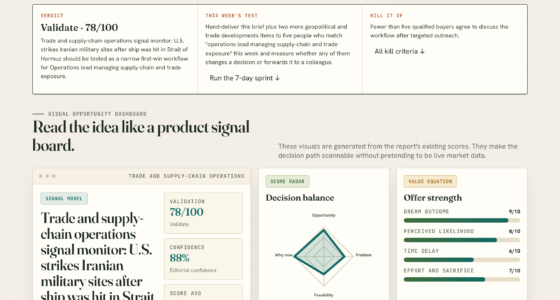
📊 Full opportunity report: Trade And Supply-Chain News Puts Argentina In Focus on IdeaNavigator AI — validation score, market gap, and execution plan.

Prime made for students and young adults
- Fast, free delivery for dorm and study essentials
- Prime Video and Amazon Music included
- Member-only deals
TL;DR
IdeaNavigator AI proposes a subscription monitor that would filter geopolitical and trade news for supply-chain operations leaders. Its Argentina example is described as a high-scoring signal, but the material gives no underlying event, dates, trade data or corroboration; it does not establish that Argentina has undergone a specific trade development.
IdeaNavigator AI has proposed a subscription monitor for operations leaders tracking trade and supply-chain exposure, using a reported rise in Argentina-related global coverage as an example. But the proposal does not identify a particular Argentina trade event or provide the underlying coverage data, so it does not establish that a new policy, disruption or market change has occurred.
The proposal describes a tool that would scan GDELT and similar feeds, filter developments for relevance to a supply-chain operations role, and produce short briefs covering what changed, why it matters and what action might follow. Its intended users are operations leads responsible for trade and supply-chain exposure, who may need to spot relevant developments sooner than a general news roundup allows.
IdeaNavigator AI assigns the Argentina signal a score of 88 out of 100. The material does not explain how that score is calculated, what period it covers, which stories or records contributed to it, or how it compares with a baseline. The score is therefore a feature of the proposal, not independent evidence of a surge in trade activity or risk.
The suggested first test is to deliver the Argentina brief and two other geopolitical or trade briefs to five people matching the intended user profile. The proposal says to watch whether recipients change a decision or forward a brief to a colleague. It does not report that the test has taken place, or provide results, subscriber commitments or evidence of customer demand.
Testing a Faster Risk Brief
For operations teams, a relevant change in trade rules, transport conditions or geopolitical risk can affect sourcing, shipping and planning. A filter that connects broad coverage to a particular company’s exposure could help staff distinguish actionable developments from general attention. The proposed product’s value would depend on whether its alerts are timely, accurate and specific enough to affect real decisions.
At this stage, the significance is as a product hypothesis, not a confirmed change in Argentina’s trading environment. Without the specific event behind the signal, readers cannot assess whether it affects a commodity, route, supplier, regulation or commercial exposure. Nor is there evidence yet that the proposed workflow improves decisions compared with existing monitoring.
As an affiliate, we earn on qualifying purchases.
From Coverage Signal to Product Test
The idea starts with a problem statement: relevant geopolitical and trade developments appear across news, forums and filings, while generic roundups may not be tailored to an operations lead’s responsibilities. It proposes a narrow initial workflow rather than a broad monitoring service: select developments relevant to one user profile and convert them into concise decision briefs.
The proposal says GDELT surfaced the Argentina item with an 88/100 signal and argues that fast-moving developments make same-day, role-specific reading useful. It supplies no timestamp, links to underlying coverage, examples of matching documents or description of the signal’s method. The claim about speed and user need is the rationale for testing the idea, not a measured result.
Revenue would come from subscriptions, according to the proposal. Its proposed validation method is a small hand-delivered trial with five prospective users, measuring actions such as a changed decision or a forwarded brief. That would offer early feedback, but the material gives no trial findings or evidence about pricing, retention or the size of the potential market.
As an affiliate, we earn on qualifying purchases.
The Argentina Signal Is Unspecified
The material does not say what happened in Argentina, when it happened or which trade or supply-chain exposure might be affected. It provides no government announcement, company filing, shipment data, policy change or independent reporting to substantiate a specific development. The phrase “surges in global coverage” is not accompanied by a coverage count, observation window or comparison baseline.
It is also unclear how GDELT produced the score, whether other feeds corroborated it, and whether the proposed summaries would identify relevant developments reliably. No interviews, customer commitments, test outcomes or operating results are reported. The available information supports describing a proposed monitoring product and validation plan, not reporting a confirmed surge in Argentina-related trade activity.
supply chain risk management subscription
As an affiliate, we earn on qualifying purchases.
As an affiliate, we earn on qualifying purchases.
A Five-User Validation Trial
The next step set out in the proposal is to deliver three briefs, including the Argentina example, to five prospective operations users during an unspecified “this week” and record whether they change a decision or share a brief. No calendar date is provided, and there is no indication that outreach has begun or that results are available.
To substantiate the Argentina signal as a news development, further reporting would need to identify the underlying stories or records, specify the time window and comparison basis, and establish whether any confirmed policy, logistics or market change affects supply chains. Until then, the proposal remains an idea for testing rather than evidence of a new Argentina-related trade event.
Source: IdeaNavigator AI
trade and supply chain news filter
As an affiliate, we earn on qualifying purchases.
As an affiliate, we earn on qualifying purchases.
Key Questions
What is the actual news development?
IdeaNavigator AI proposed testing a subscription monitor that filters trade and geopolitical news for supply-chain operations leaders. The material does not document a separate Argentina trade event.
What does the 88/100 score mean?
The proposal calls it a GDELT signal score, but does not provide its methodology, time window, comparison baseline or underlying data. It should not be read as a measure of trade activity or economic impact.
What would the proposed monitor do?
It would scan GDELT and similar feeds, select developments relevant to an operations role, and turn them into short briefs describing what changed, why it may matter and what action could be considered.
Has the product been tested with customers?
No test results are reported. The proposal recommends delivering three briefs to five prospective users and measuring whether they change a decision or forward a brief.
What is not known about Argentina?
The material does not identify the event behind the coverage signal, its timing, the sources counted or any specific effect on trade, shipping, suppliers or supply-chain risk.
Source: IdeaNavigator AI
Halloween Picks
halloween
As an affiliate, we earn on qualifying purchases.