
Deep time reshapes modern science because it offers a vast perspective on Earth’s history, allowing you to understand millions and billions of years of change. It helps you see how geological layers and fossils reveal past environments, evolution, and sudden events like eruptions or impacts. Advances in dating techniques refine this understanding, showing how Earth’s processes are constantly evolving. By exploring deep time, you gain insights that influence how you think about Earth’s future and its ongoing story—there’s much more to discover.

Prime made for students and young adults
- Fast, free delivery for dorm and study essentials
- Prime Video and Amazon Music included
- Member-only deals
Key Takeaways
- Deep time provides context for understanding Earth’s long-term geological and biological processes, influencing current scientific models.
- Advances in dating techniques continually revise timelines, reshaping theories about Earth’s history.
- Fossil records and geological layers reveal rapid events and environmental shifts, challenging static Earth models.
- Studying deep time helps predict future geological and climate changes by understanding past patterns.
- The concept broadens scientific perspectives beyond human lifespan, fostering more comprehensive Earth system studies.

Deep time, the concept of Earth’s vast and ancient history, has profoundly shaped modern science’s understanding of our planet’s development. When you think about it, it’s astonishing how scientists have pieced together millions of years of Earth’s history through fossil records. These preserved remains and traces of ancient life serve as essential clues, allowing you to trace the evolution of species and understand how life has changed over geological time. The idea of geological time stretches your imagination, revealing a timeline so immense that human history is but a blink within it. It’s this expansive scale that helps scientists explain the formation of mountain ranges, the shifting of continents, and the creation of Earth’s diverse environments.
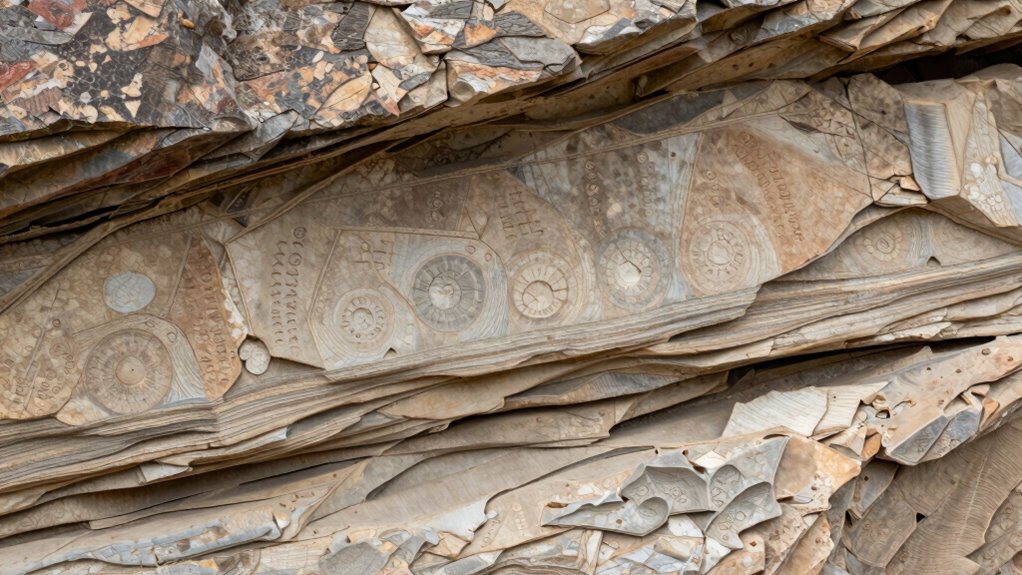
Deep time reveals Earth’s immense history, shaping our understanding of mountains, continents, and diverse environments over millions of years.
Understanding geological time is fundamental because it provides a framework for interpreting Earth’s physical features and biological history. When you study the layers of sedimentary rock, you’re essentially reading a history book written in stone. Each layer, or stratum, holds clues about the environmental conditions at the time it was formed and the life that existed then. By analyzing fossil records within these layers, scientists can determine the relative ages of fossils and correlate them across regions, effectively creating a timeline that spans millions of years. This process allows us to understand how species originated, adapted, and went extinct, offering an overall view of life’s history on Earth. Recognizing how fossil records connect to Earth’s deep past is key to understanding our planet’s evolution. Additionally, advances in dating techniques, such as radiometric dating, have further refined our understanding of geological time, providing more precise estimates of when specific events occurred. These techniques have revolutionized geoscience by enabling scientists to construct detailed chronologies of Earth’s history.
Deep time continues to reshape scientific perspectives because it challenges short-term explanations of Earth’s processes. Instead of viewing geological change as slow and static, you learn that Earth’s history is dynamic and marked by rapid events like volcanic eruptions, asteroid impacts, and climate shifts. These events, recorded in fossil records and geological layers, help scientists understand the complex interactions shaping our planet. Furthermore, the study of geological layers reveals patterns of environmental change and biological responses over vast periods, illustrating the interconnectedness of Earth’s systems. By appreciating the immense scale of geological time, scientists can develop more accurate models of Earth’s past, which in turn inform predictions about future changes. Incorporating scientific dating methods enhances our ability to build a precise timeline of Earth’s history.
In essence, deep time compels you to think beyond human lifetimes and immediate events. It emphasizes that Earth’s history is an ongoing story written over billions of years, with fossils and geological time acting as your guides. This perspective is fundamental for modern science because it provides context for understanding not just where we come from, but also how Earth’s systems operate and evolve. As you continue studying Earth’s deep past, you’ll see that it’s a foundation for all geological and biological sciences, constantly reshaping what we believe about our planet’s future.
As an affiliate, we earn on qualifying purchases.
Frequently Asked Questions
How Does Deep Time Influence Current Climate Change Models?
Deep time influences your climate change models by providing a long-term perspective through fossil calibration, which helps you understand past climate variability. This knowledge sharpens climate modeling accuracy, allowing you to better predict future trends. By studying ancient climate shifts preserved in deep time, you can refine your models, making them more reliable. This connection underscores how Earth’s deep history is essential for comprehending and combating modern climate change.
What Are the Challenges in Studying Events From Deep Geological Time?
Studying events from deep geological time presents challenges like incomplete fossil preservation and complex geological stratification. You may struggle to find well-preserved fossils that accurately represent past life, and geological layers often get disturbed over millions of years. These factors make it hard to piece together precise timelines and events, requiring careful analysis and interpretation to understand Earth’s ancient history. Despite difficulties, advances in technology help you uncover more about our planet’s deep past.
How Do Scientists Date Ancient Fossils With Precision?
You can date ancient fossils precisely through fossil calibration and isotopic analysis. Fossil calibration involves comparing fossil ages with datable materials to set chronological benchmarks. Isotopic analysis measures ratios of radioactive isotopes, like uranium or carbon, to determine the fossil’s age. By combining these methods, scientists refine their dating accuracy, unraveling Earth’s deep history and understanding evolutionary timelines more precisely.
Can Deep Time Concepts Help Predict Future Geological Events?
Deep time acts like a vast map, guiding your understanding of future geological events. By studying the fossil record and geological cycles, you can sense patterns echoing through Earth’s history. These patterns serve as clues, helping you anticipate shifts like volcanic eruptions or earthquakes. Though the future remains uncertain, deep time’s perspective sharpens your predictions, revealing Earth’s long-term rhythms and guiding your steps in steering its ever-changing landscape.
How Has Understanding Deep Time Evolved Over Scientific History?
You see, understanding deep time has evolved from early geological observations to recognize the vast scale of geological processes and ancient ecosystems. Scientists now appreciate that Earth’s history spans billions of years, revealing how gradual changes shape our planet. This deep time perspective helps you grasp how ancient ecosystems transformed over eons, influencing modern geology. Your understanding deepens as new evidence continually refines the timeline of Earth’s dynamic, ancient past.
As an affiliate, we earn on qualifying purchases.
Conclusion
Understanding deep time changes how you see the world, reminding you that Earth’s history spans billions of years, far beyond human memory. For example, imagine uncovering fossils that reveal the sudden rise and fall of ancient species, forcing you to rethink evolution. This perspective challenges your assumptions about life’s pace and resilience, urging you to see geology and biology as interconnected stories written over eons. Embracing deep time deepens your appreciation for Earth’s complex, ongoing narrative.
As an affiliate, we earn on qualifying purchases.
As an affiliate, we earn on qualifying purchases.
Fall Picks
fall essentials
As an affiliate, we earn on qualifying purchases.