Recent breakthroughs in gravitational lensing techniques allow you to see dark matter more clearly by detecting subtle distortions in light caused by cosmic structures. These improvements increase the resolution of dark matter maps, revealing detailed filaments and concentrations previously hidden. As a result, scientists can better understand how dark matter influences galaxy formation and cosmic evolution. Keep exploring to discover how these advancements could reshape our view of the universe’s unseen fabric.

Prime made for students and young adults
- Fast, free delivery for dorm and study essentials
- Prime Video and Amazon Music included
- Member-only deals
Key Takeaways
- Recent breakthroughs in gravitational lensing techniques enable more detailed and higher-resolution dark matter maps.
- Improved analysis reduces noise and distortions, revealing finer dark matter structures like filaments and concentrations.
- Enhanced lensing data helps differentiate dark matter effects from dark energy influences in cosmic structures.
- Combining advanced simulations with high-quality lensing observations sharpens dark matter image clarity.
- These advancements deepen understanding of dark matter’s role in galaxy formation and cosmic evolution.
As an affiliate, we earn on qualifying purchases.
Advancements in Gravitational Lensing Techniques

Recent breakthroughs in gravitational lensing techniques have considerably improved our ability to map dark matter. By analyzing how light from distant objects bends around massive structures, scientists can detect subtle distortions caused by dark matter in galaxy clusters. These advancements help differentiate the effects of dark energy, which influences the universe’s expansion, from the distribution of dark matter within clusters. Enhanced resolution allows you to observe the intricate patterns of gravitational lensing, revealing otherwise invisible dark matter filaments and concentrations. As you interpret these lensing signals, you’ll better understand how dark matter shapes galaxy clusters and interacts with dark energy. These innovations mark a significant step forward in unraveling the universe’s hidden mass, bringing us closer to comprehending its fundamental composition. Additionally, improving our understanding of dark matter distribution aids in refining cosmological models and enhances the accuracy of galaxy formation simulations.
As an affiliate, we earn on qualifying purchases.
Improving the Resolution of Dark Matter Images

To gain a clearer picture of dark matter, scientists are focusing on enhancing the resolution of gravitational lensing images. Improved resolution allows for more detailed dark matter maps, revealing finer structures that were previously hidden. Researchers combine high-quality lensing data with advanced dark matter simulations to refine image clarity. They also analyze the cosmic microwave background to better understand the distribution of dark matter across the universe. These approaches help reduce noise and distortions, sharpening the images and making subtle features detectable. By increasing resolution, scientists can better trace how dark matter influences galaxy formation and cosmic evolution. Additionally, data analysis techniques are employed to interpret complex signals and improve the accuracy of the maps. This progress ultimately leads to more accurate models, deepening our understanding of dark matter’s role in shaping the universe.
cosmic microwave background analysis kit
As an affiliate, we earn on qualifying purchases.
As an affiliate, we earn on qualifying purchases.
Implications for Understanding Cosmic Structure
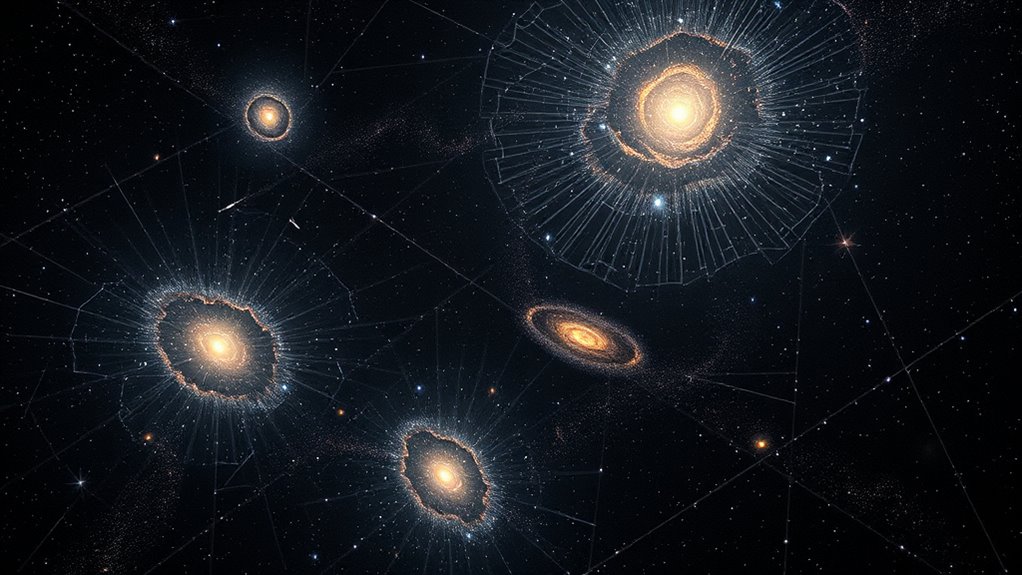
As scientists improve the resolution of dark matter maps through advanced gravitational lensing techniques, they gain deeper insights into how dark matter shapes the large-scale structure of the universe. By analyzing the dark matter distribution more accurately, you can better understand how galaxies and galaxy clusters form and cluster over cosmic time. These refined maps reveal the underlying scaffolding that guides cosmic evolution, showing where matter is concentrated and how structures grow. This enhanced understanding of dark matter’s role helps you connect the behavior of dark matter to the universe’s overall architecture, shedding light on the processes that drive cosmic expansion and structure formation. Ultimately, sharper dark matter maps enhance your understanding of the universe’s evolution from its earliest moments to today’s vast cosmic web.
high-resolution astrophotography camera
As an affiliate, we earn on qualifying purchases.
As an affiliate, we earn on qualifying purchases.
Challenges and Limitations of Current Methods

While gravitational lensing has revolutionized dark matter mapping, several challenges limit its effectiveness. Data calibration remains complex, as small errors can significantly distort results. Observational biases, like galaxy selection effects, skew the data, making accurate interpretations harder. Additionally, the technique demands precise measurements of faint signals, which can be affected by atmospheric conditions or instrument noise. These factors hinder the ability to produce highly detailed and reliable dark matter maps. Overcoming these limitations requires ongoing improvements in calibration techniques and methods to minimize observational biases. Implementing quality control measures can help reduce errors and improve data reliability. Addressing these issues is essential to access the full potential of gravitational lensing and advancing our understanding of dark matter’s distribution in the universe.
Future Directions in Dark Matter Research
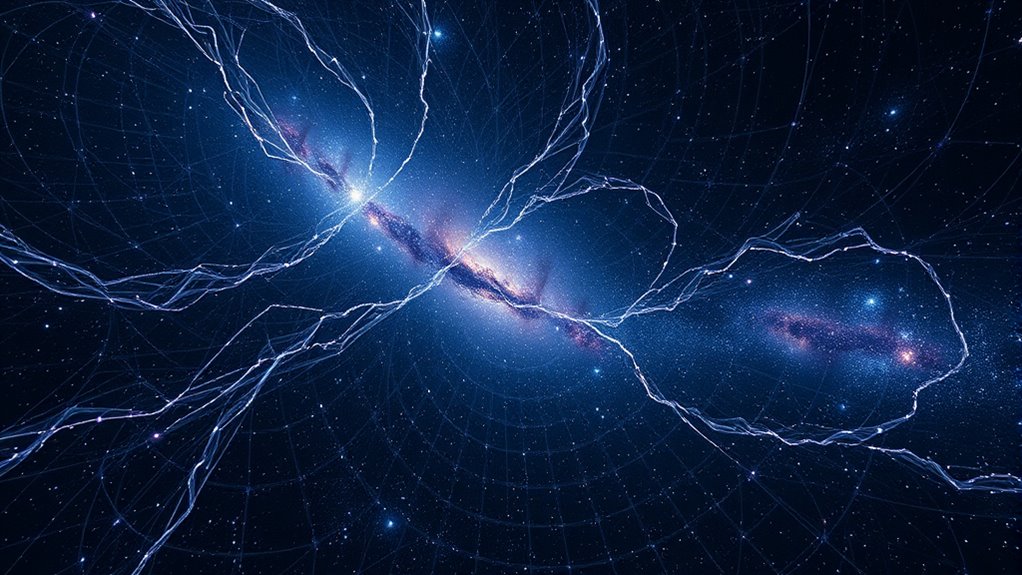
Advancements in technology and analytical methods are paving the way for transformative progress in dark matter research. You’ll see more sophisticated dark matter simulations that better model its behavior and distribution, helping to refine your understanding. As detection technologies improve, you’re closer to identifying particles directly, which could confirm dark matter’s nature. Future efforts will likely integrate gravitational lensing data with particle detection results, creating an all-encompassing picture. New instruments and experiments will focus on capturing faint signals and reducing uncertainties. By combining simulation, observational data, and experimental detection, you’ll accelerate progress toward solving dark matter’s mysteries. These directions promise to deepen your insights into the universe’s unseen mass, ultimately bringing you closer to uncovering the fundamental properties of dark matter. Enhancing research methods will further support these advancements and improve the accuracy of your findings.
Frequently Asked Questions
How Does Dark Matter Influence Galaxy Formation?
You might wonder how dark matter influences galaxy formation. Dark matter distribution plays a vital role by providing the gravitational pull needed for gas and stars to clump together. This process drives galaxy evolution, shaping their structure and growth over time. Without dark matter, galaxies wouldn’t form as we observe today, as its gravitational effects help anchor visible matter and guide the development of cosmic structures.
Can Gravitational Lensing Detect Dark Matter in Small-Scale Structures?
You can use gravitational lensing to detect dark matter in small-scale structures, like dark matter subhalos. Microlensing experiments observe how light from distant objects bends around these tiny structures, revealing their presence. This technique helps you identify dark matter on small scales that other methods might miss. By analyzing these lensing signals, you gain insights into the distribution and properties of dark matter subhalos, advancing your understanding of cosmic structure.
What Role Do Computer Simulations Play in Dark Matter Mapping?
You rely on computer simulations to improve dark matter mapping by enhancing simulation accuracy, which helps you model complex cosmic structures. These simulations generate detailed data visualizations that reveal how dark matter influences galaxy formation and gravitational lensing. As a result, you gain better insights into the universe’s dark components, allowing you to test theories and refine your understanding of dark matter’s distribution across different scales.
Are There Alternative Methods to Gravitational Lensing for Studying Dark Matter?
You might wonder if alternatives to gravitational lensing exist for studying dark matter. While lensing remains the most direct method, scientists face observational challenges and scientific controversies with other approaches, like galaxy rotation curves or cosmic microwave background analysis. These methods can be less precise or more interpretive, making gravitational lensing the preferred choice. Still, ongoing research aims to develop new techniques to better understand dark matter’s elusive nature.
How Might Dark Matter Maps Impact Our Understanding of Dark Energy?
You might find that improved dark matter maps help clarify how dark energy interacts with matter, revealing more about the universe’s expansion. By understanding this interaction, you could gain insights into the cosmological implications, like whether dark energy changes over time or remains constant. These maps enable you to better test theories about the universe’s fate, ultimately deepening your comprehension of how dark energy influences cosmic evolution.
Conclusion
With these breakthroughs, you’re closing in on the universe’s deepest secrets, much like Galileo first peered through his telescope. As gravitational lensing techniques sharpen, you’ll see dark matter maps with unprecedented clarity, revealing cosmic structures once hidden. Though challenges remain, your progress echoes the spirit of discovery across centuries. Keep pushing forward—you’re on the cusp of unravelling cosmic mysteries that even the brightest minds of yesteryear could only dream of.
Halloween Picks
halloween
As an affiliate, we earn on qualifying purchases.