TL;DR
Listen free for 30 days with Audible
Thousands of audiobooks and originals — cancel anytime.
Start your free trialAs an affiliate, we earn on qualifying purchases.
Archaeologists have uncovered a 4,400-year-old tomb of an Egyptian judge at Saqqara, notable for its preserved wall paintings. The discovery sheds light on ancient Egyptian burial customs and social hierarchy.
Archaeologists have announced the discovery of a 4,400-year-old tomb at Saqqara, Egypt, belonging to an ancient Egyptian judge. The tomb features remarkably preserved wall paintings with vibrant colors, providing valuable insights into early Egyptian funerary practices and social structure. This find is considered significant due to its age and the state of preservation, offering a rare glimpse into the artistry and burial customs of Egypt’s Third Dynasty period.
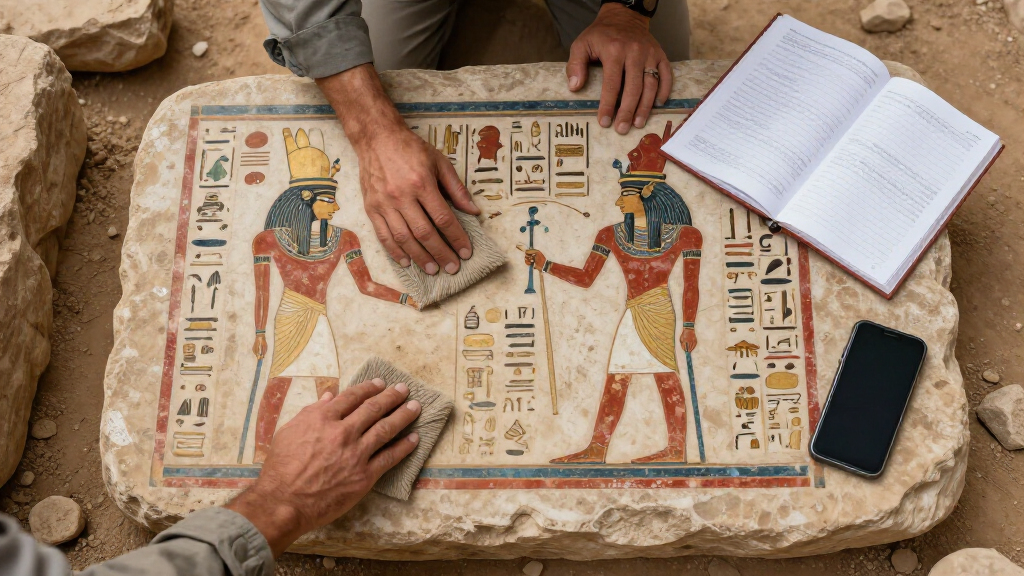
The tomb was uncovered during ongoing excavations at Saqqara, a site renowned for its extensive ancient burial complexes. The structure dates to approximately 2200 BCE, aligning with Egypt’s Third Dynasty, and is believed to have belonged to a judge or high-ranking official based on inscriptions found within. The walls of the tomb still display vivid colors, including shades of red, yellow, and blue, which have largely survived millennia due to the dry desert conditions.
Preliminary analysis indicates the tomb consists of a main chamber and an antechamber, with carved hieroglyphic inscriptions describing the deceased’s titles and achievements. The wall paintings depict scenes of daily life, religious rituals, and offerings, illustrating the cultural context of the period. Experts involved in the excavation have emphasized the exceptional preservation of the artwork, which is rare for tombs of this age.
Egyptian officials and archaeologists involved in the discovery have stated that further analysis is underway to better understand the identity of the tomb owner and the significance of the scenes depicted. The find also includes pottery and other artifacts that may provide additional context about the social status and role of the judge in ancient Egyptian society.
Implications for Understanding Early Egyptian Society
This discovery offers critical insights into the social hierarchy and judicial system of ancient Egypt during the early dynastic period. The well-preserved wall paintings and inscriptions help archaeologists piece together the cultural and religious practices of the time. The tomb’s state of preservation is particularly valuable for understanding the artistry and craftsmanship of early Egyptian artisans, as well as burial customs that aimed to ensure a favorable afterlife for the deceased.
Furthermore, the find underscores the importance of Saqqara as a key archaeological site for understanding Egypt’s early history. It also raises questions about the extent of literacy, administrative organization, and social stratification during this period, which are central themes for Egyptologists.
As an affiliate, we earn on qualifying purchases.
Saqqara’s Rich Archaeological History and Recent Discoveries
Saqqara has been a focal point for Egyptological research for centuries, renowned for its extensive necropolis and the Step Pyramid of Djoser, Egypt’s oldest pyramid. Recent decades have seen numerous discoveries, including tombs, statues, and artifacts from various dynastic periods. The site continues to yield important finds that shed light on Egypt’s political, religious, and social evolution.
The current discovery aligns with a broader trend of increased archaeological activity at Saqqara, driven by new excavation techniques and heightened interest in Egypt’s early history. The find also comes amid rising global interest in Egyptology, partly fueled by increased media coverage and academic research.
As an affiliate, we earn on qualifying purchases.
Details Still Unfolding About the Tomb Owner and Scenes
While initial inscriptions suggest the tomb belonged to a judge or high-ranking official, the exact identity of the individual remains unconfirmed. Further analysis of inscriptions and artifacts is ongoing to clarify this. Additionally, the full scope of the scenes depicted on the walls, including their symbolic meanings, is still being studied, and some interpretations are preliminary.
As an affiliate, we earn on qualifying purchases.
Further Analysis and Public Exhibition Plans
Researchers will continue detailed examinations of the tomb’s inscriptions, artwork, and artifacts to establish the identity of the tomb owner and deepen understanding of the period’s social structure. Plans are also underway to prepare the site for public display, once conservation work is completed. Future excavations at Saqqara are expected to focus on uncovering more tombs and artifacts from Egypt’s early dynastic era.
As an affiliate, we earn on qualifying purchases.
Key Questions
How old is the tomb?
The tomb is approximately 4,400 years old, dating back to around 2200 BCE during Egypt’s Third Dynasty.
What makes this tomb significant?
The tomb’s age, state of preservation, and well-preserved wall paintings provide rare insights into early Egyptian burial practices and social hierarchy.
Who was the tomb owner?
The exact identity remains unconfirmed, but inscriptions suggest the owner was a judge or high-ranking official.
What will happen next with the discovery?
Further analysis of artifacts and inscriptions is planned, along with conservation efforts and eventual public display of the site.
Are similar discoveries expected at Saqqara?
Yes, ongoing excavations continue to uncover new tombs and artifacts, suggesting Saqqara remains a rich source of Egypt’s early history.
Source: hn
NFL season / tailgating Picks
team gear
As an affiliate, we earn on qualifying purchases.