
TL;DR

Prime made for students and young adults
- Fast, free delivery for dorm and study essentials
- Prime Video and Amazon Music included
- Member-only deals
A developer has created a fully functional scientific calculator using a custom-designed nibble-oriented CPU in Verilog. The project includes microcode firmware, FPGA synthesis, and simulation tools. It demonstrates a hardware approach to complex calculations, with ongoing testing and development.
A developer has designed a custom, nibble-oriented CPU in Verilog to create a hardware-based scientific calculator implemented on an FPGA, including microcode firmware and simulation tools, marking a significant step in hardware calculator design.
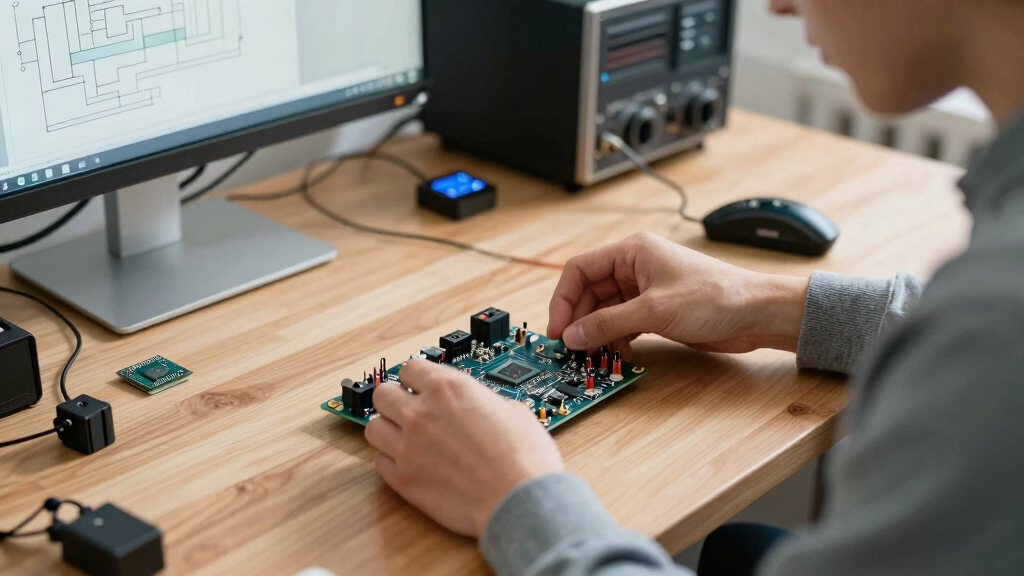
The project involves a fully functional scientific calculator built with a custom soft CPU in Verilog, which operates on a nibble (4-bit) architecture. The design includes microcode firmware that drives the CPU’s operations, and the entire system is supported by FPGA synthesis tools such as Quartus, as well as simulation environments like ModelSim and Verilator.
The developer has created a comprehensive toolchain, including a command-line test harness and a Qt-based simulator/debugger, to verify the hardware’s functionality. The project files are organized into folders for source code, microcode, FPGA synthesis, and testing, with instructions for building and testing the system on various platforms.
Why It Matters
This development demonstrates a hardware approach to implementing complex scientific calculations, emphasizing the educational and experimental potential of FPGA-based design. It offers a tangible example of how custom CPU architectures can be tailored for specific computational tasks, such as scientific computing, in a hardware environment.
For enthusiasts and researchers, this project provides a foundation for further exploration into hardware calculator design, microcode development, and FPGA implementation, potentially inspiring more advanced or specialized hardware solutions.
As an affiliate, we earn on qualifying purchases.
Background
Traditional scientific calculators are typically built with dedicated ASICs or microcontrollers. This project diverges by using a soft CPU implemented in FPGA, designed specifically around a nibble-oriented architecture. The approach allows for customization at the hardware level, offering educational insights into CPU design, microcode programming, and FPGA synthesis. The project builds on existing FPGA development practices, integrating simulation, microcode firmware, and hardware testing, with the goal of creating a fully functional, hardware-based scientific calculator.
“This project aims to demonstrate how a custom nibble-oriented CPU can be used to build a precise, hardware-based scientific calculator on FPGA.”
— the developer
“The system leverages FPGA synthesis and simulation tools to verify correctness and performance.”
— FPGA tools documentation
As an affiliate, we earn on qualifying purchases.
What Remains Unclear
It is not yet clear how the calculator performs in terms of speed and power efficiency compared to conventional designs. The project’s current status focuses on development and verification, with real-world deployment or user testing still to be reported.
As an affiliate, we earn on qualifying purchases.
What’s Next
The next steps include optimizing the CPU design, expanding microcode capabilities, and potentially porting the system to different FPGA boards. Further testing and validation are expected, along with possible user interface development for broader accessibility.
microcode firmware development kit
As an affiliate, we earn on qualifying purchases.
As an affiliate, we earn on qualifying purchases.
Key Questions
What is a nibble-oriented CPU?
A nibble-oriented CPU processes data in 4-bit units called nibbles, which can be advantageous for certain calculations and simplified hardware design.
Can this hardware calculator perform all scientific functions?
Currently, the project demonstrates core arithmetic functions and basic scientific operations, but full functionality for all scientific calculations is still under development.
Is the project available for public use?
Yes, the source code, FPGA project files, and simulation tools are publicly available on GitHub, allowing others to build and experiment with the system.
What are the advantages of a hardware-based calculator over software?
Hardware implementations can offer faster computation times, lower latency, and educational value by illustrating low-level CPU design principles.
Halloween Picks
halloween
As an affiliate, we earn on qualifying purchases.