📊 Full opportunity report: How Thunderbolt Docks Can Accelerate Your AI Research In 2026 on ThorstenMeyerAI.com — validation score, market gap, and execution plan.
TL;DR
Thunderbolt docking stations are increasingly vital for AI researchers in 2026, providing high-speed data transfer and multi-display support. This development enhances productivity and computational capacity, though some technical details remain under review.
Thunderbolt docking stations are emerging as essential tools for AI researchers in 2026, offering high-speed data transfer, multiple display support, and charging capabilities that streamline complex workflows. Learn more about top options in this guide. These docks are enabling faster data processing and more efficient multitasking, which are crucial for advancing AI development.
Recent advancements in Thunderbolt 4 technology have led to the release of new docking stations capable of supporting multi-4K display setups and delivering up to 85W of power to laptops, significantly enhancing AI research environments. For a detailed review, see the original analysis. Companies like Dell and other hardware manufacturers have introduced models that prioritize reliable high-speed data transfer and versatile port options, including Ethernet, USB-A, SD card slots, and multiple video outputs.
Experts say these docks are particularly beneficial for machine learning and deep learning tasks, which demand large data throughput and multiple high-resolution displays for visualization. For more insights, see the detailed review. The integration of Thunderbolt docks with high-performance GPUs and storage solutions is also a key factor in accelerating research timelines.
Impact of Thunderbolt Docks on AI Research Efficiency
These docks are transforming AI research by enabling faster data access and more flexible workstation setups. Researchers can now connect multiple high-resolution monitors and high-speed storage devices seamlessly, reducing bottlenecks and increasing productivity. As AI models grow more complex, the ability to handle large datasets efficiently becomes critical, making Thunderbolt docks a strategic investment for research labs and tech companies.
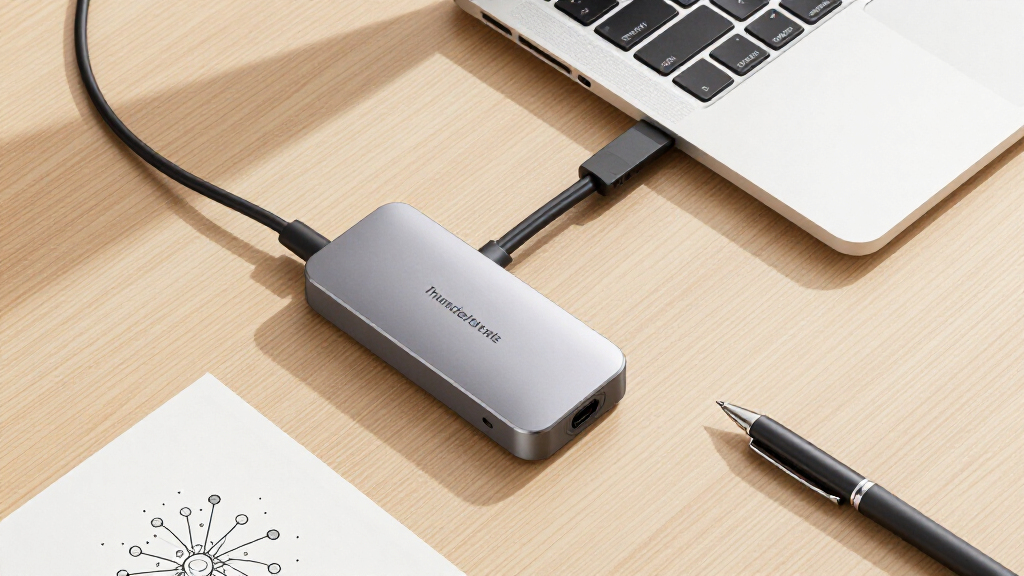
Thunderbolt 4 docking station for AI research
As an affiliate, we earn on qualifying purchases.
As an affiliate, we earn on qualifying purchases.
Evolution of Connectivity in AI Workspaces
Over the past few years, AI research has increasingly relied on powerful computing setups with multiple high-resolution displays and fast data transfer capabilities. Previously, limitations in connectivity and power delivery slowed down workflow efficiency. The advent of Thunderbolt 4 and compatible docking stations has addressed many of these issues, providing a unified solution for data, display, and power needs.
Leading hardware providers introduced Thunderbolt docks optimized for professional use, emphasizing compatibility with high-performance GPUs and large storage arrays. These developments align with the growing computational demands of AI research in 2026.
“The ability to connect multiple high-res displays and fast storage through a single dock accelerates AI development timelines significantly.”
— Michael Lee, CTO of TechInnovate
multi-display Thunderbolt dock 4K
As an affiliate, we earn on qualifying purchases.
As an affiliate, we earn on qualifying purchases.
Unconfirmed Aspects of Thunderbolt Dock Capabilities
While the current models support multiple 4K displays and high data transfer rates, the full scalability of Thunderbolt docks for extremely large datasets and GPU integration in AI research remains under review. Compatibility issues across different hardware platforms and future standards are also still being evaluated.
high-speed Thunderbolt dock with Ethernet and USB-A
As an affiliate, we earn on qualifying purchases.
As an affiliate, we earn on qualifying purchases.
Future Developments in Docking Technology for AI
Upcoming updates are expected to include enhanced GPU support and higher data transfer speeds for Thunderbolt docks, further boosting AI research capabilities. Manufacturers are also working on more compact designs with increased port versatility to support evolving research needs. Researchers and industry leaders will closely monitor these innovations to determine their impact on workflow efficiency.
Thunderbolt dock with 85W power delivery
As an affiliate, we earn on qualifying purchases.
As an affiliate, we earn on qualifying purchases.
Key Questions
Can Thunderbolt docks support multiple high-resolution monitors for AI research?
Yes, many Thunderbolt docks support multiple 4K displays at 60Hz, which is suitable for AI visualization and data analysis tasks. Always verify the specific model’s display support capabilities before purchase.
Are Thunderbolt docks compatible with both Mac and Windows systems for AI research?
Most Thunderbolt docks are compatible with both macOS and Windows, provided they support Thunderbolt 3 or 4 standards. Compatibility should be confirmed with the manufacturer’s specifications.
How much power should a Thunderbolt dock supply for AI research setups?
For high-performance laptops used in AI research, docks offering 85W or higher power delivery are recommended to ensure optimal charging and operation during intensive tasks.
Will future Thunderbolt docks improve GPU support for AI applications?
It is anticipated that upcoming models will enhance GPU support, enabling faster data transfer and better integration with AI hardware, though specific details are still under development.
Source: ThorstenMeyerAI.com