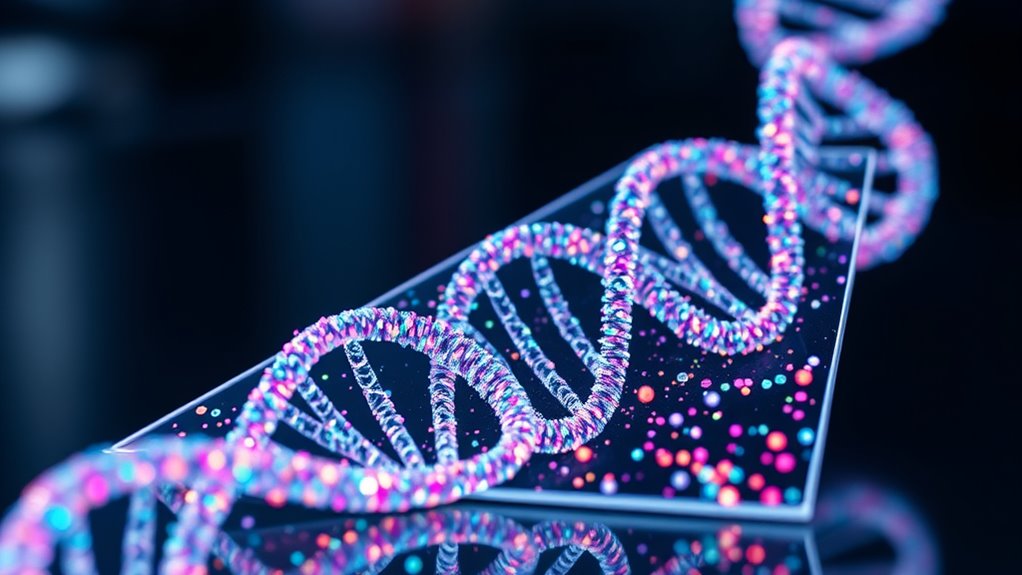

DNA data storage offers an incredible way to save information by harnessing its remarkable density and stability. You can encode vast amounts of data into tiny DNA molecules, which can last for centuries or even millennia if properly protected. This technology could replace bulky media like tapes and drive a revolution in long-term archiving. If you keep exploring, you’ll discover how ongoing innovations are making this science more practical and accessible than ever before.

Prime made for students and young adults
- Fast, free delivery for dorm and study essentials
- Prime Video and Amazon Music included
- Member-only deals
Key Takeaways
- DNA offers ultra-high-density data storage, surpassing traditional media by over 1,000 times in compactness.
- Digital information is encoded into nucleotide sequences and synthesized into DNA molecules for long-term preservation.
- Advances in enzymatic synthesis and automation are reducing costs and improving scalability of DNA data storage.
- Sequencing technologies enable accurate retrieval of stored data, facilitating reliable long-term archiving.
- DNA storage holds potential for revolutionizing data preservation, especially for historical, medical, and large-scale digital information.
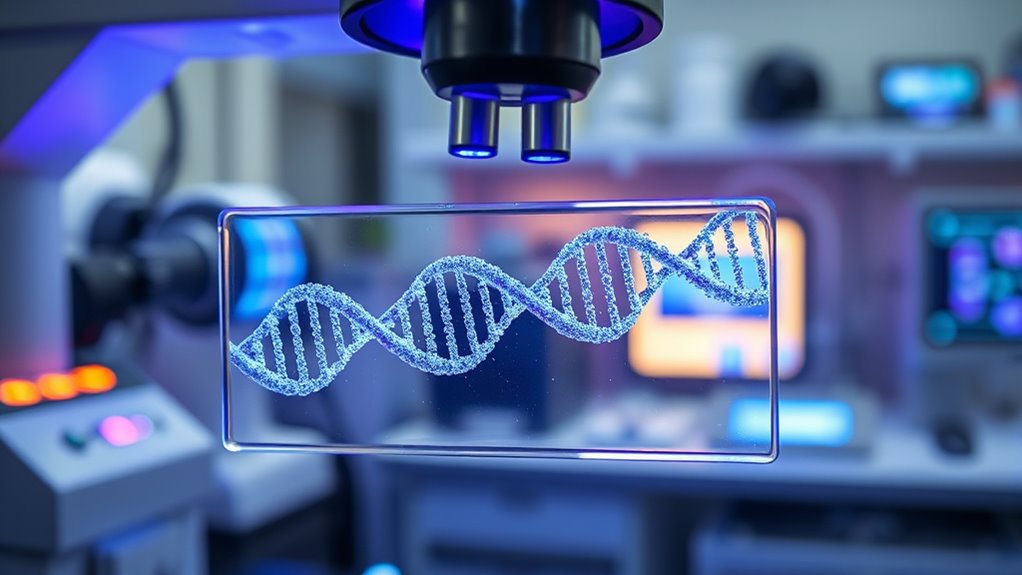
Have you ever wondered how future data storage could drastically surpass today’s technologies? The answer lies in the incredible potential of DNA as a storage medium. Unlike traditional devices, DNA can hold an astonishing amount of data in an extremely small space. Its density exceeds that of solid-state drives by at least 1,000 times, allowing you to compress vast amounts of information into a tiny volume. Imagine storing entire libraries, medical records, or historical archives in a molecule no larger than a grain of sand. This leap in capacity is made possible by DNA’s molecular structure, which is three-dimensional and offers about eight orders of magnitude higher density than current storage options. With a simple four-letter code—A, T, G, and C—DNA can represent complex digital data, translating binary code into nucleotide sequences. This process makes DNA not only incredibly dense but also capable of encoding virtually limitless information.
The process of storing data in DNA involves converting digital bits into unique nucleotide sequences. This encoding process ensures that no repetitive or problematic DNA patterns hinder accurate sequencing later. Writing data requires synthesizing DNA molecules by arranging nucleotides in specific sequences that correspond to your encoded information. Once synthesized, these DNA molecules must be protected from elements like UV light, moisture, and oxygen, typically through encapsulation or temperature-controlled environments. This protection grants DNA a durability that’s at least 300 times greater than magnetic tapes, promising long-term preservation—think centuries or even thousands of years. When you want to retrieve your stored data, sequencing technologies decode the nucleotide sequences back into binary data. Recent innovations in enzymatic synthesis are making DNA data storage more feasible by reducing costs and increasing the length of DNA strands that can be produced. Programmable enzymes can now electronically control DNA synthesis, enabling multiplexed and scalable data writing. Researchers and companies like Microsoft Research and Twist Bioscience are working on integrated devices capable of highly parallel synthesis, aiming to handle the exponential growth in data generation. Despite these improvements, challenges remain. Synthesis costs are still high, and reading or writing data on DNA is slower compared to electronic memory. Ensuring error-free long oligonucleotide synthesis and maintaining ideal storage conditions are ongoing hurdles. Additionally, ongoing research into biological stability is essential for ensuring long-term data integrity in various storage environments.
In the future, DNA data storage could revolutionize how we archive information. Its exceptional density and longevity make it suitable for long-term storage of medical records, historical documents, and surveillance data. By replacing bulky magnetic tapes with DNA, we can reduce environmental impact and storage space. Although still in development, DNA data storage offers a promising solution for the data-driven world ahead—saving information in the very fabric of life itself.
As an affiliate, we earn on qualifying purchases.
Frequently Asked Questions
How Long Can DNA Data Storage Reliably Preserve Information?
You wonder how long DNA data storage can reliably keep information. Under ideal conditions, DNA can preserve data for thousands of years, with estimates reaching up to 5,000 years. Advances in technology, like improved synthesis and sequencing, will likely extend this further. With protective methods such as encapsulation, you can expect DNA to serve as a durable, long-term storage medium for centuries, making it ideal for archival purposes.
What Are the Main Costs Involved in DNA Data Storage?
You should know that the main costs in DNA data storage come from synthesizing DNA, which is expensive due to complex chemical processes, and sequencing, which requires costly equipment. You also face expenses for developing the necessary tech infrastructure and for encoding data accurately with error correction. As technology advances and scales up, these costs are expected to decrease, making DNA storage more affordable over time.
How Does DNA Data Storage Compare to Traditional Storage Methods?
Did you know DNA can store data a billion times denser than traditional storage media? Compared to hard drives or flash drives, DNA offers incredible density, stability, and low energy costs. You’ll find that DNA’s long-term durability and minimal maintenance make it ideal for archiving. However, current methods are slower and more complex than electronic storage, so while DNA excels in capacity and longevity, it still faces challenges in speed and accessibility.
Are There Any Ethical Concerns With DNA Data Storage?
You should consider ethical concerns with DNA data storage because it involves highly sensitive personal information, like your health and ancestry. Unauthorized access, data breaches, and potential misuse by third parties pose risks to your privacy and could lead to discrimination. Additionally, issues around consent, re-identification, and the ethical use of genetic data in law enforcement or research raise important questions about control, fairness, and societal impact.
When Will DNA Data Storage Become Commercially Available?
You’re wondering when DNA data storage will hit the market. Experts expect early commercial products around 2024–2025, with broader availability by 2026–2030. The technology is still refining, but advances in synthesis and sequencing are speeding things up. Major companies are investing heavily, and market projections show rapid growth. While some hurdles remain, expect to see DNA storage becoming a practical option for archival and high-density data storage within the next few years.
As an affiliate, we earn on qualifying purchases.
Conclusion
As you step into the future of data storage, DNA acts like a tiny, mighty library holding endless information within each strand. It’s a revolution that transforms living cells into vaults of knowledge, blending biology with technology. Just as a single seed can grow into a forest, this innovation promises to grow our storage capacity exponentially. Embracing DNA storage is like revealing a secret garden of infinite possibilities, where life and data intertwine seamlessly.
As an affiliate, we earn on qualifying purchases.
As an affiliate, we earn on qualifying purchases.
Fall Picks
fall essentials
As an affiliate, we earn on qualifying purchases.