TL;DR

Get school and study supplies delivered free — and shop member deals
- Fast, free delivery on millions of items
- Access to Prime Big Deal Days deals on October 6–7
- Prime Video, Amazon Music and more included
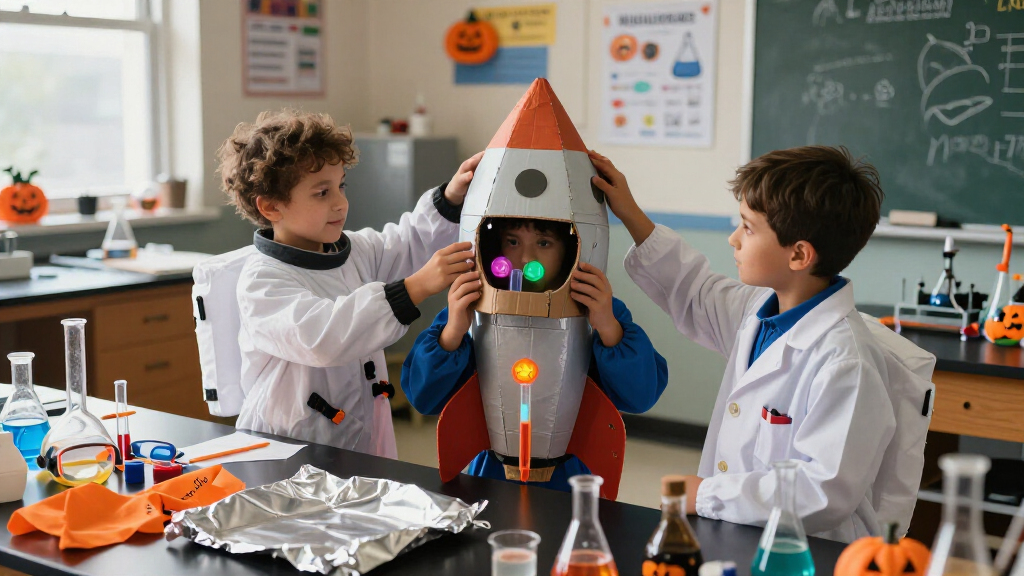
Science-themed Halloween costumes can celebrate scientists, space, biology, chemistry, or science-inspired fiction. Choose one recognizable idea, build it from comfortable clothes and lightweight reused materials, and add a clear label or fact card so people understand the reference; skip hazardous props and designs that block sight or movement.
A cardboard planet with a crooked ring can get more Halloween recognition than a costly, glowing costume. The trick is not a perfect replica; it is giving people one clear clue they can spot across a crowded room. Science-themed Halloween costumes make that easy, whether you dress as a scientist, a cell, or Saturn.
This guide helps you find an idea that suits your budget, comfort level, and audience. You’ll see how to make a science costume recognizable, adapt it for children or groups, and add accurate details without turning the project into a weekend-long craft marathon. Most ideas can start with clothes you already own and materials from a recycling bin.
You’ll also get practical safety checks for props and movement, plus ways to make the outfit more inclusive and reusable. A costume can be funny, striking, and educational at once—like a tiny science museum that happens to ask for candy.
Choose one main scientific idea and make its shape or label visible from several steps away.
Build from clothes you already own, then add one lightweight feature made from cardboard, paper, felt, or fabric.
Use a shared system—such as planets, cell parts, or a food web—to make a group costume tell one story.
Replace real lab equipment and hazardous materials with blunt, lightweight replicas; test sight, movement, and comfort at home.
Add one accurate fact or name badge to make a costume both recognizable and educational.
Choose a science costume people can recognize at a glance
Science-themed Halloween costumes work best when they combine one clear silhouette, one familiar color or shape, and one short label. That combination lets people identify the idea quickly, even if they have never seen the scientific concept up close. Think of the outfit like a road sign: a bold symbol gets the message across before the small print.
For a scientist costume, a white coat is a useful starting point, but it does not tell the whole story. Add a name badge and a signature object connected to the person’s work: a notebook for a mathematician, a paper star chart for an astronomer, or a toy chimpanzee for a Jane Goodall-inspired outfit. Choose accurate details rather than leaning on wild hair and a “mad scientist” stereotype.
Abstract ideas need even stronger visual cues. A person wearing a black shirt with a small paper circle may not read as an atom; large colored foam balls arranged around a clear center are easier to understand. Put the name “ATOM” on a broad card, and the costume becomes a conversation starter rather than a guessing game.
Before you gather supplies, try this quick recognition test: show a sketch or describe the outfit to someone who has not heard your plan. If they cannot guess the idea, add a clearer shape or label before adding more decoration. One bold clue usually beats six tiny details.
- Pick one main idea: a person, object, organism, or system.
- Choose a signature cue: a ring, double helix, coat, or planet shape.
- Add a readable name if the concept may be unfamiliar.
science-themed Halloween costume kit
As an affiliate, we earn on qualifying purchases.
As an affiliate, we earn on qualifying purchases.
Build an easy costume from clothes and craft-bin supplies
You can make a strong science costume at home with ordinary clothes, cardboard, paper, felt, and tape. The simplest plans start with a base outfit you already own, then add one lightweight feature that carries the idea. A black shirt can become outer space; a blue sweater can become Earth; a plain coat can become a particular scientist with the right name badge.
For a DNA costume, attach two broad colored ribbons to a dark shirt and connect them with short strips of felt or paper to suggest the ladder-like structure. Keep the pieces flat and secured so they do not snag on door handles. For a periodic-table element, cut a large square from cardboard, write the element symbol and atomic number in thick marker, and wear it over comfortable clothes. That’s enough for classmates to recognize the idea without a bulky costume.
Here is a practical order for putting a homemade design together:
- Choose a base from your closet, such as a dark outfit, a coat, or a one-color shirt and trousers.
- Make one large visual feature from cardboard, felt, fabric, or paper.
- Add a short label with large, high-contrast letters.
- Wear-test it by sitting, walking, and raising your arms before Halloween night.
- Save reusable parts in a labeled box after the event.
A ten-minute walk around the house can reveal a loose strap, scratchy edge, or cardboard piece that bumps your knees. Fixing those small problems at home beats discovering them on a dark sidewalk. Reusing a shirt and sturdy craft pieces also keeps the costume budget low and gives the materials another turn next year.
As an affiliate, we earn on qualifying purchases.
Pick a costume idea that fits your age, interests, and effort level
Science-themed Halloween costumes cover a wide range, from a quick lab look to a detailed group display, so choose an idea that matches the time and comfort you have. Scientists, space, biology, chemistry, and science-inspired fiction all offer recognizable starting points. Science costumes combine familiar shapes with big ideas, and they can work for children, adults, classrooms, and parties.
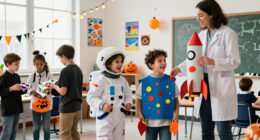
If you want a fast option, wear a shirt and trousers you already own, add a paper badge reading “astronomer,” and carry a flat star chart. For something more visual, wear a cardboard planet with a lightweight ring. If you like making things, a group can represent the solar system, with each person wearing a colored sphere or a planet name. The same theme scales from one person to a whole classroom.
Nature or space can make especially flexible themes. A leaf, mushroom, pollinator, or food-web costume connects to biology and ecology; a moon, star, or astronaut offers a crisp shape and an easy color palette. For a fiction-inspired robot or time traveler, describe it as science-inspired rather than presenting it as a real scientific device.
Recent public interest in space exploration, artificial intelligence, robotics, climate, biodiversity, and biomedical research can spark timely ideas, though local trends vary by year. For instance, a student learning about pollinators might make a bee outfit from a yellow shirt and felt wings, while an astronomy fan could carry a flat, labeled cardboard constellation. Choose a reference you genuinely enjoy; enthusiasm makes the costume easier to explain.
- Low effort: scientist badge, element square, or one-color planet.
- More visual: DNA, cell, robot, or ecosystem.
- Group-ready: planets, food web, cell parts, or a set of scientists.
As an affiliate, we earn on qualifying purchases.
Make a group costume tell one clear science story
A group science costume is easiest to understand when every person represents a part of one larger system. Instead of choosing unrelated outfits, pick a shared subject—such as the solar system, a food web, or the parts of a cell—and give each person a distinct role. The group then works like a living diagram, with each costume adding a piece to the picture.
For a solar-system theme, one person can be the Sun while others represent planets with different colors and simple labels. Keep the props flat or close to the body, especially if the group will walk through a school hallway or go door to door. A classroom might choose a food web: students can dress as a plant, an insect, a bird, and a predator, while small arrows on cards show how energy moves.
Give each participant a short line to explain their part. Someone dressed as a mushroom might say, “I help break down dead material,” while a planet can share one accurate fact about its place in the solar system. Check factual claims with a museum, science organization, or reliable educational book before printing them on cards. The small research step makes the costume more than a collection of colors.
Plan for differences in age, mobility, and sensory comfort. One child may enjoy a soft felt cell wall, while another prefers a printed sign worn over ordinary clothes. Offer choices that carry equal importance in the group design; not everyone needs a headpiece or a bulky prop. A good group costume lets each person participate comfortably while keeping the shared story clear.
A strong group costume is a visual sentence: each person adds one readable word, and together the group explains the idea.
lightweight science props for costumes
As an affiliate, we earn on qualifying purchases.
As an affiliate, we earn on qualifying purchases.
Keep science props safe, visible, and comfortable to wear
A science costume should let you see, breathe, walk, and move your arms without trouble. Avoid real chemicals, glass labware, sharp tools, lasers, and open flames; use blunt, lightweight, non-toxic substitutes instead. A plastic test-tube replica or a paper beaker cutout can suggest a lab without bringing hazardous equipment into a crowded event.
Check the costume from the wearer’s point of view. Can a child see the pavement through a helmet opening? Does a cardboard atom extend so far that it catches on chair backs? Can the wearer use the bathroom without needing a full costume crew? These are not fussy questions: a costume that pinches, blocks vision, or trips its owner may come off before the first trick-or-treat stop.
For outdoor events, keep hems clear of the ground and add reflective tape to dark clothing. Choose shoes with good grip instead of oversized novelty footwear. If the forecast is cold, build the costume over warm layers; if you expect a crowded indoor party, skip stiff parts that poke the person beside you. Comfort is part of the design, not an afterthought.
For young children, avoid small detachable pieces and choose washable materials where possible. Give the outfit a short test run at home: walk up stairs, sit down, turn around, and take off the main pieces. A five-minute trial can catch a dangling ribbon or an itchy seam before it becomes the evening’s main event.
- Use replicas instead of functional equipment or substances.
- Keep vision and movement clear, especially around stairs and streets.
- Check fit and comfort with the shoes and layers the wearer will actually use.
Add accurate details without turning your costume into homework
You can make a science costume accurate with one small fact, a correct name, or a clear explanation of the idea. Accuracy does not require a lecture or an elaborate replica. A short card beside a costume can do the work of a museum label: it tells people what they are seeing and gives them one memorable detail to take away.
For a scientist costume, check the person’s name, field, and signature work before making a badge. If you dress as Katherine Johnson, for example, a label can identify her as a mathematician whose calculations supported early U.S. spaceflight. Avoid reducing real people to a single costume prop; a name and a true detail give the portrayal more care and context.
For an abstract concept, explain the image in plain language. A wearer dressed as a cell could add, “A cell is the basic building block of living things.” A prism costume might carry a note that white light can spread into a spectrum of colors. Keep the wording short enough to read while people are moving past.
Fact cards also help when the costume is intentionally playful. A child wearing a mushroom hat can add a true line about fungi, while a robot can carry a note saying it is a fictional, science-inspired character. That distinction keeps fantasy fun without presenting imaginary technology as real. Check biographies and scientific claims against a museum, science organization, or dependable educational source before sharing them.
Make your costume cheaper, more inclusive, and easier to reuse
A thoughtful science costume can be low-cost, reusable, and welcoming without losing its visual punch. Start with borrowed or owned clothing, then make removable details from cardboard, fabric scraps, paper, or felt. A coat, dark shirt, and large label can serve for different characters in future years; only the badge or accessory needs to change.
Reuse is practical as well as environmentally minded. A cardboard planet ring can become a classroom display later, and sturdy felt DNA pieces can be stored for another event. Skip materials that crumble after one night or require a special outfit underneath if you want the costume to earn a second outing. Write the wearer’s name on a storage bag and keep small parts together.
Inclusion begins with choosing whose stories you tell and how you portray them. Highlight women and scientists from underrepresented backgrounds through accurate names and contributions, rather than relying on caricatures of nationality, culture, or appearance. For example, a group could honor several space scientists with individual name badges and one verified detail each, while letting participants choose which person interests them.
Make room for different comfort needs, too. A costume does not need face paint, a mask, a noisy gadget, or a tight fit to count. Offer a paper sign, a soft fabric symbol, or a simple lab-style badge as alternatives. The best design is one the wearer can enjoy for the whole evening—and can use again without starting from scratch.
- Borrow or reuse clothes before buying a new base outfit.
- Choose durable pieces that can become a school display or next year’s costume.
- Represent real scientists accurately and offer comfortable ways to take part.
Frequently Asked Questions
What are easy science-themed Halloween costumes to make at home?
A scientist, planet, periodic-table element, or DNA strand can come together with ordinary clothes and simple craft materials. For example, wear a dark outfit, add a large cardboard Saturn ring, and label the planet clearly. Start with one strong visual feature instead of piling on small decorations.
What are good science costumes for kids?
Choose a comfortable idea with lightweight pieces, clear vision, and no small detachable parts for young children. A planet, leaf, scientist badge, or element square can be made from washable or reusable materials. Let the child wear-test it by walking, sitting, and climbing a few steps before Halloween.
How can I make a science costume recognizable?
Use a familiar silhouette, a strong color cue, and a readable label. A large planet ring or a bright DNA pattern communicates faster than tiny details hidden across a shirt. Ask someone who has not heard your plan to guess the costume before you finish it.
How do I make a science costume on a budget?
Use clothes you already own and make the main feature from cardboard, paper, felt, or fabric scraps. A plain shirt with a large element symbol can be both inexpensive and easy to wear. Save the reusable pieces afterward for a school project or next year’s costume.
Which science props are safe for Halloween?
Choose lightweight, blunt replicas made from safe craft materials, such as a paper chart or plastic toy accessory. Avoid real chemicals, glassware, sharp tools, lasers, and open flames. Keep props small enough that they do not block sight, snag on others, or make walking difficult.
Can a science costume be fun and scientifically accurate?
Yes. Add one correct name or short fact to a playful design, such as a cell costume labeled with a plain-language description. Check biographies and science claims with a museum, science organization, or reliable educational source. A small fact card can add accuracy without making the costume feel like homework.
Conclusion
Remember the simple formula: one clear idea, one bold visual cue, and one comfortable outfit. Start with what you own, use a label when the science may be unfamiliar, and test the costume before the doorbell rings.
By Halloween night, your cardboard planet or felt cell can do more than win a smile. It can turn a hallway into a tiny science exhibit—and send someone home curious.
Halloween Picks
halloween
As an affiliate, we earn on qualifying purchases.