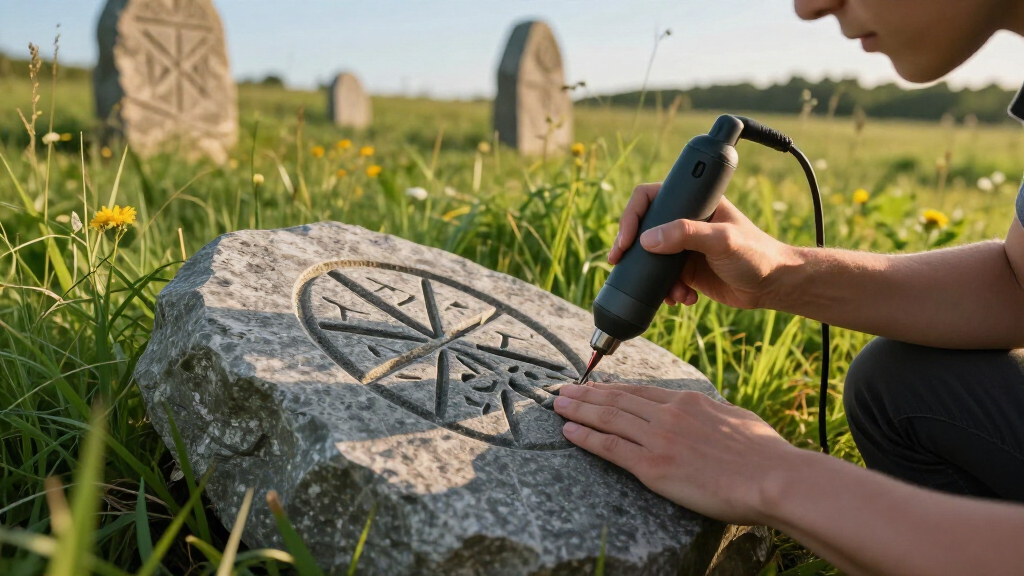

🔍 Read the full analysis: The Art And Science Of AI In SVG Carving: 'The Runestone Field' on ThorstenMeyerAI.com

Prime made for students and young adults
- Fast, free delivery for dorm and study essentials
- Prime Video and Amazon Music included
- Member-only deals
TL;DR
Thorsten Meyer’s team has used advanced AI and SVG carving techniques to animate ‘The Runestone Field,’ blending history and digital craftsmanship. This project highlights how automation can elevate storytelling through visual art.
Thorsten Meyer’s team has unveiled a new digital art project, ‘The Runestone Field,’ which uses artificial intelligence and SVG carving animation to bring ancient runic carvings to life. This development demonstrates how automation and precise digital techniques can transform traditional storytelling and visual design, making historical narratives more immersive and engaging for modern audiences. For an in-depth look at the original analysis, see Glimpse: The Runestone Field — Carve Words Into Winter.
The project, showcased live and detailed in a recent case study, employs advanced SVG techniques combined with AI-driven automation to animate static runic carvings. The animation process involves meticulous digital carving that mimics the craftsmanship of ancient artisans, but with fluid motion enabled by algorithms. This approach is similar to techniques discussed in the original analysis. The result is a dynamic landscape where stones appear to speak, revealing intricate details that viewers can explore interactively.
According to Thorsten Meyer, the project aimed to bridge the gap between historical artistry and contemporary digital craftsmanship. The team faced technical challenges in achieving both authenticity and fluidity in animation, but breakthroughs in SVG scripting and AI automation allowed for highly detailed, scalable visuals that respond to viewer interaction. For more details, see the original analysis. The project’s full case study details each step, from initial design to final execution, emphasizing the role of automation in enhancing artistic precision and storytelling depth.
The Art And Science Of AI In SVG Carving: ‘The Runestone Field’
Thorsten Meyer’s team blends artificial intelligence with SVG carving animation to bring ancient runic carvings to life — merging Norse heritage, algorithmic precision, and immersive storytelling into a dynamic digital landscape.
Where Ancient Runes Meet Algorithmic Motion
Thorsten Meyer’s team has completed an innovative project using AI-driven SVG carving to animate ‘The Runestone Field’ — a dynamic digital landscape where stones appear to speak, revealing intricate runic details that viewers can explore interactively. Digital carving mimics the craftsmanship of ancient artisans, with fluid motion enabled by algorithms.
Digital Artisanry
Meticulous SVG carving replicates the hand of historical stonemasons, preserving authenticity while unlocking motion impossible in stone.
AI-Driven Precision
AI automates the detailed carving process, producing precise, fluid animations that scale without loss of quality across platforms.
Living Narratives
Historical symbols become immersive, interactive experiences — making complex runic narratives accessible to modern audiences.
From Prototype to Runestone Field
The case study details each step from initial design to final execution, emphasizing automation’s role in enhancing artistic precision and storytelling depth. A rapid development cycle moved from concept to full showcase in under a year.
Source Study
Analyzing traditional runestones and runic symbol systems as memorials and storytelling devices in Norse culture.
Digital Carving
SVG path scripting recreates chisel-like detail with vector precision and infinite scalability.
AI Automation
Algorithms generate fluid motion, coordinating carve depth, timing, and interactivity.
Live Showcase
Interactive exhibit where animated stones respond to viewer exploration in real time.
Traditional Carving vs. Digital SVG Animation
| Dimension | Traditional Runestone | Static Digital Art | AI + SVG Carving |
|---|---|---|---|
| Production Time | Months of skilled labor | Weeks | ✓ Rapid automated cycle |
| Scalability | ✗ Fixed physical form | ~ Raster limits | ✓ Lossless vectors |
| Motion & Interactivity | ✗ None | ✗ Static image | ✓ Responsive animation |
| Historical Authenticity | ✓ Original artifact | ~ Interpretation | ✓ Craft-faithful recreation |
| Preservation Reach | ~ Site-bound | ~ Limited engagement | ✓ Global, interactive access |
Where the Technique Moves the Needle
AI and SVG technology are redefining digital storytelling — from cultural preservation to education — while raising questions about the future of automated craftsmanship and collaborative human-AI creativity.
This project demonstrates how automation can elevate traditional craftsmanship, creating immersive narratives that are both historically authentic and visually compelling.— Thorsten Meyer
What Remains to Be Seen
How does AI improve SVG carving?
AI automates the detailed carving process, enabling precise, fluid animations that mimic traditional craftsmanship while supporting scalable, interactive visualization.
Adaptable to other artifacts?
Yes — the techniques could extend to inscriptions, sculptures, and other carved objects, enhancing digital preservation and storytelling.
Main technical challenges?
Achieving authenticity and fluidity simultaneously, ensuring scalability, and integrating AI automation with precise SVG scripting.
Future applications?
Refined animations, collaborations with cultural institutions, public exhibits, and integration into educational platforms on ancient cultures.
The Impact of AI and SVG Carving on Digital Storytelling
This project exemplifies how AI and SVG technology are redefining digital storytelling and visual art. By automating detailed carving processes, creators can produce highly intricate animations that retain historical authenticity while offering new levels of interactivity. It demonstrates the potential for digital artisans to craft immersive narratives that engage audiences in novel ways, blending tradition with innovation.
Such advancements could influence fields ranging from cultural preservation to educational tools, as dynamic visualizations make complex historical symbols more accessible and engaging. The project also raises questions about the future of automated craftsmanship and its role in artistic expression, suggesting a shift toward more collaborative human-AI creative processes.
SVG carving software for digital artists
As an affiliate, we earn on qualifying purchases.
As an affiliate, we earn on qualifying purchases.
Historical and Technological Foundations of the Runestone Project
Traditional runestones are ancient artifacts carved with runic symbols, often serving as memorials or storytelling devices in Norse culture. Historically, these carvings were labor-intensive and required skilled artisans. Today, digital tools enable us to reinterpret and animate these symbols, creating new ways to experience their stories.
Thorsten Meyer’s project builds on recent advances in SVG (Scalable Vector Graphics) and AI automation, which allow for precise, scalable, and fluid animations. Prior efforts in digital art have used similar techniques for abstract visuals, but this project uniquely applies them to historical carvings, merging cultural heritage with cutting-edge technology. The project’s timeline indicates a rapid development cycle, with initial prototypes emerging in late 2023 and a full showcase in early 2024.
“This project demonstrates how automation can elevate traditional craftsmanship, creating immersive narratives that are both historically authentic and visually compelling.”
— Thorsten Meyer
As an affiliate, we earn on qualifying purchases.
Unanswered Questions About the Technology and Its Applications
While the project’s technical approach has been demonstrated successfully, details remain unclear regarding the scalability of the process for larger or more complex carvings, and how widely this technique might be adopted in professional or educational settings. It is also not yet confirmed how viewers will interact with the animated runestones in different platforms or formats, or how the technology will evolve to incorporate other forms of historical art.
Further development and testing are needed to assess the long-term durability and authenticity of automated carving animations, as well as their integration into broader digital preservation efforts.
As an affiliate, we earn on qualifying purchases.
Future Developments and Broader Adoption of SVG Carving Animation
Moving forward, the team plans to refine the animation techniques and explore applications beyond ‘The Runestone Field,’ including other historical artifacts and storytelling mediums. Additional collaborations with cultural institutions and educational platforms are expected to expand the project’s reach. Researchers anticipate that further innovations in AI and SVG scripting will enable even more detailed and responsive animations, potentially leading to new standards in digital craftsmanship.
Public demonstrations and interactive exhibits are also likely as the technology matures, offering audiences immersive experiences that combine history and modern digital art. The project’s success could inspire other artists and technologists to explore similar integrations of automation and craftsmanship in their work.
As an affiliate, we earn on qualifying purchases.
Key Questions
How does AI improve the SVG carving process in this project?
AI automates the detailed carving process, allowing for precise, fluid animations that mimic traditional craftsmanship while enabling scalable and interactive visualizations.
Can this technology be used for other types of historical artifacts?
Yes, the techniques developed could be adapted for a range of artifacts, including inscriptions, sculptures, and other carved objects, enhancing digital preservation and storytelling.
What are the main technical challenges faced in this project?
Challenges included achieving both authenticity and fluidity in animation, ensuring scalability, and integrating AI automation with precise SVG scripting.
Will this project be accessible to the public or used in educational settings?
Public demonstrations and digital exhibits are planned, with potential integration into educational platforms to enhance learning about ancient cultures and art.
What is the significance of this project for future digital art?
It showcases how automation and AI can elevate traditional craftsmanship, enabling new forms of immersive, interactive storytelling and cultural preservation.
Source: ThorstenMeyerAI.com
Halloween Picks
halloween
As an affiliate, we earn on qualifying purchases.