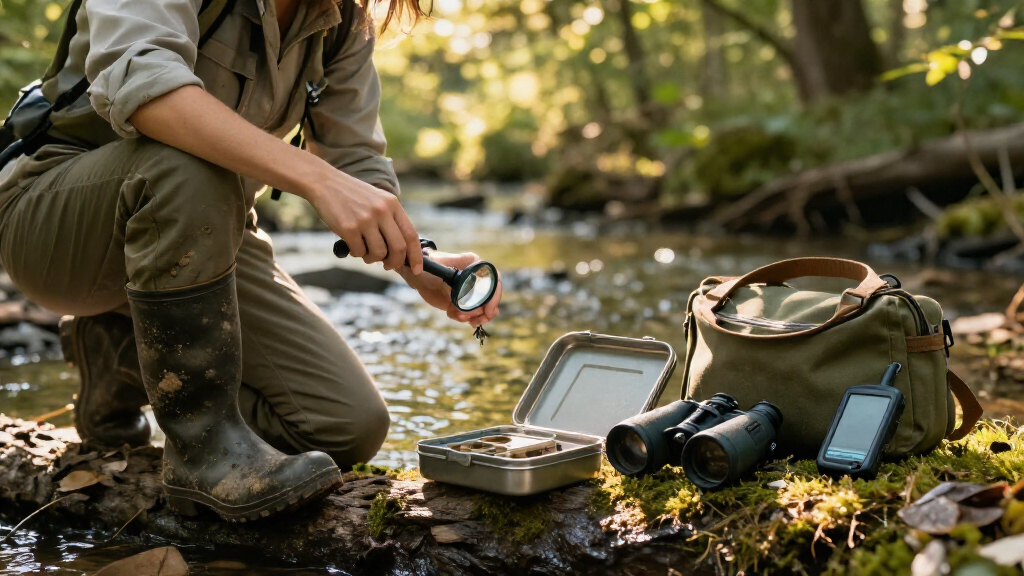

This checklist is for students, educators, and curious beginners preparing for field biology study. It covers tools for observing samples, collecting and preserving specimens, and recording what you find. Choose supplies to match your study setting and the kinds of observations you plan to make.

Prime made for students and young adults
- Fast, free delivery for dorm and study essentials
- Prime Video and Amazon Music included
- Member-only deals
The sections are organized by task: microscope work, prepared slides, soil checks, plant pressing, insect sampling, and field notes. Product picks are included where provided; the other sections offer selection advice without naming a specific product.
Use the checklist as a starting point, then check each item’s listed contents, dimensions, and compatibility before buying. Consider who will use it, where it will be carried or stored, and whether it suits your planned activities. For advice-only items, compare features against your field needs.
Binocular Microscope
A binocular microscope can support close observation of samples during classroom or lab work. The listed pick is a “Binocular Microscope for Adults with WF10x/25x Eyepieces, 40X-2000X Ma.” The product name identifies eyepiece magnifications and a stated magnification range, but it does not provide enough detail to establish what accessories are included or how the instrument fits a particular course.
A common buying mistake is to choose by the largest magnification number alone. Check the full product listing for the microscope’s objectives, focusing controls, illumination, stage dimensions, and whether the included accessories match the samples you expect to study. Confirm that the eyepiece configuration feels comfortable for the intended user and that the instrument can be stored and transported safely. If several students will share it, consider how its controls and setup suit repeated use. Read the listing carefully for any missing specifications before deciding whether the model fits your study plan.
What to look for:
- Confirm the objective lenses and stated magnification range.
- Check the stage dimensions against the samples you plan to view.
- Review the illumination and focusing details in the listing.
- Verify which accessories are included.
- Consider storage, transport, and user comfort.
Binocular Microscope for Adults with WF10x/25x Eyepieces, 40X-2000X Magnificatio

This binocular microscope features adjustable head and dual LED lighting, suitable for laboratory, educational, and home use. It offers magnification from 40x to 2000x with high-quality optics and includes a comprehensive starter kit for DIY experiments.
Pros:
- Adjustable binocular head reduces eye strain during prolonged use
- Wide magnification range with high-quality optics
- Includes comprehensive experiment kit for educational activities
- Dual LED lighting enhances specimen contrast
Cons:
- May be complex for complete beginners without prior experience
- Relatively heavy due to metal construction
- Requires careful handling of delicate lenses
Best for: Learners seeking a binocular microscope with multiple stated magnifications.
Not ideal for: Buyers who need specifications or included accessories not stated in the product name.
Bottom line: Check the full specifications and included components to confirm this microscope fits your study setup.
Prepared Microscope Slides
Prepared slides can make it easier to begin examining specimens without collecting and mounting every sample yourself. The listed pick is “Prepared Microscope Slides with Plant, Insect, Animal, and Algae Speci.” Its name points to several broad specimen categories, which may suit a study checklist spanning different kinds of samples. The product name does not clarify the number of slides, the specific specimens, or the level of detail provided.
Before buying, check the full listing for the slide count, specimen labels, preparation details, and storage case. A common mistake is assuming that broad category names guarantee coverage of the exact organisms or structures needed for a lesson. Compare the listed specimens with your study objectives, and confirm that the slides are compatible with the microscope and magnification range you plan to use. For group work, consider whether the set has enough slides for the intended users. Also look for clear handling and storage guidance so the slides can be managed appropriately between sessions.
What to look for:
- Confirm the number of slides and the specific specimens listed.
- Check whether labels identify each specimen clearly.
- Review storage case details and handling guidance.
- Match the specimens to your lesson or study objectives.
- Check compatibility with your microscope and intended magnification.
Prepared Microscope Slides with Plant, Insect, Animal, and Algae Specimens

This set includes prepared glass slides with plant, algae, mammalian tissue, cell, and insect specimens for basic biology study and microscope practice. The standard-size slides have polished, rounded edges and are designed for educational use at home or school.
Pros:
- Includes a variety of biological specimens
- Standard dimensions fit a range of microscopes
- Rounded, polished edges help prevent cuts
- Suitable for beginners and educational demonstrations
Cons:
- The title says 120 slides, while the description says 30 prepared slides
Best for: Learners who want prepared slides spanning several specimen types.
Not ideal for: Anyone needing a specific specimen set not confirmed in the listing.
Bottom line: Review the complete specimen list and slide count before matching this set to a microscope.
Digital Soil Meter
A digital soil meter can be useful when a field study calls for recorded soil readings. Since no specific product is supplied here, select one based on the measurements your study needs. Product listings can vary in the readings they claim to provide, so check each function rather than assuming every meter covers the same indicators.
A common mistake is buying a meter because it is labeled for soil without checking how it is used or what its display reports. Review the instructions for measurement steps, any stated limitations, and care requirements. Consider whether the meter’s size and controls suit the people collecting readings, and whether its design is practical to carry during your fieldwork. Check what is included, such as instructions or other components, and whether the product requires anything additional. If you will compare readings across locations or dates, follow a consistent procedure and record the conditions alongside each observation. The right choice is the one whose stated functions and instructions match your study plan.
What to look for:
- Identify which measurements the meter states it provides.
- Read the instructions and any stated limitations.
- Check how readings are taken and what care is required.
- Consider portability and ease of use for the intended users.
- Verify included components and any additional requirements.
Plant Press Kit
A plant press kit supports collecting and preserving plant specimens for later study. The listed pick is the “Forestry Suppliers Student Plant Press, 12 x 18 in, Plywood & Oak Fram.” Its name gives the dimensions and identifies plywood and an oak frame, useful details to consider when assessing fit and storage. It does not establish what additional materials or components come with the kit.
A common buying mistake is to focus on the press dimensions without checking how the assembled item will be carried, stored, or used. Compare the stated size with the specimens you expect to collect and the space available in your bag or classroom. Review the full listing for included parts and any supplies needed for pressing. Check whether the product’s instructions explain assembly and specimen placement, and consider who will handle it during field activities. If the press will be shared, think through how it will be transported between users and where it can be stored while specimens are being prepared. Confirm the complete dimensions and contents before deciding.
What to look for:
- Confirm the full dimensions and frame materials.
- Check which components and supplies are included.
- Match the press size to expected specimens and storage space.
- Review assembly and use instructions.
- Consider transport and shared use.
Forestry Suppliers Student Plant Press, 12 x 18 in, Plywood & Oak Frame

This professional-grade plant press measures 12 x 18 inches and features a durable oak frame for pressing and preserving plant specimens. It includes heavy-duty straps, ventilators, and driers, providing a complete system for specimen preparation.
Pros:
- Durable oak frame construction ensures reliable support
- Includes all necessary components for pressing and preservation
- Lightweight design for easy handling and transport
- Professional-grade quality suitable for serious botanical work
Cons:
- May be heavier than some portable presses
- Limited to 12 x 18 inch specimens
Best for: Students seeking a plant press with stated 12 x 18 inch dimensions.
Not ideal for: Anyone needing contents or transport details not confirmed in the listing.
Bottom line: Check the full dimensions and kit contents against your specimens and storage needs.
Insect Collection Net
An insect collection net may be relevant when field activities include observing or sampling insects. No specific product is provided, so first determine how the net will be used and what local study guidance applies. Choosing for the intended activity helps narrow options without assuming that all nets have the same dimensions or construction.
A common buying mistake is to select a net based on a general label while overlooking its dimensions, handle design, or care instructions. Check the listing for the hoop size, handle length, how the handle is attached, and whether the netting is described for the planned use. Consider how it will fit into your field kit and whether the intended user can handle it comfortably. Review any local rules and course guidance before collecting organisms, and plan for careful observation and handling. If the work is observation-only, consider whether collection equipment is needed at all. Let the study protocol guide the choice, then verify the product details rather than inferring them from photos or a short title.
What to look for:
- Check hoop dimensions and handle length.
- Review netting and attachment details in the listing.
- Consider portability and handling for the intended user.
- Follow course and local guidance for collection activities.
- Decide whether a net is needed for observation-only work.
Pocket Field Journal
A pocket field journal gives researchers a place to record observations as they happen. No particular journal is named here, so select one around the notes you expect to make, how it will be carried, and the conditions in which you will write. A compact format may suit field kits, but confirm its dimensions in the product listing rather than relying on the word “pocket.”
A common buying mistake is to choose a notebook without checking page layout, binding, or paper details. Consider whether you need blank pages, ruled lines, or space for sketches and labels. Check whether the journal opens comfortably for writing and whether its pages suit the pen or pencil you plan to use. Think about how it will be stored alongside other supplies and whether the format gives enough room for dates, locations, and observations. If your course or project has a record-keeping protocol, make sure the journal can support it. Compare the product’s stated dimensions and construction with your field routine before choosing.
What to look for:
- Confirm the journal’s dimensions and page count.
- Choose a page layout that suits notes, sketches, or labels.
- Check binding and how easily it opens for writing.
- Consider paper compatibility with your preferred writing tool.
- Match its format to your record-keeping protocol.
Build your checklist around the work you plan to do first. Prioritize the supplies needed for your immediate study activities, then add tools for other tasks as your plans become clearer. Compare the full listings for contents, dimensions, and compatibility before selecting products, especially when the product name leaves details unspecified.
Field biology can begin with careful observation and clear notes, then expand as your study needs grow. Use this checklist as a guide, follow your course or project instructions, and choose equipment that fits the people and activities involved. A thoughtful setup makes it easier to stay organized and focus on what you are learning.