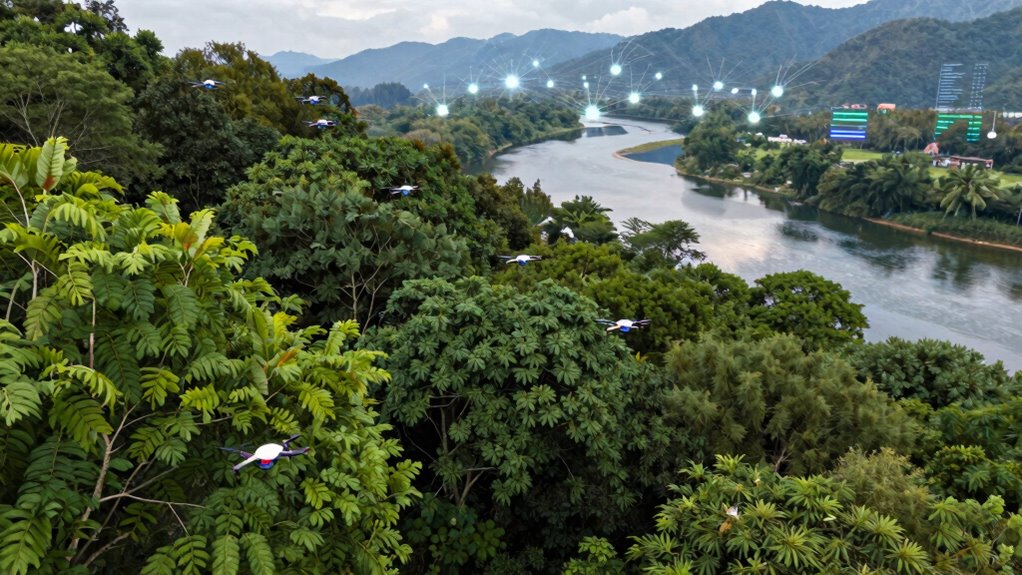

AI helps you monitor forests, water, and emissions by collecting real-time data through sensors, satellites, and drones. It analyzes images, sounds, and movement patterns to detect threats like poaching or habitat loss, allowing for swift action. AI models predict future environmental changes and identify risks such as droughts or floods. If you keep exploring, you’ll discover even more ways AI supports sustainable conservation and environmental protection efforts.
Key Takeaways
- AI analyzes remote sensing data to detect changes in forests, water bodies, and emissions at large scales.
- Machine learning models identify illegal activities like poaching and deforestation in real time.
- AI integrates sensor data for continuous monitoring of environmental health and biodiversity.
- Predictive algorithms forecast future environmental impacts, aiding proactive conservation efforts.
- Data analytics help assess risks of environmental hazards, supporting timely intervention strategies.
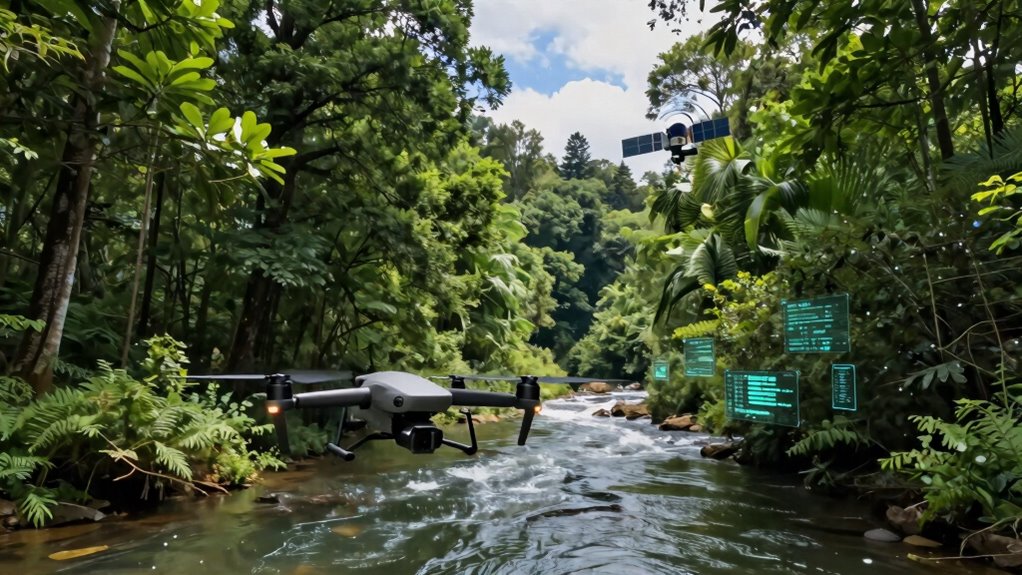
Artificial intelligence is transforming how we monitor and protect our planet’s vital resources. With AI, you can now gather real-time data on forests, water bodies, and emissions, making conservation efforts more effective and immediate. In wildlife conservation, AI-powered tools analyze images, sounds, and movement patterns to track animal populations, detect poaching activities, and identify habitat changes. This technology allows you to respond swiftly to threats and helps guarantee the survival of endangered species. AI models process vast amounts of data from camera traps, drones, and satellite imagery, giving you a clearer picture of ecological health and biodiversity. This proactive approach allows for targeted interventions, reducing human-wildlife conflicts and safeguarding fragile ecosystems. By integrating remote sensing data, AI enhances your understanding of environmental dynamics at larger scales. When it comes to climate modeling, AI accelerates the ability to predict future environmental changes with remarkable accuracy. You can use advanced algorithms to simulate complex climate systems, incorporating variables like temperature fluctuations, rainfall patterns, and greenhouse gas concentrations. These models help you understand potential impacts of climate change on forests and water resources, guiding policy and resource management decisions. Incorporating machine learning techniques further improves the precision of these predictions, allowing for more robust environmental assessments. Additionally, AI-driven data analytics facilitate the identification of environmental risks, enabling more proactive and preventive measures. As AI continues to evolve, its capacity to analyze large datasets ensures even greater insights and adaptability in environmental monitoring. By leveraging AI, you gain insights quicker than traditional methods, enabling you to develop adaptive strategies that mitigate adverse effects. You can also identify regions at heightened risk of droughts, floods, or deforestation, allowing for more precise allocation of resources and preventative measures. This makes climate modeling more dynamic and responsive, empowering you to take timely action.

HUSKYLENS 2 Plus Kit – 6 Tops Edge AI Vision Sensor with 116.6° Wide-Angle Camera & WiFi Module for Arduino, ESP32, Raspberry Pi
6 TOPS Edge AI & Deploying Custom Models Trained with YOLO: Powered by a 1.6GHz dual-core processor and…
As an affiliate, we earn on qualifying purchases.
As an affiliate, we earn on qualifying purchases.
Frequently Asked Questions
How Does AI Differentiate Between Natural and Human-Made Changes?
You can see that AI differentiates between natural patterns and human activity by analyzing data patterns over time. It recognizes natural changes like seasonal shifts or weather events, which follow predictable patterns. When deviations occur—such as deforestation or urban development—AI detects these anomalies as signs of human activity. By comparing current data with historical natural patterns, AI accurately identifies whether changes are natural or caused by human intervention.
What Are Ai’s Limitations in Remote or Dense Forest Areas?
Ironically, AI’s biggest challenge in dense forests is that it often struggles where you’d expect it most—remote areas with limited connectivity. Sensor inaccuracies add to the problem, making data less reliable. Without steady signals, AI can’t process real-time info effectively, so monitoring becomes patchy at best. You might find that, despite advanced tech, nature’s thick canopy still outsmarts AI’s ability to keep a constant watch.
Can AI Predict Future Environmental Crises?
Yes, AI can predict future environmental crises using predictive analytics and climate modeling. You can leverage AI to analyze vast data sets, identify patterns, and forecast potential issues like wildfires, floods, or droughts. By simulating various scenarios, AI helps you understand possible outcomes and prepare accordingly. This proactive approach enables timely interventions, reduces risks, and supports sustainable management of natural resources, ultimately helping you mitigate environmental crises before they escalate.
How Is AI Data Secured From Hacking or Misuse?
They say, “Better safe than sorry,” and when it comes to AI data security, you should prioritize data encryption and strict access control. These measures guarantee that sensitive environmental data stays protected from hacking or misuse. You can also implement multi-factor authentication and regular security audits, making it harder for unauthorized users to access or manipulate critical information. Staying vigilant helps safeguard the valuable insights AI provides.
What Is the Cost of Implementing AI for Environmental Monitoring?
Implementing AI for environmental monitoring involves costs that vary with project size and technology complexity. You’ll need to account for initial investment, ongoing maintenance, and data infrastructure. Conducting a thorough cost analysis helps identify potential expenses and benefits. Implementation challenges, like data quality and technical expertise, can impact costs. While initial expenses might seem high, the long-term benefits of accurate monitoring and decision-making often justify the investment.

Deep Learning for Satellite Imagery with Python: End-to-End Workflows for Image Analysis, Object Detection, and Change Monitoring
As an affiliate, we earn on qualifying purchases.
As an affiliate, we earn on qualifying purchases.
Conclusion
By now, you see how AI acts like a vigilant guardian, constantly watching over our forests, water, and emissions. It’s like having a second set of eyes that never tire, catching problems early and helping us protect our planet. With AI’s help, you can feel more confident that we’re making smarter, faster decisions to preserve nature’s delicate balance. Together, you and AI can be the steady beat driving a healthier, more sustainable future.
THE WILDLIFE DRONE MONITORING HANDBOOK: A Beginner’s Guide to Drone-Based Conservation, Animal Tracking, and Habitat Protection
As an affiliate, we earn on qualifying purchases.
As an affiliate, we earn on qualifying purchases.

AMOROM 7 in 1 Hidden Camera Detectors, GPS Tracker Finder with AI-Powered Detection, OLED Display, 7 Modes, Anti-Theft, Flashlight, Spy Camera Detector for Travel/Hotel/Car/Bathroom, Black
✔️【AI-Powered Detection】With advanced AI algorithms, AMOROM hidden camera detector analyzes electromagnetic signals, Wi-Fi anomalies, and lens reflections to…
As an affiliate, we earn on qualifying purchases.
As an affiliate, we earn on qualifying purchases.