
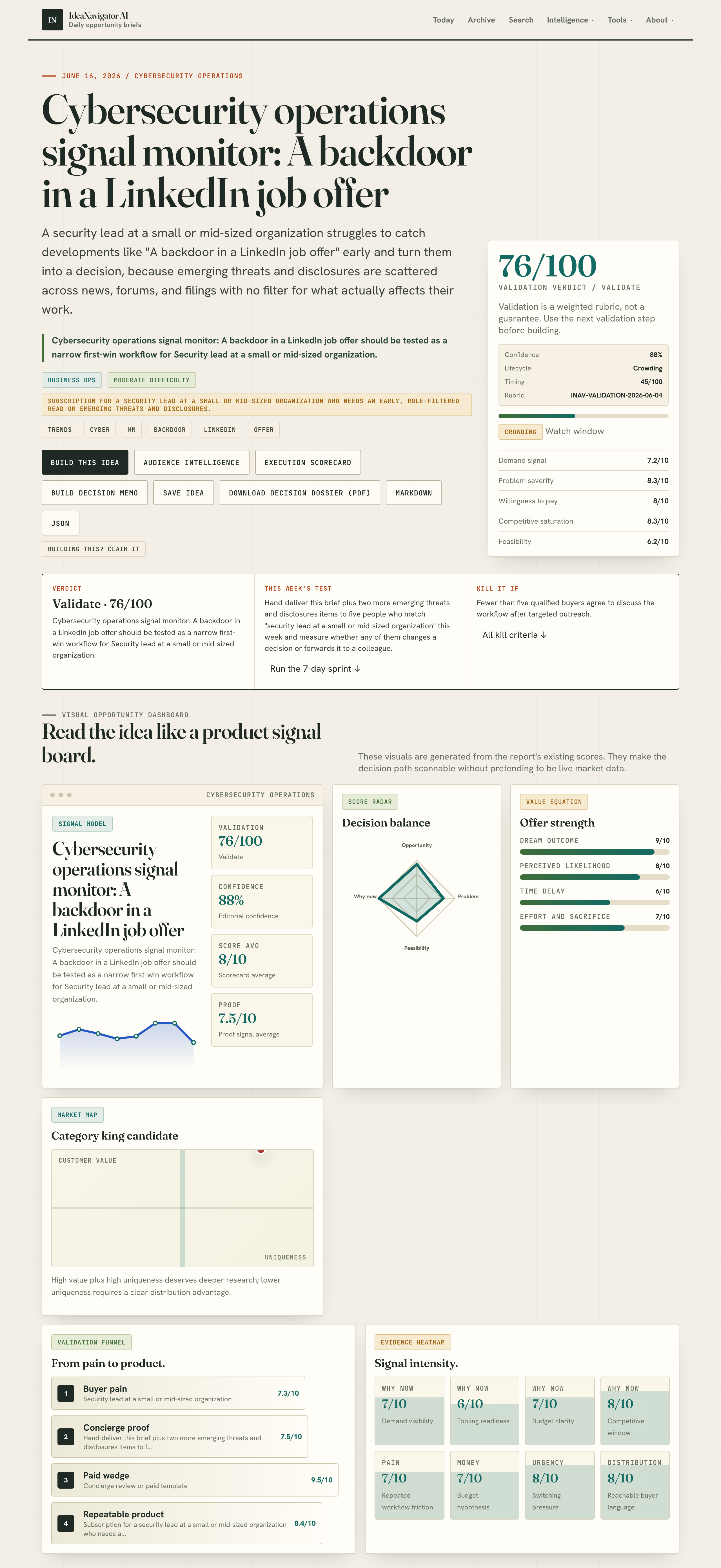
📊 Full opportunity report: Cybersecurity operations signal monitor: A backdoor in a LinkedIn job offer on IdeaNavigator AI — validation score, market gap, and execution plan.
TL;DR
Cybersecurity operations have detected a backdoor in a LinkedIn job offer, indicating a new method for attackers to compromise target systems. This development underscores the need for vigilance in online recruitment channels.
Cybersecurity analysts have confirmed the discovery of a backdoor embedded within a LinkedIn job offer, representing a new threat vector for cyber attackers targeting recruitment platforms. This finding is significant for security teams at small and mid-sized organizations, which often lack the resources to detect such sophisticated exploits early.
Recent investigations by cybersecurity teams revealed a malicious backdoor hidden within a LinkedIn job posting. The exploit appears to be designed to deliver malware or establish remote access once an applicant interacts with the posting or downloads associated files. The backdoor was detected through anomaly monitoring in security operations centers and confirmed by multiple independent security firms.
According to cybersecurity experts, this type of attack leverages social engineering combined with technical exploits embedded in seemingly legitimate job offers. The threat was flagged after unusual network activity was observed following interactions with the targeted LinkedIn post. The malicious code is believed to be embedded in document attachments or embedded scripts within the job listing.
LinkedIn has not publicly acknowledged the incident but has reportedly taken steps to remove the affected postings and issued reminders to users to verify job postings and avoid downloading suspicious files. Security researchers warn that similar tactics could be used in future recruitment scams to compromise organizational networks.
Implications for Small and Mid-Sized Organizations
This discovery highlights a growing threat in online recruitment channels, which are increasingly being exploited by attackers to gain initial access to organizational networks. Small and mid-sized organizations, often lacking dedicated cybersecurity teams, are particularly vulnerable to such sophisticated social engineering attacks. Early detection and awareness are critical to prevent potential breaches.
AI-POWERED CYBERSECURITY OPERATIONS: Threat intelligence anomaly detection and automated incident response systems
As an affiliate, we earn on qualifying purchases.
As an affiliate, we earn on qualifying purchases.
Over the past year, cybersecurity incidents involving social media platforms have increased, with threat actors using fake job postings to deliver malware or establish persistence within target systems. This incident marks a notable escalation, demonstrating that attackers are embedding backdoors directly into legitimate-looking job offers. Experts have noted that similar tactics have been used in phishing campaigns but embedding backdoors in recruitment posts is a newer development.
Previous incidents involved malicious links or attachments, but the recent case indicates a shift toward more covert, persistent access methods. The detection was part of ongoing threat monitoring by cybersecurity teams who track emerging attack patterns on social media and professional networking sites.
“The backdoor embedded in this LinkedIn job offer is a clear sign that attackers are refining their methods to target recruitment channels directly. Organizations need to be more vigilant about the authenticity of online job postings.”
— an anonymous cybersecurity researcher

Practical Malware Analysis: The Hands-On Guide to Dissecting Malicious Software
As an affiliate, we earn on qualifying purchases.
As an affiliate, we earn on qualifying purchases.
Extent of the Threat and Future Use Cases
It remains unclear how widespread this specific backdoor technique is and whether other similar exploits are currently active in the wild. Details about the specific malware payload, the actors behind the campaign, and whether the technique has been used in other contexts are still emerging. Security experts caution that attackers may adapt and deploy similar tactics in future campaigns.

Industrial Network Security: Securing Critical Infrastructure Networks for Smart Grid, SCADA, and Other Industrial Control Systems
As an affiliate, we earn on qualifying purchases.
As an affiliate, we earn on qualifying purchases.
Monitoring and Defense Strategies Moving Forward
Security teams are advised to enhance monitoring of social media and recruitment platforms for suspicious activity. Organizations should verify job postings through multiple channels and educate HR and recruitment staff about potential scams. Further research is expected to uncover whether this backdoor technique will be adopted in broader attack campaigns, and efforts are underway to develop detection signatures.

Tool Phishing Text Email detection by Natural language processing with Machine Learning- Research paper
As an affiliate, we earn on qualifying purchases.
As an affiliate, we earn on qualifying purchases.
Key Questions
How can organizations protect themselves from such backdoors?
Organizations should verify job postings through official channels, train staff to recognize suspicious activity, and implement advanced threat detection tools that monitor social media and email for malicious links or code.
Is this backdoor linked to known hacking groups?
At this stage, attribution to specific hacking groups has not been confirmed. Investigations are ongoing to identify the threat actors involved.
What are the signs of a compromised job offer?
Signs include unusual request for personal information, suspicious attachments or links, and inconsistencies in the posting details compared to legitimate job offers.
Will LinkedIn take further action to prevent such exploits?
LinkedIn has not issued a detailed statement but has taken down the affected postings and is likely to enhance its monitoring for malicious activity.
Are there specific industries or roles targeted by this attack?
Current information does not specify targeted industries; however, attackers typically focus on sectors with high-value data or access, such as IT, finance, and healthcare.
Source: IdeaNavigator AI