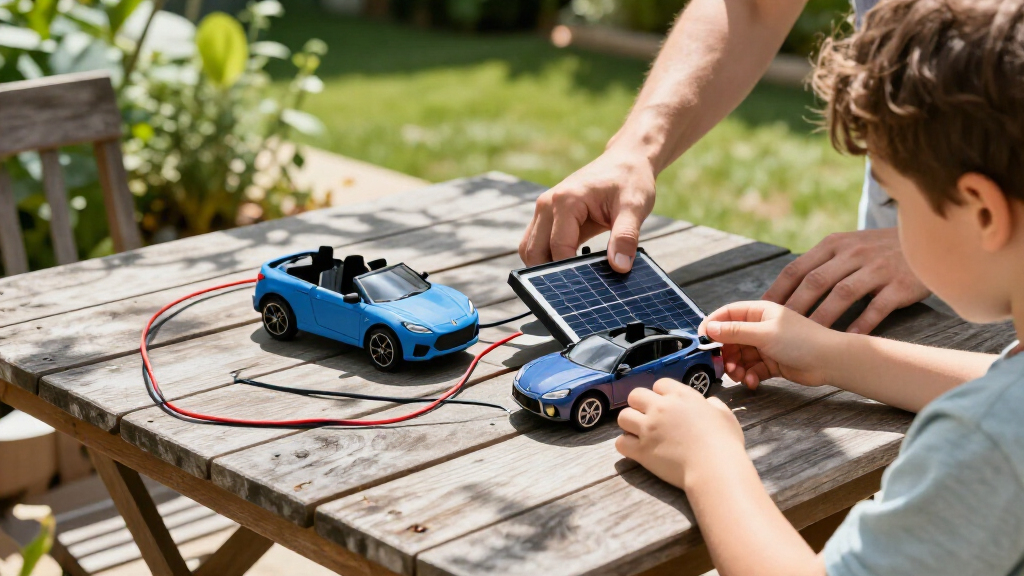
The CYOEST Solar Power STEM Kit is my best overall pick for its four different projects, giving kids more ways to explore solar power than a single-vehicle kit. For repeat builds or group activities, the Sillbird 12-in-1 Solar Robot Building Kit offers the widest construction range, while the Delinx Physics Experiment Kit stands out for comparing solar power with wind and hand-cranked generation. The main tradeoff is between variety and simplicity: more builds can extend play, but may call for more patience and adult help. Multipacks favor classrooms and siblings, while a focused kit can be easier for one child to finish. Read on for my full comparison and advice on matching a kit to your child.

Prime made for students and young adults
- Fast, free delivery for dorm and study essentials
- Prime Video and Amazon Music included
- Member-only deals
Key Takeaways
- CYOEST is the most balanced starting point: its four project types provide more variety than a single-purpose solar car or fan kit without the 12-build scope of Sillbird.
- Sillbird offers the broadest building range: its 12-in-1 format suits children who want to rebuild, though the larger project count may be less appealing to kids seeking a quick first success.
- Delinx teaches energy comparisons: adding wind and hand-cranked generation makes it the clearest choice for exploring how different sources can produce power.
- Multipacks solve a different problem than project variety: WESAYEE, BeAndge, and Yutin provide several kits for groups, while CYOEST and Sillbird focus more on giving one builder different project options.
- Solar performance depends on the setting: kits that rely on sunlight may be frustrating indoors or in weak light, so families should plan where and when builds can run.


| solar science kits for kid | Brand | Recommended age | Material | Assembly |
|---|---|---|---|---|
| CYOEST Solar Power STEM Kit fo | CYOEST | 8 years and up | Wood | No welding required |
| WESAYEE Solar-Powered STEM Fan | WESAYEE | 8 years and up | — | Tool-free; uses double-sided tape |
| BeAndge 4-Pack Solar Robot Car | BeAndge | 8–12 years | — | — |
| Yutin Solar Car STEM Kits for | Yutin | 8 years and up | Plywood | Plug-in circuit connections; no soldering or special tools required |
| 4-Piece STEM Science Kit with | SCAEMO | 8–16 years | Wood | No welding; includes instructions |
| Sillbird 12-in-1 Solar Robot B | Sillbird | 10 years and up | ABS | — |
| Delinx Physics Experiment Kit | Delinx | — | Plastic | — |
More Details on Our Top Picks
CYOEST Solar Power STEM Kit for Kids, 4 Buildable Science Projects
The CYOEST Solar Power STEM Kit is a strong fit for kids who will learn more from comparing different kinds of motion than from building several versions of one vehicle. Its four projects include a solar-powered car and fan, plus a wind-powered car and wooden plane, giving families a broader set of builds than the car-focused BeAndge 4-Pack Solar Robot Car STEM Kits. Simple circuit connections and a magnetic screwdriver make assembly approachable without welding, though children may still need an adult nearby for some steps. The tradeoff is that only part of the set focuses directly on solar power, so it is less concentrated as a solar-car activity than the Yutin Solar Car STEM Kits. I’d choose it for a home project session where variety matters more than building multiples for a group.
Pros:- Four distinct builds cover solar, wind, and model-plane projects
- Simple circuit connections require no welding
- Magnetic screwdriver and instructions are included
- Wood construction offers a hands-on building experience
Cons:- Only some projects use solar power, making it less focused than a solar-car set
- Children may need adult help or supervision during assembly
- Recommended for ages 8 and up, so it is not aimed at younger builders
Best for: Families seeking several different energy and motion projects for one child or small household activity.
Not ideal for: Teachers who need matching solar-car builds for a full group, since the four projects are different models and only some are solar-powered.
- Brand:CYOEST
- Recommended age:8 years and up
- Number of projects:4
- Included projects:Solar-powered car, solar-powered fan, wind-powered car, wooden plane
- Material:Wood
- Dimensions:11.8 x 6.5 x 2 inches
- Weight:0.29 kg
- Assembly:No welding required
- Included accessories:Magnetic screwdriver and instructions
Our verdict“Choose CYOEST when you want one kit to offer several kinds of hands-on energy projects rather than a stack of similar solar cars.”
WESAYEE Solar-Powered STEM Fan Kits for Kids, 8-Pack
For a teacher or club leader, the WESAYEE 8-Pack solves a practical problem the single-project kits do not: it supplies eight individual solar fan builds, each with its own instruction manual. That makes it easier for children to assemble at the same time than the mixed-project CYOEST Solar Power STEM Kit, where each build explores a different model. Tool-free assembly with double-sided tape keeps the setup simple and reduces the need to distribute tools, while the fan gives learners a visible way to connect sunlight with motion. The compromise is limited project variety: this is a repeated fan activity, not a multi-model exploration like the SCAEMO 4-Piece STEM Science Kit. I’d pick it for group instruction, but not for a child hoping to build cars or explore several mechanisms in one box.
Pros:- Eight individual kits support simultaneous group building
- Tool-free assembly uses double-sided tape
- Each kit includes an instruction manual
- Introduces basic circuits and engineering through a solar-powered fan
Cons:- Offers just one project type, unlike the mixed-model CYOEST and SCAEMO kits
- Recommended for ages 8 and up, so younger children may need a different activity
Best for: Educators, STEM-club organizers, and families running a group activity for several children at once.
Not ideal for: Children who want to build cars or switch between different project types, since every kit in the pack is a solar fan.
- Brand:WESAYEE
- Kit quantity:8
- Recommended age:8 years and up
- Power source:Solar
- Project:Solar-powered fan
- Assembly:Tool-free; uses double-sided tape
- Included:8 kits and instruction manuals
- Materials:Non-toxic plastics
Our verdict“Choose WESAYEE when you need matching, tool-free solar builds for a classroom, club, or multi-child activity.”
BeAndge 4-Pack Solar Robot Car STEM Kits for Kids Ages 8–12
The BeAndge 4-Pack keeps the activity focused: every build is a solar-powered car, so children can concentrate on how sunlight drives a small vehicle rather than moving between unrelated models. Four kits, manuals, and screwdrivers make it more practical for a sibling pair or small group than buying a single car project, while the 8–12 age range gives its intended audience a clear target. Compared with the Yutin Solar Car STEM Kits, BeAndge provides fewer builds but similarly centers the experience on cars; Yutin’s six-kit quantity is a better match for larger groups. The tradeoff is limited variety, and the cars need sunlight to operate. I’d choose this over the mixed-project CYOEST kit when repeated car assembly is the point, not exploring wind power or fans.
Pros:- Four matching solar-car kits support shared building or repeat attempts
- Runs on sunlight without batteries
- Includes four manuals and four screwdrivers
- Encourages construction, problem-solving, and hand-eye coordination
Cons:- All four builds are cars, with less project variety than CYOEST or SCAEMO
- Requires sunlight for solar-powered movement
- Younger builders may need adult guidance
Best for: Families with children ages 8–12 who want several matching solar-car builds for siblings or a small group.
Not ideal for: Buyers seeking a range of different energy projects or an activity that works reliably without sunlight.
- Brand:BeAndge
- Recommended age:8–12 years
- Number of kits:4
- Project:Solar-powered toy car
- Power source:Solar
- Included components:4 solar car kits, 4 manuals, 4 screwdrivers, 1 color box
- Model number:BA1024
- Educational skills:Coding, construction, problem solving, hand-eye coordination, motor skills
Our verdict“Choose BeAndge if the goal is for several children to build and explore the same kind of solar-powered car.”
Yutin Solar Car STEM Kits for Kids, 6-Pack
The Yutin Solar Car STEM Kits offer a useful middle ground for group leaders who want one shared project and enough sets for several builders: the box includes six solar-car kits. Plug-in circuit connections avoid soldering and special tools, while the activity introduces not only solar power and circuits but also gear transmission—a mechanical idea that the fan-focused WESAYEE pack does not address. Compared with the four-car BeAndge pack, Yutin supplies two more builds, which can make planning a larger session easier. Its focus is narrower than the four-model SCAEMO kit, though, and sunlight is needed to demonstrate the cars’ movement. I’d choose Yutin for a classroom or club that wants children to build the same vehicle and discuss how its parts work together, not for a varied take-home project box.
Pros:- Six kits suit classroom and group activities
- Explores solar power, circuits, and gear transmission
- Plug-in connections require no soldering or special tools
- Illustrated instructions support the build process
Cons:- All included builds focus on solar cars rather than varied models
- Cars require sunlight to demonstrate solar-powered movement
Best for: Teachers, club leaders, and families arranging a shared solar-car activity for up to six builders.
Not ideal for: Children who want different project types in one kit or need to demonstrate solar motion indoors without suitable sunlight.
- Brand:Yutin
- Model:YT1022
- Quantity:6 kits
- Recommended age:8 years and up
- Material:Plywood
- Power source:Solar
- Assembly:Plug-in circuit connections; no soldering or special tools required
- Included components:Building toys, circuit kit, wooden puzzle, illustrated instructions
- Educational skills:STEM, creativity, logical thinking, motor skills, problem solving
Our verdict“Choose Yutin for a larger group that wants matching solar-car builds with a basic introduction to gears and circuits.”
4-Piece STEM Science Kit with Solar Cars, Solar Plane, and Electric Fan
The SCAEMO 4-Piece STEM Science Kit earns its place for children who want to compare how energy can produce movement across several models. Its solar car, solar plane, and electric fan sit alongside a wind-powered car, making it a broader energy-conversion set than the car-only BeAndge 4-Pack or Yutin 6-Pack. Simple circuit connections and no-welding assembly keep the projects accessible for the stated ages 8–16, while the included instructions give builders a starting point. The tradeoff is that the kit has fewer repeated builds for group sessions than Yutin or the eight-pack WESAYEE fan set, and assembling the models takes time. I’d choose SCAEMO over the CYOEST kit when the solar plane and electric fan are a better fit for the child’s interests; neither is the pick for a stack of identical builds.
Pros:- Four different models offer more variety than car-only kits
- Includes solar car, solar plane, wind-powered car, and electric fan
- Simple circuit connections require no welding
- Instructions support hands-on STEM and energy-conversion learning
Cons:- Assembly is required for all four models
- Fewer kits for group use than the Yutin six-pack or WESAYEE eight-pack
- A mixed set is less focused on solar cars than BeAndge or Yutin
Best for: Families with school-age children who want several distinct models for discussing solar, wind, and energy conversion.
Not ideal for: Teachers needing enough identical kits for a large group, or buyers seeking a single focused solar-car project.
- Brand:SCAEMO
- Recommended age:8–16 years
- Number of kits:4
- Included models:Solar-powered car, solar-powered plane, wind-powered car, electric fan
- Material:Wood
- Educational focus:STEM and energy conversion
- Assembly:No welding; includes instructions
- Dimensions:9.1 x 5.9 x 2 inches
- Weight:0.31 kg
Our verdict“Choose SCAEMO when variety across energy-powered models matters more than having multiple copies of one solar build.”
Sillbird 12-in-1 Solar Robot Building Kit, 190 Pieces
The Sillbird 12-in-1 is the strongest fit here for kids who want to build, take apart, and rebuild rather than make one solar project. Its 190 pieces and 12 models offer a longer engineering challenge than the simpler solar vehicle projects in the CYOEST Solar Power STEM Kit for Kids, while step-by-step instructions and varied difficulty levels give builders a route into more involved designs. The solar motor can also run under a strong artificial light, though weak indoor lighting may leave a model sitting still; outdoor or bright-window use is a better bet. Its age-10-and-up guidance makes it less suitable for younger children who need quick wins. Choose this over the Delinx kit if construction variety matters more than comparing different ways to generate electricity.
Pros:- Twelve rebuildable models keep the construction challenge varied.
- 190 pieces support hands-on assembly and problem-solving.
- Step-by-step instructions and differing difficulty levels help guide builders.
- Can use sunlight or a strong artificial light source.
Cons:- May not run consistently under typical indoor lighting.
- The recommended age of 10 and up rules it out for younger beginners.
- Repeatedly rebuilding models may appeal less to children who prefer ready-to-run experiments.
Best for: Builders around age 10 and up who enjoy assembling multiple robot and vehicle designs and have access to sunny or strongly lit spaces.
Not ideal for: Younger children or families seeking reliable indoor demonstrations under ordinary room lighting; the models may need stronger light to operate.
- Brand:Sillbird
- Models:12
- Parts:190
- Power source:Solar or strong artificial light
- Material:ABS
- Recommended age:10 years and up
- Item dimensions:10.24 x 7.87 x 2.56 inches
- Model number:US-SB-SolarRobot
Our verdict“Choose the Sillbird for an older child who wants a substantial, reusable robot-building challenge and can work in bright light.”
Delinx Physics Experiment Kit with Windmill, Hand-Cranked Generator, and Solar Power
The Delinx Physics Experiment Kit treats solar power as one part of a broader lesson: kids can compare solar, wind, and hand-cranked generation, then see electricity light an LED or power a fan. That makes it a better match for older students exploring energy conversion and basic circuits than the Sillbird 12-in-1, which puts more emphasis on assembling robots and vehicles. Its 23 pieces keep the activity focused, but the listed 12-and-up age guidance and missing paper instructions make it less ready for younger children to pick up independently. Instructions must be downloaded, a practical hurdle for families without easy device access or who want a printed guide. Pick Delinx for comparing how electricity is generated; choose the Sillbird for more building variety.
Pros:- Demonstrates electricity generation through solar, wind, and hand-cranked power.
- Connects energy conversion with basic circuit activities.
- Can light an LED or power a fan.
- Compact listed dimensions make it easy to store.
Cons:- Paper instructions are not included and must be downloaded.
- The recommended age of 12 and up limits its fit for younger children.
- With 23 items, it offers less construction variety than the Sillbird 12-in-1.
Best for: Families or educators working with learners ages 12 and up who want to compare solar, wind, and hand-cranked power in circuit activities.
Not ideal for: Younger children or buyers who need printed instructions and a fully self-contained, easy-to-follow kit.
- Brand:Delinx
- Age range:12 years and up
- Number of items:23
- Learning topics:STEM, physics, circuitry, energy conversion
- Power modes:Solar, hand-cranked, wind
- Item dimensions:3 x 3 x 2 inches
- Item weight:0.18 kg
- Material:Plastic
- Instructions:Paper instructions not included; download required
Our verdict“Choose Delinx for an older learner who wants to compare several power sources and can access the downloadable instructions.”
How We Picked
I compared the seven kits by how well they turn solar power into a clear, child-friendly activity, not simply by counting included parts or projects. My main criteria were project variety, the likelihood of a child being able to build and use the projects, the kit’s fit for solo play or group use, and the learning opportunities beyond assembling a model. I also weighed practical tradeoffs such as reliance on strong light, the patience a build may require, and whether a kit’s format supports repeat play.
The ranking favors a useful balance of learning, variety, and approachability. CYOEST ranks first as a versatile middle ground; Sillbird and Delinx follow for families seeking deeper building or energy comparisons. I place the multipacks lower for one-child versatility, not because group kits lack value: WESAYEE, BeAndge, and Yutin make more sense when several children need their own build. The four-piece mixed-project kit serves as another accessible option, though its appeal depends on wanting several types of solar-powered models rather than a dedicated build system.
| solar science kits for kid | Material | Assembly | Power source |
|---|---|---|---|
| CYOEST Solar Power STEM Kit fo | Wood | No welding required | — |
| WESAYEE Solar-Powered STEM Fan | — | Tool-free; uses double-sided tape | Solar |
| BeAndge 4-Pack Solar Robot Car | — | — | Solar |
| Yutin Solar Car STEM Kits for | Plywood | Plug-in circuit connections; no soldering or special tools required | Solar |
| 4-Piece STEM Science Kit with | Wood | No welding; includes instructions | — |
| Sillbird 12-in-1 Solar Robot B | ABS | — | Solar or strong artificial light |
| Delinx Physics Experiment Kit | Plastic | — | — |
Factors to Consider When Choosing Best Solar Science Kits For Kids
Project counts alone can make solar kits look interchangeable, but the right choice depends on how your child likes to learn and where the kit will be used. I’d match the kit’s build style to the child’s patience, the available light, and whether this is a solo activity or a group project.
Match Project Variety to Your Child’s Attention Span
A larger project count can keep a builder busy, but it does not automatically make a kit a better first experience. Some children enjoy taking models apart and rebuilding them; others are happiest completing one clear project and seeing it move. Think about whether your child tends to repeat favorite activities or wants something new each time. A multi-build kit can justify a more involved setup if the child likes experimenting, while a focused car or fan kit may be easier to approach. Avoid choosing by the biggest number of builds alone; check whether the range of projects actually interests your child.
Plan for Sunlight Before Choosing a Solar-Only Build
Solar-powered models need suitable light, so a kit can sit unused if there is no convenient bright outdoor space or sunny window. Think through when the child will build: a weekend activity outside has different constraints from an after-school project in a dim room. Indoor lighting may not provide the conditions a model needs to run reliably. This affects more than performance; repeated attempts in poor light can make a child think the build is faulty. If indoor use or variable weather is a concern, prioritize a kit whose learning activities are not limited to watching a solar model move.
Decide Between a Multipack and More Builds for One Child
Multipacks are designed around having several builds available at once, which can help when siblings, classmates, or party guests need their own activity. A kit with many different projects, by contrast, can give one child more ways to continue exploring over time. Those are different kinds of value, so ask whether the main goal is sharing or repeat play. For a group, separate kits can reduce waiting and arguments over a single model, although they also require more space and adult oversight. For one child, a multipack may add duplicates rather than meaningful new challenges.
Look Beyond Movement to the Science You Want to Teach
A moving car or fan can make solar energy feel tangible, but movement is only one possible learning outcome. Consider whether your child mainly wants to build a working model or is ready to compare how different forms of energy produce motion. A kit that combines solar with wind or hand-cranked power can support a broader discussion than a solar-only vehicle. That added scope may be less useful for a child who just wants a quick, hands-on introduction. Pick the learning goal first, then choose the kit format that makes that idea easy to see.
Check the Age Fit and the Amount of Adult Help Available
Age guidance is a starting point, not a guarantee that a child can complete every build independently. Small assembly steps, following diagrams, and troubleshooting a model that does not move can each call for different skills. Consider how much help an adult can offer and whether the child enjoys working through a tricky step. A more involved construction kit may suit a patient builder with support, while a simpler project can be a better match for a first STEM activity. If independent use matters, prioritize clarity and a manageable build over extra components.
Set Expectations for Durability and Repeat Use
Science kits are often handled, disassembled, and rebuilt, so the first successful build is not the only measure of usefulness. Before choosing, think about whether the child will treat the model as a display, a one-time experiment, or a toy to use repeatedly. More project options can create opportunities for rebuilding, but they also mean more parts to keep track of. A multipack spreads activity across children, while a larger build kit concentrates its value in one builder’s continued interest. A simple storage plan can prevent small components from becoming the reason a kit stops being used.
Frequently Asked Questions
Which solar science kit is a sensible first choice for a child new to STEM projects?
I’d start with the CYOEST kit if you want a mix of project types without jumping straight to the largest build set. A first kit should make it possible to complete a project and see a result, rather than overwhelm a child with choices. The four-project format offers more than one activity while keeping the scope more contained than Sillbird’s 12-in-1 approach. If your child is especially young or loses patience with assembly, plan to build together and treat the first project as a guided activity. Also check that you have a bright place to run solar-powered models.
Can these kits work indoors on a cloudy day?
Solar-powered models generally need sufficiently strong light, so cloudy conditions or ordinary indoor lighting may limit their movement. A kit can still offer a building activity indoors, but a child may not see the same result they would in bright sunlight. Plan a test outdoors or near a bright window when conditions allow, and avoid assuming that a model is assembled incorrectly if it does not run in weak light. For an indoor-first activity, the Delinx kit’s wind and hand-cranked experiments give families additional energy sources to explore. The exact experience still depends on the kit’s instructions and setup.
Should I choose a multipack or a kit with many different projects?
Choose a multipack when several children need their own activity at the same time; choose a multi-project kit when one child wants different builds to try. WESAYEE, BeAndge, and Yutin are group-oriented options, while Sillbird offers a broader set of builds for a single builder. A multipack can avoid turn-taking, but it may repeat the same type of activity. A larger project collection can encourage continued exploration, though it may demand more patience and help. Decide who will use the kit and whether sharing or variety matters more before comparing pack counts.
Which kit is best for teaching more than solar power?
The Delinx Physics Experiment Kit is the clearest match because it includes windmill, hand-cranked generator, and solar power activities. Comparing these methods can help a child see that different energy sources can generate useful motion or electricity. That broader scope is more suitable when the goal is a lesson or experiment, rather than simply assembling a solar car. The tradeoff is that a child focused on building several kinds of robots may find Sillbird’s construction range more engaging. Consider which question you want the child to explore: how models are built, or how different energy sources work.
What should I do if my child’s solar model does not move after assembly?
Start by checking the instructions and testing the model in stronger sunlight, since weak light can prevent a solar-powered build from running as expected. Review the assembly steps and look for parts that may be misaligned or connections that need to be seated correctly. Keep the first troubleshooting session calm: diagnosing why a model is still can be part of the learning, but repeated failures can become discouraging. If the model remains inactive under suitable light, consult the kit’s instructions for troubleshooting or contact the seller about missing or faulty components. An adult can help separate a setup problem from a light problem before the child rebuilds everything.
Conclusion
For a balanced pick, I recommend the CYOEST Solar Power STEM Kit as the best overall choice: its four project types offer variety without the broad scope of a large construction set. For best value in group use, I’d look first at the multipacks—WESAYEE for solar fans, BeAndge for robot cars, or Yutin for solar cars—and choose by the activity your children will enjoy. Sillbird is my best premium-style pick for a child who wants many building options, while CYOEST is also my best beginner-friendly choice for a manageable mix of projects. For teaching energy sources beyond solar, choose Delinx; for a mix of solar vehicles and a fan, the four-piece STEM Science Kit fills that specific need. Match the kit to the builder, the group size, and your access to bright light, and the choice becomes much clearer.
Halloween Picks
halloween
As an affiliate, we earn on qualifying purchases.