Choosing the right Halloween logic puzzle books for kids requires balancing age-appropriate difficulty with sustained engagement. My top pick, Halloween Brain Games – Spooky Fun Puzzles to Challenge Young Minds, stands out for its varied puzzle types that prevent boredom, while The Halloween Thief offers a unique narrative-driven experience for older children. The main tradeoff in this category is between broad activity mixes and focused logical depth; many books dilute their logic content with coloring pages or mazes. If you want pure deduction practice, look for titles explicitly focused on grid logic or clue-based mysteries rather than general activity books. Read on to see which options truly sharpen critical thinking skills versus those that just fill time.

Prime made for students and young adults
- Fast, free delivery for dorm and study essentials
- Prime Video and Amazon Music included
- Member-only deals
Key Takeaways
- Books with narrative frameworks (like detective stories) sustain engagement longer than standalone puzzle collections.
- Most ‘activity’ books dilute logic content with coloring and mazes, reducing the time spent on actual critical thinking.
- Travel-sized formats often compromise on puzzle complexity to fit smaller page dimensions.
- Age ranges are frequently optimistic; many books labeled for ages 8+ are too difficult for average third-graders without guidance.
- Answer keys are essential for independent play but often poorly printed or separated, hindering self-correction.


| Halloween logic puzzle books for kid | Theme | Target Age |
|---|---|---|
| Halloween Brain Games | Spooky/Halloween | — |
| Halloween Whodunit Puzzles: 30 | — | 8-12 |
| brainPLAY Halloween Puzzles: A | — | 7 and Up |
| The Super Fun Halloween Challe | Halloween Challenge | 7-10 |
| Challenging Halloween Activity | Spooky Halloween | 8-12 |
| Halloween Logic & Problem Solv | Halloween | — |
| Spooky Brain Logic Elimination | Halloween | — |
| The Halloween Thief: An Intera | Detective/Mystery | — |
| Mystery Logic Puzzles for Kids | Ghost hunt | — |
| The MEGA Halloween Activity Bo | Halloween | — |
| The Halloween Puzzle Files: Co | Halloween | 7–11 years |
| Catch the Halloween Thief! Det | Halloween / Detective | 7 and up |
| Halloween Activity Book for Ki | Halloween | 7-12 years |
| Halloween Kids Activity Book: | Halloween | 6 and up |
| Who Stole Salem?: An Interacti | Detective / Halloween | — |
More Details on Our Top Picks
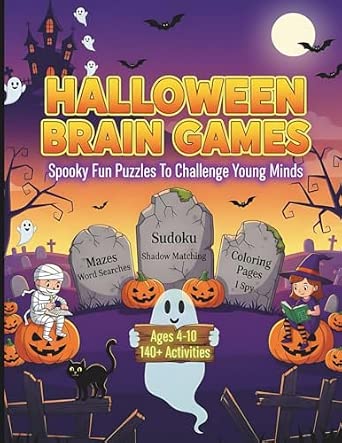
Halloween Brain Games – Spooky Fun Puzzles to Challenge Young Minds
This book stands out for its diverse puzzle mix, combining crosswords, mazes, and word games into a single volume. Unlike Challenging Halloween Activity Book for Kids 8-12, which leans heavily into math and logic, this collection prioritizes accessible wordplay and visual navigation, making it ideal for younger minds who need gentler entry points into puzzle-solving. The 140+ puzzles offer substantial value, ensuring the book lasts through the entire holiday season. However, the lack of specified difficulty levels is a drawback; parents may find themselves skipping pages if the puzzles are too easy for advanced readers or too hard for novices. It serves as a broad entertainer rather than a targeted skill-builder.
Pros:- High volume of content with over 140 puzzles
- Mixes word games and mazes for varied engagement
- Wholesome, age-appropriate spooky themes
Cons:- No clear difficulty progression or labeling
- Lacks specific target age range guidance
- Puzzle depth may be shallow for advanced solvers
Best for: Parents seeking a general Halloween activity book for children aged 5-7 who enjoy mixing word games with mazes.
Not ideal for: Older children (8+) who prefer rigorous logic grids or math-based challenges over simple word searches.
- Puzzle Count:140+
- Puzzle Types:Crosswords, Mazes, Word Games
- Target Audience:Young Minds (General)
- Theme:Spooky/Halloween
- Difficulty Level:Unspecified
- Content Focus:Variety & Entertainment
Our verdict“Choose this for broad, low-pressure entertainment rather than targeted cognitive training.”
Halloween Whodunit Puzzles: 30 Medium-to-Hard Kawaii Mystery Logic Puzzles for Kids Ages 8–12
This title carves a specific niche by focusing exclusively on medium-to-hard mystery logic, distinguishing it sharply from the broader scope of brainPLAY Halloween Puzzles. While brainPLAY offers variety, Whodunit dives deep into deductive reasoning, using kawaii aesthetics to make complex clues approachable for the 8-12 demographic. The 30 puzzles are fewer in number but significantly higher in cognitive demand, requiring sustained attention rather than quick flips through pages. The absence of a mentioned answer key is a significant friction point for independent solvers who need immediate feedback. This is not a casual activity book; it is a structured workout for critical thinking skills.
Pros:- Focused on medium-to-hard logic difficulty
- Engaging kawaii visual style appeals to target age
- Strong emphasis on critical thinking skills
Cons:- No answer key included for self-checking
- Limited puzzle count (30) compared to competitors
- Narrow puzzle type (mystery logic only)
Best for: Parents of children aged 8-12 who want to strengthen deductive reasoning and enjoy mystery narratives.
Not ideal for: Younger children under 8 or those who prefer visual variety over intense logical deduction.
- Puzzle Count:30
- Difficulty:Medium-to-Hard
- Target Age:8-12
- Puzzle Type:Mystery Logic/Whodunit
- Visual Style:Kawaii
- Answer Key:Not Mentioned
Our verdict“Ideal for older kids who want a challenging mental workout rather than casual holiday fun.”
brainPLAY Halloween Puzzles: A Challenging Halloween Activity Book for Kids Ages 7 and Up with Over 200 Puzzles, Logic Games, Mazes and Hidden Objects
If sheer quantity is your priority, brainPLAY Halloween Puzzles leads the pack with over 200 puzzles. Compared to Halloween Whodunit Puzzles, which offers only 30 deep-dive mysteries, brainPLAY provides a wide array of activities including hidden objects and logic games, ensuring no two pages feel identical. The ages 7 and up label suggests a flexible difficulty curve, though the lack of specific level indicators means parents might encounter sudden spikes in complexity. This book is a robust resource for keeping kids occupied for weeks, but it trades depth for breadth. It is less specialized than the mystery-focused options but far more versatile for mixed-age households.
Pros:- Extensive library of 200+ puzzles
- Wide variety including hidden objects and logic
- Broad age suitability (7+)
Cons:- No clear difficulty progression indicated
- Lacks specialized focus on any single puzzle type
- May feel overwhelming due to high volume
Best for: Families needing a long-lasting activity book with diverse puzzle types for ages 7+.
Not ideal for: Puzzle enthusiasts seeking a single, consistent difficulty level or specialized logic training.
- Puzzle Count:200+
- Puzzle Types:Logic, Mazes, Hidden Objects
- Target Age:7 and Up
- Difficulty:Challenging (Unspecified Levels)
- Series:brainPLAY
- Focus:Variety & Volume
Our verdict“The go-to choice for maximum screen-free entertainment hours over the Halloween season.”
The Super Fun Halloween Challenge & Activity Book for Kids Ages 7-10
This book targets the 7-10 age gap with a balanced blend of logic puzzles, coloring pages, and matching games. Unlike brainPLAY Halloween Puzzles, which focuses heavily on active solving, this title integrates coloring activities to break up the mental exertion, making it less fatiguing for younger stamina levels. The 100+ puzzles are sufficient for a month of intermittent play. However, the inclusion of coloring pages might dilute the experience for kids who strictly want logic challenges. It is a well-rounded holiday gift that appeals to creative and analytical thinkers alike, though it lacks the rigorous difficulty of the 8-12 focused mystery books.
Pros:- Balanced mix of logic and creative activities
- Includes coloring pages for varied pacing
- Specifically tailored for ages 7-10
Cons:- Lower puzzle count (100+) compared to top competitors
- Limited product feature details available
- May lack depth for advanced solvers
Best for: Parents of 7-10 year olds who want a mix of creative coloring and light logic puzzles.
Not ideal for: Older children (11+) or serious puzzle solvers who find coloring pages tedious.
- Puzzle Count:100+
- Target Age:7-10
- Activities:Crosswords, Logic, Coloring, Mazes
- Theme:Halloween Challenge
- Entertainment Type:Screen-free
- Focus:Balanced Fun & Learning
Our verdict“A versatile holiday gift that balances mental challenge with creative relaxation.”
Challenging Halloween Activity Book for Kids 8-12: Spooky Math and Logic Puzzles, Mazes, Word Searches, Coloring Pages, and More
This book distinguishes itself by integrating spooky math problems alongside traditional logic puzzles, a feature largely absent in Halloween Brain Games. For kids aged 8-12, this adds an educational layer that parents will appreciate, turning holiday fun into subtle academic reinforcement. The combination of math, logic, and word searches ensures a comprehensive cognitive workout. However, the math component may alienate children who dislike numerical challenges. Compared to the Whodunit Puzzles, this book is more varied but less narratively cohesive. It is a robust choice for households that value STEM-adjacent activities during the holiday break.
Pros:- Integrates math problems with logic puzzles
- Comprehensive activity mix including coloring
- Targeted specifically at ages 8-12
Cons:- Math component may deter non-numerical learners
- No page count or specific content details listed
- May be too challenging for younger end of age range
Best for: Parents who want to keep math and logic skills sharp during Halloween break for ages 8-12.
Not ideal for: Children who struggle with or dislike math problems, or those seeking purely narrative-driven mysteries.
- Target Age:8-12
- Puzzle Types:Math, Logic, Mazes, Word Searches
- Additional Activities:Coloring Pages
- Theme:Spooky Halloween
- Skill Focus:Critical Thinking & Math
- Difficulty:Challenging
Our verdict“Choose this if you want holiday fun that doubles as a math and logic review session.”
Halloween Logic & Problem Solving Activity Book for Kids Ages 5-8
This book stands out for its diverse puzzle formats, blending visual challenges with critical thinking games specifically calibrated for ages 5 to 8. Unlike The MEGA Halloween Activity Book, which casts a wider net with mazes and dot-to-dots, this option focuses more tightly on logic and problem-solving mechanics. It serves as a gentle introduction to deduction without overwhelming younger readers. However, the lack of an included answer key is a significant drawback for parents who want to verify answers independently or for older siblings helping out. While it builds foundational skills, it lacks the self-checking convenience found in more compact travel books. It is a solid choice for structured learning time, but less ideal for independent, unsupervised play where immediate feedback is needed.
Pros:- Targets critical thinking skills appropriate for early elementary ages
- Mixes visual puzzles with logical matching activities
- Themed consistently to maintain engagement during October
Cons:- No answer key provided for self-checking
- Limited variety compared to broader activity books
- Narrow age range may exclude 4-year-olds
Best for: Parents seeking structured logic exercises for children aged 5-8 who need guided practice with critical thinking concepts.
Not ideal for: Independent learners who require an answer key for self-correction, or parents looking for a comprehensive activity variety pack.
- Target Age Range:5-8 years
- Puzzle Count:30 puzzles
- Puzzle Types:Logic, visual challenges, matching
- Answer Key:Not mentioned
- Theme:Halloween
- Skill Focus:Critical thinking, problem-solving
Our verdict“Choose this if you want focused logic practice for young children and don’t mind checking answers yourself.”
Spooky Brain Logic Elimination Puzzle Book for Kids: 24 Halloween-Themed Activities with Answer Key, 4×6 Travel Size
This pocket-sized book solves a specific problem: keeping kids entertained on the go without carrying a large activity book. At 4×6 inches, it fits easily into backpacks or car cup holders, unlike the larger format of Halloween Logic & Problem Solving Activity Book. The inclusion of an answer key allows children to self-correct, fostering independence. However, the tradeoff is volume; with only 24 activities, it may be exhausted quickly on long trips. Compared to The MEGA Halloween Activity Book, which offers a broad mix of mazes and jokes, this focuses strictly on logic elimination. It is best viewed as a snack-sized brain teaser collection rather than a main event. It excels in portability and self-correction but lacks the longevity of larger, more varied books.
Pros:- Ultra-portable 4×6 inch format
- Includes answer key for independent solving
- Focused on logic elimination mechanics
Cons:- Only 24 activities limits longevity
- May be too simple for children over age 10
- Small text and images can strain eyes
Best for: Families who travel frequently and need a small, self-checking puzzle book to keep kids occupied during transit.
Not ideal for: Kids who need hours of continuous entertainment or those who prefer varied activity types beyond logic puzzles.
- Target Age Range:Kids (general)
- Puzzle Count:24 activities
- Dimensions:4 x 6 inches
- Answer Key:Included
- Puzzle Type:Logic elimination
- Theme:Halloween
Our verdict“Ideal for travel days when space is limited and self-correction is a priority.”
The Halloween Thief: An Interactive Mystery Story & Detective Puzzle Book for Kids Ages 8–12
This book differentiates itself by wrapping logic puzzles inside a cohesive mystery story. Instead of isolated challenges, kids follow a narrative arc to identify a culprit, which sustains engagement longer than the disjointed puzzles in Spooky Brain Logic Elimination Puzzle Book. It appeals to the same age group as The Ghost Hunt, but offers a detective-themed experience rather than a search-based one. The interactive nature encourages deeper immersion, making the logic feel purposeful. However, because it relies on a specific storyline, it may not be replayable in the same way a collection of standalone puzzles is. It requires sustained attention to follow the plot, which might frustrate younger readers in the 8-year-old bracket. It is best for kids who love stories as much as they love puzzles.
Pros:- Integrates puzzles into an engaging mystery plot
- Encourages sustained logical deduction over time
- Appeals to fans of detective genres
Cons:- Less replayable than standalone puzzle books
- Requires following a long narrative thread
- May be too complex for younger 8-year-olds
Best for: Children aged 8-12 who prefer storytelling and narrative context over standalone puzzle challenges.
Not ideal for: Kids who want quick, disconnected puzzles or those who struggle with sustained narrative attention.
- Target Age Range:8-12 years
- Format:Interactive mystery story
- Theme:Detective/Mystery
- Skill Focus:Deduction, critical thinking
- Activity Type:Clue elimination, suspect solving
- Replayability:Low (story-dependent)
Our verdict“Perfect for story-loving kids who want their logic puzzles to have a plot and a payoff.”
Mystery Logic Puzzles for Kids – The Ghost Hunt: Find the Little Ghost in 80 Clue-Based Deduction Puzzles
If you want to keep a child busy for weeks, this book delivers 80 distinct puzzles, far outpacing the 24 found in Spooky Brain Logic Elimination Puzzle Book. Each puzzle is a standalone deduction challenge centered on finding a ghost, providing a consistent theme without a rigid narrative structure like The Halloween Thief. This format allows kids to jump in and out of the book as they please. The downside is the lack of specified difficulty progression; parents may find some puzzles too easy or too hard without clear indicators. It is a pure logic grinder, ideal for building stamina in deduction. However, it lacks the variety of activities found in The MEGA Halloween Activity Book, making it a specialized tool for logic practice rather than general entertainment.
Pros:- High volume of 80 puzzles for long-term use
- Standalone puzzles allow flexible engagement
- Consistent deduction-based mechanics
Cons:- No clear difficulty level indicators
- Lacks variety beyond logic puzzles
- No answer key mentioned in description
Best for: Parents needing a large volume of standalone logic puzzles to keep children aged 8-12 engaged over an extended period.
Not ideal for: Kids who need clear difficulty indicators or those who prefer mixed activity types like mazes and coloring.
- Target Age Range:8-12 years
- Puzzle Count:80 puzzles
- Puzzle Type:Clue-based deduction
- Theme:Ghost hunt
- Difficulty Level:Not specified
- Answer Key:Not mentioned
Our verdict“The go-to choice for families wanting a substantial backlog of logic puzzles without a narrative constraint.”
The MEGA Halloween Activity Book for Kids Ages 4-8: Brain Games, Mazes, Puzzles, Dot-to-Dot, Trivia, Jokes & Riddles
This book wins on breadth of content, offering mazes, dot-to-dots, jokes, and trivia alongside logic puzzles. It targets a younger demographic (4-8) than The Ghost Hunt or The Halloween Thief, which cater to older children. The variety ensures that if a child gets bored of logic, they can switch to a maze or joke. However, this breadth comes at the cost of depth; the logic puzzles here are likely simpler and less rigorous than those in Halloween Logic & Problem Solving Activity Book. It is a generalist activity book rather than a specialized logic trainer. The lack of specific material details is a minor concern, but the wide age range suggests a flexible difficulty curve. It is best for families who want one book to cover multiple types of Halloween entertainment.
Pros:- Wide variety of activity types beyond logic
- Suitable for a broad age range of 4-8
- Includes humor elements like jokes and riddles
Cons:- Logic puzzles may be too simple for older kids
- No specific answer key information provided
- Less focused on skill development than specialized books
Best for: Families with children aged 4-8 who want a mixed bag of activities including logic, mazes, and humor.
Not ideal for: Older children (9+) or parents seeking rigorous, advanced logic puzzle practice.
- Target Age Range:4-8 years
- Activity Types:Mazes, puzzles, dot-to-dot, trivia, jokes
- Theme:Halloween
- Skill Focus:Creativity, problem-solving
- Answer Key:Not specified
- Content Volume:High (MEGA)
Our verdict“The best all-rounder for younger children who need variety to stay engaged.”
The Halloween Puzzle Files: Codes, Clues, Logic Games, Riddles & Mini Mysteries for Ages 7–11
This collection stands out for its diverse mix of puzzle types, blending codes, riddles, and mini-mysteries into a single volume. Compared to Halloween Activity Book for Kids Ages 7-12, which leans heavily on standard grids like Sudoku, this book prioritizes narrative-driven logic and cryptography, offering a more engaging story layer for older readers. The age range of 7–11 suggests a moderate difficulty curve, though the lack of explicit difficulty indicators means parents might encounter uneven pacing. It is an excellent choice for kids who get bored with repetitive formats, but the missing answer key is a significant drawback for independent solvers who need immediate feedback.Pros:- Blends multiple puzzle formats including codes and logic games
- Narrative elements provide context for abstract logic problems
- Suitable for a broad elementary school age range
Cons:- No mention of an included answer key
- Difficulty progression is not clearly marked
- May feel disjointed due to varied puzzle types
Best for: Children aged 7-11 who enjoy cryptography and narrative mysteries rather than simple word searches
Not ideal for: Independent solvers who require a visible answer key to check their work without parental help
- Target Age:7–11 years
- Puzzle Types:Codes, Clues, Logic Games, Riddles, Mini Mysteries
- Theme:Halloween
- Format:Paperback Book
- Skill Focus:Critical Thinking, Problem Solving
- Answer Key:Not specified
Our verdict“A versatile choice for kids who want variety, though the lack of solutions limits its utility for unsupervised play.”
Catch the Halloween Thief! Detective Puzzle Book for Kids: 24 Days of Riddles & Puzzles
This book differentiates itself through its 24-day countdown structure, turning puzzle-solving into a daily ritual leading up to Halloween. Unlike Halloween Kids Activity Book: Puzzles, Mazes, & Games for Ages 6+, which offers a static collection of activities, this title builds anticipation and routine, making it ideal for families who enjoy seasonal traditions. The detective theme provides a cohesive narrative arc that keeps kids returning daily, though this structure means it is seasonally limited and less useful outside of October. It is better suited for children who enjoy daily goals than those who prefer to solve puzzles at their own pace.Pros:- Countdown format builds sustained engagement over 24 days
- Combines storytelling with daily problem-solving tasks
- Clear thematic focus on detective mysteries
Cons:- Limited usability outside the Halloween season
- May be too difficult for children under 7
Best for: Families who want to build daily excitement for Halloween through a structured advent-style activity
Not ideal for: Buyers looking for a year-round activity book or kids who dislike strict daily schedules
- Target Age:7 and up
- Duration:24 Days
- Theme:Halloween / Detective
- Format:Activity Book
- Content Type:Riddles & Puzzles
- Structure:Daily Countdown
- Seasonal Use:Halloween
Our verdict“A unique advent-style puzzle book that excels at building holiday excitement, provided you buy it in October.”
Halloween Activity Book for Kids Ages 7-12
Positioned as a solid all-rounder, this book covers classic puzzle staples like crosswords, Sudoku, and word searches with a Halloween twist. It competes directly with The Halloween Puzzle Files, but while that title focuses on logic and codes, this book offers a broader mix of traditional brain teasers, making it safer for a wide audience. The 7-12 age range is expansive, which suggests varied difficulty levels, though the lack of page count or specific content details makes it hard to gauge value. It is a reliable gift choice, but generic branding means it lacks the unique narrative hook found in detective-themed competitors.Pros:- Includes popular formats like Sudoku and word searches
- Broad age appeal from 7 to 12 years
- Well-suited for gifting due to familiar structure
Cons:- Lacks specific details on page count or content depth
- No unique narrative or story element
- Difficulty levels are not explicitly defined
Best for: Parents seeking a safe, recognizable gift with familiar puzzle formats for a wide age group
Not ideal for: Kids who prefer narrative-driven mysteries or those who need precise difficulty guidance
- Target Age:7-12 years
- Puzzle Types:Word searches, Mazes, Crosswords, Sudoku, Logic, Riddles
- Theme:Halloween
- Use Case:Gift, Entertainment
- Skill Focus:Engagement, Brain Teasers
- Page Count:Not specified
Our verdict“A dependable, no-frills activity book that works well as a gift but lacks the engaging narrative of its rivals.”
Halloween Kids Activity Book: Puzzles, Mazes, & Games for Ages 6+
This title is the most age-inclusive option in this batch, targeting children as young as 6. Compared to Catch the Halloween Thief!, which starts at age 7, this book likely offers simpler mazes and puzzles suitable for developing readers. However, the lack of specific content details and the generic “Ages 6+” label suggest it may not challenge older elementary students who have moved past basic mazes. It serves as a low-barrier entry point to logic puzzles, but parents of kids aged 9-10 might find it too easy compared to the logic-heavy options in this roundup.Pros:- Accessible entry point for younger children
- Includes foundational puzzle types like mazes and games
- Suitable for early readers
Cons:- May be too simple for older elementary students
- No detailed content list or difficulty breakdown
- Generic theme without distinct narrative features
Best for: Families with children aged 6-8 who are just starting to engage with puzzle books
Not ideal for: Children aged 9 and up who need more complex logic challenges to stay engaged
- Target Age:6 and up
- Content Types:Puzzles, Mazes, Games
- Theme:Halloween
- Skill Level:Beginner
- Format:Activity Book
- Accessories:None mentioned
Our verdict“A gentle introduction to Halloween puzzles for the youngest age group, but likely insufficient for older kids.”
Who Stole Salem?: An Interactive Detective Mystery Puzzle for Kids
This product differs sharply from standard books by functioning as a interactive detective game rather than a collection of isolated puzzles. With 10,000 suspects and 18 clues, it offers a depth of deduction that The Halloween Puzzle Files cannot match in a single session. The scale of the mystery encourages long-term critical thinking and family collaboration, as the complexity likely exceeds what a young child can solve alone. However, the lack of detailed instructions mentioned in the description poses a risk of frustration, and the challenge level may be prohibitive for very young children who need more guided hints.Pros:- Highly interactive with a large suspect pool
- Encourages family collaboration and deep deduction
- Unique game format distinct from standard puzzle books
Cons:- May be too challenging for young children
- Instructions and hint systems are unclear
Best for: Families who enjoy cooperative mystery-solving and want a single, deep-dive challenge rather than quick puzzles
Not ideal for: Young children who need step-by-step guidance or parents looking for quick, independent activities
- Suspects:10,000
- Clues:18
- Format:Interactive Mystery Game
- Theme:Detective / Halloween
- Skill Focus:Critical Thinking, Deduction
- Target Audience:Kids and Families
- Instructions:Not detailed in description
Our verdict“A complex, game-like mystery that rewards patience and teamwork but may frustrate younger or independent solvers.”

How We Picked
I evaluated each book based on puzzle integrity, age-appropriateness, and engagement duration. First, I examined the ratio of logic-based tasks (deduction, grid puzzles, coding) versus filler activities (coloring, simple mazes). Books that offered consistent logical challenges earned higher rankings than those with scattered, low-effort puzzles. Second, I assessed the scaffolding provided—whether clues were clear and if the difficulty curve was smooth or erratic. Finally, I considered the format, weighing the benefits of travel sizes against the need for adequate working space. This ranking prioritizes books that genuinely develop reasoning skills over those that simply use Halloween themes as superficial decoration.
Factors to Consider When Choosing Halloween Logic Puzzle Books For Kids
Selecting a logic puzzle book involves more than just checking the age label. You need to match the child’s current cognitive stage with the type of logical reasoning the book demands. Here are the key factors to weigh before making a purchase.
Logic Depth vs. Activity Variety
Many Halloween books market themselves as puzzle collections but are actually mixed activity books. Logic depth refers to how much sustained reasoning is required to solve a single puzzle. A true logic puzzle (like a grid elimination or clue-based mystery) might take 15-20 minutes of focused thought. In contrast, a maze or word search might take 2-3 minutes. If your goal is to build critical thinking stamina, avoid books where logic puzzles make up less than 50% of the content. Look for titles that explicitly mention ‘deduction,’ ‘grid logic,’ or ‘problem-solving’ rather than just ‘fun activities.’
Narrative Context Enhances Retention
Children often disengage from abstract puzzles quickly. Narrative context—such as solving a mystery to find a stolen candy or escaping a haunted house—provides a ‘why’ for the ‘what.’ Books that wrap logic problems in a story framework tend to have higher completion rates because the child feels a sense of progress and purpose. Standalone puzzles can feel like homework, whereas interactive mystery stories feel like play. If your child struggles with focus, prioritize interactive mystery books over standard puzzle anthologies.
Age Labels Are Often Misleading
Publisher age ranges are frequently inaccurate, often skewing too young to maximize market reach. A book labeled for ages 6-8 might require reading comprehension levels closer to age 10. Reading level is the hidden barrier in logic puzzles; if a child cannot parse the clues, they cannot solve the puzzle. Check sample pages for sentence complexity and vocabulary. If the text is dense, consider whether your child is an independent reader. For early readers, look for books with visual clues and minimal text to reduce frustration.
Physical Format and Working Space
The physical design impacts usability. Travel-sized books are convenient for road trips but often lack sufficient margin space for writing down deductions, which is critical for grid logic puzzles. Standard-sized workbooks provide ample room for scratch work, which is part of the learning process. Conversely, large-format books are less portable. Consider where the child will use the book. If it is for a car ride, a compact format is better, even if it means slightly simpler puzzles. For home use, prioritize page size to allow for proper note-taking.
Self-Correction and Answer Keys
Independent play requires reliable feedback mechanisms. Answer keys should be clearly printed and ideally located at the back to prevent accidental spoilers. Some books use online codes for solutions, which can be a barrier if digital access is restricted or if the parent wants to limit screen time. Books with step-by-step solutions are superior to simple answer grids because they teach the method, not just the result. If the goal is educational growth, choose books that explain the logic behind the solution rather than just giving the final answer.
Frequently Asked Questions
Are logic puzzle books better than general activity books for brain development?
Yes, if the goal is specific cognitive skill building. General activity books often rely on fine motor skills (coloring) or visual scanning (mazes), which are valuable but different from logical reasoning. Logic puzzle books explicitly target deduction, pattern recognition, and sequential thinking. These skills transfer directly to mathematics and reading comprehension. However, general activity books can be less frustrating and more relaxing. Choose logic-focused books for active brain training and general activity books for downtime or travel entertainment.
How do I know if a book is too hard for my child?
Look for the presence of example puzzles or ‘how-to’ sections. Good books start with a guided example where the author walks through the first step of the logic. If the book jumps straight into complex grids without scaffolding, it is likely too difficult. Also, check the clue density; if a puzzle has more than 5-6 interdependent clues, it is usually suited for older children (10+). If your child gets frustrated, pause and switch to a book with visual-only logic puzzles or simpler grid sizes.
Do these books require any special tools like pencils or erasers?
Most logic puzzles, especially grid-based ones, require a pencil and eraser because initial guesses are often wrong and need correction. Using a pen is discouraged as it prevents experimentation. Some interactive mystery books might require scissors or glue if they involve cut-out clues, but this is less common in pure logic puzzles. Ensure your child has a comfortable writing tool and enough erasing power, as excessive erasing can tear thin paper. Durable paper is a plus in higher-quality books.
Can these books be used for group activities or classrooms?
Some books are better suited for groups than others. Individual puzzle books are hard to use in a group unless you make copies of the pages. However, narrative mystery books often have components that can be assigned to different ‘detectives’ in a group, making them ideal for classroom or party use. Check if the book includes reproducible pages or a digital download option for multiple copies. If not, buying multiple copies of a cheaper title is more cost-effective for group settings.
Is it better to buy a series or a single standalone book?
It depends on your child’s interest in the theme. Series books often introduce more complex logic mechanics as the series progresses, providing a structured learning path. Standalone books offer variety but may not show progression. If your child enjoys the character or setting (like a specific detective or ghost), a series keeps them motivated to tackle harder puzzles. For casual Halloween fun, a standalone anthology with varied puzzle types prevents boredom. Watch for series that simply rehash previous puzzles with new graphics.
Conclusion
Choosing the right Halloween logic puzzle book depends on your child’s reading level and attention span. For Best Overall, Halloween Brain Games – Spooky Fun Puzzles to Challenge Young Minds offers the best balance of variety and difficulty. If you want a Narrative-Driven Experience, The Halloween Thief is superior for keeping older kids engaged through story. For Beginners, Halloween Logic & Problem Solving Activity Book for Kids Ages 5-8 provides necessary scaffolding without overwhelming text. If you need a Travel-Friendly Option, Spooky Brain Logic Elimination Puzzle Book for Kids is compact but requires careful handling due to smaller writing space. Finally, for those seeking High Value, brainPLAY Halloween Puzzles offers a massive volume of content, though it mixes logic with simpler activities. Match the book’s structure to your child’s current skill level to maximize both fun and learning.
Evergreen bestsellers Picks
bestsellers
As an affiliate, we earn on qualifying purchases.