Educational microscopes for kids range from simple prepared-slide kits to handheld digital models with screens. My best overall pick is the National Geographic Kids Microscope Kit, which pairs familiar hands-on viewing with up to 400x magnification; the BEAVERLAB 4.0-Inch Handheld Digital Microscope stands out for its larger built-in screen, while the Educational Insights GeoSafari Talking Microscope adds spoken learning prompts. The main choice is between a traditional microscope that teaches slide preparation and a digital model that makes sharing images easier. Magnification claims, included specimens, and age-appropriate controls also vary widely. Read on for the full comparison and guidance on matching a microscope to your child.

Prime made for students and young adults
- Fast, free delivery for dorm and study essentials
- Prime Video and Amazon Music included
- Member-only deals
Key Takeaways
- Traditional kits and digital viewers teach different skills: slide-based models encourage specimen handling and focusing, while handheld screens make it easier to share a view.
- Screen size shapes the group experience: the BEAVERLAB‘s 4.0-inch display offers more room for shared viewing than the 2.0- and 2.4-inch screens listed on several handheld models.
- Magnification numbers do not tell the whole story: the National Geographic Junior’s 50x–250x range may suit introductory exploration better than a larger advertised range that lacks clear context.
- Included learning materials separate kits: the Mileonaim‘s 61-piece set, Uarzt‘s 58-piece kit, and the 52-piece compound kit offer more accessories to sort through, but piece count alone does not show how useful each item is.
- Phone and storage features serve different needs: the TOMLOV DM301K includes a phone adapter and prepared slides, while the Odatay lists a 32GB card for saving images without relying only on a phone.
| BEAVERLAB 4.0-Inch Handheld Digital Microscope for Kids |  | Best for On-the-Go Digital Exploration | Display: 4.0-inch IPS | Magnification: 100x–1600x | Image resolution: 1920 × 1080 | VIEW LATEST PRICE | See Our Full Breakdown |
| Educational Insights GeoSafari Talking Microscope | 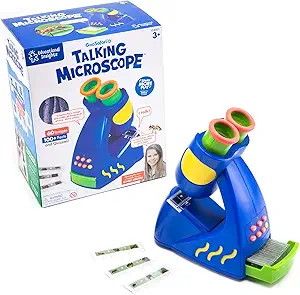 | Best for Preschool Science Learning | Recommended age: 3–5 years | Prepared slides: 20 | Images: 60 full-color images | VIEW LATEST PRICE | See Our Full Breakdown |
| National Geographic Kids Microscope Kit, Up to 400x Magnification |  | Best for Guided First Experiments | Maximum magnification: 400x | Magnification levels: 3 | Lighting: Upper and lower lights | VIEW LATEST PRICE | See Our Full Breakdown |
| Kids Digital Microscope STEM Toy Kit |  | Best Compact Kit for Saving Observations | Magnification: 200×–1000×, five levels | Storage: 32GB memory card | Prepared slides: 5 real glass specimens | VIEW LATEST PRICE | See Our Full Breakdown |
| Compound Microscope for Kids and Beginners, 40X–1000X with 52-Piece Educational Kit |  | Best for Home Biology Experiments | Magnification: 40X–1000X | Illumination: Dual LED, top and bottom | Filters: 6 color filters | VIEW LATEST PRICE | See Our Full Breakdown |
| National Geographic Junior Microscope Science Kit, 50x–250x Magnification |  | Best for Guided First Experiments | Magnification: 50x–250x | Slides: 6 prepared and 6 blank | Lighting: Lights above and below | VIEW LATEST PRICE | See Our Full Breakdown |
| BMDSAE 1000X Handheld Digital Microscope for Kids with 2.0-Inch IPS Screen |  | Best for Saving and Sharing Discoveries | Magnification: Up to 1000X | Display: 2.0-inch IPS | Camera: 2MP | VIEW LATEST PRICE | See Our Full Breakdown |
| Mileonaim Kids Microscope Kit, 61-Piece Set with Slides and Carrying Case |  | Best for Hands-On Slide Variety | Magnification: 100X, 400X, and 1200X | Set size: 61 pieces | Prepared slides: 12 | VIEW LATEST PRICE | See Our Full Breakdown |
| Pozifu Handheld Digital Microscope for Kids, 50x–1000x Magnification |  | Best for Protected Outdoor Use | Magnification: 50x–1000x | Display: 2.0-inch IPS | Camera: 2MP, 1080P | VIEW LATEST PRICE | See Our Full Breakdown |
| Kids Digital Microscope with 1000x Magnification and 2.4-Inch Screen |  | Best for a Larger Built-In Display | Magnification: Up to 1000x | Display: 2.4-inch IPS color screen | Image resolution: 1920 × 1080P | VIEW LATEST PRICE | See Our Full Breakdown |
| Little World Kids Microscope with LED Light, 100x/400x/1200x Magnification |  | Best for Hands-On Starter Kits | Magnification: 100x, 400x, 1200x | Viewing head: Monocular | Light source: LED | VIEW LATEST PRICE | See Our Full Breakdown |
| TOMLOV DM301K Kids Microscope, 640x, with Prepared Slides and Phone Adapter |  | Best for Shared Viewing | Model: DM301K | Magnification: 640x | Lighting: Dual LED lights | VIEW LATEST PRICE | See Our Full Breakdown |
| Odatay 4K Digital Microscope for Kids, 200–1000x Magnification, 32GB Card, 2.4-inch Screen, Blue |  | Best for Recording Discoveries | Magnification: 200–1000x, 4 levels | Camera: 4K HD | Screen: 2.4 in | VIEW LATEST PRICE | See Our Full Breakdown |
| ASPOVEN 4K Handheld Digital Microscope, 200–1000x Magnification, 2.0-Inch IPS Screen, Blue |  | Best for Lightweight Field Use | Magnification: 200–1000x | Camera: 4K HD | Screen: 2.0-inch IPS | VIEW LATEST PRICE | See Our Full Breakdown |
| Uarzt 58-Piece Kids Microscope Kit, 100X–1200X Magnification |  | Best for Slide Preparation | Pieces: 58 | Magnification: 100X–1200X | Microscope dimensions: 4.6 × 2.75 × 8.15 in | VIEW LATEST PRICE | See Our Full Breakdown |
| educational microscopes for kid | Magnification | Lighting |
|---|---|---|
| BEAVERLAB 4.0-Inch Handheld Di | 100x–1600x | 8 adjustable lights |
| Educational Insights GeoSafari | — | — |
| National Geographic Kids Micro | — | Upper and lower lights |
| Kids Digital Microscope STEM T | 200×–1000×, five levels | — |
| Compound Microscope for Kids a | 40X–1000X | — |
| National Geographic Junior Mic | 50x–250x | Lights above and below |
| BMDSAE 1000X Handheld Digital | Up to 1000X | 8 adjustable LEDs with 3 brightness modes |
| Mileonaim Kids Microscope Kit | 100X, 400X, and 1200X | LED |
| Pozifu Handheld Digital Micros | 50x–1000x | 8 adjustable LED lights |
| Kids Digital Microscope with 1 | Up to 1000x | 8 adjustable LED lights |
| Little World Kids Microscope w | 100x, 400x, 1200x | — |
| TOMLOV DM301K Kids Microscope | 640x | Dual LED lights |
| Odatay 4K Digital Microscope f | 200–1000x, 4 levels | 8 built-in LEDs; 3 brightness levels |
| ASPOVEN 4K Handheld Digital Mi | 200–1000x | 8 built-in LEDs; 3 brightness levels |
| Uarzt 58-Piece Kids Microscope | 100X–1200X | — |
More Details on Our Top Picks
BEAVERLAB 4.0-Inch Handheld Digital Microscope for Kids
The 4.0-inch IPS display gives kids a larger view of specimens than the small screens on handheld options such as the BMDSAE 1000X. Its portable form and adjustable magnification make it suited to moving between a leaf, fabric, or coin without setting up a full tabletop microscope. The 1080p photo and video capture and built-in hotspot also let children save observations and share them to a phone, adding a useful record-making activity to exploration. Compared with the National Geographic Kids Microscope Kit, this model favors portability and screen-based viewing over prepared slides and a guided activity set. That tradeoff matters for first-time users who benefit from structured experiments. The description does not specify battery life or included accessories, so buyers should expect to supply their own exploration materials.
Pros:- Large 4.0-inch IPS screen makes viewing easier to share
- Portable handheld design suits exploration away from a desk
- 1080p photo and video capture records observations
- Built-in hotspot supports sharing images to a mobile phone
Cons:- Battery life is not specified
- Included slides and other accessories are not specified
Best for: Families who want children to inspect everyday objects outdoors and save or share what they see
Not ideal for: Beginners who need prepared specimens and step-by-step activities included in the kit
- Display:4.0-inch IPS
- Magnification:100x–1600x
- Image resolution:1920 × 1080
- Camera sensor:2 MP CMOS
- Lighting:8 adjustable lights
- Connectivity:Built-in hotspot
- Form factor:Portable handheld microscope
Our verdict“Choose this for portable, screen-based exploration and image sharing; choose the National Geographic Kids kit for included specimens and guided activities.”
Educational Insights GeoSafari Talking Microscope
For preschoolers, this microscope makes learning approachable through 20 prepared slides, 60 colorful images, and spoken facts and quiz questions. Fact and Quiz modes give a young child something to do with each image, while four audio languages can make it useful in multilingual households. Compared with the National Geographic Kids Microscope Kit, the GeoSafari is built around guided content for ages 3–5 rather than focusing on hands-on slide preparation and higher magnification. That makes it a better fit for children not yet ready to manage small specimens and focus adjustments, but a less natural choice for families seeking open-ended observation. It is a learning toy rather than a traditional microscope for examining newly collected samples. The three AAA batteries are not included, so the audio experience requires a separate purchase before play.
Pros:- Prepared slides offer 60 full-color images to explore
- Fact and Quiz modes pair viewing with active learning
- Over 100 spoken facts and questions provide guided content
- Audio is available in English, Spanish, French, and German
Cons:- Requires three AAA batteries, which are not included
- Prepared-image play offers less open-ended specimen work than the National Geographic Kids kit
Best for: Families with preschoolers who learn well from short, guided audio activities and colorful prepared images
Not ideal for: Older children who want to prepare their own slides or inspect real specimens through a conventional microscope
- Recommended age:3–5 years
- Prepared slides:20
- Images:60 full-color images
- Play modes:Fact Mode and Quiz Mode
- Audio content:Over 100 facts and quiz questions
- Voice:Bindi Irwin
- Languages:English, Spanish, French, and German
- Batteries:3 AAA batteries, not included
Our verdict“Pick the GeoSafari for preschoolers who need guided, multilingual science play; choose a conventional kit for hands-on slide experiments.”
National Geographic Kids Microscope Kit, Up to 400x Magnification
This kit earns its place for children ready to move from looking at prepared images to doing simple microscope activities. Its three magnification levels, large focus knobs, and soft-touch eyepiece keep the basic controls approachable, while upper and lower lights help illuminate different kinds of samples. The set includes prepared plant slides, rocks and minerals, blank slides, and tools, so a child can start with supplied material and then try making observations of their own. Compared with the Educational Insights GeoSafari Talking Microscope, it offers more hands-on experimentation and less narrated guidance. It also tops out at 400x, well below the claimed ranges of the handheld BEAVERLAB and the 52-piece compound microscope. That lower ceiling suits beginner activities, but children seeking extended magnification options may outgrow it sooner.
Pros:- Three levels and large focus knobs simplify basic operation
- Upper and lower lights support a range of specimens
- Includes prepared plant slides, rocks, and minerals
- Blank slides and experiment tools encourage hands-on activities
Cons:- Maximum magnification is 400x, below the 1000x options in this roundup
- Designed for children and beginner use rather than more advanced microscopy
Best for: School-age beginners who want guided specimen activities and the tools to try making their own slides
Not ideal for: Children looking for a digital screen, photo capture, or a broader magnification range for more advanced experiments
- Maximum magnification:400x
- Magnification levels:3
- Lighting:Upper and lower lights
- Included specimens:6 prepared plant slides and 6 rocks and minerals
- Slides:6 blank slides
- Accessories:Pipette, specimen dish, tweezers, lab guide, and merit badge stickers
Our verdict“Choose this kit for structured first experiments with supplied specimens; choose a higher-range compound model if magnification headroom matters more.”
Kids Digital Microscope STEM Toy Kit
At 0.34 lb, this rechargeable handheld microscope is easy for a child to carry between rooms or take along on a family outing. A 32GB memory card and five glass specimens mean there is room to record observations and something to view right away. The fitted case and neck strap add practical protection and carrying options, details that give this set a more complete portable package than the BEAVERLAB, whose supplied accessories are not specified. Its five magnification levels cover 200×–1000×, though the BEAVERLAB claims a wider range and has a larger 4.0-inch display. This kit’s clearest limitation is its approximately 2.5-hour battery life, alongside manual focus adjustments that may slow younger users down. It suits short observation sessions better than all-day field use.
Pros:- Light 0.34 lb design is easy to carry
- 32GB memory card provides storage for photos and videos
- Five glass specimens are included for getting started
- Fitted EVA case and neck strap support transport
Cons:- Approximately 2.5 hours of use per charge limits longer outings
- Manual focus adjustments may frustrate younger children
Best for: Families seeking a lightweight digital microscope with storage, starter slides, and a carrying case
Not ideal for: Children who need long continuous sessions or a microscope with simpler, less hands-on focusing
- Magnification:200×–1000×, five levels
- Storage:32GB memory card
- Prepared slides:5 real glass specimens
- Weight:0.34 lb
- Battery life:Approximately 2.5 hours
- Charging:Type-C cable
- Included accessories:EVA case, neck strap, and user manual
Our verdict“Pick this for a light, well-equipped portable kit and saved observations; choose the BEAVERLAB for a larger display and broader stated magnification range.”
Compound Microscope for Kids and Beginners, 40X–1000X with 52-Piece Educational Kit
For children who want a traditional microscope and a broad range for biology activities, this 40X–1000X compound model combines dual LED illumination with a rotatable head and a 52-piece kit. Top and bottom lights let a young scientist switch between opaque objects and translucent slide specimens, while the six color filters add another way to vary what they observe. Compared with the National Geographic Kids Microscope Kit, it offers a higher stated maximum magnification and more tools, which may suit a child ready for repeated experiments at home or school. The National Geographic kit, however, provides a specified lab guide and named specimens, making its starting activities clearer. This model’s metal frame is a practical feature, but the product data does not establish how easy its controls are for younger children. Batteries are not included.
Pros:- 40X–1000X range supports varied biology observations
- Dual top and bottom LED lighting suits opaque and translucent specimens
- 52-piece kit includes prepared and blank slides plus tools
- Rotatable head and six color filters add viewing flexibility
Cons:- Batteries are not included
- Product details do not specify a lab guide or the identities of included specimens
Best for: Families or classrooms seeking a traditional compound microscope for repeated slide-based biology activities
Not ideal for: Young children who need a clearly guided starter set or families who prefer a screen-based portable microscope
- Magnification:40X–1000X
- Illumination:Dual LED, top and bottom
- Filters:6 color filters
- Included accessories:52-piece kit with prepared slides, blank slides, and tools
- Frame:Metal
- Head:Rotatable
- Batteries:Not included
Our verdict“Choose this for a traditional, broadly equipped home or classroom microscope; choose the National Geographic kit for more clearly described beginner activities.”
National Geographic Junior Microscope Science Kit, 50x–250x Magnification
The National Geographic Junior Microscope is the most lesson-oriented pick in this batch: its adjustable focus and specimen platform pair with a lab guide, prepared slides, and tools to give beginners a clear first path from setup to observation. Lights above and below help with different kinds of specimens, while the 50x–250x range keeps the controls approachable for a child learning how focus and magnification work. Compared with the Mileonaim kit, it offers fewer magnification steps and a smaller slide collection, but its guide makes the activities feel more directed. The tradeoff is a lower ceiling for children who want to pursue detailed microscopy; this is an introductory learning set, not a choice for advanced users.
Pros:- Lab guide introduces cells and microorganisms through structured activities.
- Adjustable focus and specimen platform give children practice with basic microscope controls.
- Lights above and below support viewing different types of specimens.
- Includes prepared and blank slides, tweezers, and a pipette for hands-on exploration.
Cons:- 50x–250x magnification offers less range than the Mileonaim kit’s listed settings.
- Beginner-focused controls and magnification may limit longer-term use for advanced learners.
Best for: Children new to microscopy who benefit from guided activities, prepared samples, and simple specimen tools.
Not ideal for: Older children seeking high magnification or a microscope they can grow into for more advanced observation.
- Magnification:50x–250x
- Slides:6 prepared and 6 blank
- Lighting:Lights above and below
- Included tools:Tweezers and pipette
- Other included items:6 slide covers, instructions, lab guide, and sticker sheet
- Model:RTMICROJR
- Brand:Blue Marble
Our verdict“Choose this kit for a child’s first guided microscope activities; pick the Mileonaim set if broader magnification options matter more.”
BMDSAE 1000X Handheld Digital Microscope for Kids with 2.0-Inch IPS Screen
The BMDSAE handheld digital microscope suits children who want to keep a record of what they find: its 2MP camera and photo and video storage let them revisit observations or transfer files to a Windows or Mac computer. A built-in 2.0-inch IPS screen makes viewing self-contained, and eight adjustable LEDs help adapt the light to the object. Compared with the Pozifu handheld, the BMDSAE listing specifies internal 32M storage and support for 200 or more photos or AVI videos; the Pozifu instead lists 1080P video and a protective case. The tradeoff is a short battery life of up to two hours, and children may need help with manual focus. Its 1000X claim also does not make it a substitute for a guided slide-based compound microscope.
Pros:- Built-in screen supports viewing without a separate phone or computer.
- Can save photos and AVI videos for later review or USB transfer.
- Eight adjustable LEDs with three brightness modes help adapt illumination.
- Includes a carry lanyard and a one-year warranty.
Cons:- Battery lasts up to two hours per charge.
- Manual focusing may take practice and adult help for younger children.
- Handheld digital format is less suited to guided slide-based lessons than the National Geographic Junior kit.
Best for: Families who want a portable microscope that lets children capture observations and move them to a computer.
Not ideal for: Young children who need automatic focusing or learners who want guided slide experiments and a conventional microscope setup.
- Magnification:Up to 1000X
- Display:2.0-inch IPS
- Camera:2MP
- Lighting:8 adjustable LEDs with 3 brightness modes
- Battery:600mAh; up to 2 hours
- Storage:32M; supports 200+ photos or AVI videos
- Included items:Microscope, instruction manual, lanyard, and USB-C data cable
- Warranty:1 year
Our verdict“Pick this for portable, recordable discoveries, provided the child can manage manual focus and short sessions.”
Mileonaim Kids Microscope Kit, 61-Piece Set with Slides and Carrying Case
The Mileonaim 61-piece kit is the broadest hands-on slide set here, combining three listed magnification levels with 12 prepared slides, 32 blank plastic slides, and basic specimen tools. That gives a school-age child room to move from ready-made examples to collecting and preparing observations at home or on the go. Its carrying case adds practical organization that the National Geographic Junior kit does not list, while the Junior’s lab guide offers more explicit instruction for a first-time learner. The tradeoff is that Mileonaim’s description does not provide dimensions or weight, so portability is suggested by the case rather than quantified. The blank slides are plastic, and the supplied details do not establish image quality at the highest magnification settings.
Pros:- Three magnification settings support varied exploration.
- Includes 12 prepared slides and 32 blank plastic slides.
- Tweezers, dropper, scalpel, and mixing plate support hands-on sample preparation.
- Carrying case keeps the kit together for storage or travel.
Cons:- Blank slides are plastic rather than glass.
- Microscope dimensions and weight are not specified.
- Compared with the National Geographic Junior kit, the listing does not specify a lab guide.
Best for: Children ages 6–12 who want to alternate between prepared samples and their own slide experiments.
Not ideal for: Families prioritizing a detailed lesson guide, glass blank slides, or clear information about the microscope’s size and weight.
- Magnification:100X, 400X, and 1200X
- Set size:61 pieces
- Prepared slides:12
- Blank slides:32 plastic slides
- Lighting:LED
- Included tools:Tweezers, dropper, scalpel, and mixing plate
- Carrying case:ABS
- Recommended age:6–12 years
- Warranty:2 years
Our verdict“Choose Mileonaim for a school-age child who wants many slides and tools, and look elsewhere if structured lessons are the priority.”
Pozifu Handheld Digital Microscope for Kids, 50x–1000x Magnification
The Pozifu handheld microscope is aimed at children who want a digital viewer they can take outside: it pairs a 2-inch IPS screen and adjustable LEDs with a lanyard and protective case. Photo and video capture, USB connection, and a rechargeable battery add ways to keep and share observations. Compared with the BMDSAE, it lists a broader 50x–1000x range and a protective case, while the BMDSAE specifies 32M storage and a one-year warranty. A key tradeoff is that Pozifu’s TF card is not included, and the listing says storage for up to 200 pictures without clarifying the card arrangement. Its handheld format is convenient for examining objects, but offers fewer guided slide activities than the National Geographic Junior kit.
Pros:- Adjustable 50x–1000x magnification and LED lighting support varied close-up viewing.
- Captures photos and videos and connects to a PC over USB.
- Lanyard and protective case suit portable use.
- Rechargeable 600mAh battery with Type-C charging.
Cons:- TF memory card is not included.
- Warranty is 180 days, shorter than the BMDSAE’s listed one-year warranty.
- Handheld digital format lacks the prepared slides and lab guide included with the National Geographic Junior kit.
Best for: Families seeking a portable digital microscope for children ages 3–12 to inspect objects and save observations.
Not ideal for: Buyers who want included prepared slides, an explicit battery runtime, or video storage ready to use without adding a TF card.
- Magnification:50x–1000x
- Display:2.0-inch IPS
- Camera:2MP, 1080P
- Lighting:8 adjustable LED lights
- Photo storage:Up to 200 pictures
- Memory card:TF card not included
- Battery and charging:600mAh rechargeable; Type-C
- Recommended age:3–12 years
- Warranty:180 days
Our verdict“Choose Pozifu for portable digital viewing with a protective case, if you are comfortable supplying a TF card for storage needs.”
Kids Digital Microscope with 1000x Magnification and 2.4-Inch Screen
This kids digital microscope makes the screen the main draw: its 2.4-inch IPS display is larger than the 2.0-inch screens on the BMDSAE and Pozifu handhelds, giving children more room to inspect an image without connecting another device. It stores up to 200 JPG photos internally, so basic photo capture does not depend on a separate card; a TF card is needed for 1080P video, though, and is not included. At 150 g with listed dimensions of 4.13 × 3.74 × 2.6 inches, it is a portable option for indoor or outdoor viewing. The tradeoff is a battery runtime of up to two hours, similar to the BMDSAE, while neither the 1000x claim nor the screen replaces guided specimen work with slides.
Pros:- 2.4-inch IPS screen is larger than the listed 2.0-inch screens on the BMDSAE and Pozifu.
- Stores up to 200 JPG photos internally without a TF card.
- 1080P video recording and support for TF cards up to 64 GB.
- Lightweight 150 g body with listed dimensions and Type-C charging.
Cons:- TF card is not included and is required for video recording.
- Battery life is up to two hours, with a listed two-hour charging time.
- Does not include prepared slides or a lab guide like the National Geographic Junior kit.
Best for: Children ages 4–12 who want a portable digital viewer with a larger screen and internal photo storage.
Not ideal for: Families who expect video recording to work out of the box or need longer sessions between charges.
- Magnification:Up to 1000x
- Display:2.4-inch IPS color screen
- Image resolution:1920 × 1080P
- Lighting:8 adjustable LED lights
- Dimensions:4.13 × 3.74 × 2.6 in
- Weight:150 g (0.34 lb)
- Photo and video:Up to 200 JPG photos internally; 1080P AVI at 30 fps with TF card
- Battery:600 mAh; up to 2 hours
- Recommended age:4–12 years
Our verdict“Pick this model if a larger screen and ready-to-use photo storage matter more than included slide lessons or long battery life.”
Little World Kids Microscope with LED Light, 100x/400x/1200x Magnification
Little World pairs three magnification settings with a useful set of beginner tools, giving children several ways to handle specimens instead of just looking through the eyepiece. Slides, collecting bottles, tweezers, labels, and plastic specimens support simple activities at home or in a classroom. Its small, light plastic body is easy for a child to carry, though it is less substantial than a more feature-rich kit such as the Uarzt 58-Piece Kids Microscope Kit. The stated 1200x ceiling offers range on paper, but this remains a basic monocular instrument for introductory exploration. Families should also have two AA batteries ready, since they are not included. This is a good fit when the goal is accessible, tactile discovery; choose a digital model such as the Odatay 4K Digital Microscope if sharing photos and video matters more.
Pros:- Three magnification settings provide room to explore different specimens.
- LED illumination helps light samples during viewing.
- Includes slides, collecting bottles, tweezers, labels, and plastic specimens.
- Lightweight size is manageable for young children.
Cons:- Plastic construction may feel less durable than a more substantial kit.
- Two AA batteries are required and not included.
- Monocular viewing offers no built-in way to share or record observations.
Best for: Families with children ages 5–12 who want a compact first microscope and simple tools for collecting and handling specimens.
Not ideal for: Buyers seeking a sturdier build, advanced microscopy, or a screen for group viewing and saving observations.
- Magnification:100x, 400x, 1200x
- Viewing head:Monocular
- Light source:LED
- Power:2 AA batteries, not included
- Dimensions:4.7 × 2.9 × 8.8 in
- Weight:335 g
- Included items:5 slides, 2 collecting bottles, tweezers, labels, plastic container, 12 plastic specimens
- Recommended age:5–12 years
- Warranty:1 year
Our verdict“Choose Little World for a lightweight, hands-on first kit, and pick the Uarzt if a larger selection of slides and tools matters more.”
TOMLOV DM301K Kids Microscope, 640x, with Prepared Slides and Phone Adapter
The TOMLOV DM301K makes sharing observations its main advantage: a phone adapter lets a child show a specimen to family or classmates, while dual LEDs support both prepared transparent slides and opaque everyday objects. Its focus dial and rechargeable battery also make it a simpler, more self-contained starting point than the Little World Kids Microscope, which needs separate AA batteries and relies on direct eyepiece viewing. The tradeoff is a narrower learning path: the listed 640x magnification and beginner-focused design suit guided exploration, not children ready for more advanced microscopy. Its 12 prepared plastic slides provide an immediate activity, though they offer less open-ended slide preparation than the Uarzt 58-Piece Kids Microscope Kit. Pick this model when ease of use and showing discoveries on a phone matter more than a broad lab-tool assortment.
Pros:- Dual LEDs support viewing transparent slides and opaque objects.
- Focus dial is designed for straightforward beginner adjustment.
- Rechargeable battery offers up to 24 hours of runtime.
- Phone adapter makes observations easier to share.
Cons:- 640x magnification and beginner design limit its appeal for advanced microscopy.
- The 12 included prepared slides are plastic.
- The listed accessory set is less extensive than the Uarzt kit’s 58 pieces.
Best for: Children ages 6–12 who want a rechargeable beginner microscope and families or classrooms that want to share views through a phone.
Not ideal for: Young microscopists who want to prepare many of their own slides or need an instrument for advanced microscopy.
- Model:DM301K
- Magnification:640x
- Lighting:Dual LED lights
- Battery:Rechargeable; up to 24 hours of runtime
- Recommended age:6–12 years
- Prepared slides:12 plastic slides
- Phone adapter:Included
- Unit count:1
Our verdict“Choose the TOMLOV for beginner-friendly, shareable viewing, especially if phone display matters more than a large hands-on kit.”
Odatay 4K Digital Microscope for Kids, 200–1000x Magnification, 32GB Card, 2.4-inch Screen, Blue
Odatay is the documentation-focused choice in this group: its 4K camera, photo and video capture, and included 32GB card let children save observations for projects or revisit them later. The 2.4-inch screen also gives siblings a shared view without requiring a phone adapter, unlike the TOMLOV DM301K. Four magnification levels, adjustable brightness, and a long-distance viewing option add flexibility for close-up exploration, while the lanyard and tripod hole support portable use. Those digital features come with a clear compromise: the built-in display is small, so it is better for quick inspection than extended group viewing. At 0.5 lb, it is easy to carry, but children seeking traditional slide-by-slide microscope practice may prefer the Uarzt 58-Piece Kids Microscope Kit and its larger hands-on supply set.
Pros:- 4K camera captures photos and videos of observations.
- Included 32GB TF card provides storage without a separate purchase.
- Four magnification levels and three brightness settings offer viewing flexibility.
- Portable design includes a lanyard and tripod hole.
Cons:- The 2.4-inch screen is small for group viewing.
- Digital operation may offer less practice with traditional eyepiece microscopy.
- Age recommendations vary across the product text.
Best for: Families and teachers who want children to photograph or record observations and use them in projects.
Not ideal for: Buyers who prefer a traditional eyepiece microscope, a larger viewing display, or extensive lab tools for preparing slides.
- Magnification:200–1000x, 4 levels
- Camera:4K HD
- Screen:2.4 in
- Lighting:8 built-in LEDs; 3 brightness levels
- Storage:32GB TF card included
- Weight:0.5 lb
- Connectivity:PC connection for file transfer
- Included accessories:12 prepared slides, data cable, lanyard, slide viewing cover, silicone screen case
- Warranty:5 years
Our verdict“Choose Odatay when saving and sharing microscope observations is a priority and a compact screen is acceptable.”
ASPOVEN 4K Handheld Digital Microscope, 200–1000x Magnification, 2.0-Inch IPS Screen, Blue
ASPOVEN keeps the digital microscope format simple and portable, with a 0.5 lb body, neck strap, adjustable LEDs, and PC connection for transferring files or using a larger display. Like the Odatay 4K Digital Microscope, it offers 200–1000x magnification and 4K image capture; Odatay has the larger 2.4-inch screen and a specified 32GB card, while ASPOVEN’s 2.0-inch IPS display is more compact. That difference matters when children want to show a find outdoors: this screen is handy for a quick check, but cramped for several viewers. PC connectivity can help at home, though it is less convenient away from a computer. The product information also does not specify the complete kit contents, making it harder to plan activities than with the slide-equipped Odatay or the Uarzt 58-Piece Kit.
Pros:- Lightweight 0.5 lb design suits portable use.
- Neck strap supports carrying during outdoor exploration.
- Adjustable LED brightness helps adapt lighting to specimens.
- PC connection supports file transfer and extended viewing.
Cons:- The 2.0-inch screen is small for shared viewing.
- Complete kit contents are not specified.
- PC connection is less convenient for viewing away from a computer.
Best for: Families who want a lightweight digital microscope for outdoor walks and occasional PC viewing.
Not ideal for: Buyers who need a clearly specified starter kit, larger on-device screen, or a generous set of included slides and tools.
- Magnification:200–1000x
- Camera:4K HD
- Screen:2.0-inch IPS
- Lighting:8 built-in LEDs; 3 brightness levels
- Weight:0.5 lb
- Connectivity:PC connection for file transfer or extended use
- Charging:Type-C charging cable
- Warranty:2 years
- Color:Blue
Our verdict“Choose ASPOVEN for lightweight digital exploration on the move, provided you are comfortable with a small screen and unspecified kit contents.”
Uarzt 58-Piece Kids Microscope Kit, 100X–1200X Magnification
Uarzt puts the emphasis on doing the work of a beginner microscopist: 31 blank slides, 13 prepared specimens, lab tools, a guide, and a carrying box give children plenty to handle and compare. That breadth makes it more activity-oriented than the Little World Kids Microscope, whose smaller assortment includes collecting bottles and plastic specimens, and more suitable for repeated slide practice than digital models such as the Odatay 4K Digital Microscope. Its 100X–1200X range is aimed at introductory exploration; the stated magnification alone does not make it an advanced instrument. The kit’s likely appeal is variety and guided hands-on learning, with the tradeoff that children must work at the eyepiece rather than capture images on a screen. Two AA batteries are not included, so families need to supply them before the LED light can be used.
Pros:- 31 blank slides invite children to prepare their own samples.
- 13 prepared specimens provide ready-to-view starting points.
- Lab tools and a learning guide support structured activities.
- Carrying box keeps the kit together between sessions.
Cons:- Two AA batteries are required and not included.
- Beginner-focused design is not intended for advanced microscopy.
- No screen or image capture is listed for sharing observations.
Best for: Families and educators who want a broad set of slides and tools for guided beginner microscopy activities.
Not ideal for: Children who want a digital screen for sharing or recording, or buyers seeking advanced microscope performance.
- Pieces:58
- Magnification:100X–1200X
- Microscope dimensions:4.6 × 2.75 × 8.15 in
- Prepared specimens:13
- Blank slides:31
- Power:2 AA batteries, not included
- Included materials:Lab tools, learning guide, carrying box
- Manufacturer part number:C2171_1A
Our verdict“Choose Uarzt for a slide-centered learning kit with many practice materials, and choose Odatay if digital recording is more important.”
How We Picked
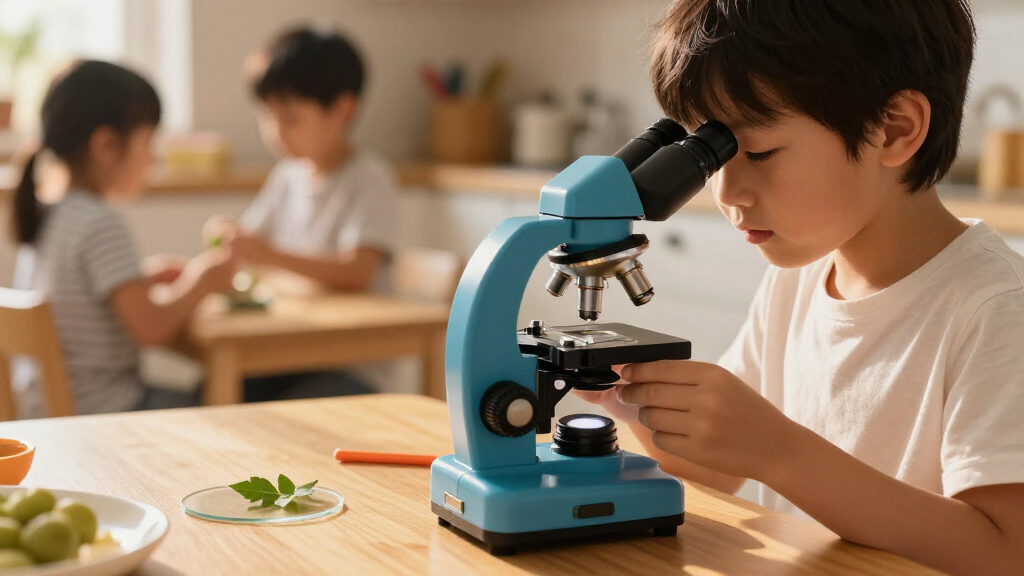
I compared these microscopes as learning tools for children, looking at how each supports a first successful observation, how much adult setup it may require, and whether its viewing method suits solo or shared exploration. I also weighed the clarity of the product information, the usefulness of included slides and accessories, screen size or phone connectivity where listed, and the practical difference between tabletop compound models and handheld digital viewers.
The ranking favors a balanced learning experience over the largest magnification claim or the longest accessory list. Models with clear educational support and a straightforward path from setup to observation rank ahead of options whose listings emphasize numbers without explaining the learning experience. Digital features earn credit when they help children view, share, or save observations, while kit contents matter most when they support repeated exploration. Product details vary by listing, so I call out uncertainty where specifications alone do not establish real-world image quality or age fit.
Factors to Consider When Choosing Educational Microscopes For Kids
Before choosing a microscope, decide what you want the child to do with it week after week. These broader tradeoffs can help you avoid buying around a headline specification that does not match your household.
Choose the viewing style before the magnification
A tabletop compound microscope and a handheld digital microscope create different learning routines. Compound models ask children to position a slide, adjust lighting, and focus through an eyepiece, which can build patience and careful observation. Handheld viewers can be easier to point at larger objects and show the image on a screen, making them convenient for siblings or a parent to see together. A screen does not automatically make a device easier: children still need a steady hand and a useful subject distance. Think about whether your child wants to inspect prepared slides or explore objects around the house. Picking the viewing style first makes magnification comparisons more meaningful.
Treat magnification claims as one clue
Large magnification figures can sound decisive, but the number by itself does not tell you how sharp, bright, or usable the image will be. Ask whether the listed range describes optical magnification, digital enlargement, or a combination, especially for screen-based products. For a young beginner, a stable image at a modest setting can be more satisfying than a difficult high setting. More power can also narrow the visible area, so finding and focusing on a specimen may take longer. Look for product information about focus controls, illumination, and the intended specimen types. If those details are missing, keep expectations modest rather than choosing by the biggest number.
Match setup demands to the child’s age and patience
A microscope can be educational and still require adult help at first. Small slides, focus wheels, detachable parts, and delicate samples may frustrate a child who wants immediate results. Younger children often benefit from a simple first activity and a grown-up nearby to demonstrate safe handling. Older children may enjoy the challenge of preparing a slide and recording observations independently. Check the manufacturer’s age guidance and consider who will help with setup, cleanup, and storage. A slightly simpler instrument that gets used often can teach more than a feature-rich kit that stays packed away.
Inspect the kit contents, not just the piece count
Large accessory counts can include useful slides, tools, containers, and carrying cases, but they can also include small items that rarely leave the box. Look for details about prepared slides, blank slides, specimen tools, and instructions, then ask which of those match your child’s interests. Prepared slides can produce a quick first success; blank slides support more open-ended experiments but may require adult guidance. A case helps keep small parts together and makes a kit easier to bring out for an activity. Avoid assuming that more accessories mean better teaching support. Clear instructions and a few relevant materials often matter more than a high total count.
Decide whether sharing and saving images matter
A built-in screen, phone adapter, or memory card is useful when a child wants to show an observation to someone else or revisit it later. A larger screen can make group viewing more comfortable, while a phone connection may help with sharing or documenting work. Storage can be helpful when the microscope supports image capture and the child wants to build a record of discoveries. These features add controls, charging, and file management to the activity, so they may be unnecessary for a child mainly learning to focus through an eyepiece. Check what is included and how images transfer before counting connectivity as a benefit. Choose digital extras for a real use in your household, not just because they appear on the feature list.
Plan for care and repeat use
Microscope use depends on small parts staying organized and optical surfaces staying clean. Before buying, consider where the instrument will live, whether its case or stand fits that space, and whether an adult can help with cleanup. Slides and accessories can turn a first observation into a continuing hobby, but only if replacement or additional materials are practical to find. Digital models also bring battery charging and screen care into the routine. Ask what activity the child can try after the included samples are used. A microscope with a clear next step is more likely to remain useful beyond its first afternoon.
Frequently Asked Questions
Should I choose a digital screen microscope or a traditional compound microscope for a first-time learner?
Choose based on the activity you want to encourage. A compound microscope supports hands-on work with slides, focusing, and specimen preparation, while a digital screen model can make shared viewing and image capture easier. If the child gets frustrated looking through an eyepiece, a screen may help them stay engaged. If they are curious about how samples are prepared and want to work independently, a traditional kit may offer a stronger learning routine. Adult help and the child’s patience with setup should guide the decision as much as age.
Does a 1000x or 1200x label mean a microscope is better for a child?
No. A high stated magnification does not by itself establish image clarity, useful lighting, or ease of focusing. On digital models, check whether the claim includes screen enlargement rather than only optical magnification. A narrower field of view at high settings can make it harder to locate a sample, which may be discouraging for beginners. Clear controls, stable viewing, and suitable slides can matter more for learning than the maximum number printed in a listing.
Are prepared slides worth prioritizing in a kids’ microscope kit?
Prepared slides can be valuable when a child needs a quick, guided first observation because the sample is already in place. They reduce one setup step and help demonstrate how focus and illumination affect what appears. Blank slides are better for open-ended exploration, though children may need help choosing and preparing specimens. A mix can support both early success and later experimentation. Check whether the kit identifies its slides and includes instructions that make them useful.
What should I check before buying a handheld microscope for use away from a desk?
Look beyond portability and check screen size, how the device is held, its lighting, and how images are focused. A handheld model may be convenient for exploring larger objects, but keeping it steady can be difficult for younger children. Ask whether it needs charging and whether image storage or a memory card is included if saving observations matters. Also consider where the child will set it down while examining a specimen. A handheld device works best when its portability matches a real activity, such as exploring leaves or household materials with an adult.
When should I pay more for a microscope with a screen, phone adapter, or image storage?
Those features are most useful when the child wants to share discoveries, make a visual record, or view samples with other people. A built-in screen can reduce the need to take turns at an eyepiece, while a phone adapter may connect observations to a school project. Storage helps when image capture is supported and files can be retrieved without fuss. If the main goal is learning basic slide viewing, the added digital functions may not improve the core activity. Consider the child’s likely routine and the setup needed to use each feature before paying for it.
Conclusion
For a balanced starting point, I recommend the National Geographic Kids Microscope Kit as best overall because its up-to-400x range and traditional format suit hands-on exploration. For beginners who benefit from guided content, the Educational Insights GeoSafari Talking Microscope has a distinct educational angle; for a larger shared display, consider the BEAVERLAB 4.0-Inch Handheld Digital Microscope. The broader accessory sets from Mileonaim, Uarzt, and the 52-piece compound kit suit families who want multiple tools and slides to explore, though compare the listed contents rather than choosing by count alone. For image saving, the Odatay lists a 32GB card, while the TOMLOV DM301K includes prepared slides and a phone adapter. Choose the option whose setup, learning style, and sharing features fit the child who will use it.
Fall Picks
fall essentials
As an affiliate, we earn on qualifying purchases.