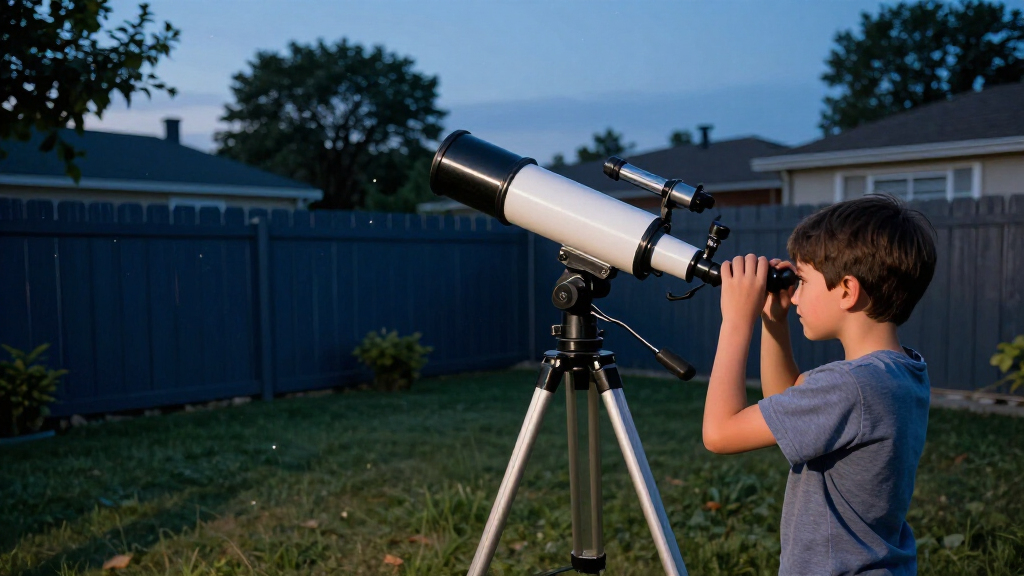

Choosing your first telescope comes down to one core tradeoff: aperture and stability versus portability and price. For most beginners, the MEEZAA 150EQ Newtonian Reflector is the best overall pick thanks to its large 150mm aperture and equatorial mount, which together reveal far more detail on planets and deep-sky objects than any small refractor here. If you want something grab-and-go, the Celestron Travel Scope 70 wins on portability, while the Celestron AstroMaster 130EQ offers serious light-gathering power at a mid-range price. Smaller 70mm and 80mm models are easier to carry but will show you less of the night sky. Read on for the full breakdown of all 15 models and which one fits your budget, patience, and observing goals.

Prime made for students and young adults
- Fast, free delivery for dorm and study essentials
- Prime Video and Amazon Music included
- Member-only deals
Key Takeaways
- Aperture was the single biggest differentiator in this lineup: the 150mm and 130mm reflectors (MEEZAA 150EQ, AstroMaster 130EQ) showed noticeably more planetary and deep-sky detail than every 70mm–90mm refractor.
- The 70mm models clustered at the bottom of the performance range — fine for the Moon and bright planets, but most buyers outgrow them within months, making the 80mm–90mm refractors a better long-term value despite the higher cost.
- Mount type mattered as much as optics: equatorial mounts (MEEZAA 150EQ, AstroMaster 130EQ) reward beginners willing to learn polar alignment, while alt-azimuth mounts on the Koolpte 90mm and AstroMaster 70AZ are far more intuitive on night one.
- Included accessories were a hidden differentiator — the EACONN 80mm and 90mm models bundled with phone adapters, tripods, and carrying cases delivered better out-of-box value than similarly priced bare kits.
- Portability came at a real optical cost: the Celestron Travel Scope 70 is the easiest model here to actually take places, but its views fall well short of the 800mm focal-length refractors from HUGERSTAR and MEEZAA.




| astronomy telescopes for beginner | Aperture | Eyepieces | Focal Length | Included Accessories |
|---|---|---|---|---|
| MEEZAA 150EQ Newtonian Reflect | 150mm | 25mm and 10mm | 650mm | 2X Barlow lens, red dot finderscope, moon filter, phone adapter, tripod, carry bag |
| 70mm Aperture Astronomical Ref | 70mm | 6mm and 20mm | 300mm | Phone adapter, wireless remote |
| Celestron AstroMaster 70AZ Ref | 70mm (2.8-inch) | — | — | — |
| EACONN 80mm Aperture | 80mm | K20mm and K9mm | 600mm | Adjustable tripod, smartphone adapter, backpack |
| Celestron Travel Scope 70 Port | 70mm | 20mm and 10mm | — | — |
| UncleHu 90mm Aperture 600mm Re | 90mm | 25mm and 10mm Kellner | 600mm | Folding stool, phone adapter, carry bag, 5×24 finder scope |
| NASA Lunar Telescope for Kids | — | Two included | — | — |
| MEEZAA 80mm Refractor Telescop | 80mm | 25mm and 10mm Kellner | 500mm | 3X Barlow lens, phone adapter, waterproof backpack |
| Celestron AstroMaster 130EQ Te | 130mm (5.1 inches) | — | — | — |
| Koolpte 90mm Refractor Telesco | — | K10mm and K25mm | 700mm | Carrying bag, phone adapter, wireless remote |
| 90mm Refractor Telescope with | 90mm | 25mm and 10mm | 600mm | Adjustable tripod, folding stool, carry bag, eyepieces, 3X Barlow, sticker sets |
| 70mm Refractor Telescope for B | 70mm | 20mm and 6mm | 300mm | Tripod, phone adapter, wireless camera remote, star chart |
| Gskyer 70mm Aperture Refractin | 70mm | 2 replaceable eyepieces | 400mm | Adjustable aluminum tripod, carry bag, smartphone adapter, wireless remote |
| HUGERSTAR 90mm Aperture | 90mm | 10mm and 25mm | 800mm | Phone adapter, moon filter, accessory tray, carrying bag |
| MEEZAA 90mm Aperture Refractor | 90mm | 10mm and 25mm | 800mm | Phone adapter, carry bag, paper manual |
More Details on Our Top Picks
MEEZAA 150EQ Newtonian Reflector Telescope with Equatorial Mount
Of everything in this lineup, this MEEZAA 150EQ gathers the most light by a wide margin, and that single fact explains why it sits at the top. A 150mm aperture pulls in roughly four times the light of the 70mm and 80mm refractors here, which is the difference between seeing the Moon and actually resolving detail in nebulae and star clusters. The German equatorial mount with slow-motion controls lets you track objects as Earth rotates — something the alt-azimuth mounts on the Celestron AstroMaster 70AZ and Travel Scope 70 force you to do by constantly nudging the tube. The tradeoff is real: learning an EQ mount takes an evening or two of patience, and a Newtonian reflector needs occasional collimation to stay sharp. Compared with the Celestron AstroMaster 130EQ, you get a larger aperture and a fuller accessory kit, including a Barlow, moon filter, and phone adapter, so nothing needs upgrading right away.
Pros:- 150mm aperture gathers far more light than any refractor in this lineup, revealing fainter deep-sky objects
- German equatorial mount with slow-motion controls tracks objects smoothly once aligned
- Complete accessory kit — Barlow, two eyepieces, moon filter, phone adapter — means no immediate extra purchases
- Tool-free assembly despite the larger optical design
Cons:- Manual equatorial mount requires learning polar alignment and patient tracking practice
- Newtonian optics need occasional collimation, which intimidates some first-time owners
- Bulkier and less portable than the backpack-friendly 70mm and 80mm refractors
Best for: Adult beginners and families who want a first telescope that stays satisfying for years and can handle faint deep-sky objects
Not ideal for: Young kids or casual users who want grab-and-go simplicity — the equatorial mount has a learning curve and the whole setup is heavier than any refractor here
- Type:Newtonian Reflector
- Aperture:150mm
- Focal Length:650mm
- Mount:German Equatorial with slow-motion controls
- Magnification Range:26X – 130X
- Eyepieces:25mm and 10mm
- Included Accessories:2X Barlow lens, red dot finderscope, moon filter, phone adapter, tripod, carry bag
Our verdict“Buy this if you’re committed to astronomy as a hobby rather than a one-night novelty — it’s the only option here that won’t feel outgrown within a year.”
70mm Aperture Astronomical Refracting Telescope for Kids and Adults (15X-150X)
Where most scopes in this roundup are built for adults who occasionally hand the eyepiece to a child, this one flips that order. The tool-free assembly is genuinely simple enough for an eight-year-old to manage, and the bundled wireless remote plus phone adapter lets kids capture lunar photos without touching — and shaking — the telescope. Compared with the Celestron Travel Scope 70, the same aperture size, you trade brand-name polish for a wider accessory loadout and a 3X Barlow that stretches the magnification ceiling. Be skeptical of that 150X maximum, though: a 70mm aperture with a 300mm focal length runs out of useful resolution well before that number, and pushing it just produces blurry images. The inverted finderscope image is another quirk that confuses first-timers until they adjust. Still, for a low-commitment family gift, it delivers where it counts.
Pros:- Tool-free setup that children can complete without adult help
- Wireless remote and phone adapter make lunar photography easy and shake-free
- Fully multi-coated optics deliver bright, low-glare views of the Moon
- Adjustable tripod works at kid and adult heights
Cons:- Finderscope shows an inverted image, which frustrates beginners learning to aim
- Short 300mm focal length limits high-power planetary detail despite the advertised 150X
Best for: Families buying for children aged 8-12 who want a first telescope with photography fun built in
Not ideal for: Adults focused on planetary detail — the short 300mm focal length and modest aperture cap out before serious observations of Mars or Saturn
- Type:Refractor
- Aperture:70mm
- Focal Length:300mm
- Magnification Range:15X – 150X
- Eyepieces:6mm and 20mm
- Barlow Lens:3X
- Finderscope:5×24
- Tripod Height:Up to 45 inches
- Included Accessories:Phone adapter, wireless remote
Our verdict“A sensible first telescope for children who will mostly view the Moon — just don’t expect the advertised maximum magnification to be usable.”
Celestron AstroMaster 70AZ Refractor Telescope
The AstroMaster 70AZ earns its place on trust rather than raw specs. Its 70mm aperture matches the generic 70mm models in this lineup, but the Celestron name carries a two-year warranty, established support channels, and included astronomy software that helps a true novice actually find things in the sky — often the hardest part after the box is opened. The alt-azimuth mount moves intuitively, up-down and left-right, which makes it friendlier for complete beginners than the equatorial mount on the MEEZAA 150EQ, at the cost of constant manual nudging to keep objects centered. It also doubles as a daytime spotting scope for birds and scenery, matching the versatility of the EACONN 80mm but with a longer optical reputation. The achromatic optics do show color fringing around bright planets and the Moon, a limitation of any budget refractor — if that bothers you, the reflector designs avoid it entirely.
Pros:- Two-year warranty and established manufacturer support network
- Intuitive alt-azimuth mount that behaves like a camera tripod
- Works for both night-sky and daytime terrestrial viewing
- Includes StarPointer red dot finderscope and beginner astronomy software
Cons:- Manual mount requires continuous adjustment to track objects as they drift
- Achromatic optics produce visible color fringing on bright targets like the Moon and Venus
Best for: Cautious first-time buyers who want a recognized brand, warranty support, and guidance software alongside the hardware
Not ideal for: Anyone chasing deep-sky targets — the 70mm aperture and simple mount are limited to the Moon, bright planets, and star clusters
- Type:Refractor
- Aperture:70mm (2.8-inch)
- Mount:Alt-Azimuth
- Weight:10.8 lbs (4.9 kg)
- Included Eyepieces:20mm (45x) and 10mm (90x)
- Finderscope:StarPointer red dot
- Warranty:2 years (US)
Our verdict“The safest first telescope purchase in this batch — modest optics, but the brand support and software make the learning curve gentler.”
EACONN 80mm Aperture, 600mm Refractor Telescope with Backpack
This EACONN 80mm occupies the sweet spot between the basic 70mm scopes and the pricier 90mm models like the Koolpte and HUGERSTAR. That extra 10mm of aperture over the Celestron Travel Scope 70 translates to noticeably brighter views of planets, while the 600mm focal length doubles the tube length of the short 70mm kids’ refractor, giving sharper, more stable high-power images. At 840 grams for the optical tube, it’s the lightest serious option here, and the included backpack makes it a genuine travel scope for camping trips. The honest limitation is magnification: with the supplied K20mm and K9mm eyepieces, you get 30x to 66x, which is comfortable for the Moon and star fields but modest for Saturn’s rings — you’d need an additional eyepiece to push further. Compared with the MEEZAA 150EQ, you sacrifice more than half the light-gathering power in exchange for a scope you can carry on a hike.
Pros:- 80mm aperture outperforms the 70mm entry models on brightness and resolution
- 600mm focal length produces sharper high-power views than short-tube designs
- Backpack and lightweight tube make it genuinely portable for travel and camping
- Doubles as a spotting scope for birds and landscapes
Cons:- Stock magnification range of 30x–66x is limiting for planetary observation
- Manual focus and alt-azimuth mount require constant hands-on adjustment
Best for: Budget-conscious beginners and travelers who want above-entry optics that fit in a backpack
Not ideal for: Planetary enthusiasts — the stock eyepiece set tops out at 66x, so detailed views of Saturn and Jupiter require extra purchases
- Type:Refractor
- Aperture:80mm
- Focal Length:600mm
- Magnification:30x – 66x (stock eyepieces)
- Eyepieces:K20mm and K9mm
- Finderscope:5×24
- Mount:Alt-Azimuth
- Optical Coating:Multi-coated
- Included Accessories:Adjustable tripod, smartphone adapter, backpack
Our verdict“The best compromise in this roundup between price, portability, and optical performance — just budget for an extra eyepiece down the road.”
Celestron Travel Scope 70 Portable Refractor Telescope
If the deciding factor is portability over power, the Travel Scope 70 is the pick. Everything — tube, tripod, eyepieces, star diagonal — packs into the included backpack, and setup takes minutes with no tools, making it the scope most likely to actually leave the closet on a random clear night. Its views match the other 70mm refractors here: satisfying lunar craters, Jupiter’s moons, and decent terrestrial scenery, but nothing the EACONN 80mm can’t show brighter. Against the AstroMaster 70AZ, its sibling from the same brand, you gain travel convenience and a star diagonal for more comfortable upright daytime viewing, while giving up the dedicated finderscope quality and software package. Like all budget refractors, expect some chromatic aberration on bright targets, and the tripod is serviceable rather than rock-solid at full extension. As a second scope or a travel companion for a casual observer, it fills a role none of the larger models can.
Pros:- Complete kit packs into an included backpack for genuine travel use
- Tool-free setup in minutes encourages spontaneous observing
- Works for both astronomy and daytime terrestrial viewing with the star diagonal
- Backed by a two-year Celestron warranty
Cons:- 70mm aperture is the entry-level minimum for serious astronomical observing
- Included tripod is lightweight and vibrates in wind or when focusing at full height
Best for: Travelers, campers, and casual observers who want a telescope that fits in carry-on luggage and sets up in minutes
Not ideal for: Anyone whose main interest is planets or deep-sky objects — the 70mm aperture and bundled eyepieces reach their limit quickly
- Type:Refractor
- Aperture:70mm
- Eyepieces:20mm and 10mm
- Finderscope:Included
- Setup:Tool-free
- Portability:Backpack included
- Warranty:2 years
Our verdict“Choose this when portability matters more than aperture — it’s the easiest scope in this roundup to actually take somewhere.”
UncleHu 90mm Aperture 600mm Refractor Telescope with Tripod and Stool
Most beginner kits stop at the telescope and tripod, but this option adds a folding stool, which changes the whole experience for families with kids. Instead of crouching or taking turns bending over an eyepiece, younger viewers get a stable, comfortable perch at the right height. The 90mm aperture gathers noticeably more light than 70mm starter scopes like the Gskyer, which means the Moon shows crisper detail and bright planets aren’t just faint dots. The 24x–180x magnification range is generous for this price class, though the practical ceiling is lower than the numbers suggest — pushing past 150x on a manual altazimuth mount gets frustrating because you constantly nudge the scope to keep the target centered. Compared with the MEEZAA 80mm, the extra 10mm of aperture and longer focal length give it a real edge on planets, but the plastic accessory fittings feel like the corners that were cut to fund the stool and carry bag.
Pros:- Folding stool makes extended family viewing sessions far more comfortable
- 90mm aperture delivers brighter, sharper lunar and planetary views than typical 70mm starter scopes
- Quick 10-minute assembly with clear instructions and a smartphone adapter included
- Wide 24x–180x magnification range suits both quick looks and closer study
Cons:- Altazimuth mount with manual focus makes high-magnification tracking tedious
- Plastic components in the tripod and accessories feel less durable than premium builds
Best for: Families with children who want a complete viewing setup — stool, tripod, phone adapter, and bag in one box
Not ideal for: Buyers who want to track planets smoothly at high power — the manual altazimuth mount demands constant hands-on adjustment
- Aperture:90mm
- Focal Length:600mm
- Magnification Range:24x–180x
- Mount Type:Altazimuth
- Eyepieces:25mm and 10mm Kellner
- Barlow Lens:3x included
- Tripod Height:22–47 inches
- Included Accessories:Folding stool, phone adapter, carry bag, 5×24 finder scope
Our verdict“This pick makes the most sense for families who value a complete, kid-friendly setup over refined optics or tracking precision.”
NASA Lunar Telescope for Kids with Tripod and Finder Scope
This is the most age-appropriate option in the lineup — a genuinely simple, moon-focused scope for children in the 8–12 range, not a scaled-down adult instrument. Where the UncleHu or MEEZAA kits overwhelm younger users with Barlow lenses, phone adapters, and magnification math, this one keeps things stripped down: two eyepieces, a finder scope, and a tabletop tripod that a child can set up on a porch rail without adult help. The included educational learning guide leans into the NASA branding and turns the first night into a structured activity rather than a frustrated scramble. The tradeoff is real, though. The small objective lens and 90x ceiling mean this is effectively a lunar telescope — Saturn’s rings and deep-sky objects are out of reach in any satisfying way. Compared with the Celestron AstroMaster 130EQ, it’s a toy-adjacent first step, but that’s precisely the point: it’s built to spark interest, not to sustain a hobby for years.
Pros:- Purpose-built for children with simple controls and minimal setup
- Tabletop tripod is steady and easy for small hands to adjust
- Straight-through finder scope makes aiming intuitive for kids
- Educational learning guide adds structured, screen-free engagement
Cons:- Optical performance is limited to the Moon and little else
- Small objective lens will be outgrown quickly if interest turns serious
Best for: Parents buying a first telescope for an 8–12 year old who wants an easy, moon-focused introduction with adult supervision
Not ideal for: Anyone hoping to see planets or deep-sky objects — the small optics limit rewarding targets to the Moon
- Recommended Age:8–12 years
- Maximum Magnification:90x
- Eyepieces:Two included
- Finder Scope:Straight-through
- Mount:Tabletop with smooth motion
- Optics Coating:Fully coated
- Extras:NASA-branded; educational learning guide
Our verdict“Choose this as a child’s very first telescope when the goal is a fun lunar experience, not a long-term observing tool.”
MEEZAA 80mm Refractor Telescope for Adults & Kids
This model stands out for travel readiness. The waterproof backpack, tool-free assembly, and compact 50cm optical tube make it the easiest scope here to toss in a car trunk or carry to a darker sky site — something neither the heavier Celestron AstroMaster 130EQ nor the stool-laden UncleHu kit can claim. The 80mm aperture with fully multi-coated optics lands in the sweet spot for beginners: enough light gathering for satisfying lunar detail and decent planetary views, without the bulk of a 90mm or 130mm setup. The adjustable tripod drops low enough for seated children and extends for adults, which is why it genuinely earns the dual “adults & kids” label. The tradeoffs are a 150x magnification ceiling, which caps how close you can get to Saturn’s rings and Jupiter’s cloud bands, and plastic construction that won’t tolerate rough handling. Compared with the EACONN 80mm, the bundled phone adapter and backpack give this kit the edge as a grab-and-go package for casual astrophotography with a smartphone.
Pros:- Waterproof backpack and compact tube make it the most travel-friendly full kit in this group
- Fully multi-coated optics deliver sharp, bright lunar and planetary images for the class
- Tripod adjusts low enough for children and high enough for adults
- No-tool assembly means first-time users can be observing within minutes
Cons:- Magnification tops out at 150x, limiting high-power planetary study
- Plastic construction feels less durable than metal-built alternatives
Best for: Beginners and families who want a grab-and-go kit for camping trips, travel, and occasional backyard sessions
Not ideal for: Users focused on planetary detail — the 150x ceiling limits close-up views of Saturn and Jupiter
- Aperture:80mm
- Focal Length:500mm
- Magnification Range:20x–150x
- Mount Type:Altazimuth
- Eyepieces:25mm and 10mm Kellner
- Optical Coating:Fully multi-coated
- Tripod Height:16.92–44.48 inches
- Included Accessories:3X Barlow lens, phone adapter, waterproof backpack
Our verdict“This is the right pick if portability and a complete accessory bundle matter more than maximum magnification.”
Celestron AstroMaster 130EQ Telescope
This is the only Newtonian reflector in this batch, and that optical design is the whole story. With a 130mm aperture, it gathers roughly two and a half times the light of the 80mm MEEZAA — enough to pull in faint objects like the Orion Nebula and star clusters that smaller refractors simply cannot show. The German equatorial mount with slow-motion controls is the other differentiator: once polar-aligned, a single slow-motion knob tracks objects as the sky rotates, something no altazimuth scope in this lineup can do comfortably. That capability comes with a learning curve. Beginners will need a few sessions to understand how the equatorial mount moves, and at 17 pounds, a young child won’t be hauling it outside alone. Compared with the Koolpte 90mm, this model trades daytime versatility and easy pointing for raw light-gathering power. Refractor fans should also note the Newtonian design requires occasional collimation. The 2-year warranty and established brand support add confidence the budget brands can’t match.
Pros:- 130mm aperture gathers far more light than any refractor here, opening up nebulae and star clusters
- Equatorial mount with slow-motion controls enables smooth, precise tracking
- Tool-free assembly and clear documentation ease the learning curve
- Two-year warranty and established brand support for repairs and advice
Cons:- Equatorial mount takes several sessions to learn and polar-align properly
- 17-pound weight makes solo transport difficult for younger users
- Newtonian design requires occasional collimation that refractors avoid
Best for: Older beginners and adults who want to graduate beyond the Moon and planets into deep-sky observing
Not ideal for: Young children or casual users — the equatorial mount demands practice and the 17-pound setup is awkward to move alone
- Optical Design:Newtonian Reflector
- Aperture:130mm (5.1 inches)
- Mount Type:German Equatorial with slow-motion controls
- Included Eyepieces:20mm (33x), 10mm (65x)
- Finderscope:StarPointer Red Dot
- Weight:17 lb (7.71 kg)
- Assembly:Tool-free
- Warranty:2-year US warranty
Our verdict“Buy this if you’re ready to invest a little learning effort in exchange for the deepest views available in this group.”
Koolpte 90mm Refractor Telescope with Vertisteel AZ Mount
Of the 90mm refractors in this roundup, this one takes a different approach: a longer 700mm focal length rather than the 600mm used by the UncleHu. That extra reach, combined with a top magnification of 210x, makes it the strongest choice here for planetary detail — Jupiter’s bands and Saturn’s rings hold up better at high power than they would through the shorter, wider-field MEEZAA 80mm. The standout practical feature is the slow-motion Vertisteel altazimuth mount. Unlike the plain manual mounts on most budget kits, it lets you follow drifting planets with fine controlled knobs instead of nudging the whole tube, which quietly solves the biggest frustration of beginner astronomy. The wireless remote and phone adapter round out a genuinely useful accessory set. Tradeoffs exist: at 4.8kg it’s heavier than it looks, manual focus needs patient hands at high magnification, and the supplied Kellner eyepieces are serviceable rather than sharp — upgrading them later is where this scope’s real potential lives.
Pros:- 700mm focal length and 210x ceiling deliver the best planetary views among this batch’s refractors
- Slow-motion mount allows precise, frustration-free tracking without constant nudging
- Phone adapter and wireless remote make capturing lunar images straightforward
- Tool-free setup with carrying bag supports backyard portability
Cons:- At 4.8kg it’s heavier and less travel-friendly than compact 80mm kits
- Stock Kellner eyepieces limit image sharpness at high magnification until upgraded
Best for: Beginners whose main interest is the Moon and planets and who want usable high magnification out of the box
Not ideal for: Travel-focused users — at 4.8kg with a longer tube, it’s less convenient to haul than the MEEZAA 80mm backpack kit
- Optical Design:Refractor
- Objective Lens Diameter:90mm
- Focal Length:700mm
- Magnification Range:28x–210x
- Mount:Altazimuth Vertisteel AZ with slow-motion controls
- Eyepieces:K10mm and K25mm
- Barlow Lens:3x
- Optics Coating:Fully multi-coated
- Included Accessories:Carrying bag, phone adapter, wireless remote
Our verdict“This model is better suited than any other refractor here for beginners fixated on planets, provided they accept a heavier, less portable setup.”
90mm Refractor Telescope with 600mm Focal Length for Adults and Kids
What sets this model apart from the other 90mm refractors here is everything that comes outside the optical tube. The folding stool and carry bag make this a complete family observing kit, not just a telescope — a genuine advantage over the HUGERSTAR 90mm, which assumes you already have somewhere to sit during long lunar sessions. The 600mm focal length also gives a wider true field than the 800mm models, which makes locating the Moon and bright planets easier for impatient kids. The tradeoff is optical reach: at f/6.7, the highest magnifications will be softer than what the HUGERSTAR or MEEZAA 800mm tubes deliver on planets. The sticker sets are a fun touch for younger astronomers, though serious teens will outgrow them quickly.
Pros:- Folding stool and carry bag create a complete family observing setup
- 90mm aperture gathers meaningfully more light than 70mm entry models
- 600mm focal length provides a wide, forgiving field of view for beginners
- Works for both night-sky and daytime wildlife viewing
Cons:- Shorter focal length limits sharp high-magnification views of planets
- Highest stated magnifications will exceed what the optics can usefully resolve
Best for: Families with children who want a grab-and-go kit with seating, storage, and kid-friendly extras for Moon and wildlife nights
Not ideal for: Buyers focused on planetary detail — the short focal length gives up image sharpness at high magnification compared to 800mm alternatives
- Telescope type:Refractor
- Aperture:90mm
- Focal length:600mm
- Optics:Fully multi-coated
- Magnification range:24X–180X
- Eyepieces:25mm and 10mm
- Barlow lens:3X
- Finder scope:5×24
- Included accessories:Adjustable tripod, folding stool, carry bag, eyepieces, 3X Barlow, sticker sets
Our verdict“This is the pick for families who want the whole evening experience — scope, stool, bag, and lunar views — rather than maximum planetary performance.”
70mm Refractor Telescope for Beginners with Phone Adapter and Tripod
Compared with the Gskyer 70mm, this model trades a little focal length (300mm vs 400mm) for a more complete photography starter package — phone adapter, wireless remote, and a star chart included. That shorter tube makes it the lightest, fastest setup in this batch, ideal for a first night under the stars without frustration. The honest tradeoff is aperture: like all 70mm scopes here, it will show the Moon beautifully but planets stay small and faint galaxies are out of reach — the 90mm HUGERSTAR simply collects more light. The very short focal length also pushes the Barlow-and-6mm-eyepiece combination past what the optics can deliver cleanly. Still, for the price of admission, few beginners outgrow this quickly enough to regret it.
Pros:- Phone adapter and wireless remote make capturing lunar photos easy on day one
- Short 300mm tube is extremely portable and quick to set up
- Included star chart helps true beginners find targets
- No-tools setup gets observers viewing within minutes
Cons:- 70mm aperture limits useful magnification and brightness on planets
- Tripod height and adjustment range are not specified, which matters for taller adults
Best for: First-time buyers and casual stargazers who want the cheapest low-risk entry point with phone photography included
Not ideal for: Anyone hoping for satisfying views of planets or deep-sky objects — 70mm and a 300mm focal length hit that ceiling fast
- Type:Refractor telescope
- Aperture:70mm
- Focal length:300mm
- Magnification:15×–150×
- Optics:Fully multi-coated
- Eyepieces:20mm and 6mm
- Barlow lens:3×
- Finderscope:5×24
- Included accessories:Tripod, phone adapter, wireless camera remote, star chart
Our verdict“The most sensible low-commitment first telescope here, provided expectations stay on the Moon and bright stars.”
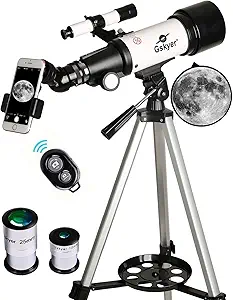
Gskyer 70mm Aperture Refracting Telescope for Beginners
The Gskyer 70mm carves out a travel niche between the budget 300mm model above and the bulkier 90mm scopes. Its 400mm focal length at f/5.7 strikes a middle ground — more magnification headroom than the 300mm beginner refractor, while staying far more packable than the 800mm HUGERSTAR. The carry bag and aluminum tripod make it a genuine grab-and-go option for camping trips or dark-sky weekends, and the smartphone adapter rounds out a complete accessory loadout. Realistically, image quality is where budget shows: views of the Moon will please, but planetary observers will want the MEEZAA or HUGERSTAR 90mm models instead. As a second scope for travel, or a first scope that fits in a backpack, this option makes the most sense.
Pros:- Carry bag and lightweight tube make it genuinely portable
- 400mm focal length offers more magnification headroom than shorter 70mm models
- Smartphone adapter and wireless remote support easy image capture
- Adjustable aluminum tripod accommodates seated or standing viewing
Cons:- 70mm aperture restricts detail on planets and faint deep-sky objects
- No performance or image-quality details to verify how coatings hold up at higher powers
Best for: Campers, travelers, and apartment dwellers who need a scope that packs into a bag and sets up anywhere
Not ideal for: Observers whose main target is planets or nebulae — 70mm aperture will leave them wanting an upgrade within a season
- Aperture:70mm
- Focal length:400mm
- Focal ratio:f/5.7
- Mount type:AZ mount
- Optics:Fully coated glass lens
- Eyepieces:2 replaceable eyepieces
- Barlow lens:3x
- Finder scope:5×24
- Included accessories:Adjustable aluminum tripod, carry bag, smartphone adapter, wireless remote
Our verdict“A well-rounded travel-first refractor that trades aperture for portability — right for stargazers on the move.”
HUGERSTAR 90mm Aperture, 800mm Refractor Telescope for Beginners
Among the three 90mm refractors in this lineup, the HUGERSTAR earns the planetary detail crown through its long 800mm focal length at f/8.89 — a slower optical system that naturally delivers sharper, higher-contrast images at magnification than the 600mm family model with the stool. The included moon filter is a thoughtful touch the MEEZAA 90mm omits, taming the Moon’s glare during full-phase viewing. The published tripod range of 28.7–46.4 inches also gives buyers certainty the MEEZAA matches but the budget 70mm scopes can’t promise. The cost of that long tube is portability and patience: it’s less car-trunk-friendly than the Gskyer 70mm, and the 240X ceiling is optimistic — realistic useful magnification lands closer to 180X.
Pros:- f/8.89 focal ratio delivers sharper high-magnification views than shorter 90mm models
- Moon filter included for comfortable full-Moon observing
- Tool-free assembly with accessory tray keeps eyepieces organized
- 90mm aperture provides real planetary performance beyond any 70mm option here
Cons:- Long tube is awkward to transport compared to shorter refractors
- No image-quality information at the highest magnifications, and 240X exceeds realistic resolving power
Best for: Beginners whose primary interest is the Moon, Saturn’s rings, and Jupiter’s bands and who will observe mostly from one location
Not ideal for: Travelers and hikers — the 800mm tube is the longest and least packable in this batch
- Aperture:90mm
- Focal length:800mm
- Focal ratio:f/8.89
- Magnification:32X–240X
- Eyepieces:10mm and 25mm
- Barlow lens:3X
- Finder scope:5×24
- Tripod height:28.7–46.4 inches
- Included accessories:Phone adapter, moon filter, accessory tray, carrying bag
Our verdict“The best choice in this batch for beginners who want crisp lunar and planetary views and don’t need to carry the scope far.”
MEEZAA 90mm Aperture Refractor Telescope, 800mm Focal Length
The MEEZAA 90mm/800mm sits in a near-identical optical class to the HUGERSTAR — same aperture, same focal length, same f/8.88 tube — so the choice between them comes down to accessories and intent. Where the HUGERSTAR leans into lunar specialists with its moon filter and accessory tray, the MEEZAA keeps the package simpler and leans on its fully multi-coated optical glass promise of brightness and clarity for mixed family use, from Moon and planets to daytime scenery. Its tripod range of 28–46 inches covers kids through seated adults comfortably, matching the HUGERSTAR step for step. The missing moon filter is a genuine gap for anyone who’ll spend long nights on a bright Moon, but for a household splitting time between birds and Saturn, this model is better balanced than the more astronomy-locked alternatives.
Pros:- Fully multi-coated 90mm optics deliver bright views across night and daytime use
- Dual-purpose performance suits astronomy and terrestrial observing
- Adjustable 28–46 inch tripod works for children and adults
- Phone adapter supports sharing photos and videos of what the family sees
Cons:- No moon filter included despite the high magnification ceiling
- Fast setup claim relies on the manufacturer’s description and may vary for true beginners
Best for: Households wanting one 90mm scope that handles both night-sky viewing and daytime wildlife or scenery observation
Not ideal for: Dedicated lunar observers who would miss a moon filter — the HUGERSTAR covers that use case better
- Telescope type:Refractor
- Aperture:90mm
- Focal length:800mm
- Focal ratio:f/8.88
- Magnification range:32×–240×
- Eyepieces:10mm and 25mm
- Barlow lens:3×
- Tripod height:28–46 inches
- Included accessories:Phone adapter, carry bag, paper manual
Our verdict“A well-rounded 90mm pick for families splitting their time between the Moon and the backyard birds.”

How We Picked
I evaluated each telescope through the lens of a first-time buyer: how much can you actually see, how frustrated will you get setting it up, and how long before you outgrow it. Aperture and optical quality came first, because a telescope that shows blurry or dim views is the number-one reason beginners abandon the hobby. Mount stability and ease of aiming came second — a wobbly tripod or confusing slow-motion controls ruin good optics. I also weighed included accessories (eyepieces, finders, phone adapters), portability for buyers with limited storage or dark-sky travel plans, and overall value relative to what else sits at the same capability level in this lineup.
The ranking order reflects a simple philosophy: buy the most aperture and mount quality your budget and patience allow. Larger reflectors rank higher despite their learning curve because they deliver views that keep beginners engaged past the first month. Compact 70mm refractors rank lower — not because they are bad products, but because nearly every other option here offers a meaningfully better long-term return. Where two models are optically similar, I broke ties on mount quality, accessory bundles, and portability.
Factors to Consider When Choosing Astronomy Telescopes For Beginners
Before you pick a specific model, it helps to understand what actually drives telescope performance and satisfaction. These are the factors that separated the winners from the also-rans in this comparison — and the traps that catch most first-time buyers.Aperture Matters More Than Magnification
Almost every beginner telescope box shouts about magnification — “150X!” “375X!” — and almost all of it is marketing noise. Magnification is limited by aperture: a 70mm telescope physically cannot deliver useful views above roughly 140x, no matter what eyepiece you screw in. Push a small scope past that and you get a dim, mushy blob. Aperture, by contrast, determines how much light the telescope collects, which controls how faint an object you can see and how much detail emerges on planets and the Moon. This is why the 150mm and 130mm reflectors in this roundup outperform every refractor here despite lower advertised magnification claims. A useful rule: ignore the magnification number entirely and compare aperture sizes instead. Moving from 70mm to 90mm gathers more than 60% more light; moving to 130mm more than triples it. The most common beginner mistake is buying a small scope sold on inflated magnification and being disappointed that galaxies look like gray smudges — because at that aperture, they are.
Mount Type: The Overlooked Dealbreaker
The mount affects your experience as much as the optics do, and it is where cheap telescopes cut the most corners. Alt-azimuth mounts move up-down and left-right, which feels natural within minutes — the AstroMaster 70AZ and Koolpte 90mm use these and are the easiest here to start observing on night one. Equatorial mounts, like those on the MEEZAA 150EQ and AstroMaster 130EQ, are designed to track the sky’s rotation with a single slow-motion knob, which is wonderful for extended viewing — but only after you learn a roughly 30-minute setup process called polar alignment. Many beginners buy an EQ-mounted scope, get confused by the counterweights and setting circles, and quit before ever finding anything. Also scrutinize tripod stability: thin aluminum legs transmit every touch and gust of wind as image shake, which is a chronic weakness on budget 70mm kits. My honest advice: choose an EQ mount only if you enjoy learning equipment; otherwise, a sturdy alt-az mount will get you observing faster and more often.
Reflector vs. Refractor: Maintenance and Tradeoffs
This roundup contains both designs, and the difference shapes your ownership experience. Refractors (sealed tube, lens at the front) are nearly zero-maintenance, hold alignment permanently, and produce crisp, high-contrast views of the Moon and planets — which is why most beginner kits here are refractors. Newtonian reflectors (mirror at the back, open tube) deliver far more aperture per dollar, which is why the MEEZAA 150EQ and AstroMaster 130EQ outperform every refractor in this list on raw viewing power. The tradeoff is maintenance: reflector mirrors gradually fall out of alignment (called collimation) and need occasional adjustment with a cheap tool and a 15-minute tutorial video. Reflectors are also larger, heavier, and their optics can degrade if stored in dusty or humid conditions. If you want a grab-and-go, forget-about-it telescope, buy a refractor. If you want maximum performance per dollar and don’t mind occasional tinkering, a reflector is the smarter purchase.
The Accessory Trap and True Total Cost
Beginner kits are often priced attractively because the bundled accessories are the cheapest possible versions. The included eyepieces on budget kits (usually H20mm and H10mm Huygens designs) work, but a single better-quality eyepiece bought later can transform the view more than upgrading the telescope would. A red-dot finder or finderscope is essential for aiming — check that the included one is adjustable and usable, because a misaligned finder is the top reason beginners can’t find anything in the sky. Phone adapters, included on models like the EACONN 80mm and the 70mm beginner kit here, are genuinely fun for snapping lunar photos, so treat them as a bonus rather than a deciding factor. When budgeting, plan to spend a modest amount on a better eyepiece or a Barlow lens within the first few months — a telescope’s sticker price is not its true lifetime cost. Also budget for nothing else besides a red flashlight and a free star app; expensive accessory bundles at checkout are rarely worth it.
Who Is Actually Using It: Adults vs. Kids
Matching the telescope to the user prevents the classic outcome of a gift that sits in a closet. For children under 10, models like the NASA Lunar Telescope and the 70mm refractor kits make sense: they’re light, simple, inexpensive, and the goal is seeing craters on the Moon, not hunting galaxies. For teens and adults, skip the toy-tier 70mm options and go straight to an 80mm–90mm refractor or a 130mm+ reflector, because the payoff in visible detail is what sustains interest. Solo adults with a real interest in the hobby should seriously consider the larger reflectors — buying too small and upgrading within a year costs more overall. Also consider physical logistics: a 150mm Newtonian on an equatorial mount weighs a lot and needs storage space, which matters if you live in an apartment or must carry the scope downstairs to observe. The best telescope is the one that gets used, and a bulky scope that never leaves the closet loses to a modest one you take out every clear night.
Light Pollution and Where You’ll Observe
Your observing location should shape your purchase more than most buyers realize. Under bright urban skies, faint deep-sky objects like nebulae and galaxies are nearly invisible through any telescope here — so city dwellers should optimize for the Moon and planets, which punch through light pollution, making high-contrast refractors like the 800mm focal-length HUGERSTAR and MEEZAA 90mm models excellent choices. Under darker suburban or rural skies, larger aperture pays off dramatically, and the 130mm–150mm reflectors will reveal objects that simply don’t exist visually through 70mm tubes. If you plan to travel to dark-sky sites, weight and packed size become real constraints — this is the entire appeal of the Celestron Travel Scope 70 and EACONN’s backpack-bundled 80mm, and a legitimate reason to accept less aperture. Don’t buy a heavy reflector for dark-sky travel you’ll never do, and don’t buy a travel scope for a permanent backyard setup. Match the telescope to where you will actually stand with it at 10 p.m., not to an idealized version of your plans.
Frequently Asked Questions
Is a 70mm telescope good enough to start with, or will I outgrow it quickly?
A 70mm telescope will show satisfying views of the Moon’s craters, Saturn’s rings, Jupiter’s cloud bands, and bright star clusters — that is genuinely enough for a first taste of astronomy, especially for kids or casual users. The honest limitation is that everything beyond those targets looks faint and gray, and planetary detail plateaus quickly. Most engaged adults find themselves wanting more within three to six months, which is why the 70mm models rank lower in this roundup despite their low cost. If your budget can stretch to an 80mm–90mm refractor or a 130mm reflector, the extra light-gathering power meaningfully extends what you’ll see and how long the telescope stays satisfying. Buy 70mm only if the user is young, the budget is strict, or portability is the top priority.
Should a beginner get an equatorial mount or an alt-azimuth mount?
If you want to be observing within fifteen minutes of opening the box, choose an alt-azimuth mount — it moves up-down and left-right like a camera tripod, and aiming it is intuitive with zero learning curve. Choose an equatorial mount only if you’re willing to spend an evening learning polar alignment, because out of the box an EQ mount feels baffling: it moves on tilted axes, has counterweights, and won’t point where you push it. The reward is that once aligned, a single slow-motion control tracks objects across the sky, which becomes very valuable for long viewing sessions at higher magnifications. In this lineup, the MEEZAA 150EQ and AstroMaster 130EQ pair big optics with EQ mounts, so you’re accepting a learning curve in exchange for serious performance. A reasonable middle path is starting with an intuitive AZ-mounted scope like the Koolpte 90mm, then upgrading to EQ later if the hobby sticks.
Why do reflectors give more telescope for the money than refractors?
It comes down to manufacturing physics: a mirror is a single surface that only needs to be ground to one precise curve, while an objective lens requires two or more surfaces ground and aligned perfectly, plus expensive glass free of color distortion. That cost difference means a 130mm or 150mm reflector typically sells for the same price as an 80mm–90mm refractor, yet delivers two to three times the light-gathering area. The catch is that reflectors demand a little ownership effort — the mirrors occasionally need realignment (collimation), the open tube collects dust, and the whole assembly is bulkier and slower to set up. Refractors, by contrast, are sealed, permanently aligned, and genuinely maintenance-free. If you want maximum view per dollar and tolerate tinkering, buy a reflector; if you want zero-fuss reliability, pay the refractor premium.
Can I take photos through any of these beginner telescopes?
You can capture satisfying smartphone photos of the Moon and bright planets through any telescope here using the phone adapters bundled with models like the EACONN 80mm and the 70mm beginner kit — that’s what those adapters are designed for, and lunar shots through a 90mm refractor can be genuinely impressive. What these telescopes cannot do is long-exposure astrophotography of nebulae and galaxies, because that requires precise motorized tracking, a sturdy equatorial platform, and typically a camera body none of these kits accommodate. Attempting deep-sky photography on a beginner alt-az mount produces smeared, trailed images no matter how good your phone is. Set your expectations at “great Moon snapshots” and these scopes deliver; expect Hubble-style galaxy portraits and you’ll be disappointed. Serious astrophotography is a separate equipment path you can pursue later if the hobby takes hold.
How much should a first telescope cost to avoid junk?
Below roughly the price of the budget 70mm kits in this roundup, telescope quality collapses fast — wobbly tripods, plastic lenses, and unusable finders dominate, and those scopes actively drive people away from the hobby. The good news is that the entry-level sweet spot is genuinely affordable: solid 80mm–90mm refractors with decent mounts and accessories sit at very accessible prices and will serve you for years. The next meaningful step up is a 130mm–150mm reflector like the AstroMaster 130EQ or MEEZAA 150EQ, which costs more but delivers views that keep pace with a growing interest in the hobby. My guidance is to buy the best mount and aperture you can afford in one purchase rather than starting small and upgrading twice, because resale value on beginner scopes is poor. Also reserve a small amount for one quality eyepiece later — it’s the cheapest meaningful upgrade in all of amateur astronomy.
Conclusion
The right pick depends entirely on who is standing behind the eyepiece. For the best overall beginner telescope, the MEEZAA 150EQ Newtonian Reflector stands out — its 150mm aperture delivers views that no refractor in this lineup can match, and the equatorial mount rewards beginners ready to invest one evening in learning it. For best value, the Celestron AstroMaster 130EQ gets you serious light-gathering power from a trusted brand without the top-tier price. For the easiest possible start, the Koolpte 90mm with its Vertisteel AZ mount offers intuitive aiming and crisp planetary views with no learning curve, while the Celestron AstroMaster 70AZ serves the same role on a tighter budget.
Specific needs narrow it further: for portability and travel, the Celestron Travel Scope 70 and the backpack-bundled EACONN 80mm are the picks that will actually leave the house. For planetary detail and crisp refractor views, the long-focal-length HUGERSTAR 90mm/800mm and MEEZAA 90mm/800mm excel. For young children, the NASA Lunar Telescope and the 70mm kids’ kits are appropriately simple and forgiving. Whatever you choose, remember that the best telescope is the one you take outside on clear nights — pick the model that matches your budget, your storage space, and your willingness to learn, and the sky will do the rest.
Fall Picks
fall essentials
As an affiliate, we earn on qualifying purchases.