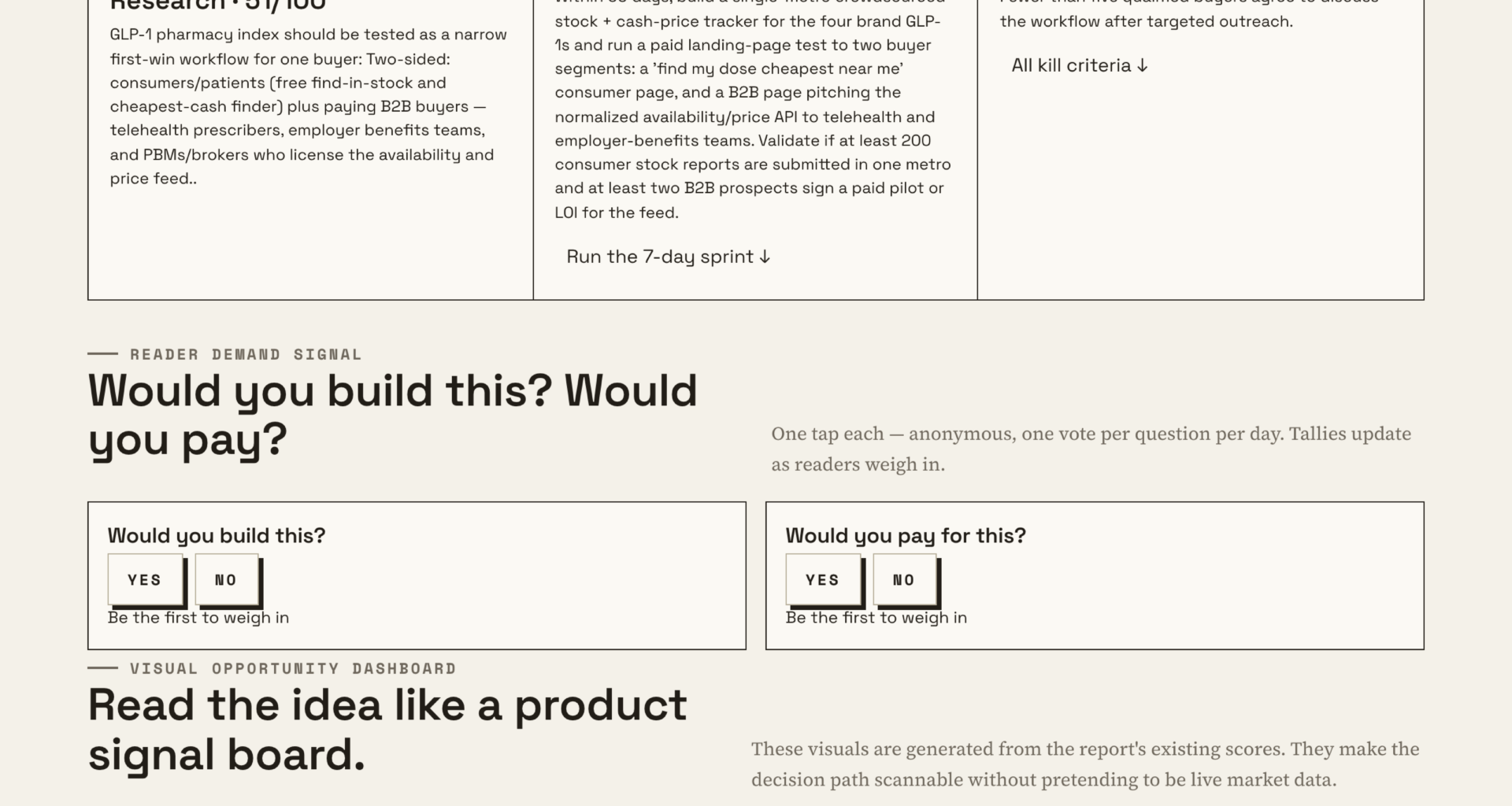

📊 Full opportunity report: What’s Available? A GLP-1 Stock And Price Index on IdeaNavigator AI — validation score, market gap, and execution plan.

Prime made for students and young adults
- Fast, free delivery for dorm and study essentials
- Prime Video and Amazon Music included
- Member-only deals
TL;DR
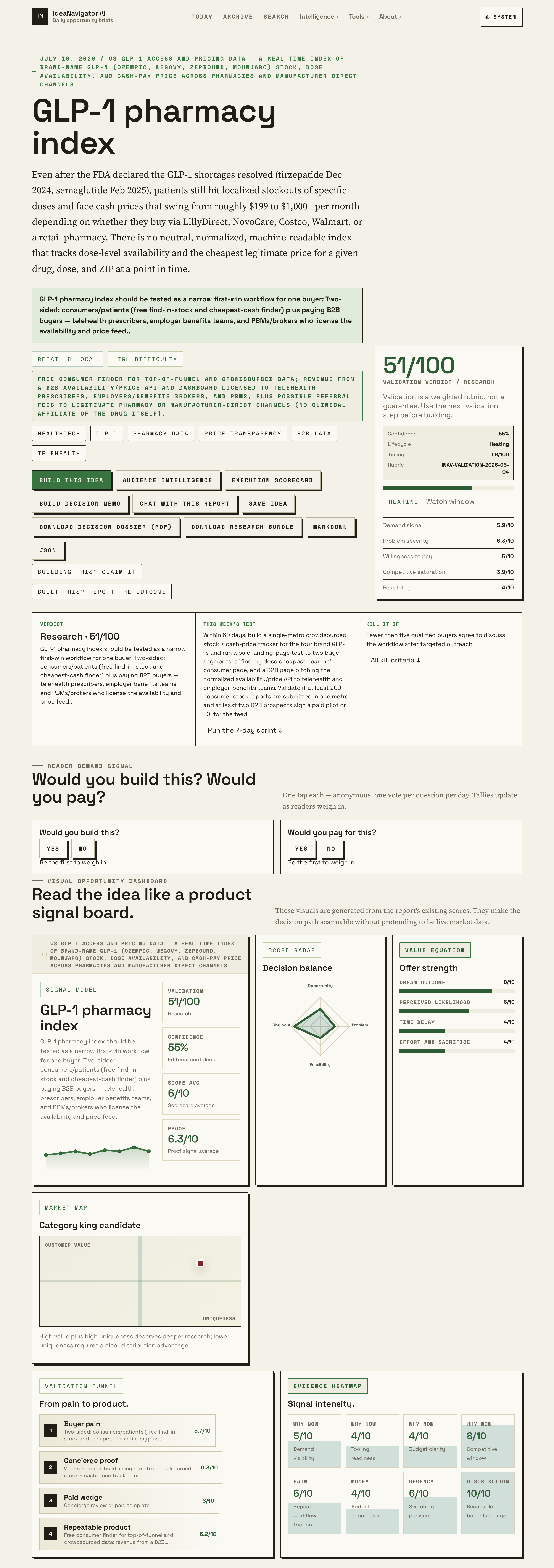
IdeaNavigator AI has outlined a proposed index to show dose-level availability and cash prices for four branded GLP-1 drugs by ZIP code. The proposal describes a potential consumer tool and a paid business data feed; it does not report that either has launched or that buyers have signed on.
IdeaNavigator AI has proposed a stock and cash-price index for four branded GLP-1 drugs, aiming to help patients locate specific doses and give healthcare businesses a normalized view of availability and prices. The proposal outlines an early test, not an operating service: it reports no launch, pharmacy coverage, buyer commitments or collected stock reports.
In its proposal, IdeaNavigator AI says the index would cover Ozempic, Wegovy, Zepbound and Mounjaro, with searches organized by drug, dose and ZIP code. A free consumer website would combine user reports about local stock with public cash-price information from manufacturer-direct programs, retail channels and a price-comparison layer. The proposal names LillyDirect, NovoCare, Costco and Walmart among the channels whose prices could be normalized.
IdeaNavigator AI describes a tool patients could use to look for a dose in stock and compare cash prices, with possible alerts for dose-level availability. It also proposes licensing the resulting data to telehealth prescribers, employer benefits teams, pharmacy benefit managers and brokers through an API or dashboard. The proposal raises referral fees from legitimate pharmacy or manufacturer-direct channels as a possible revenue source and says revenue would not come from clinical promotion of the drugs themselves.
To test demand, IdeaNavigator AI proposes building a tracker in one US metro area and running landing-page tests for consumers and business buyers. Its stated 60-day targets are at least 200 consumer stock reports in that metro and paid pilots or letters of intent from at least two business prospects. These are proposed validation thresholds, not results already achieved.
A Shift From Shortage to Price Fragmentation
IdeaNavigator AI’s proposal frames the index as a response to an access problem that can persist even when a drug is no longer listed on the federal shortage list. The proposal says availability can vary by location and dose, while cash-paying patients may encounter different prices across manufacturer programs and retail pharmacies. A dose-specific local view could make those differences easier to compare, if the information is timely and accurate.
The proposal also says businesses could use a normalized feed to assess where patients face access gaps and how cash prices vary. IdeaNavigator AI claims employers report GLP-1 drugs account for roughly 20% of pharmacy spending, but provides no survey, date range or methodology for that figure. It should be treated as a claim in the proposal, not an independently documented measure. If representative, such spending would give benefits teams a reason to evaluate tools that could inform coverage and cost discussions.
IdeaNavigator AI presents the central commercial test as whether a consumer service can also produce data buyers will pay for. Crowdsourced reports may help reveal local gaps, but a paid feed would need sufficiently broad coverage and dependable updates. The proposal identifies that two-sided model; it provides no evidence yet that either side has adopted it.
Why Dose-Level Data Is Proposed
IdeaNavigator AI’s proposal describes a market that has moved from nationwide shortage concerns toward more localized variation. It says the FDA declared tirzepatide shortages resolved in December 2024 and semaglutide shortages resolved in February 2025. These dates are reported by the proposal as federal shortage-status changes; they do not establish that every dose is consistently available at every pharmacy.
The proposal also points to changing rules and sales channels as factors behind a more fragmented market. According to IdeaNavigator AI, deadlines affecting compounded versions pushed compounders out, while manufacturer-direct cash-pay options and retail programs added more places to check. It cites LillyDirect and NovoCare, as well as Costco and Walmart. The proposal says the TrumpRx portal launched in February 2026, but supplies no details about its listed products, prices or coverage.
IdeaNavigator AI’s proposal cites a price range of roughly $199 to more than $1,000 per month, depending on channel. It gives no specific drug, dose, date, geographic area or included fees for those figures. The range is therefore a broad illustration in the proposal, not a current, like-for-like price comparison. A functioning index would need to show the terms and timing behind each listed price.
Coverage, Accuracy and Buyers Remain Unknown
IdeaNavigator AI’s proposal reports no operating product, data feed, pharmacy agreements, user submissions or business customers. It does not identify a launch date or the metro area for the suggested test. The proposal also does not say whether prospective buyers have been interviewed or whether any have agreed to pay.
How the index would verify a stock report is unresolved. A patient-submitted observation can become outdated quickly, and a pharmacy’s inventory may change before another person acts on it. IdeaNavigator AI’s proposal does not set out how reports would be timestamped, checked, corrected or removed when they are stale. Nor does it define what “in stock” would mean for a particular dose, such as whether a pharmacy has confirmed availability for a new prescription.
Price comparisons also depend on conditions that IdeaNavigator AI’s proposal does not specify. Cash prices may be affected by eligibility, dose, quantity, location, discounts and program terms. The proposal does not explain how the index would compare those conditions, distinguish a listed price from one a patient can actually obtain, or keep price records current. It also leaves open how the service would earn referral revenue while maintaining a neutral presentation.
A Proposed 60-Day Market Test
IdeaNavigator AI’s proposal sets out a 60-day validation test: build a single-metro tracker for the four named drugs, collect reports about stock and cash prices, and test separate pages for consumers and business buyers. The proposal’s stated thresholds—200 consumer reports and two paid pilots or letters of intent—would offer an initial signal of participation and buyer interest if the test goes ahead.
The proposal provides no schedule, chosen metro, development team or funding plan, so it is unclear whether the test has begun or when results might be available. Any results reported by IdeaNavigator AI would need to distinguish completed paid pilots from letters of intent and explain how reports and prices were gathered. Until then, the index remains a proposed business concept rather than a verified source of live availability or pricing.
Source: IdeaNavigator AI proposal
Key Questions
Has the GLP-1 pharmacy index launched?
No launch is reported. The material describes a proposed tool and a suggested market test.
Which drugs would the proposed index cover?
It names Ozempic, Wegovy, Zepbound and Mounjaro, with searches by drug, dose and ZIP code.
Would patients have to pay to use it?
The proposal describes a free consumer finder. It suggests charging business customers for access to availability and price data.
Are the cited prices current quotes?
No. The proposal gives a broad range of roughly $199 to more than $1,000 per month but does not specify the dates, doses, locations or terms needed to treat those figures as comparable current prices.
What would count as an initial validation?
The proposed 60-day test sets targets of 200 consumer stock reports in one metro and at least two business prospects signing a paid pilot or letter of intent. No results are reported.
Source: IdeaNavigator AI
Halloween Picks
halloween
As an affiliate, we earn on qualifying purchases.