Language learning flash cards range from spoken-audio cards for young children to phrase decks and sign-language sets, so the right choice depends on what you want to practice. My best overall pick is Briston Spanish Vocabulary Flash Cards, which combines words, sentences, and pronunciation for more varied Spanish study. For hands-on listening practice, Airbition Bilingual Talking Flash Cards pair English and Spanish audio, while 500 Common Spanish Phrases Flash Cards focus on useful expressions rather than isolated words. The main tradeoffs are breadth versus depth, printed study versus audio, and child-friendly pictures versus material suited to adult learners. Read on for the full breakdown and help matching a deck to your learning goals.

Prime made for students and young adults
- Fast, free delivery for dorm and study essentials
- Prime Video and Amazon Music included
- Member-only deals
Key Takeaways
- Briston Spanish Vocabulary Flash Cards stand out for combining vocabulary, sentences, and pronunciation, giving learners more practice formats than a word-only deck.
- The two Airbition talking-card sets prioritize audio: the bilingual version supports English-Spanish pairing, while the toddler version focuses on English words.
- 500 Common Spanish Phrases Flash Cards serve a different purpose from vocabulary decks by emphasizing ready-to-use expressions instead of broad word coverage.
- The ASL choices vary in scale and organization: YIYDONG’s 10 themed packs offer a large starter bundle, while smaller sets may be easier to handle and review.
- Picture-based options such as SpriteGru’s 50 real-life photo cards favor concrete visual cues, while the German and larger Spanish decks suit learners seeking broader vocabulary coverage.
| Airbition Bilingual Talking Flash Cards, 512 English and Spanish Words, Blue |  | Best for Early English-Spanish Practice | Languages: English and Spanish | Word count: 512 | Themes: 31 | VIEW LATEST PRICE | See Our Full Breakdown |
| Airbition Talking Flash Cards for Toddlers, 510 English Words, Blue |  | Best for English-Only Toddler Listening | Language: English | Word count: 510 | Themes: 31 | VIEW LATEST PRICE | See Our Full Breakdown |
| 500 Common Spanish Phrases Flash Cards |  | Best for Practical Spanish Phrases | Card count: 500 | Language: Spanish | Material: 350 GSM cardstock | VIEW LATEST PRICE | See Our Full Breakdown |
| German Vocabulary 1000 Flash Cards: A QuickStudy Tool |  | Best for High-Volume German Vocabulary Review | Number of flash cards: 1,000 | Language: German | Product name: German Vocabulary 1000 Flash Cards: A QuickStudy Tool | VIEW LATEST PRICE | See Our Full Breakdown |
| 500+ Spanish Vocabulary Flash Cards for Adults and Kids Ages 15+ |  | Best for Broad Spanish Study Support | Card count: 500+ | Language: Spanish | Card categories: 150 regular verbs, 100 irregular verbs, 50 reflexive verbs, 100 household items and common nouns, 50 adjectives, 50 phrases, and practice cards | VIEW LATEST PRICE | See Our Full Breakdown |
| Carson Dellosa American Sign Language Flash Cards, 105 Cards with 122 ASL Signs |  | Best for Preschool ASL Basics | Brand: Carson Dellosa Education | Age range: 4 years and up | Card count: 105 | VIEW LATEST PRICE | See Our Full Breakdown |
| SpriteGru 50 Noun Flashcards with Real-Life Photos |  | Best for Real-Photo Vocabulary Practice | Brand: SpriteGru | Card count: 50 | Design: Double-sided; photo on front and corresponding word on back | VIEW LATEST PRICE | See Our Full Breakdown |
| 300 Noun Picture-Word Flashcards for Vocabulary and Language Learning |  | Best for Broad Everyday Noun Practice | Brand: SpriteGru | Card count: 300 | Design: Double-sided; picture on front and word on back | VIEW LATEST PRICE | See Our Full Breakdown |
| YIYDONG ASL Flash Cards, 500-Card Starter Bundle with 10 Themed Packs |  | Best for Extensive ASL Vocabulary | Brand: YIYDONG | Card count: 500 | Themed packs: 10 packs of 50 cards | VIEW LATEST PRICE | See Our Full Breakdown |
| Briston Spanish Vocabulary Flash Cards: 600 Words, Sentences, and Pronunciation |  | Best for Spanish Study with Sentence Context | Brand: Briston | Card count: 600 | Categories: 28 | VIEW LATEST PRICE | See Our Full Breakdown |
| Sign Language Flash Cards |  | Best for Young ASL Beginners | Brand: Teacher Created Resources | Model: EP62076 | Card count: 56 | VIEW LATEST PRICE | See Our Full Breakdown |
| American Sign Language Flash Cards, 240 Large-Sized Cards |  | Best for Broad ASL Vocabulary Practice | Brand: Aizweb | Language: English | Card count: 240 | VIEW LATEST PRICE | See Our Full Breakdown |
| language learning flash card | Material | Card count | Brand |
|---|---|---|---|
| Airbition Bilingual Talking Fl | — | — | — |
| Airbition Talking Flash Cards | Plastic | — | — |
| 500 Common Spanish Phrases Fla | 350 GSM cardstock | 500 | — |
| German Vocabulary 1000 Flash C | — | — | — |
| 500+ Spanish Vocabulary Flash | Cardstock | 500+ | — |
| Carson Dellosa American Sign L | Glossy cardstock | 105 | Carson Dellosa Education |
| SpriteGru 50 Noun Flashcards w | — | 50 | SpriteGru |
| 300 Noun Picture-Word Flashcar | Cardstock | 300 | SpriteGru |
| YIYDONG ASL Flash Cards | 350 gsm laminated cardstock | 500 | YIYDONG |
| Briston Spanish Vocabulary Fla | 350 GSM glossy laminated cardstock | 600 | Briston |
| Sign Language Flash Cards | Coated paper | 56 | Teacher Created Resources |
| American Sign Language Flash C | 350 gsm laminated cardstock | 240 | Aizweb |
More Details on Our Top Picks
Airbition Bilingual Talking Flash Cards, 512 English and Spanish Words, Blue
English and Spanish audio makes this Airbition set the clearest fit for families who want young children to hear both languages while learning basic vocabulary. Its 512 words span 31 themes, including animals, shapes, and transportation, while the insert-and-listen reader gives children a simple way to hear a word without needing to read. Compared with the English-only Airbition Talking Flash Cards for Toddlers, this set adds a second language but lists two different age recommendations: 2+ in the description and 3+ in manufacturer information. I’d treat adult help as part of the setup, especially when choosing cards for a child’s level. The tradeoff is that it teaches paired vocabulary rather than the practical phrases or grammar found in adult-focused Spanish sets.
Pros:- Presents vocabulary in both English and Spanish across 31 themes.
- Reader plays words aloud, supporting listening alongside visual recognition.
- Insertion format is designed for straightforward child-led practice.
- Includes 512 words, slightly more than the English-only Airbition set.
Cons:- Listing gives conflicting age guidance: 2+ in the description and 3+ in manufacturer information.
- Adult guidance is recommended to choose cards suited to the child’s development.
- Focuses on individual themed vocabulary rather than phrases or grammar.
Best for: Families introducing English and Spanish vocabulary to young children through spoken audio and themed cards.
Not ideal for: Learners seeking adult conversation practice, grammar explanations, or an age recommendation that is consistent across the listing.
- Languages:English and Spanish
- Word count:512
- Themes:31
- Age guidance:Description: 2 years and up; manufacturer: 3 years and up
- Color:Blue
- Model number:X2
- Included components:Flash cards
Our verdict“Choose this Airbition set if you want a young child to hear basic English and Spanish vocabulary, and skip it if you need structured conversation or grammar study.”
Airbition Talking Flash Cards for Toddlers, 510 English Words, Blue
For families focused on an early English vocabulary, this Airbition reader pairs 510 everyday words with audio across 31 themes. Children insert a card to hear the word, which makes listening practice more accessible before independent reading begins. Compared with the bilingual Airbition Bilingual Talking Flash Cards, this version keeps the content in English; that is a useful focus for an English-first home, but a limitation for families seeking exposure to two languages. The listing also gives varying age guidance, from 12 months–3 years to ages 1–6, so parents may need to select cards and supervise use based on the child rather than rely on a single age range. It offers less phrase-level practice than the Woifish Spanish set, but is more tailored to young children than adult study cards.
Pros:- Covers 510 words across 31 everyday themes.
- Spoken word playback adds listening practice to visual word recognition.
- Card insertion is designed to support simple, independent use.
- Includes a reusable storage box.
Cons:- Limited to English vocabulary, unlike the bilingual Airbition set.
- Age guidance varies across the listing, making the intended age span unclear.
- Focuses on individual words rather than conversational phrases.
Best for: Caregivers who want an audio-supported English vocabulary activity for toddlers and preschool-age children.
Not ideal for: Bilingual households seeking two-language audio, or older learners who want phrases, grammar, and structured language study.
- Language:English
- Word count:510
- Themes:31
- Age guidance:Listing ranges from 12 months–3 years to ages 1–6
- Material:Plastic
- Dimensions:4 x 4 x 0.1 inches
- Item weight:1.1 pounds
- Included components:Flash cards and card reader
Our verdict“Pick this set for toddler-focused English listening practice, but choose the bilingual Airbition version if Spanish exposure is a priority.”
500 Common Spanish Phrases Flash Cards
Unlike the child-oriented Airbition readers, this set targets learners who want to practice usable Spanish phrases rather than label individual objects. It contains 500 basic phrases and uses QR codes to link to pronunciation videos, giving learners a way to hear guidance beyond the printed cards. That audio support depends on having a device available, though, so it is less self-contained than the Airbition card reader. The 350 GSM cardstock has glossy, water-resistant lamination, a practical advantage for cards carried between home, class, and travel. Its beginner focus is also narrower than the Study Key set, which includes verb categories, gender indicators, and example sentences. I’d choose Woifish for portable phrase practice, not as a full Spanish grammar or advanced vocabulary course.
Pros:- Includes 500 basic phrases aimed at everyday conversation.
- QR codes link to pronunciation videos.
- Water-resistant glossy lamination suits frequent handling and travel.
- Large, clear fonts support quick reading during short practice sessions.
Cons:- Pronunciation videos require a device to scan the QR codes.
- Beginner-level phrases may not meet advanced learners’ needs.
- Provides less vocabulary and grammar detail than the Study Key Spanish set.
Best for: Adult beginners, travelers, and classroom learners who want portable practice with common Spanish phrases and can scan QR codes.
Not ideal for: Learners who need advanced Spanish, detailed grammar instruction, or spoken pronunciation access without a phone or other device.
- Card count:500
- Language:Spanish
- Material:350 GSM cardstock
- Finish:Glossy laminate
- Water resistance:Water-resistant
- Pronunciation support:Free videos accessed by scanning QR codes
- Recommended age:15 years and up
Our verdict“Choose Woifish for device-assisted practice with practical beginner Spanish phrases, but look to a broader study set for verb and grammar coverage.”
German Vocabulary 1000 Flash Cards: A QuickStudy Tool
With 1,000 German vocabulary flash cards, this QuickStudy tool is the largest single-language vocabulary set in this group by stated card count. That scale may suit learners who want a large pool for repeated recall practice, while the Airbition sets are more clearly designed around young children, themed words, and audio playback. The main tradeoff is the limited product information: the available data does not describe card format, vocabulary selection, pronunciation support, or included materials. That makes it harder to judge whether the cards suit a beginner, a class syllabus, or independent study. Compared with the detail-rich Study Key Spanish set, which specifies word categories and learning aids, this German set gives buyers less evidence about how its content is organized. I’d choose it for its stated scale and language, with expectations kept modest.
Pros:- Includes 1,000 flash cards for a substantial vocabulary pool.
- Focused specifically on German vocabulary study.
- A straightforward option for learners who prefer card-based recall practice.
Cons:- Available product information does not specify card size or format.
- Vocabulary contents and learning level are not described.
- No pronunciation or supplementary study resources are listed.
Best for: German learners who want a large card-based vocabulary pool and are comfortable choosing a set with few format details.
Not ideal for: Beginners who need pronunciation guidance, a described vocabulary level, or details about card layout and included study materials.
- Number of flash cards:1,000
- Language:German
- Product name:German Vocabulary 1000 Flash Cards: A QuickStudy Tool
- Format details:Not provided
- Vocabulary contents:Not provided
- Pronunciation support:Not provided
Our verdict“Choose this QuickStudy set if German vocabulary volume matters more than documented card features or pronunciation support.”
500+ Spanish Vocabulary Flash Cards for Adults and Kids Ages 15+
This Study Key set suits learners who want more than basic word recognition: its stated categories include regular, irregular, and reflexive verbs, household vocabulary, adjectives, phrases, and practice cards. Pronunciation guides, gender indicators, conjugations, and example sentences add context that the Woifish phrase cards do not describe, while the included workbook, e-book, and grammar sheets promise several study formats in one package. The tradeoff is that the listing does not explain the extent or format of those extra resources, so buyers cannot tell how much instruction they provide. It also gives conflicting age information: the title says 15+ while manufacturer guidance says 0 months and up. The compact cards and keychain support portability, but this broader set may feel like more material than a learner seeking quick travel phrases needs.
Pros:- Covers multiple vocabulary groups, including regular, irregular, and reflexive verbs.
- Cards include pronunciation guides, gender indicators, conjugations, and example sentences.
- Includes a workbook, e-book, grammar sheets, and master sheet.
- Rings and a keychain support portable organization.
Cons:- Age guidance conflicts between the title’s 15+ and manufacturer information of 0 months and up.
- The listing does not specify the format or extent of the workbook and digital resources.
- Broader vocabulary and grammar coverage may be more than phrase-focused learners need.
Best for: Older teens and adults who want Spanish vocabulary, verb practice, and supplementary grammar materials in a portable card set.
Not ideal for: Travelers seeking a small set of common phrases, or buyers who need clear age guidance and detailed descriptions of digital and workbook materials.
- Card count:500+
- Language:Spanish
- Card categories:150 regular verbs, 100 irregular verbs, 50 reflexive verbs, 100 household items and common nouns, 50 adjectives, 50 phrases, and practice cards
- Card dimensions:3.5 x 2.1 inches
- Thickness:0.5 mm
- Material:Cardstock
- Included components:Flash cards, rings, keychain, workbook, e-book, grammar rule sheets, and master sheet
- Age guidance:Title: 15+; manufacturer recommendation: 0 months and up
Our verdict“Choose Study Key for a broad Spanish vocabulary and grammar toolkit, but opt for Woifish if you mainly need beginner conversation phrases.”
Carson Dellosa American Sign Language Flash Cards, 105 Cards with 122 ASL Signs
For a young learner’s first contact with signing, Carson Dellosa keeps the material approachable: 105 double-sided cards cover 122 everyday ASL signs, from letters and numbers to animals, feelings, and common objects. Pairing illustrations with words gives caregivers a simple prompt for practicing a sign and connecting it to meaning. The included resource card with practice activities also makes this more guided than a basic picture-and-word set such as SpriteGru’s noun cards, which focus on spoken vocabulary rather than signing.
The tradeoff is scope. This set is aimed at basic learning for ages 4 and up, not advanced ASL instruction, and its 3 x 5.9-inch cards may be hard for a whole group to see at once. I’d choose it for home or small-group introductions, but pick a larger or broader ASL set for classroom demonstrations or sustained study.
Pros:- Covers 122 signs across everyday topics, including the alphabet, numbers, people, animals, and feelings.
- Double-sided format pairs signing illustrations with corresponding words.
- Resource card provides activities for practice at home or in class.
- Rounded corners make the cards easier to sort and handle.
Cons:- Focuses on basic sign-language learning rather than advanced instruction.
- Card size may limit visibility during group demonstrations.
Best for: Caregivers and preschool educators introducing children ages 4 and up to everyday ASL signs in one-on-one or small-group practice.
Not ideal for: Learners seeking advanced ASL instruction or teachers who need cards large enough for easy viewing across a full classroom.
- Brand:Carson Dellosa Education
- Age range:4 years and up
- Card count:105
- ASL signs:122
- Topics:Alphabet, numbers, sight words, people, animals, feelings, verbs, and common objects
- Card dimensions:3 x 5.9 inches
- Material:Glossy cardstock
- Included components:Flash cards and resource card
Our verdict“Choose this set for an activity-supported introduction to everyday ASL with young children, not for advanced study or large-group viewing.”
SpriteGru 50 Noun Flashcards with Real-Life Photos
Real-life photos give this 50-card set a concrete way to connect a printed noun with a familiar object. Each card puts the photo on one side and the word on the other, so an adult can prompt recall before revealing the answer. That makes it a more focused visual choice than SpriteGru’s 300-card picture-word set, which offers far more vocabulary and categories but uses illustrations rather than real photographs.
The larger 4 x 5.8-inch format helps images and words stand out during home practice, speech therapy, or small-group activities. Cards can also support matching, sentence-making, and storytelling, though the set itself covers nouns only. Its size is less convenient for compact storage or travel than the smaller Carson Dellosa ASL cards, and 50 words may feel limited for learners ready to build a broader vocabulary. I’d pick it for clear, concrete noun practice rather than a complete language curriculum.
Pros:- Real-life photos connect vocabulary to recognizable objects.
- Word-on-reverse format supports recall before checking the answer.
- Large cards make images and text easier to use in activities.
- Can prompt matching, sentence-making, and storytelling.
Cons:- Limited to 50 noun cards, so it offers less breadth than SpriteGru’s 300-card set.
- Noun-only content does not teach other word types.
- The larger format takes more space to store or carry.
Best for: Parents, preschool teachers, and speech therapists who want photo-based noun prompts for young learners and sentence-building activities.
Not ideal for: Buyers seeking verbs, varied parts of speech, a large word bank, or compact cards for frequent travel.
- Brand:SpriteGru
- Card count:50
- Design:Double-sided; photo on front and corresponding word on back
- Card size:4 x 5.8 inches
- Recommended age:3 years and up
- Set name:Noun Flashcards Set 1
- Educational objective:Language skills
- Manufacturer part number:Gru559
Our verdict“Pick this set for photo-led practice with a small, focused noun vocabulary, but choose a broader pack for more words or word types.”
300 Noun Picture-Word Flashcards for Vocabulary and Language Learning
When the priority is repeated practice across a sizeable everyday word bank, this set’s 300 double-sided cards offer a stronger range than SpriteGru’s 50-card real-photo pack. Color-coded groups cover food, animals, outdoor items, and basic concepts, giving adults a practical way to sort sessions by theme instead of presenting every word at once. Pictures on one side and words on the other support image-to-word association and early reading practice.
The tradeoff is that breadth does not mean broad grammar coverage: the cards are limited to noun vocabulary and the listed categories. The product description also does not specify a storage case or box, a notable gap beside YIYDONG’s ASL bundle, which includes both a box and binder rings. At 4.33 x 3.15 inches, these cards are larger than YIYDONG’s 4.3 x 2.8-inch cards, so they may be easier to handle but less compact to pack. This is best for learners who want category-based noun practice, not a full language course.
Pros:- 300 cards provide more everyday noun practice than the 50-card SpriteGru set.
- Color-coded categories help adults organize and pace activities.
- Picture-and-word sides support association and early reading.
- Rounded corners and sturdy cardstock are suited to repeated handling.
Cons:- Vocabulary is limited to nouns and the listed everyday categories.
- No storage case or box is specified in the product details.
- The card dimensions may be less convenient to pack than smaller cards.
Best for: Families, preschool classrooms, and speech therapists looking for a large, color-coded bank of everyday nouns for repeated practice.
Not ideal for: Learners who need verbs and other parts of speech, or buyers who require a specified storage case for organizing the cards.
- Brand:SpriteGru
- Card count:300
- Design:Double-sided; picture on front and word on back
- Material:Cardstock
- Categories:Food, animals, outdoor items, and basic concepts
- Recommended age:3 years and up
- Dimensions:4.33 x 3.15 x 0.04 inches
- Theme:Everyday objects
Our verdict“Choose this set for a substantial, organized collection of everyday nouns, but skip it if you need varied grammar or a confirmed storage solution.”
YIYDONG ASL Flash Cards, 500-Card Starter Bundle with 10 Themed Packs
YIYDONG is the broadest ASL option in this batch: 500 cards across 10 themed packs cover letters, numbers, colors, food, animals, emotions, verbs, nouns, and sight words. That range makes it a better fit for learners ready to move beyond introductory signs than Carson Dellosa’s 105-card set, which is aimed at basic practice for children. Color coding and answers on the reverse help users separate topics and check recall without an adult supplying every response.
Laminated cardstock is designed to resist water and tearing, while the box and 10 metal rings give the large collection a defined storage and sorting system. The tradeoff is volume: at 3.7 pounds, the set is a substantial home or classroom resource, not a particularly light study pack. Its 4.3 x 2.8-inch cards may also feel small for group display. I’d choose it for broad, organized ASL practice and pass if compactness matters most.
Pros:- 500 cards span 10 themed packs and a wide range of practical ASL topics.
- Color coding helps separate subjects for focused practice.
- Reverse-side answers support self-checking.
- Laminated cards, metal rings, and a storage box support repeated use and organization.
Cons:- The 3.7-pound set is less convenient to carry than a small study pack.
- Cards may be too small for clear viewing across a large group.
- The extensive card count may be more than beginners need at first.
Best for: Families, teachers, and speech therapists seeking a large, topic-organized ASL collection for ongoing practice at home or in a classroom.
Not ideal for: Buyers wanting a light travel set, large cards for group viewing, or a small starter collection with minimal storage needs.
- Brand:YIYDONG
- Card count:500
- Themed packs:10 packs of 50 cards
- Card type:Double-sided
- Card dimensions:4.3 x 2.8 inches
- Material:350 gsm laminated cardstock
- Included accessories:10 metal binder rings and storage box
- Weight:3.7 pounds
- Recommended age:12 months and up
Our verdict“Choose YIYDONG for a large, organized ASL vocabulary resource, but opt for Carson Dellosa if you want a smaller introduction for young beginners.”
Briston Spanish Vocabulary Flash Cards: 600 Words, Sentences, and Pronunciation
For Spanish learners who need more than isolated translations, Briston adds pronunciation guides and example sentences to 600 English-to-Spanish vocabulary cards. Those details give each word a little more context for speaking and recall than the picture-and-word format of SpriteGru’s 300-card noun set. With 28 color-coded categories, learners can also focus on a topic at a time rather than sorting through a single undifferentiated stack.
The glossy laminated cardstock and rounded edges are designed for repeated handling, but the set is listed for ages 15 and up, so it is a less direct fit for younger children than the SpriteGru cards recommended from age 3. Its 2.7-pound weight also favors a study space or classroom over a lightweight everyday carry option. I’d choose Briston for structured Spanish vocabulary practice with sentence and pronunciation support; learners wanting a small portable deck should look elsewhere.
Pros:- 600 English-to-Spanish cards span 28 categories.
- Pronunciation guides and example sentences add context beyond word translation.
- Pictures and color-coded text support visual topic-based study.
- Glossy laminated cardstock and rounded edges are suited to repeated handling.
Cons:- Recommended age of 15 years and up limits its fit for younger learners.
- At 2.7 pounds, it is less convenient to carry than a smaller card set.
- The broad collection may be cumbersome for learners who want a short daily deck.
Best for: Teen and adult Spanish learners who want vocabulary organized by topic with pronunciation support and example sentences.
Not ideal for: Younger children or learners who want a lightweight, compact deck for carrying between study sessions.
- Brand:Briston
- Card count:600
- Categories:28
- Material:350 GSM glossy laminated cardstock
- Features:Bilingual text, pictures, pronunciation guides, example sentences, and color-coded design
- Item weight:2.7 pounds
- Recommended age:15 years and up
- Model number:Vocab
- Manufacturer part number:SP-ED
Our verdict“Pick Briston for topic-organized Spanish practice with pronunciation and sentence context, but choose a smaller set if portability or younger learners are the priority.”
Sign Language Flash Cards
For a child starting with basic signs, Sign Language Flash Cards pairs letters with common words and questions, giving practice more variety than an alphabet-only set. The illustrated signs make each card a visual prompt, while activity suggestions offer parents and educators ways to use the set beyond simple recall. Compared with American Sign Language Flash Cards, 240 Large-Sized Cards, this set is smaller and less extensive, but its 56 cards may feel more manageable for short practice sessions. The tradeoff is card size: at 3-1/8 x 5-1/8 inches, the illustrations have less room than on the larger set. The coated paper is intended for repeated handling, though the description suggests laminating for longer use. Corner holes also make it easy to keep cards together on a ring.
Pros:- Illustrations cover letters, common words, and questions.
- Instructions and activity suggestions support varied practice.
- Corner holes allow cards to be stored together on a ring or string.
- Coated paper is designed to handle repeated use.
Cons:- The 3-1/8 x 5-1/8-inch cards are relatively small.
- The product description suggests laminating for longer-lasting use.
- Its 56-card selection offers less vocabulary breadth than larger ASL sets.
Best for: Parents and early-childhood educators introducing children ages four and up to ASL letters, everyday words, and simple questions.
Not ideal for: Learners seeking broad vocabulary coverage or large, easy-to-see cards; the 56-card set is limited beside the 240-card Aizweb option.
- Brand:Teacher Created Resources
- Model:EP62076
- Card count:56
- Card dimensions:3-1/8 x 5-1/8 inches
- Material:Coated paper
- Age range:4 years and up
- Educational focus:Language skills and sign language
Our verdict“Choose this set for approachable, activity-led ASL practice with young children, but pick the Aizweb 240-card set for broader vocabulary and larger cards.”
American Sign Language Flash Cards, 240 Large-Sized Cards
This set is the stronger choice when a learner needs more than a first introduction to ASL. Its 240 cards across five themed packs span alphabets, numbers, colors, food, emotions, seasons, and greetings, giving practice a wider range than the 56-card Sign Language Flash Cards. Each card pairs a visual guide with written cues for handshape, location, and movement, which can help learners follow how a sign is formed rather than rely on a picture alone. Color coding and five included rings make the large collection easier to sort into smaller study groups. The laminated, wipeable cardstock also suits frequent handling and written practice. The compromise is portability: at 5.71 x 3.94 inches, these cards take up more space than the smaller Teacher Created Resources set, so they are better suited to home or classroom sessions than a pocket-sized review.
Pros:- Covers 240 signs across five practical themed packs.
- Visual guides and written cues explain handshape, location, and movement.
- Color-coded packs and five rings help divide and organize the cards.
- Laminated cardstock is writable, wipeable, and tear-resistant.
Cons:- The large card size is less convenient to carry than compact flash cards.
- The extensive selection may feel like more material than a new learner needs at first.
Best for: Preschool and elementary learners, families, or teachers who want a large, organized ASL vocabulary set for repeated practice at home or in class.
Not ideal for: Learners who need a compact set for travel or prefer a small deck for quick beginner sessions; these cards are larger and more extensive than a simple starter pack.
- Brand:Aizweb
- Language:English
- Card count:240
- Themed packs:5
- Included rings:5
- Card size:5.71 x 3.94 inches
- Material:350 gsm laminated cardstock
- Age range:3 years and up
- Set name:ASL Starter Bundle
Our verdict“Pick this set for organized, broad ASL practice with durable large cards; choose the 56-card Teacher Created Resources set for a smaller, simpler introduction.”
How We Picked
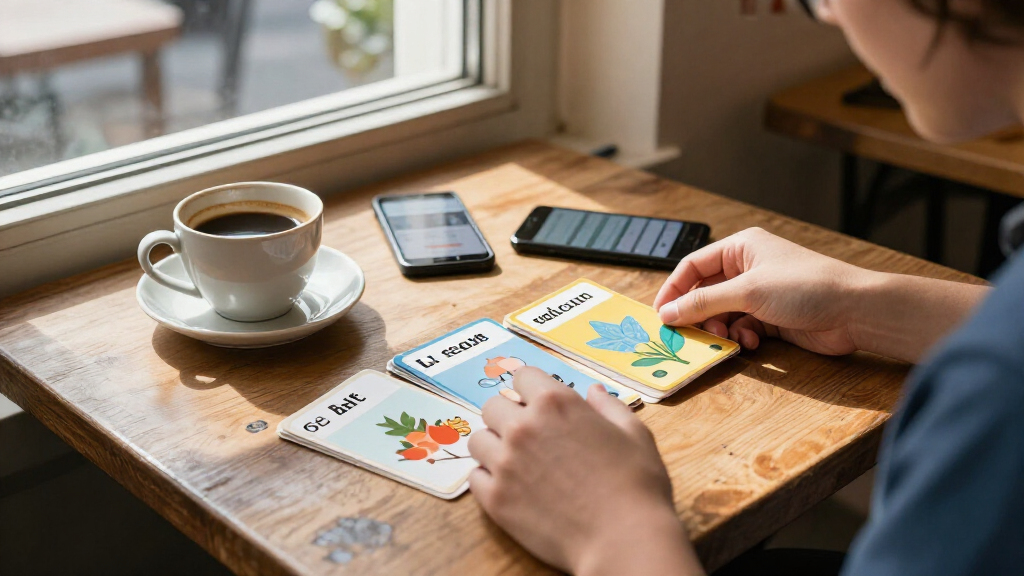
I compared these 12 language learning flash card sets by the kind of learning they support: vocabulary recall, useful phrases, pronunciation or listening practice, visual association, and ASL sign study. I also weighed who each deck appears designed for, how clearly its format matches that audience, and whether its stated scope gives learners a practical path for repeated practice. A large card count can add breadth, but it does not automatically make a deck more useful than a smaller set built around phrases, photos, or audio.
The ranking gives priority to versatility and a clear learning purpose. Sets that combine more than one practice mode or connect words with sentences have broader use, while specialized choices rank for the learners they serve rather than being treated as universal picks. I also account for tradeoffs: audio-dependent cards may be less useful when sound is inconvenient, and expansive decks may take more effort to sort and review. Since the lineup spans different languages and learner ages, each recommendation is judged against its intended use, not as a direct substitute for every other product.
| language learning flash card | Brand |
|---|---|
| Airbition Bilingual Talking Fl | — |
| Airbition Talking Flash Cards | — |
| 500 Common Spanish Phrases Fla | — |
| German Vocabulary 1000 Flash C | — |
| 500+ Spanish Vocabulary Flash | — |
| Carson Dellosa American Sign L | Carson Dellosa Education |
| SpriteGru 50 Noun Flashcards w | SpriteGru |
| 300 Noun Picture-Word Flashcar | SpriteGru |
| YIYDONG ASL Flash Cards | YIYDONG |
| Briston Spanish Vocabulary Fla | Briston |
| Sign Language Flash Cards | Teacher Created Resources |
| American Sign Language Flash C | Aizweb |
Factors to Consider When Choosing Language Learning Flash Cards
Before choosing a deck, match its learning method to the habit you can keep up. A high card count can look appealing, but a well-matched set is easier to use consistently than one with more material than you can review.
Choose the skill you want to practice
Decide whether your priority is remembering individual words, speaking in useful phrases, hearing pronunciation, or learning signs. These skills overlap, but they are not interchangeable: a vocabulary deck may help you recognize words without preparing you to form sentences. Phrase cards offer context, while audio cards add listening and pronunciation cues. For ASL, check that the deck centers on signs and the kind of vocabulary you need rather than assuming a general language deck will help. A common mistake is buying the broadest set before identifying the skill that currently limits your progress.
Match the format to your study setting
Think about where and how you will review: at a desk, on a commute, with a child, or in short shared study sessions. Printed cards are easy to sort and use without a device, but they cannot provide spoken audio unless paired with another resource. Talking cards can support listening practice, though their usefulness depends on being able to play sound and on the learner being comfortable with the device. Large or numerous decks can also be awkward to carry and may discourage quick practice. Pick the format you are most likely to reach for, not just the one with the most modes.
Look beyond the card count
A larger deck can offer more vocabulary, yet the number alone says little about whether those words fit your level or goals. Beginners may benefit more from a focused, manageable set than a large bundle that is hard to organize. More advanced learners may prefer added breadth, but should still check whether the content includes useful context rather than disconnected terms. Consider whether you can divide the cards into small review groups and revisit difficult items. A practical deck is one you can work through repeatedly, not simply one with the highest stated total.
Check how words are presented
Images, translations, example sentences, and pronunciation cues each help in different ways. Real-life photos can make concrete nouns easier to associate with objects, while sentences show how a word works in context. Translation-based cards may be familiar to use, but they can encourage learners to rely on an English equivalent instead of recalling meaning directly. Before buying, ask whether the learner needs visual support, contextual examples, or a prompt for speaking aloud. The best presentation depends on the material: a tangible object, a phrase, and an ASL sign each call for different cues.
Choose a level and audience that will last
Age guidance and beginner-friendly design affect whether a learner can use a deck independently or needs help. Child-focused cards may use simple words and audio, while adult learners may want phrases, sentence examples, or more extensive vocabulary. For a household with learners at different levels, a narrow deck may suit one person but leave another without a useful challenge. Avoid choosing solely by the label “beginner”; check whether the content aligns with the learner’s reading ability and learning goal. A good fit should be accessible now without feeling irrelevant after a few review sessions.
Treat flash cards as one part of study
Flash cards work best for recall and repeated exposure, but they do not replace listening to natural speech, conversation, or learning grammar in context. If your goal is travel conversation, pair word cards with phrase practice and listening. For ASL, cards can support sign recognition, but learners also benefit from seeing signs in motion and in conversational context. Avoid expecting a deck to teach every part of a language on its own. Choose cards that fill a specific gap in a broader routine, then add another resource when your study goals move beyond that gap.
Frequently Asked Questions
Should I choose a talking deck or printed cards?
Choose talking cards if hearing a spoken prompt is part of the practice you need and you can use audio during study. A bilingual talking set can connect a word across two languages, while a printed deck gives you quiet, device-free review and more control over pacing. Neither format automatically teaches pronunciation well: audio helps you hear a model, but learners still need to repeat and listen actively. If you study in shared or quiet spaces, printed cards may be easier to use consistently. Your best choice is the one that fits both your learning goal and your usual study setting.
Are phrase cards better than vocabulary cards for travel?
Phrase cards are often a stronger starting point for travel situations because they present expressions you can adapt and say, rather than only isolated words. Vocabulary cards can still help you recognize menus, signs, and common objects, so they are useful as a complement. If you are new to the language, prioritize phrases tied to needs such as greetings, directions, and ordering, then add vocabulary for places you expect to visit. Check whether the phrase set supports pronunciation practice if speaking is your main goal. A vocabulary-only deck may be a better fit if you already know basic sentence patterns.
How can I choose between a small deck and a large bundle?
Start with how many cards you can review regularly, not the maximum amount of content you could own. A smaller deck can be easier to carry, sort, and repeat, which may suit a new learner or someone building a daily habit. Larger bundles can make sense when you already have a routine and want more topics or vocabulary to draw from. Check whether the cards can be grouped by theme or level so the full set does not feel like one oversized task. If you are unsure, a focused deck tied to a concrete goal is usually a safer starting point than buying for card count alone.
Can picture cards help an adult learn a language?
Yes, picture cards can help adults connect a word to a concrete object without relying only on translation. They are most useful for visible, specific concepts such as common nouns; abstract words and conversation patterns need more context. Adults seeking fluent speech may find photo-only cards too limited if they do not also practice sentences, listening, or speaking. Use picture cards as a vocabulary aid rather than a complete study plan. If your goal is conversational ability, pair them with phrase practice and audio or spoken practice.
What should I check before buying ASL flash cards?
First, check that the set is specifically for ASL and that its stated content matches the vocabulary you want to learn. Compare theme organization and set size with your ability to review the material; a very large bundle may offer breadth but require more sorting. Cards are useful prompts for remembering signs, yet static images cannot show every movement or expression clearly. Plan to supplement them with video or instruction that demonstrates signs in motion and context. If you are learning with a teacher or class, choose a deck that fits the terms and topics being taught.
Conclusion
For the best overall Spanish study mix, I recommend Briston Spanish Vocabulary Flash Cards because words, sentences, and pronunciation cues cover more than isolated recall. For value-minded learners seeking a focused Spanish resource, 500 Common Spanish Phrases Flash Cards put practical expressions at the center; for a premium-style audio-focused choice, Airbition Bilingual Talking Flash Cards add spoken English-Spanish practice, though they suit buyers who want an electronic format. Beginners and young learners may prefer Airbition’s English-only toddler set for straightforward word practice, while adults wanting a broad Spanish vocabulary set can look to the 500+ Spanish Vocabulary cards. For German, choose the 1,000-card QuickStudy deck; for ASL, compare YIYDONG’s themed bundle with the smaller Carson Dellosa set or the 240 large-sized cards based on preferred scope and handling. For visual noun learning, SpriteGru’s real-life photos offer a more focused alternative to larger picture-word collections. The right pick is the one whose language, format, and study scope match what you will practice next.