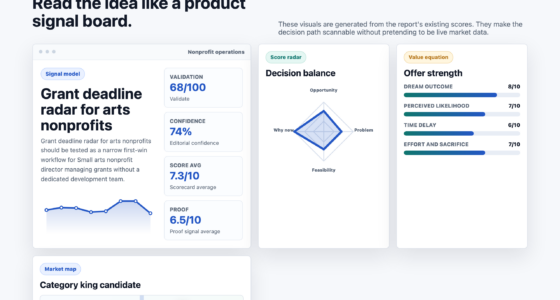
📊 Full opportunity report: The Intersection Of Civic Engagement And Logistics Space Design on IdeaNavigator AI — validation score, market gap, and execution plan.

Prime made for students and young adults
- Fast, free delivery for dorm and study essentials
- Prime Video and Amazon Music included
- Member-only deals
TL;DR
A nonprofit is testing a new logistics workspace tool to streamline planning for citizens’ assemblies. This development aims to address manual workflows and improve scalability in civic engagement efforts.
A civic-dialogue nonprofit is testing a new logistics workspace designed specifically for organizing citizens’ assemblies, aiming to streamline participant management, scheduling, and reporting processes. This development addresses the manual workflows currently used and seeks to improve scalability as demand for deliberative democracy programs grows.
The nonprofit plans to pilot a guided event-operations workspace that takes a cohort from participant roster to demographic balancing, session scheduling, and attendance tracking, culminating in a final report. This tool is intended to replace the current reliance on spreadsheets and email, which can be inefficient and error-prone.
The initiative is motivated by increasing funding and government interest in citizens’ assemblies, but small organizations face challenges in managing logistics at scale. The proposed MVP (minimum viable product) would be offered as a per-program subscription to civic engagement organizations, aiming to fill a clear market need.
Validation involves recruiting five coordinators planning upcoming forums, running their workflow manually in shared documents, and assessing whether they would be willing to pay for a dedicated platform. This trial aims to determine the product’s practical value and market fit.
Potential Impact on Civic Engagement Operations
This development could significantly improve the efficiency of organizing citizens’ assemblies, making it easier for small nonprofits to manage complex logistics and scale up their efforts. By providing a purpose-built workspace, organizations may reduce administrative burdens, improve participant diversity, and ensure more consistent reporting.
As governments and funders increasingly support deliberative democracy, scalable logistics tools could become essential infrastructure, enabling broader participation and more effective civic processes. This innovation also highlights the intersection of civic engagement and operational technology, emphasizing the importance of design in supporting democratic participation.
citizen assembly logistics management software
As an affiliate, we earn on qualifying purchases.
As an affiliate, we earn on qualifying purchases.
Growing Demand for Structured Civic Deliberation
Over recent years, there has been a surge in the commissioning of citizens’ assemblies and deliberative panels by governments and local authorities. These processes aim to foster inclusive, representative decision-making but often rely on small nonprofits that manually manage logistics.
Currently, many of these organizations use spreadsheets and email to coordinate participant recruitment, demographic balancing, facilitator scheduling, and reporting. These manual workflows limit scalability and increase the risk of errors, hindering broader adoption.
The need for dedicated, purpose-built tools has become more urgent as the volume and complexity of civic engagement initiatives grow, prompting innovators to develop solutions that streamline operations and support larger-scale participation.
“The manual processes currently used by civic nonprofits are a bottleneck for scaling deliberative democracy efforts.”
— an anonymous researcher
civic engagement participant tracking tool
As an affiliate, we earn on qualifying purchases.
As an affiliate, we earn on qualifying purchases.
Uncertain Outcomes of the Pilot Program
It is not yet clear whether the nonprofit’s pilot will demonstrate sufficient value for organizations to adopt the platform widely. The success depends on whether coordinators find the tool easier and more efficient than their current workflows, and if they are willing to pay for it.
Further, the broader market response and potential integration with existing civic engagement platforms remain untested at this stage.
event scheduling platform for nonprofits
As an affiliate, we earn on qualifying purchases.
As an affiliate, we earn on qualifying purchases.
Next Steps for Validation and Expansion
The nonprofit plans to complete the pilot with five coordinators over the coming months, collecting feedback on usability and effectiveness. If results are positive, they will refine the platform and prepare for broader rollout, including marketing to other civic organizations and local governments.
Additional development may include integrating data analytics, expanding features for facilitator management, and exploring partnerships with civic tech providers to scale adoption.
demographic balancing software for civic events
As an affiliate, we earn on qualifying purchases.
As an affiliate, we earn on qualifying purchases.
Key Questions
How will this logistics workspace improve current planning processes?
The platform aims to replace manual spreadsheets and email coordination with an integrated, guided workflow that manages participant recruitment, demographic balancing, scheduling, and reporting in one interface.
Who will be able to access this tool?
The initial target users are civic engagement nonprofits organizing citizens’ assemblies. The platform will be offered via a per-program subscription model.
What are the main challenges in scaling civic logistics tools?
Challenges include demonstrating clear value to organizations, integrating with existing civic tech infrastructure, and ensuring affordability for small nonprofits.
When will the platform be available for wider use?
The pilot phase is ongoing, with broader availability depending on pilot success, likely within the next 6-12 months.
Could this approach be adopted by government agencies directly?
Potentially, if the platform proves effective and scalable, local governments or agencies involved in civic participation could adopt or adapt it for larger programs.
Source: IdeaNavigator AI
Halloween Picks
halloween
As an affiliate, we earn on qualifying purchases.