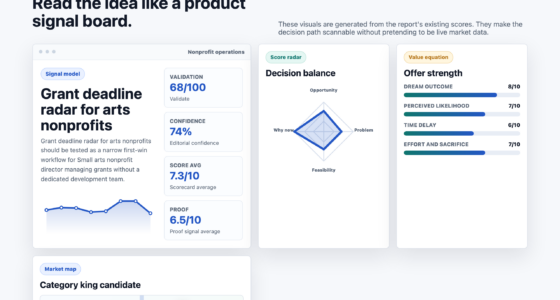
📊 Full opportunity report: Can A Document Scanner Help A Small Office Stay Organized? on IdeaNavigator AI — validation score, market gap, and execution plan.
TL;DR
IdeaNavigator AI has proposed testing a phone-based document scanner that classifies paperwork, suggests filenames and saves searchable PDFs for small offices. The proposal recommends a one-week pilot at five offices, but provides no test results, verified accuracy figures or evidence of customer demand.
IdeaNavigator AI has proposed testing a phone-based document scanner that automatically classifies and files paperwork for small nonprofits, clinics and law offices. The plan calls for a one-week pilot at five offices; whether the system can sort documents accurately or persuade offices to pay for it has not yet been established.
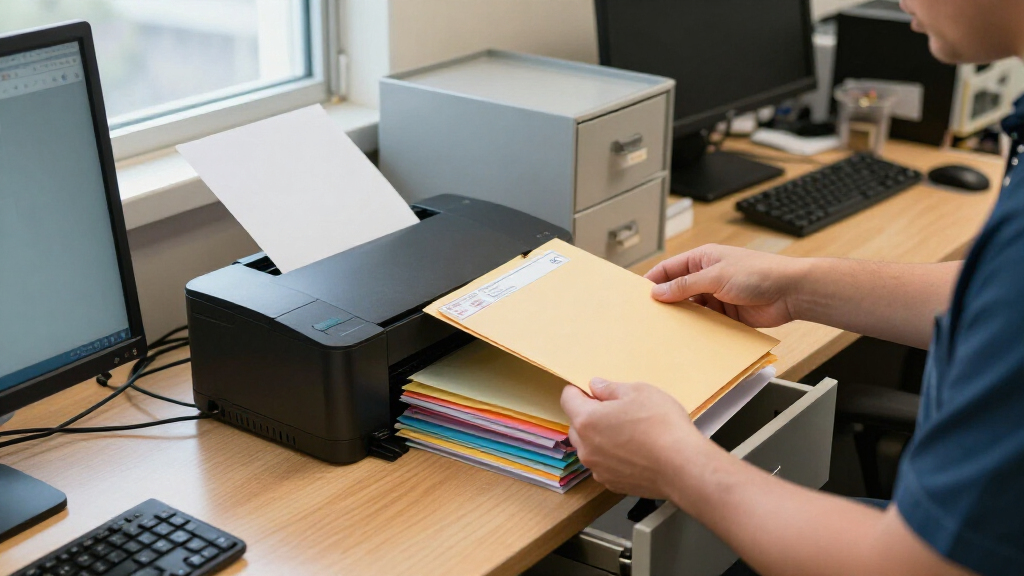
In its proposal, IdeaNavigator AI says the app would let an employee photograph a stack of documents with a phone. Optical character recognition (OCR) would read the text, while document-layout analysis would help suggest a category and filename. The plan gives an invoice filename containing its document type, date and vendor as an example. The resulting files would be searchable PDFs saved to a shared folder.
The proposal identifies office managers at small organizations that handle paper records, including intake forms, invoices and other files, as the intended users. IdeaNavigator AI says generic scanner apps can leave offices with unsorted images that lack useful names or extracted fields. That is the problem the proposed workflow aims to address; the proposal includes no comparative product test or customer interviews.
To test the idea, IdeaNavigator AI recommends recruiting five small offices and asking each to scan a real backlog of 200 documents during a weeklong trial. The proposal names the rate of correct automatic classification and whether participants would pay per seat as suggested measures. The business model under consideration is a monthly subscription with a page-volume limit and charges for additional pages.
A Filing Test for Small Offices
For a small office, the practical question is not simply whether a scanner can create a digital copy. It is whether the resulting files can be found, named consistently and shared without adding substantial review work. If staff must manually correct most categories or filenames, automation may shift the filing burden rather than reduce it.
The proposed pilot focuses on a concrete operational test: can the tool handle documents already waiting to be filed, and do office managers see enough value to pay for it? A measured trial could help distinguish a useful administrative aid from a technically plausible product concept. But the proposed sample—five offices over one week—would be an early validation exercise, not proof that the system works across the wider market.
There are also handling considerations for sensitive records, especially in clinics and law offices. A product that stores searchable copies would need clear practices for access, retention and security. The proposal does not specify how those issues would be addressed, so an office could not judge suitability from the feature outline alone.
document scanner with OCR for small office
As an affiliate, we earn on qualifying purchases.
As an affiliate, we earn on qualifying purchases.
From Scanning to Searchable Files
IdeaNavigator AI’s proposal describes a gap between digitizing a page and organizing it. A basic scanner can capture an image, but an office still has to decide what the document is, choose a filename and place it somewhere colleagues can locate. The suggested product combines OCR, document classification and filename suggestions in one workflow.
IdeaNavigator AI presents on-device and API-based OCR and layout-aware models as technology that has become inexpensive and capable enough to support this kind of product without a dedicated IT team. That is the proposal’s rationale, not an independently verified benchmark: it includes no accuracy figures, named technology providers or cost analysis. The distinction matters because performance may vary with handwriting, poor photographs, unusual forms and mixed document types.
The plan is at the idea-validation stage. It outlines a minimum viable product and a way to test it, but reports no completed pilot, deployed service, customer commitments or subscription pricing. Its suggested page cap and overage charges are possible pricing mechanics rather than an established offer.
As an affiliate, we earn on qualifying purchases.
Accuracy, Privacy and Demand
IdeaNavigator AI reports no pilot results. It is not known how often the proposed tool would classify documents correctly, how much staff review would be needed, or whether searchable files would be easy to retrieve in day-to-day use. The 200-document workload per office is a test plan in the proposal, not a result.
The proposal does not specify which document types and languages the product would support, how it would handle low-quality scans or handwritten notes, or whether users could correct mistakes and teach the system their filing conventions. It gives no details on storage location, encryption, permissions, retention periods or compliance practices. Those questions are especially relevant where files contain health, legal or personal information.
Finally, willingness to pay remains untested. IdeaNavigator AI’s proposed subscription model does not include a price, and the proposal reports no interviews, signed commitments or comparisons with existing scanning and storage tools. It does not quantify the market opportunity.
searchable PDF scanner for business
As an affiliate, we earn on qualifying purchases.
As an affiliate, we earn on qualifying purchases.
Results From the Proposed Pilot
IdeaNavigator AI’s proposal recommends recruiting five small offices, scanning 200 backlog documents at each during a one-week trial, and recording classification accuracy and willingness to pay per seat. The proposal names no start date or pilot participants, and provides no results or launch schedule.
If the test proceeds, useful reporting would include the types of documents evaluated, how accuracy is measured, how often staff corrected suggested names or categories, and the time required compared with existing filing practices. Offices would also need information about data handling before using real records. Until those details and results are available, the scanner remains a proposal to test—not a demonstrated solution for small-office filing.
Source: IdeaNavigator AI proposal
smart document classification scanner
As an affiliate, we earn on qualifying purchases.
As an affiliate, we earn on qualifying purchases.
Key Questions
What would the proposed scanner do?
According to IdeaNavigator AI’s proposal, it would use a phone to capture documents, apply OCR, suggest a document category and filename, then save the result as a searchable PDF in a shared folder.
Has the scanner been tested in offices?
IdeaNavigator AI’s proposal describes a possible pilot but reports no completed trial or performance results. It recommends testing the idea at five small offices for one week.
How would the pilot measure success?
The proposal suggests measuring the rate of correct automatic classification and participants’ willingness to pay per seat. It says each office would scan a backlog of 200 documents.
Would it be suitable for clinic or legal records?
That cannot be determined from IdeaNavigator AI’s proposal. It does not describe data storage, access controls, retention or security practices, all of which offices handling sensitive records would need to evaluate.
Source: IdeaNavigator AI