
📊 Full opportunity report: Estate And Inheritance Facilitator Marketplace on IdeaNavigator AI — validation score, market gap, and execution plan.

Get school and study supplies delivered free — and shop member deals
- Fast, free delivery on millions of items
- Access to Prime Big Deal Days deals on October 6–7
- Prime Video, Amazon Music and more included
TL;DR
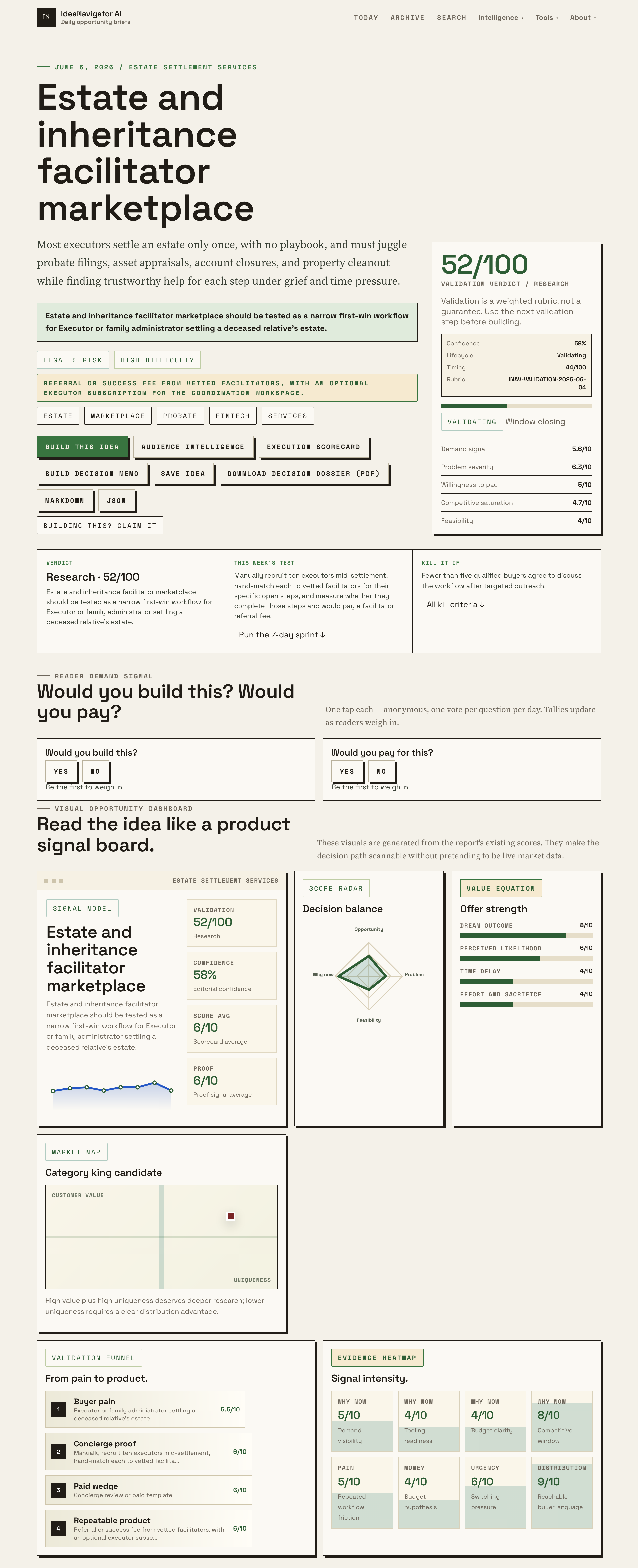
A startup is testing a marketplace designed to assist executors in settling estates. It offers a guided workflow that diagnoses needs and matches them with vetted facilitators. The initiative seeks to streamline estate settlement amid increasing generational wealth transfer.
A new marketplace focused on estate and inheritance facilitation is being tested to assist executors and family administrators in settling estates more efficiently. The platform aims to provide a guided workflow that diagnoses the specific steps needed and then connects users with vetted facilitators, tracking progress throughout the process. This development comes amid the largest generational wealth transfer in history, which increases demand for streamlined estate settlement services.
The initiative is designed to address a key challenge faced by executors, who often have no clear playbook for settling estates. Most settle only once, juggling probate filings, asset appraisals, account closures, and property cleanouts under grief and time pressure. The marketplace’s MVP involves a guided intake process that assesses the estate’s needs, then hand-matches each step with vetted facilitators, providing a concierge-style service before any self-serve marketplace is launched.
According to an anonymous researcher involved in the project, the goal is to manually recruit ten executors mid-settlement, assign each to appropriate facilitators for their open steps, and measure whether they complete those steps and would pay a referral fee. This approach aims to validate the model before scaling further. Revenue is expected to come from referral or success fees from facilitators, with an optional subscription for executors to access a coordination workspace.
Impact of the Facilitator Marketplace on Estate Settlement
This marketplace could significantly reduce the complexity and stress of estate settlement for executors, especially as estates become more complex with multi-state assets and digital accounts. By providing a structured, guided process and vetted service providers, it may improve efficiency, reduce delays, and ensure compliance. The initiative also responds to the growing demand driven by the ongoing large-scale transfer of wealth between generations, which is expected to increase the volume of estate settlements needing streamlined solutions.
As an affiliate, we earn on qualifying purchases.
Background and Market Need for Estate Facilitation Services
The estate settlement industry has traditionally been fragmented, with scattered directories of facilitators and no standardized process for guiding executors through complex steps. The current landscape is challenged by the increasing number of estates requiring settlement, driven by demographic shifts and the rise of digital assets. As the largest wealth transfer in history unfolds, the need for efficient, trustworthy facilitation services has become more urgent. Existing services often lack coordination, leaving executors to navigate legal, financial, and property issues alone under emotional distress.
Previous efforts to digitize estate services have focused on online directories or legal tech solutions, but few have provided a comprehensive, guided experience that matches specific estate needs with vetted facilitators. This pilot aims to fill that gap by offering a concierge-style, step-by-step process that simplifies estate settlement for non-professional executors.
“The goal is to provide a clear, guided workflow that helps executors understand what steps are needed and connects them with trusted facilitators for each task.”
— an anonymous researcher
As an affiliate, we earn on qualifying purchases.
Uncertainties About Scalability and Market Adoption
It is not yet clear how well the pilot will perform at scale or whether executors will adopt the guided process over traditional methods. The effectiveness of the matchmaking and tracking system remains to be validated through the initial recruitment and completion of estate settlements. Additionally, the willingness of facilitators to participate on a referral or success fee basis is still uncertain, as is the platform’s ability to maintain trust and quality across providers.
As an affiliate, we earn on qualifying purchases.
Next Steps for Pilot Validation and Market Expansion
The project plans to recruit ten executors mid-settlement to test the workflow and facilitator matching process. Success will be measured by completion rates and willingness to pay referral fees. If the pilot proves successful, the team intends to refine the platform, expand the network of vetted facilitators, and explore broader market adoption, potentially scaling to larger jurisdictions and more complex estate types.
As an affiliate, we earn on qualifying purchases.
Key Questions
How does the marketplace help executors manage estate settlement?
The platform provides a guided intake to identify needed steps, then connects executors with vetted facilitators for each task, tracking progress to simplify and coordinate the settlement process.
What types of estate settlement steps are included?
Typical steps include probate filings, asset appraisals, property cleanouts, account closures, and digital asset management. The platform aims to diagnose and match facilitators for each specific step.
Is this service available to all types of estates?
Initially, the pilot focuses on specific estate types, particularly those requiring multiple steps and involving multi-state assets. Broader availability will depend on pilot outcomes.
How will the platform ensure the quality of facilitators?
Facilitators will be vetted through a screening process, and the platform will track performance and completion rates to maintain quality standards.
When will the platform be available for wider use?
The timeline depends on pilot results. If successful, the team plans to expand the service within the next 12 to 18 months.
Source: IdeaNavigator AI
Fall Picks
fall essentials
As an affiliate, we earn on qualifying purchases.