Advanced optics have transformed learning outside the classroom by creating immersive experiences through virtual and augmented reality, making complex concepts more accessible and engaging. You can explore microscopic worlds, natural optical systems, and innovative designs inspired by nature. These tools help you visualize things beyond your usual reach, sparking curiosity and understanding. By understanding how light influences perception, you’ll discover new ways to see and learn from the world around you—if you keep exploring further, you’ll find even more insights await.

Prime made for students and young adults
- Fast, free delivery for dorm and study essentials
- Prime Video and Amazon Music included
- Member-only deals
Key Takeaways
- Enable immersive learning experiences through AR and VR, making complex concepts accessible outside traditional classrooms.
- Improve visual clarity and focus in remote education tools using advanced optical technologies.
- Facilitate interactive exploration of microscopic environments, biology, and chemistry beyond physical labs.
- Enhance online educational resources with realistic, engaging visuals powered by optical principles.
- Inspire innovative teaching methods by integrating biomimicry and optical systems from nature into learning tools.
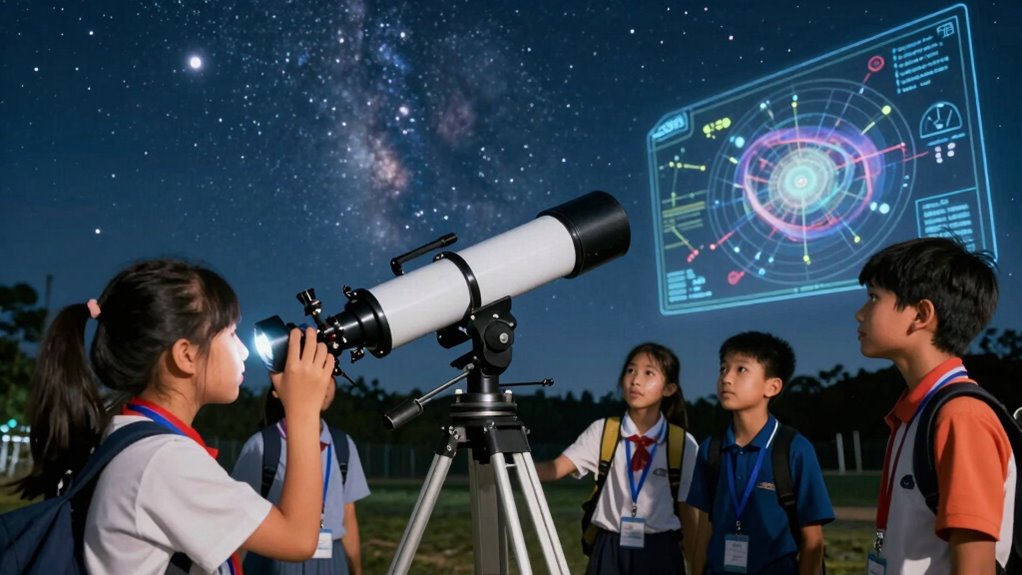
Have you ever wondered how the way we see and interpret light influences the way we learn? It’s a fascinating thought that the fundamental nature of optics shapes not just what we observe but how we understand the world around us. Thanks to advances in optics, learning outside the classroom has transformed dramatically, opening doors to exploration that were once limited by technology and perception. For example, microscope applications have revolutionized scientific discovery by allowing you to see things that are invisible to the naked eye. With powerful microscopes, you can examine tiny organisms, cell structures, and even molecules, gaining insights that deepen your understanding of biology, chemistry, and medicine. This microscopic view makes complex concepts tangible, engaging your curiosity and helping you grasp intricate details that textbooks alone can’t convey.
Beyond microscopes, optics also plays an essential role in creating optical illusions—visual tricks that challenge your perception and reveal the brain’s interpretation of light and images. When you encounter optical illusions, you see how your mind can be fooled or how it fills in gaps based on visual cues. These illusions aren’t just entertainment; they serve as educational tools that teach you about how light interacts with surfaces, how the brain processes visual information, and how perception can be manipulated. By exploring optical illusions, you learn about the physics of light and the cognitive processes behind visual interpretation, making abstract concepts more concrete and engaging. Advancements in optical technology continue to expand our understanding of perception and visual processing, providing new ways to explore these phenomena. Additionally, understanding the physics of light can help you appreciate how these optical technologies work and their potential to revolutionize education further. Exploring biodiversity in optical systems can also reveal how nature employs optical principles for survival and adaptation, inspiring innovative design. Moreover, studying optical systems in nature highlights how organisms utilize light manipulation for survival, which can inspire biomimetic innovations in optical technology.
The application of advanced optics extends even further into areas like augmented reality (AR) and virtual reality (VR), transforming how you learn by immersing you in digital environments that blend real and virtual worlds. These technologies rely heavily on optical principles to project images, adjust focus, and create realistic visuals that enhance your understanding of complex subjects—from anatomy to engineering. The clarity and precision of these optical systems allow for interactive, hands-on experiences that were impossible before, fostering experiential learning outside traditional settings. As these innovations continue to evolve, they hold the promise of making visual learning more immersive and accessible than ever before.
As an affiliate, we earn on qualifying purchases.
Frequently Asked Questions
How Affordable Are Advanced Optical Tools for Educational Institutions?
Advanced optical tools are becoming more affordable for educational institutions, especially when you compare costs with traditional equipment. You’ll find that the initial investment varies, but many options now offer cost-effective solutions. Keep in mind, maintenance requirements are generally low, helping you save over time. By doing a thorough cost comparison and considering ongoing upkeep, you can make informed decisions that fit your budget without sacrificing quality.
What Training Is Needed for Teachers to Utilize Optics Effectively?
Like sharpening a blade, optics training fine-tunes your skills. You’ll need to attend teacher workshops focused on optics concepts, hands-on experiments, and equipment handling. These workshops help you understand how to operate lenses, microscopes, and telescopes effectively. You’ll also learn troubleshooting and maintenance. This training guarantees you can confidently integrate advanced optics into your lessons, enriching student experiences and making science more accessible and engaging outside the classroom.
Can Optics Be Integrated Into Existing Curricula Easily?
Yes, optics can be integrated into existing curricula easily. You’ll find that they enhance visual engagement and make lessons more interactive. Practical applications, like microscopes or telescopes, help students grasp complex concepts more intuitively. By incorporating simple optical tools into lessons, you create engaging, hands-on experiences that reinforce theoretical knowledge and spark curiosity, making learning outside the classroom both effective and enjoyable.
How Durable Are Optical Devices Used in Outdoor Learning?
While optical devices might seem delicate, they’re actually quite durable. Durability testing guarantees they withstand outdoor conditions, and material resilience is key. You’ll find these devices crafted from tough, weather-resistant materials that resist scratches, moisture, and temperature changes. So, whether you’re exploring nature or conducting field experiments, you can trust these optics to perform reliably, providing clear views even in rugged environments.
Are There Age-Specific Optical Learning Tools Available?
Yes, you can find child-friendly, age-appropriate optical learning tools designed specifically for different age groups. These tools feature simplified designs, sturdy materials, and safety features to guarantee safe exploration for young learners. They help children engage more effectively with outdoor environments, fostering curiosity and understanding. Whether for toddlers or older children, these specialized optical devices make learning fun, safe, and tailored to their developmental needs.
augmented reality educational kit
As an affiliate, we earn on qualifying purchases.
As an affiliate, we earn on qualifying purchases.
Conclusion
As you embrace advanced optics in education, you subtly open doors to a richer, more immersive learning experience. These innovations gently guide your understanding beyond traditional boundaries, inviting you to see the world through clearer, more detailed lenses. In doing so, you cultivate a refined appreciation for knowledge, quietly transforming the way you learn and explore. Ultimately, these technological strides serve as delicate catalysts, enriching your journey toward enlightenment with elegance and grace.
virtual reality science learning headset
As an affiliate, we earn on qualifying purchases.
As an affiliate, we earn on qualifying purchases.
As an affiliate, we earn on qualifying purchases.
Halloween Picks
halloween
As an affiliate, we earn on qualifying purchases.