
Archaeologists are using AI to decode ancient scripts like never before. With advanced algorithms, they analyze patterns and symbols in writings that were once indecipherable. This high-precision technology speeds up the process and offers insights that might take experts years to find. It even helps preserve fragile artifacts by creating digital models. If this sparks your curiosity, you’ll want to discover how these tools are changing our understanding of history.
Key Takeaways
- AI tools utilize advanced algorithms to analyze patterns in ancient scripts, enhancing the decoding process.
- These systems achieve remarkable precision and objectivity, minimizing biases found in traditional methods.
- AI can reconstruct incomplete or damaged texts, revealing valuable historical insights quickly.
- Digital modeling preserves fragile artifacts, allowing for exploration without physical contact.
- Continuous advancements in AI technology promise even greater accuracy in understanding ancient civilizations and languages.
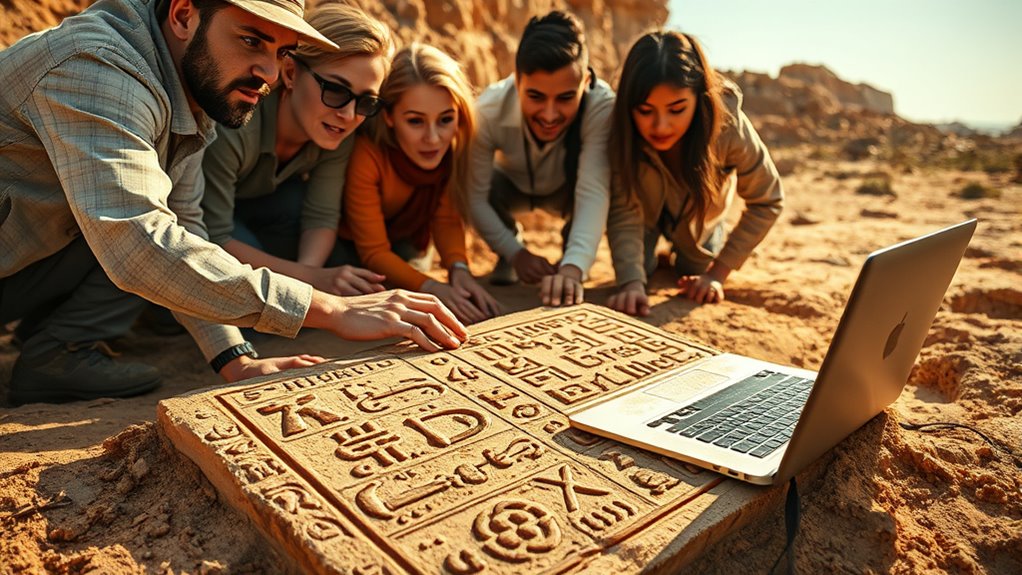
As researchers explore the mysteries of ancient civilizations, they’ve discovered that artificial intelligence is revolutionizing the way we decode forgotten scripts. You might be amazed at how AI tools are transforming archaeology, making it easier to interpret texts that have been lost to time. With advanced algorithms and machine learning techniques, AI can analyze patterns and symbols in ancient writings like never before. This means you can witness a new era of understanding our past, as these technologies enhance our ability to comprehend languages and scripts that once seemed indecipherable.
One of the standout benefits of using AI in archaeology is its remarkable precision. Traditional methods of deciphering ancient scripts often relied on the expertise of a few scholars, which could lead to subjective interpretations. However, AI doesn’t have biases or emotions; it processes data objectively. By training on vast amounts of linguistic data, AI can uncover correlations between symbols and their meanings with incredible accuracy. When you see AI at work, it’s like having a supercharged assistant that can sift through complex information in seconds, revealing insights that might take human experts years to figure out.
AI in archaeology offers unparalleled precision, objectively deciphering ancient scripts and uncovering insights faster than ever before.
Moreover, AI isn’t just about decoding; it’s also playing an essential role in preservation techniques. Many ancient artifacts are fragile and deteriorate over time, threatening their survival. AI can help create digital models of these artifacts, allowing you to explore and study them without physical contact. This means that even if the original pieces suffer damage, their digital counterparts remain intact for future generations. By combining AI with advanced imaging technologies, researchers are developing methods to digitally reconstruct damaged texts, providing a clearer picture of history.
You might be wondering how exactly this all works. AI systems are trained on a diverse range of ancient scripts, enabling them to recognize and categorize symbols. When you feed an incomplete or damaged text into the system, its algorithms can suggest possible reconstructions based on existing patterns. This way, the AI not only decodes the text but also aids in preserving valuable historical knowledge. As these systems advance, they may even incorporate color accuracy techniques to enhance the visual clarity of the texts being studied.

CZUR Aura Pro Book & Document Scanner,Capture A3 & A4, Auto-Flatten & Deskew Powered by AI Technology, Foldable & Portable, Compatible with Windows & Mac OS
Compatibility: Work with macOS 10.13 or later AND Windows XP/7/8/10/11
As an affiliate, we earn on qualifying purchases.
As an affiliate, we earn on qualifying purchases.
Frequently Asked Questions
What Specific Ancient Scripts Are Currently Being Decoded Using AI?
You’ll find that researchers are currently using AI to decode several specific ancient scripts, including cuneiform inscriptions and Mayan glyphs. These scripts, once considered nearly indecipherable, are being analyzed through advanced algorithms that identify patterns and meanings. By applying machine learning techniques, you can see how AI is transforming our understanding of these fascinating ancient languages, revealing insights into the cultures that created them and enhancing our knowledge of history.
How Accurate Is AI in Interpreting Ancient Languages?
AI accuracy in interpreting ancient languages can be surprisingly high, but it’s not infallible. You’ll find that AI systems rely on vast datasets and patterns to make sense of scripts. While they can decode and translate with impressive precision, they sometimes misinterpret nuances or context. It’s essential to combine AI findings with expert analysis to guarantee a deeper understanding. So, while AI aids in language interpretation, human insight remains invaluable.
What Role Do Human Archaeologists Play in the Decoding Process?
You can’t make a silk purse out of a sow’s ear. Human archaeologists bring crucial interpretive expertise to the decoding process, ensuring AI’s findings are accurate and meaningful. They provide essential cultural context that machines can’t grasp. By analyzing historical significance, social structures, and linguistic nuances, you help transform raw data into a thorough understanding of ancient scripts. Your role is irreplaceable, bridging the gap between technology and human insight.
Are There Ethical Concerns Regarding the Use of AI in Archaeology?
Yes, there are ethical concerns regarding the use of AI in archaeology. You should consider privacy concerns, especially when AI analyzes sensitive data or personal artifacts. Additionally, the potential for misrepresenting cultural heritage can arise if AI misinterprets or oversimplifies complex historical contexts. It’s essential for you to make certain that AI tools complement human expertise, respecting the integrity of the past while safeguarding the cultural narratives that define communities.
How Is AI Technology Evolving in the Field of Archaeology?
AI technology’s evolving rapidly in archaeology, driving digital preservation and enhancing research capabilities. You’ll notice machine learning advancements enabling faster data analysis, more accurate artifact classification, and improved site mapping. As algorithms refine their ability to recognize patterns, you’ll see archaeologists uncover hidden connections within ancient cultures. With AI’s growing role, the field’s becoming more efficient, allowing researchers to focus on interpretation while technology handles the heavy lifting of data processing.

2D & 3D CAD Software Suite USB – 8 Program Bundle for Windows & macOS – Complete Design & Drafting Tools
Ready-to-use software preloaded on a high-speed USB flash drive for easy installation on any Windows PC, no internet…
As an affiliate, we earn on qualifying purchases.
As an affiliate, we earn on qualifying purchases.
Conclusion
As archaeologists harness AI to decode ancient scripts, they’re revealing secrets that have remained hidden for centuries. This fusion of technology and history not only enhances our understanding of past cultures but also sparks curiosity about what other mysteries lie waiting in the shadows of time. Isn’t it fascinating to think that the stories of our ancestors could be just a code away from being revealed? The future of archaeology is bright, and it’s only just beginning.

Decoding the Antichrist and the End Times: What the Bible Says and What the Future Holds
As an affiliate, we earn on qualifying purchases.
As an affiliate, we earn on qualifying purchases.

Thames & Kosmos I Dig It! Treasure – Egyptian Artifacts Excavation Kit | Explore Archaeology, Ancient Egypt & Hieroglyphics | Dig Out Collectible Relics & Minerals | Safe, Fun Educational Activity
EGYPTIAN-THEMED DIG-OUT KIT! Assume the role of skillful archaeologist as you carefully excavate a plaster block (approximately 7"…
As an affiliate, we earn on qualifying purchases.
As an affiliate, we earn on qualifying purchases.