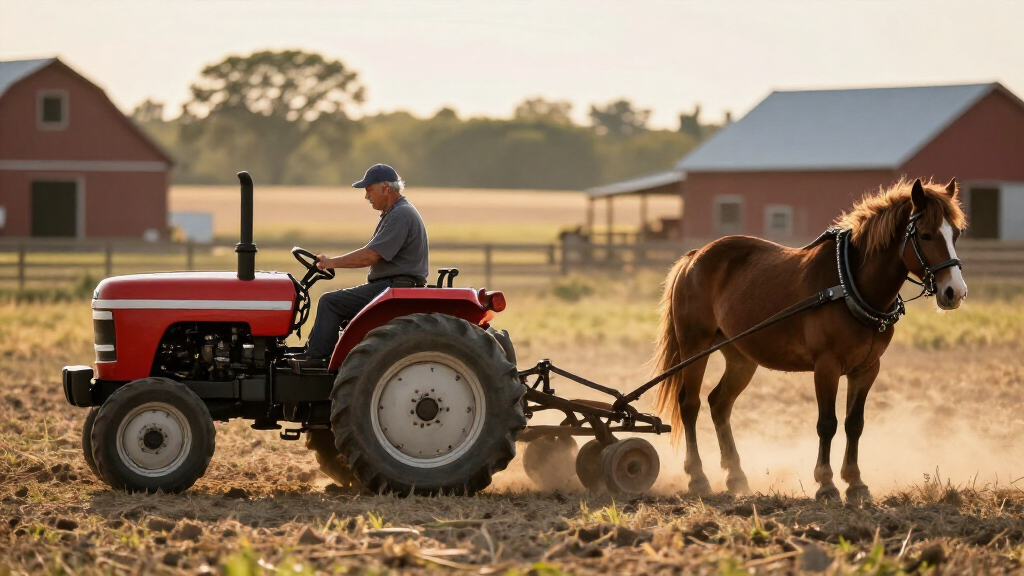

🔍 Read the full analysis: When Farm Work Shifted From Horses To Machines on ThorstenMeyerAI.com

Prime made for students and young adults
- Fast, free delivery for dorm and study essentials
- Prime Video and Amazon Music included
- Member-only deals
TL;DR
U.S. farm horses and mules peaked at 26.7 million in 1918, then fell to 3.1 million by 1960 as tractors and other machinery spread. Farm employment also declined while agricultural output per worker rose, but the history is an analogy—not proof—of what automation will do to people today.
U.S. farms went from relying on 26.7 million horses and mules in 1918 to 3.1 million in 1960 as tractors and other machinery took over much of their work, according to historical agricultural statistics summarized by ThorstenMeyerAI.com on November 4. The shift freed land previously used to grow animal feed and coincided with a steep decline in farm employment, offering a useful but limited comparison for debates about automation and workers today.
The figures cited in the report come from the U.S. Census Bureau’s Historical Statistics of the United States, Colonial Times to 1970, which reprinted Department of Agriculture estimates. Horses alone peaked at 21.4 million in 1915; mules continued increasing, bringing the combined total to 26.7 million on January 1, 1918. In 1915, about 93 million acres of harvested cropland—more than a quarter of the national total—grew feed for the animals.
Tractor adoption accelerated over the following decades. The report lists about 1,000 tractors on U.S. farms in 1910, 246,000 in 1920 and 4.69 million in 1960. Around 1955, its figures show tractors outnumbering farm horses and mules: 4.35 million to 4.31 million. By 1960, the working-animal count had fallen to 3.1 million. These estimates come from sources with differing dates and counting methods; the report notes that the series’ horse and mule counts were combined from 1951.
The change extended beyond tractors. Combine harvesters, which cut, thresh and clean grain in one pass, rose from about 4,000 on U.S. farms in 1920 to more than one million in 1960, the report says. Department of Agriculture estimates put the number of people supplied by each farm worker at 7.1 in 1910 and 47.1 in 1970; that last figure includes people abroad supplied through exports. The report also cites farm employment falling from 13.6 million in 1916 to 4.5 million in 1970, while the overall U.S. labor force doubled.
The Land and Labor Left Behind
The switch changed more than how farmers pulled ploughs or moved harvests. Feed crops took up land and required labor; as the number of working animals declined, that acreage could be used for crops intended for people or sale. The report puts the area devoted to horse and mule feed at about 5 million acres in 1960, down from 93 million in 1915. That is a major shift in agricultural resource use, though the figures alone do not show how much of the released land went to any particular crop.
Farm machinery also helped fewer workers produce a larger supply of food. The report’s measure of people supplied per farm worker rose over the period, while farm employment fell. Those trends matter to readers because productivity gains can reduce demand for some kinds of work even as they lower production costs or support growth elsewhere. They do not, by themselves, tell us what happened to each displaced worker or whether new jobs were available in the same places.
The report says the expanding jobs were increasingly in cities, making migration part of the adjustment. It describes no mass retraining program for horses: farmers stopped breeding replacements, and the working population aged out. Human workers, unlike horses, can move between occupations, but doing so may require new skills, relocation and time. That difference puts a limit on treating the animal transition as a direct forecast for people affected by current technologies.
Popular right now

KitchenAid Artisan 5-Quart Tilt-Head Stand Mixer, Almond Cream

Shark HydroVac MessMaster Wet/Dry Vacuum & Mop Combo (AW261)

iRobot Roomba 105 Combo Robot Vacuum and Mop
As an affiliate, we earn on qualifying purchases.
From Fordson to Farm Machinery
Gasoline tractors existed before World War I, but the report describes early models as heavy, expensive and better suited to large farms. Ford introduced the Fordson in 1917. The Henry Ford museum describes it as the first mass-produced, inexpensive lightweight tractor, designed for small farmers, and says it quickly became the most popular tractor in the United States. Its 100,000th unit left the assembly line on February 21, 1920.
Mechanization proceeded alongside other changes, including combine harvesters, corn pickers, balers and milking machines, as well as fertilizer and improved seed. The report’s figures document the growth in machinery and output, but they do not isolate the effect of tractors from these other developments. The rise in productivity is best understood as part of a broader change in farming, not the result of one machine alone.
The report connects the history to economist Wassily Leontief, who compared workers with horses displaced by tractors in 1983. It also notes a limit Leontief himself identified: horses could not vote. That distinction matters when considering public policy, workers’ rights and the social response to automation. A historical analogy can frame questions about displacement, but it cannot establish that human outcomes will follow the same path.
Limits of the Horse Comparison
The historical counts establish a large decline in farm horses and mules alongside rising tractor numbers, but they do not show exactly what happened to every animal or worker. The report says farmers stopped breeding replacement animals and the working population aged out; it does not provide a detailed account of individual animal fates. Nor do the employment totals trace how many former farm workers moved, changed occupations or left the labor force.
The comparison with present-day automation is more uncertain still. The source describes John Deere’s February 2025 16-camera autonomy kit as performing tillage on select large tractors, not as a general replacement for all farm labor. It also reports China’s claim that about 74% of ploughing, sowing and harvesting was mechanized in 2023, but does not supply the underlying methodology or a comparison with U.S. measures. These figures do not establish how many jobs current systems will eliminate or create.
Even the historical series requires care: tractor estimates for several census years use different dates, and horse and mule reporting changed over time. The report presents no analysis that separates machinery’s contribution from other changes in seed, fertilizer, farm size or markets. The horse analogy can illustrate displacement and adaptation, but it is not a law predicting the scale, pace or human consequences of future automation.
Automation’s Next Farm Tests
The near-term question is how far farm autonomy moves beyond specific tasks and selected equipment. The source report says John Deere’s autonomy kit is used for tillage on select large tractors; it does not describe broad deployment across farms or all agricultural work. Wider adoption would depend on factors the report does not detail, including operating costs, reliability, the range of tasks systems can handle and whether farms of different sizes can use them.
For readers assessing future claims, the most useful evidence will be measured adoption over time, clearly defined employment data and information about where affected workers find other work. Reports of mechanized operations, such as China’s stated 74% share in 2023, need a clear definition of which tasks and farms are included before they can be compared with other countries or years.
The historical record offers a starting point rather than a verdict: machinery sharply reduced the need for working animals, while farming output per worker increased and employment shifted. Whether today’s technologies produce comparable changes for people remains open. The next stages of adoption and better labor data will show how closely the analogy fits.
Key Questions
When did tractors outnumber horses and mules on U.S. farms?
According to the figures in the report, the totals crossed around 1955: 4.35 million tractors compared with 4.31 million horses and mules. The figures use historical series with differing dates and methods.
How many horses and mules worked on U.S. farms at the peak?
The combined farm population peaked at 26.7 million on January 1, 1918, according to estimates reprinted in the U.S. Census Bureau’s historical statistics. Horses alone peaked earlier, at 21.4 million in 1915.
Why did tractors appeal to farmers?
Unlike horses, tractors did not need feed every day when they were not working. The land used to grow feed could instead grow crops for people or sale. Early tractors were expensive and heavy, while the Fordson, introduced in 1917, was designed as a lighter, less expensive option for small farmers.
Does the history prove that automation will replace human workers?
No. It shows that machinery displaced working animals and changed farm production, but it does not predict the effects of current technologies on people. Humans can vote, move between jobs and respond politically—differences the report says limit the horse analogy.
What do current farm automation examples show?
The report describes John Deere’s February 2025 16-camera autonomy kit as handling tillage on select large tractors. It also cites China’s claim that about 74% of ploughing, sowing and harvesting was mechanized in 2023. Neither figure, as presented, establishes the effect on jobs or indicates that all farm tasks are automated.
Source: ThorstenMeyerAI.com