
🔍 Read the full analysis: AI In Action: Building A Digital Memory Of La Citadelle’s 1693 Siege on ThorstenMeyerAI.com

Prime made for students and young adults
- Fast, free delivery for dorm and study essentials
- Prime Video and Amazon Music included
- Member-only deals
TL;DR
An AI-generated interactive digital exhibit reconstructs the 1693 siege of La Citadelle, offering a cinematic, scroll-driven experience. The project uses advanced code-driven visuals to balance education and artistry.
An AI-powered digital exhibit has been launched, recreating the 1693 siege of La Citadelle with a high degree of historical fidelity and artistic storytelling. The project features a dynamic, scroll-driven simulation built entirely with code, without static images, to provide an immersive experience that balances educational content with visual artistry. You can explore the detailed reconstruction in La Citadelle — An Anatomy of Siege, 1693: A Digital Archive Built by AI for Interactive History.
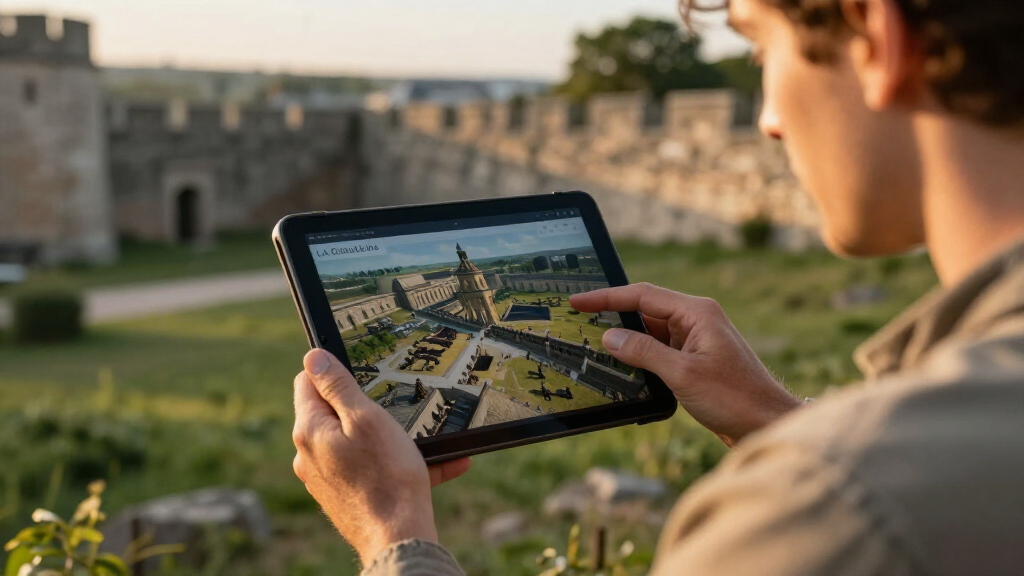
The exhibit, hosted on a dedicated website, employs layered SVGs, CSS, and canvas elements to animate a cinematic siege tableau. It features a detailed digital map of La Citadelle, where military movements, earthworks, and artillery fire are animated in real time, simulating the events of the historic siege. The entire experience is orchestrated by AI-guided workflows that ensure visual coherence, responsiveness, and historical plausibility, with final approval by an art director. This approach exemplifies how AI can assist in creating complex digital reconstructions of historical events.
According to the creators, the project follows a three-stage pipeline: initial construction using layered code, iterative critique driven by AI analysis, and final aesthetic approval. The site’s design emphasizes a restrained color palette inspired by archival materials, combining parchment, fortress ink, and vivid red accents, with typography that balances monumentality and clarity. The signature interaction involves a multi-layered SVG siege map, where trenches, fortifications, and trajectories animate in sync with user scrolls, creating a cinematic sense of the siege unfolding over days.
Developers highlight that all visual elements are generated through code, with no static images or external assets, ensuring scalability and fidelity across devices. The project aims to demonstrate how AI can craft complex, layered history exhibits that are both educational and artistically compelling, without relying on traditional image assets. For more on AI-driven digital history projects, see the original analysis.
Innovative Use of AI for Historical Digital Reconstruction
This project exemplifies how artificial intelligence can transform historical education by creating immersive, visually rich reconstructions of past events. It demonstrates the potential for AI to assist in digital humanities, enabling detailed, scalable, and interactive exhibits that are accessible across devices. For educators, historians, and technologists, this approach offers a new way to engage audiences with history, providing a cinematic, explorable experience that enhances understanding of complex military sieges like that of La Citadelle in 1693.
Moreover, the project pushes forward the boundaries of web-based visualization, showing that code-driven, image-free visualizations can be both beautiful and precise. This could influence future digital museums, interactive history displays, and educational tools, making historical reconstructions more dynamic, customizable, and engaging.
interactive digital history exhibit
As an affiliate, we earn on qualifying purchases.
As an affiliate, we earn on qualifying purchases.
Background on La Citadelle and Digital Reconstruction Efforts
La Citadelle, a star-shaped fortress, was the site of a significant siege in 1693, during a period marked by frequent European military conflicts. Historically, the siege involved complex military maneuvers, trench digging, artillery bombardments, and strategic sorties, which have been documented through engravings and written accounts. However, existing visual and textual records are limited in providing an immersive understanding of the event.
Recent advances in AI and web technologies have enabled digital artists and historians to create interactive reconstructions that go beyond static images and text. This project builds upon prior efforts to digitize historical sites and battles, but distinguishes itself by its entirely code-based, image-free approach, emphasizing layered SVGs, CSS animations, and canvas rendering. The goal is to produce a cinematic, explorable experience that faithfully represents the siege while allowing viewers to engage with the event dynamically.
According to the creators, the project follows a meticulous workflow involving AI critique at each stage, ensuring both historical accuracy and aesthetic quality. The digital siege map incorporates geometric principles from Vauban’s fortification designs, illustrating the strategic angles and earthworks involved in the siege. The entire process is guided by a detailed manual authored by an AI assistant, emphasizing layered architecture, precise interactions, and emotional storytelling.
“This project demonstrates the potential of AI to craft detailed, interactive historical reconstructions that are both educational and artistically compelling.”
— Thorsten Meyer
AI-driven historical reconstruction software
As an affiliate, we earn on qualifying purchases.
As an affiliate, we earn on qualifying purchases.
Remaining Questions About Accuracy and Interactivity
While the exhibit claims high fidelity to historical events, it is not yet clear how closely the animations and reconstructions align with primary sources or archaeological data. The AI critique process aims to ensure plausibility, but some details—such as the precise movements of troops and artillery—are based on interpretive algorithms rather than direct historical records. Additionally, the extent of user interactivity and how it influences the narrative remains to be fully demonstrated.
It is also uncertain how scalable or adaptable this approach is for other historical events, or whether future iterations will incorporate more detailed data or user-driven customization. The project’s reliance on code and layered SVGs offers flexibility, but the accuracy of the simulation depends on the underlying algorithms and data inputs, which are not publicly detailed at this stage.
scroll-based web visualization tools
As an affiliate, we earn on qualifying purchases.
As an affiliate, we earn on qualifying purchases.
Future Developments and Potential Expansions
Developers plan to further refine the exhibit by integrating more detailed historical data and expanding interactive features, such as allowing users to explore different siege scenarios or perspectives. There is also interest in applying this code-based approach to other historical battles and sites, potentially creating a library of interactive reconstructions accessible to educators and museums.
Additionally, the team aims to explore more sophisticated AI critique mechanisms to enhance accuracy and responsiveness, as well as to incorporate user feedback to improve engagement. As the project is open for public access, ongoing testing and community input will likely shape future updates, making the exhibit more immersive and educationally valuable.
Ultimately, this initiative sets a precedent for AI-driven digital history, blending technological innovation with scholarly rigor to produce engaging, scalable, and accurate virtual reconstructions of the past.
digital map projection for history
As an affiliate, we earn on qualifying purchases.
As an affiliate, we earn on qualifying purchases.
Key Questions
How accurate is the reconstruction of the 1693 siege?
The reconstruction aims for high historical plausibility, guided by AI critique and manual approval, but some details are interpretive rather than directly sourced from primary documents.
Can users interact with the exhibit to explore different scenarios?
Yes, the exhibit features scroll-driven animations and layered interactions, allowing users to explore the siege from various angles, though customization options are still being developed.
What technologies are used to build this digital reconstruction?
The project employs layered SVGs, CSS animations, and canvas elements, all generated through code without static images, ensuring scalability and fidelity across devices.
Will this approach be used for other historical events?
Developers intend to expand this methodology to other battles and sites, creating a library of AI-generated interactive reconstructions for educational and cultural institutions.
Source: ThorstenMeyerAI.com
Halloween Picks
halloween
As an affiliate, we earn on qualifying purchases.