
TL;DR

Prime made for students and young adults
- Fast, free delivery for dorm and study essentials
- Prime Video and Amazon Music included
- Member-only deals
Thorsten Meyer AI has published a headline-only item titled “How to Reduce Heat and Noise in a High-Power AI Workstation.” The available source confirms the topic but does not provide the article body, so specific recommendations cannot be verified from the supplied material.
Thorsten Meyer AI has published a headline-only item titled “How to Reduce Heat and Noise in a High-Power AI Workstation”, pointing to rising reader interest in managing thermals and acoustics as desktop systems take on heavier AI workloads.
The supplied source confirms the headline and topic, but the original article body could not be extracted. Because of that, no specific steps, product recommendations, benchmark results, or configuration claims can be verified from the provided material.
The confirmed development is narrow: the article topic concerns heat and noise reduction in high-power AI workstations. The source does not state whether the guidance covers hardware layout, cooling upgrades, GPU power limits, fan curves, room airflow, sound damping, or workload scheduling.
Readers should treat any detailed method beyond the headline as unconfirmed unless it is supported by additional source text or direct testing. In workstation cooling, results can vary by case design, GPU model, CPU cooler, ambient temperature, fan placement, dust buildup, and workload type.
Why It Matters
Heat and noise are practical limits for local AI workstations. Systems used for model training, fine-tuning, inference, rendering, or data-heavy development often run high-wattage CPUs and GPUs for long periods, which can raise component temperatures and fan noise.
For readers building or maintaining an AI workstation, the topic matters because poor thermal control can lead to throttling, unstable performance, shorter component life, and an unpleasant work environment. Noise also affects shared offices, home studios, and long work sessions where constant fan ramping can become disruptive.
The headline points to a real operational concern, but the supplied material does not confirm which fixes the publisher recommends or whether those fixes were tested.
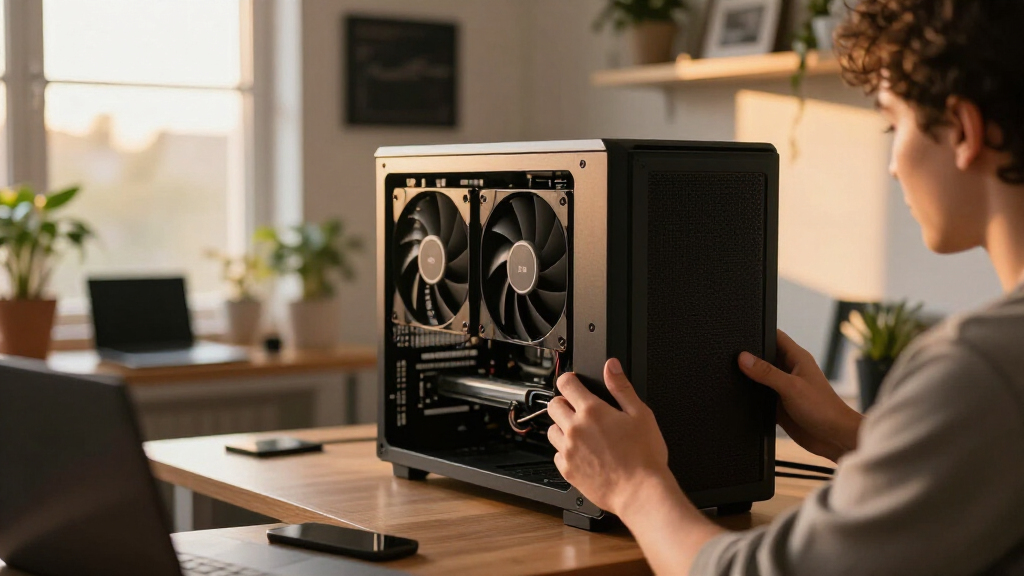
high-performance PC cooling fans
As an affiliate, we earn on qualifying purchases.
As an affiliate, we earn on qualifying purchases.
Background
High-power AI workstations commonly combine multi-core processors, large GPUs, fast memory, and dense storage. Those parts can draw substantial power when running sustained AI workloads, producing heat that must be moved out of the case and away from the user.
Commonly discussed approaches in workstation practice include improving case airflow, using larger or higher-quality fans, tuning fan curves, managing GPU power limits, cleaning filters, separating hot exhaust paths, and reducing unnecessary background load. These are general practices, not confirmed recommendations from the supplied Thorsten Meyer AI article.
The missing article body limits what can be reported about the publisher’s actual advice. No test setup, measurements, before-and-after results, or named workstation configuration was available in the provided source material.
“How to Reduce Heat and Noise in a High-Power AI Workstation”
— Thorsten Meyer AI headline
GPU cooling solutions for AI workstations
As an affiliate, we earn on qualifying purchases.
As an affiliate, we earn on qualifying purchases.
What Remains Unclear
It is not yet clear what specific advice the Thorsten Meyer AI article gives, whether the guidance is based on testing, or which workstation class it addresses. The source material does not confirm any temperature targets, noise measurements, hardware examples, or cooling products.
sound dampening computer case panels
As an affiliate, we earn on qualifying purchases.
As an affiliate, we earn on qualifying purchases.
What’s Next
The next step is to review the full article text if it becomes available, then separate tested recommendations from general guidance. Readers acting before that should verify any cooling change against their own system temperatures, fan noise, warranty limits, and workload needs.
Source: Thorsten Meyer AI
As an affiliate, we earn on qualifying purchases.
Key Questions
What was confirmed by the supplied source?
The supplied source confirms only the headline and topic: Thorsten Meyer AI published or listed an item about reducing heat and noise in a high-power AI workstation.
Did the source provide specific cooling recommendations?
No. The article body could not be extracted, so specific recommendations cannot be attributed to the source from the material provided.
Why does heat matter in an AI workstation?
Sustained AI workloads can keep CPUs and GPUs under heavy load for long periods. If heat is not removed well, systems may run louder, throttle performance, or become less stable.
Why does noise matter for workstation users?
Fan noise can affect concentration, calls, recordings, and shared spaces. In high-power systems, noise often rises when cooling systems respond to sustained heat.
What remains unknown?
The supplied material does not show the full article, test methods, recommended parts, measured results, or the specific workstation configuration discussed.
Source: Thorsten Meyer AI
Evergreen bestsellers Picks
bestsellers
As an affiliate, we earn on qualifying purchases.