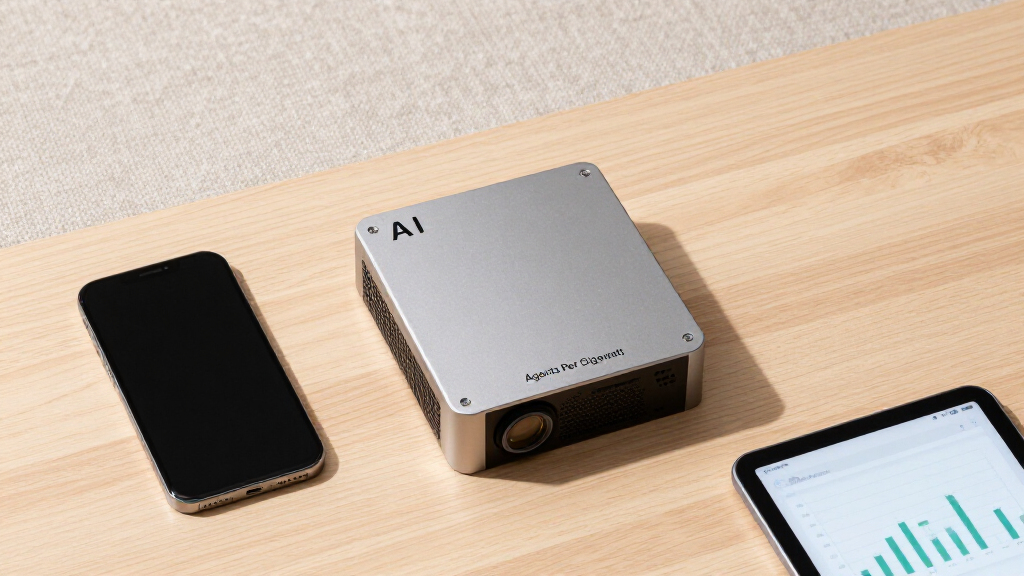

📊 Full opportunity report: Introducing A New AI Power Unit: Agents Per Gigawatt on ThorstenMeyerAI.com — validation score, market gap, and execution plan.

Prime made for students and young adults
- Fast, free delivery for dorm and study essentials
- Prime Video and Amazon Music included
- Member-only deals
TL;DR
A new unit, agents per gigawatt, has been proposed to measure AI capacity based on energy conversion efficiency. This shift highlights the importance of power availability in scaling autonomous cognition, affecting industry, geopolitics, and infrastructure.
The concept of agents per gigawatt has been introduced as a new unit to measure the capacity of autonomous AI systems, emphasizing the role of energy in scaling cognitive work. This development signals a fundamental shift in how technological and national power are quantified, moving away from traditional metrics like GDP.
Thorsten Meyer, a thinker on economic and technological metrics, proposes agents per gigawatt as the primary measure of AI capacity, directly linking it to the amount of energy available for computation. This comes amid a surge in AI infrastructure investments, such as data centers and specialized hardware, driven by the need to maximize autonomous cognitive output.
The core idea is that power—specifically, gigawatts of electricity—sets the limit for how many AI agents can operate simultaneously. The more efficiently energy is converted into cognitive work, the higher the agents per gigawatt ratio, which reflects a system’s productive capacity. This reframes industry efforts, infrastructure buildouts, and even geopolitical strategies around energy availability and technological efficiency.
Every era measures power in whatever is scarce: land, then steel, then GDP. The binding constraint is changing again — and the new unit is how much autonomous cognition a nation or company can produce per unit of energy it can command.
▲ Opinion & analysis · not investment adviceMore agents means more tokens, which takes compute, which takes chips, which take one thing above all — power. The energy story and the AI story became the same story.
Once you hold it, the separate stories of the moment stop being separate — they’re all the same ratio, seen from different angles.
Adopting it drags three things into the open that softer framings let you avoid.
And the unit rewards concentration — unless we deliberately build against it.
Implications of the Agents Per Gigawatt Metric
This new metric shifts the focus from traditional economic indicators to the energy-to-cognition conversion capacity, affecting how countries and companies measure technological and economic power. It emphasizes that power infrastructure—such as nuclear plants, data centers, and energy grids—is now the backbone of AI development and national competitiveness. As a result, investments in energy generation and hardware optimization become central to AI growth and sovereignty.
Furthermore, this perspective highlights vulnerabilities, such as Europe's reliance on imported chips and energy, which could limit its sovereign agents per gigawatt capacity. The framing clarifies the strategic importance of energy independence and hardware innovation in the AI era.
As an affiliate, we earn on qualifying purchases.
The Evolution of Power and AI Infrastructure
Historically, national power was measured by tangible assets like land, steel, or GDP. In the current era, the rise of autonomous AI agents shifts the productive focus from human labor to energy-dependent cognition. Recent investments in data centers, specialized chips, and energy infrastructure reflect this transition, as industry leaders compete to maximize agents per gigawatt.
Thorsten Meyer notes that the buildout of AI hardware—including low-voltage chips, optical interconnects, and cooling systems—is fundamentally aimed at increasing the agents per gigawatt ratio. This aligns with broader trends where energy and hardware efficiency determine the capacity for autonomous decision-making at scale.
"The honest unit of productive capacity is not the number of chips or the cleverness of models, but the rate at which energy is converted into intelligence."
— Thorsten Meyer
As an affiliate, we earn on qualifying purchases.
Uncertainties About Practical Implementation
It is still unclear how quickly the agents per gigawatt metric will be adopted across industry and government. The precise impact on existing infrastructure investments and geopolitical strategies remains to be seen, as the concept is still emerging and not yet formalized in industry standards.
As an affiliate, we earn on qualifying purchases.
Next Steps for Industry and Policy Development
Further discussions are expected to clarify how this metric will influence investment decisions, infrastructure planning, and national strategies. Industry leaders and policymakers may begin to incorporate agents per gigawatt into their assessments of AI capacity, energy planning, and technological sovereignty in the coming months.
As an affiliate, we earn on qualifying purchases.
Key Questions
What exactly does agents per gigawatt measure?
It measures the number of autonomous AI agents that can operate per unit of energy (gigawatt), reflecting the efficiency of converting power into cognitive work.
Why is energy so central to AI capacity now?
Because the core limitation on scaling autonomous cognition is the ability to produce and deliver enough power to run large numbers of AI agents efficiently.
How might this change industry investments?
Investments may shift toward energy infrastructure, low-power hardware, and technologies that improve the energy-to-cognition conversion rate, optimizing agents per gigawatt.
Will this affect national competitiveness?
Yes, countries with abundant, reliable energy and advanced hardware will have higher agents per gigawatt capacity, influencing global AI and technological sovereignty dynamics.
Is this metric officially recognized yet?
No, it is a conceptual framework proposed by Thorsten Meyer and industry analysts; formal adoption is still forthcoming.
Source: ThorstenMeyerAI.com
Halloween Picks
halloween
As an affiliate, we earn on qualifying purchases.