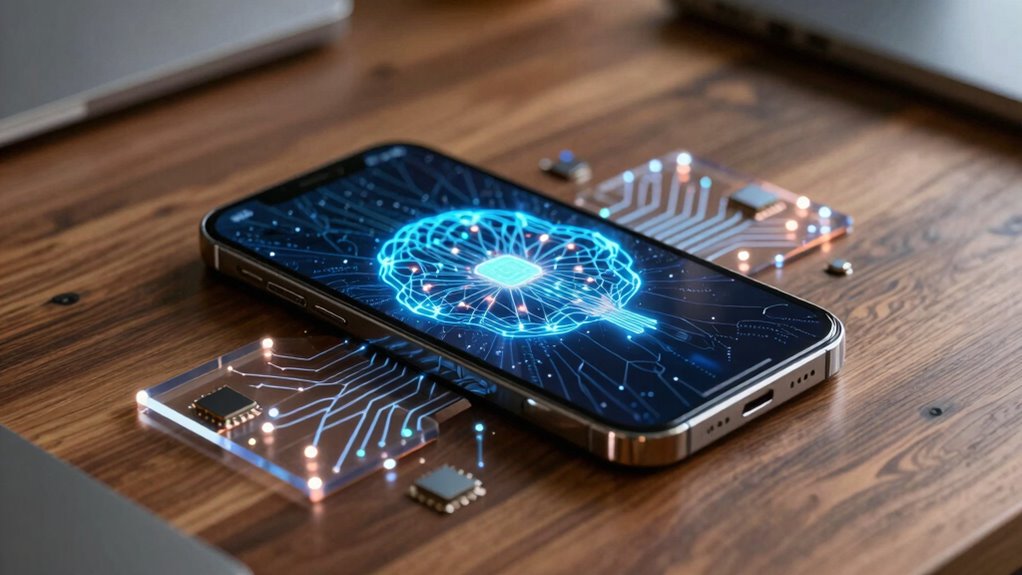

When AI lives on your device instead of the cloud, your personal data stays closer and more secure, reducing exposure risks. You’ll experience faster responses and real-time reactions, even offline or in poor network areas. It also uses less energy by minimizing data transmission, making your device more efficient and sustainable. Plus, you won’t rely on continuous internet access, which keeps everything running smoothly. If you want to understand how these benefits work together, keep exploring.

Prime made for students and young adults
- Fast, free delivery for dorm and study essentials
- Prime Video and Amazon Music included
- Member-only deals
Key Takeaways
- Personal data stays on the device, reducing exposure and enhancing user privacy.
- Responses are faster due to immediate local processing, enabling real-time interactions.
- Devices become more reliable and functional offline, not dependent on internet connectivity.
- Energy consumption decreases by minimizing data transmission to cloud servers.
- Hardware advancements allow for more complex AI tasks directly on the device.

As artificial intelligence becomes more integrated into everyday life, it’s increasingly common for AI to live directly on your devices rather than in the cloud. This shift means that your smartphone, tablet, or even your smart home gadgets are becoming smarter and more responsive because the AI processes data locally. This change impacts your experience in two significant ways: data privacy and processing speed.
When AI resides on your device, your personal data stays closer to you, reducing the risk of exposure. You don’t need to send sensitive information across the internet to cloud servers, which can be vulnerable to breaches or misuse. This local processing keeps your private data within your device, giving you more control over what’s shared and when. As a result, you gain peace of mind knowing that your conversations, images, and habits aren’t constantly transmitted elsewhere. This setup aligns with growing concerns about data privacy, making it easier for you to safeguard your personal information. Additionally, local data processing can reduce energy consumption by minimizing data transmission, contributing to more sustainable device operation.
Another major advantage of on-device AI is its processing speed. Since the data doesn’t have to travel over the internet to reach distant servers, responses happen almost instantaneously. You notice this when your device recognizes your voice commands quickly or suggests relevant content without noticeable lag. This immediate responsiveness enhances your user experience because the AI can act on your inputs in real-time, whether you’re adjusting your smart thermostat or dictating a message. The reduction in latency is especially valuable in situations that require quick reactions, like emergency commands or real-time translations. Moreover, hardware advancements are making it possible for devices to handle more complex AI tasks locally, further expanding the potential of on-device AI. As these hardware improvements continue, they open new possibilities for embedded AI to be integrated into a wider range of everyday devices.
Additionally, processing speed improves because local AI can prioritize tasks more efficiently. It doesn’t need to wait for the cloud to handle complex computations, which can take seconds or longer. Instead, your device’s hardware can be optimized for specific AI functions, making these operations faster and more reliable. This efficiency not only benefits your daily interactions but also reduces reliance on constant internet connectivity. You can enjoy a more seamless experience even when offline or in areas with poor network coverage. Additionally, advancements in hardware capabilities are steadily making on-device AI more powerful and accessible, further expanding its potential uses.
As an affiliate, we earn on qualifying purchases.
Frequently Asked Questions
How Does Device-Based AI Impact User Privacy?
Device-based AI enhances your data privacy by keeping sensitive information on your device, reducing the risk of data breaches. It gives you more user control, allowing you to decide what data to share and when. Since your data doesn’t need to leave your device, you have greater security and privacy. This setup minimizes exposure, helping you feel more confident that your personal information stays private and under your control.
What Are the Energy Consumption Differences Between Device and Cloud AI?
When AI runs on your device, edge computing allows for more power efficiency compared to cloud AI. You use less energy because data processing happens locally, reducing the need for constant data transmission to remote servers. Cloud AI consumes more power due to large data centers and continuous internet connectivity. So, device-based AI enhances power efficiency, conserving energy and reducing environmental impact, especially when optimized for local processing.
Can Device AI Systems Learn and Adapt Over Time?
Yes, device AI systems can learn and adapt over time. This enables personalization benefits, making your experience more tailored and relevant. Since processing occurs locally, you’ll notice latency improvements, allowing for quicker responses without relying on cloud connectivity. As you interact more, the device refines its algorithms, providing smarter, more efficient functionality. This continuous adaptation creates a seamless, personalized experience that evolves with your needs.
How Secure Is AI Stored Directly on Devices?
Your AI stored directly on devices benefits from edge computing, reducing reliance on cloud servers, but security isn’t foolproof. While data encryption safeguards your information, vulnerabilities remain if the device’s security is compromised. Unlike cloud storage with centralized protections, on-device AI faces risks from physical access or malware. So, your device’s security measures are essential to keep AI data safe, balancing convenience with potential exposure.
What Hardware Requirements Are Necessary for On-Device AI?
To run AI on your device, you’ll need hardware capable of supporting edge computing and local processing. This includes a powerful processor, sufficient RAM, and dedicated AI chips or accelerators like GPUs or NPUs. Your device should have ample storage for models and data, plus a stable power source. These requirements guarantee efficient, real-time AI performance without relying on cloud connectivity, making your device smarter and more autonomous.
As an affiliate, we earn on qualifying purchases.
Conclusion
So, imagine AI living right on your device, not just helping you but becoming an unstoppable force in your pocket. With all its power tucked inside, you might think you’ve gained ultimate control, but in reality, you’ve unleashed a digital beast that’s constantly watching, learning, and adapting—more intelligent than you ever imagined. It’s not just about convenience anymore; it’s about handing over the keys to a mind that never sleeps, forever changing what it means to be truly connected.
As an affiliate, we earn on qualifying purchases.
As an affiliate, we earn on qualifying purchases.
Halloween Picks
halloween
As an affiliate, we earn on qualifying purchases.