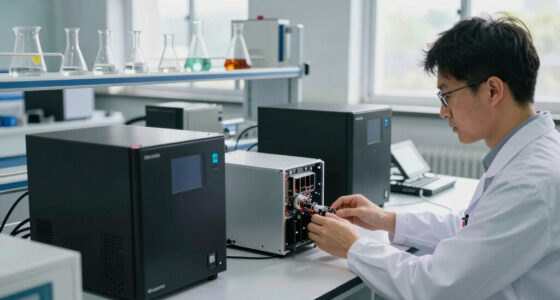
As AI’s applications grow, hardware efficiency becomes a big deal because it directly impacts performance, energy use, and sustainability. Faster data processing and optimized architectures allow for more scalable and cost-effective solutions. Specialized chips and innovations can reduce environmental impact while tackling complex tasks. If you keep exploring, you’ll discover how ongoing hardware advancements are shaping a more sustainable and powerful AI future that benefits everyone.

Prime made for students and young adults
- Fast, free delivery for dorm and study essentials
- Prime Video and Amazon Music included
- Member-only deals
Key Takeaways
- Growing AI applications demand faster data processing, making hardware efficiency critical for performance.
- Larger neural networks increase energy consumption, emphasizing the need for energy-efficient hardware solutions.
- Specialized AI accelerators improve performance while reducing operational costs and environmental impact.
- Efficient hardware design minimizes resource use, supporting sustainable and scalable AI deployment.
- Continuous hardware innovation is essential to meet evolving AI model demands and ensure long-term viability.

As artificial intelligence becomes more integral to technology, optimizing hardware efficiency is essential to keep up with growing demands. The rapid expansion of AI applications—whether in healthcare, finance, or autonomous vehicles—places immense pressure on hardware systems. To handle complex tasks like neural network optimization, your hardware must process vast amounts of data quickly and accurately. But as these models grow larger and more sophisticated, they also consume more energy. Managing energy consumption becomes a vital factor, not just for cost savings but also for sustainability. If your hardware isn’t efficient, you risk bottlenecks that slow down AI performance and hike operational costs. That’s why understanding and improving AI hardware efficiency is now a top priority. Additionally, incorporating color accuracy considerations into hardware design can improve the precision of AI-driven image and video processing tasks.
You need hardware that can power neural network optimization without draining resources. Larger neural networks demand more computational power, which leads to increased energy consumption. Efficient hardware design helps balance this demand by reducing unnecessary processing and optimizing data flow. When your hardware is optimized for AI workloads, it can deliver faster training times, quicker inference, and lower energy use—all essential for scaling AI solutions effectively. This efficiency isn’t just about saving money; it’s about enabling your AI systems to operate sustainably over time. As AI models become more complex, the importance of hardware that can handle these demands without excessive energy expenditure grows exponentially. Emphasizing hardware architecture innovations can further enhance performance while reducing environmental impact. Incorporating natural pool features can also complement AI-driven environmental monitoring systems for more sustainable solutions.
The shift toward specialized AI hardware, like AI accelerators and tensor processing units, exemplifies this focus on efficiency. These devices are designed specifically for neural network tasks, offering higher performance with less energy consumption compared to traditional CPUs and GPUs. If you’re deploying AI at a large scale, investing in these specialized chips can dramatically reduce operational costs and environmental impact. Furthermore, advancements in hardware architecture, such as low-power chips and more efficient memory management, directly contribute to better neural network optimization. These innovations allow you to do more with less, making AI deployment more feasible and sustainable across different industries.
Ultimately, the push for AI hardware efficiency is about maximizing performance while minimizing resource use. Whether you’re working on developing new AI models or deploying existing systems, understanding how to optimize your hardware for energy efficiency and neural network performance is vital. It determines not just the speed and cost-effectiveness of your AI solutions but also their long-term viability. As AI continues to evolve, so must your approach to hardware—focusing on smarter, more efficient designs that support the future of AI innovation without exhausting resources.
As an affiliate, we earn on qualifying purchases.
Frequently Asked Questions
How Does AI Hardware Efficiency Impact Consumer Device Battery Life?
AI hardware efficiency directly impacts your device’s battery life through better power management and energy optimization. When AI chips consume less energy, your device runs longer between charges, especially during intensive tasks like voice recognition or image processing. By improving efficiency, manufacturers enable smoother performance without draining your battery quickly. So, smarter, more energy-efficient AI hardware means you get more usage out of your device before needing to recharge.
What Industries Benefit Most From Improved AI Hardware Efficiency?
You probably think industries like gaming or smartphones benefit most, but think bigger—AI chipsets revolutionize data centers and healthcare. Enhanced efficiency means faster processing, lower energy costs, and greener operations. Data centers, in particular, squeeze more juice from less power, saving billions and reducing environmental impact. So, while you enjoy smoother apps, these industries get a turbo boost, proving that smarter hardware isn’t just good for your device—it’s good for the planet.
Can AI Hardware Efficiency Reduce Overall Energy Consumption Globally?
Yes, AI hardware efficiency can reduce global energy consumption by enabling better energy optimization. When AI systems run more efficiently, they use less power, cutting down on unnecessary energy use. This supports sustainability initiatives by decreasing carbon emissions and conserving resources. As you adopt more efficient AI hardware, you contribute to a greener future, helping to lower overall energy demands and promote environmentally responsible technology development.
How Do Hardware Efficiency Improvements Influence AI Model Development Costs?
Hardware efficiency improvements lead to significant energy savings, which directly reduce AI model development costs. When your hardware consumes less power, you spend less on energy bills and infrastructure, making the entire process more affordable. This cost reduction allows you to allocate resources toward refining models or expanding projects. Ultimately, enhanced hardware efficiency streamlines development, cuts expenses, and accelerates AI innovation without sacrificing performance or accuracy.
What Are the Future Trends in AI Hardware Design for Efficiency?
You’re on the cutting edge of AI hardware design, where future trends focus on boosting efficiency. Quantum computing promises revolutionary speed and power, while neuromorphic chips mimic brain processes for smarter, faster processing. These innovations aim to reduce energy consumption and hardware costs, making AI more accessible. As the saying goes, “the best is yet to come,” and these advancements will shape AI’s evolution for years to come.
energy-efficient neural network chips
As an affiliate, we earn on qualifying purchases.
As an affiliate, we earn on qualifying purchases.
Conclusion
As you explore the world of AI hardware, you’ll find that boosting efficiency isn’t just about saving energy—it’s about revealing even greater potential in your projects. When hardware works smarter, not harder, you’ll enjoy smoother performance and longer-lasting devices, making your innovations more delightful and sustainable. Embracing efficiency gently guides you toward a future where technology seamlessly supports your ambitions, all while treading lightly on our planet’s precious resources.
As an affiliate, we earn on qualifying purchases.
As an affiliate, we earn on qualifying purchases.
Fall Picks
fall essentials
As an affiliate, we earn on qualifying purchases.