
📊 Full opportunity report: Turning Practice Into Progress: IEP Simulators For Parent Negotiation on IdeaNavigator AI — validation score, market gap, and execution plan.
TL;DR
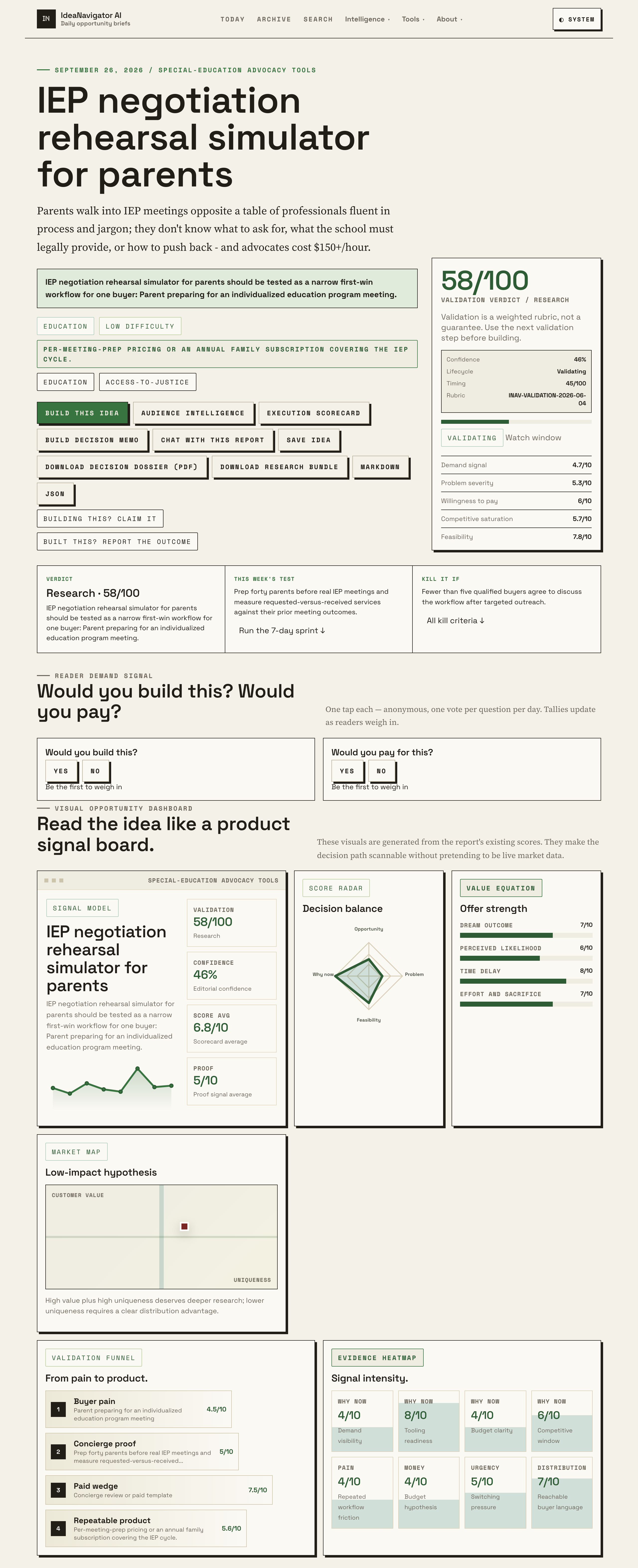
IdeaNavigator AI has published a proposal for an AI-powered IEP meeting rehearsal simulator that would let parents upload documents, learn their entitlements in plain language, and role-play negotiations with realistic pushback. The concept targets a narrow first-use case: a parent preparing for an individualized education program meeting. Validation would involve prepping forty parents and comparing requested-versus-received services against prior outcomes.
A new proposal from IdeaNavigator AI lays out a plan for an AI-driven IEP meeting simulator that would let parents rehearse special-education negotiations before sitting across the table from school staff. The concept, published as a narrow “first-win” workflow, targets a single buyer — a parent preparing for an individualized education program (IEP) meeting — and includes a defined minimum product, a pricing model, and a forty-parent validation plan.
According to the proposal, the core problem is informational asymmetry. Parents typically enter IEP meetings facing a table of professionals who are fluent in special-education process and jargon, while the parents themselves may not know what to ask for, what the school district is legally required to provide, or how to push back when requests are declined. Professional advocates who can bridge that gap charge $150 or more per hour, a cost the proposal identifies as a barrier for many families.
The proposed minimum viable product works in three stages. First, the parent uploads their child’s current IEP and evaluation reports. The system then explains the family’s entitlements in plain language and generates a request list with legal grounding attached to each item. Finally, the simulator role-plays the meeting itself — including realistic pushback from the school-side participants — repeating until the parent can hold their positions under pressure.
The proposal identifies two revenue models: per-meeting-prep pricing or an annual family subscription that covers the full IEP cycle, which typically includes annual reviews, re-evaluations, and any interim amendment meetings. The target market is described as special-education advocacy tools, a category that currently includes human advocates, paid prep courses, and document templates rather than interactive rehearsal products.
Why Meeting Rehearsal Matters Now
The proposal’s stated timing argument rests on two converging trends. First, large language model role-play has reached a quality level where simulated conversations can plausibly resemble a real IEP meeting, including adversarial moments — something earlier chatbot technology could not reliably do. Second, according to the proposal, special-education identification rates keep climbing while district resources tighten, a combination the proposal says is making IEP meetings more adversarial as schools and families compete for limited services.
For families, the practical stakes are concrete. The services written into an IEP — therapy hours, classroom accommodations, aide support — determine what a child actually receives for a full school year. A parent who arrives unprepared may accept a weaker plan simply because they did not know what to request or lacked the language to contest a refusal. A rehearsal tool that rehearses both the legal grounding and the negotiation itself could shift that dynamic, if it works as described.
The narrow scope is deliberate. By designing for one buyer in one situation — the parent walking into a scheduled meeting — the proposal avoids the broader and more crowded market of general parenting or education apps, focusing on a moment where the parent’s need is immediate and the outcome is measurable.
The Advocacy Gap Parents Face
An IEP is the legally binding document required in the United States under the Individuals with Disabilities Education Act (IDEA) for students who qualify for special-education services. Meetings to draft or revise the IEP typically include teachers, specialists, and administrators, and parents are legally entitled to participate as equal members of the IEP team — a right that is difficult to exercise without knowledge of entitlements and process.
Families who can afford it often hire special-education advocates, who charge hourly rates the proposal pegs at $150 and above, to attend meetings, interpret evaluations, and negotiate service levels. Families who cannot afford advocacy frequently rely on free resources such as parent training centers, printed guides, and online forums, which provide information but not practice. The proposed simulator would sit between these options: more interactive than a guide, cheaper than a hired advocate.
The concept is a proposal only. No product has been built, no company has been named, and no pilot results exist. The idea reflects a broader pattern of applying LLM-based role-play — already used in sales training, interview preparation, and medical communication practice — to a domain where rehearsal has historically been expensive or unavailable.
What the Proposal Hasn’t Proven
The most important open question is effectiveness: no parent has yet used the proposed simulator before a real meeting, so there is no evidence that rehearsal improves requested-versus-received service outcomes. The forty-parent validation plan is designed to answer exactly this, but it has not been run.
Several practical risks are also unaddressed in the proposal. It does not specify which legal framework or jurisdiction the entitlement explanations would draw from, how the system would stay accurate as special-education law and district policies vary by state, or how it would handle the risk of a parent receiving incorrect legal guidance before a high-stakes meeting. The proposal also does not estimate development cost, address student-data privacy requirements that would apply to uploaded IEPs and evaluation reports, or state who would build the product.
Additionally, the claim that rising identification rates and tightening budgets are making meetings more adversarial is presented in the proposal without cited data, so the size of the trend — and by extension the size of the demand — remains unverified.
The Forty-Parent Test
According to the proposal, the immediate next step is validation: recruit forty parents with real IEP meetings scheduled, run them through the full preparation workflow, and compare the services they request and receive against the outcomes of their previous meetings. That comparison would provide the first real evidence of whether rehearsal changes negotiation results.
For builders considering the concept, the decision point after the pilot would be whether per-meeting pricing or an annual subscription better matches how families actually use the tool across an IEP cycle. Before any launch, a workable product would also need clear answers on legal-content accuracy, privacy handling of uploaded documents, and disclaimers distinguishing the tool from licensed legal or advocacy advice.
Source: IdeaNavigator AI
Key Questions
Is this IEP simulator an actual product I can use today?
No. What exists is a product proposal from IdeaNavigator AI describing a concept, a minimum viable product design, and a validation plan. No product has been built or launched.
How would the proposed simulator work?
According to the proposal, a parent would upload the current IEP and evaluation reports, receive a plain-language explanation of entitlements and a legally grounded request list, then role-play the meeting with an AI that includes realistic pushback, repeating until they can hold their positions.
How would anyone know whether the simulator actually helps?
The proposed validation method is to prepare forty parents before their real IEP meetings and compare the services they request and receive against the outcomes of their prior meetings.
Would this replace a paid special-education advocate?
The proposal positions the simulator as a cheaper alternative to advocates, who it says charge $150 or more per hour. However, the tool has not been tested, and the proposal does not claim it matches the value of an experienced human advocate attending a meeting.
What are the main risks with this concept?
Key uncertainties include the accuracy of AI-generated legal guidance across different states and districts, privacy handling of sensitive uploaded documents such as IEPs and evaluations, and the untested assumption that rehearsal translates into better meeting outcomes.
Source: IdeaNavigator AI