
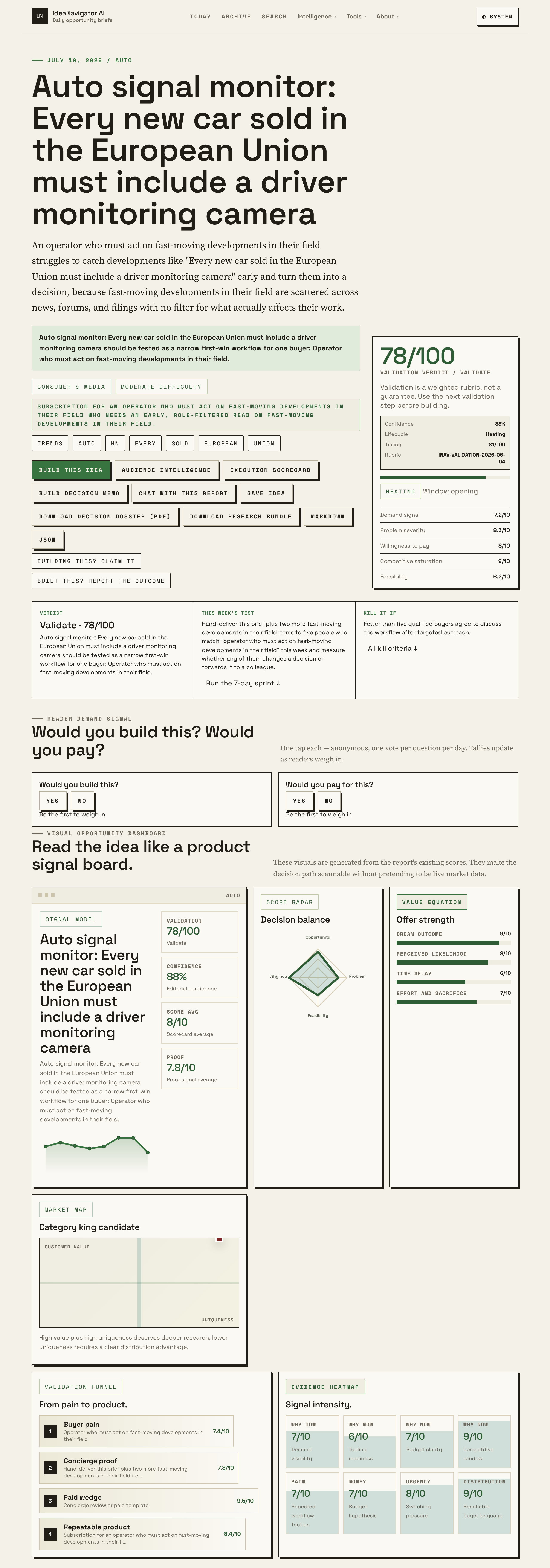
📊 Full opportunity report: EU Lawmakers Decide: Every New Car Must Include A Driver Monitoring Camera on IdeaNavigator AI — validation score, market gap, and execution plan.

Prime made for students and young adults
- Fast, free delivery for dorm and study essentials
- Prime Video and Amazon Music included
- Member-only deals
A widely shared claim that every new car sold in the European Union must include a driver monitoring camera has gained renewed attention as the EU’s updated vehicle safety rules take effect in stages through July 2026. The claim reflects a real regulatory development — the EU’s General Safety Regulation requires advanced driver assistance systems on new vehicles — but the specific detail about a mandatory camera requires careful unpacking, because the law mandates monitoring capability rather than prescribing one technology.
The regulatory basis is Regulation (EU) 2019/2144, the General Safety Regulation adopted in 2019, which set out a package of mandatory safety technologies for vehicles sold in the EU. From July 2024, all newly type-approved vehicle models had to be equipped with systems including driver drowsiness and attention warning, intelligent speed assistance, and event data recorders. From July 2026, these requirements extend to all new vehicles registered in the EU, not just newly approved models.
What the regulation explicitly requires is that cars detect driver fatigue and distraction. How manufacturers achieve this is left partly to engineering choice: camera-based systems that track eye movement and head position have become the dominant industry approach, which is why reporting frequently describes the rule as a camera mandate. Some implementations combine camera monitoring with steering-input analysis. According to IdeaNavigator AI, which surfaced the topic as a high-signal development trending on Hacker News, the framing “every new car sold in the European Union must include a driver monitoring camera” has circulated as shorthand for the broader rule package.
The requirement applies to new cars sold in the EU, not to vehicles already on the road, and not directly to cars sold outside the bloc — although manufacturers often design safety systems globally, so the effect tends to spread beyond Europe.
Safety Gains and Privacy Trade-Offs
The driver monitoring requirements matter for two reasons that pull in different directions. On the safety side, EU policymakers have framed drowsiness and distraction detection as a tool to reduce collisions caused by fatigued or inattentive drivers, and the same regulation package made automatic emergency braking and lane-keeping assistance standard equipment across the EU fleet.
On the privacy side, cabin cameras raise questions about what is recorded, where the data goes, and how long it is stored. Data protection rules under the GDPR apply to the processing of such data in the EU, but enforcement details — such as whether footage leaves the vehicle at all, and under what circumstances it may be accessed after a crash — vary by manufacturer and remain an area of active debate among consumer groups and regulators.
For car buyers, the practical effect is that virtually every new car sold in the EU from mid-2026 onward will contain some form of driver monitoring, making questions about its accuracy and data handling relevant to millions of drivers.
From 2019 Regulation to 2026 Deadline
The General Safety Regulation was adopted by the European Parliament and Council in November 2019, following advocacy from safety bodies pushing for technology mandates similar to those already adopted in some other markets. The regulation deliberately used a two-stage phase-in: new vehicle type approvals from July 2024, then all new registrations from July 2026, giving manufacturers time to redesign models and exhaust existing stock.
Discussions around semi-automated driving have increased attention on driver monitoring, because systems marketed as hands-off or eyes-off driving still require verifying that a human can take over. Camera-based monitoring has become the standard answer across most major manufacturers, predating but reinforced by the EU mandate.
Camera Mandate Details Still Debated
Several points remain unclear or contested. The regulation does not, on its face, mandate a camera specifically — it mandates drowsiness and attention warning capability — so the popular camera framing is a description of industry practice rather than an exact quote of the law. It is not yet clear how uniformly the systems will perform across manufacturers, or how false positives (warnings triggered when a driver is attentive) will be handled in practice.
Data governance questions are also unresolved in detail: retention periods, processing locations, and access rules for cabin camera data differ by brand and are subject to ongoing scrutiny by EU data protection authorities. Enforcement of the July 2026 all-registrations deadline, including any transitional allowances for remaining stock, may also produce country-by-country variation.
Countdown to July 2026 Compliance
The key upcoming milestone is July 2026, when the driver monitoring and related safety requirements apply to all new vehicle registrations in the EU, closing the two-year gap that currently applies only to newly type-approved models. Buyers can expect manufacturers to roll out monitoring systems across their full lineups before that date.
Watch also for follow-up regulatory activity: possible EU-level guidance on cabin data handling, consumer testing of monitoring system accuracy by safety organisations, and any amendments to the General Safety Regulation as automated driving features evolve.
Source: IdeaNavigator AI
Key Questions
Do I have to install a camera in my current car?
No. The requirements apply to new cars sold in the EU. Vehicles already registered are not affected, and there is no retrofit obligation for existing owners.
Does the EU law literally require a camera?
The regulation requires a driver drowsiness and attention warning system. Cameras are the approach most manufacturers have chosen, but the law does not prescribe the specific sensor technology.
When does the requirement take full effect?
Newly approved vehicle models had to comply from July 2024. From July 2026, the rules cover all new cars registered in the EU.
Who can access the camera footage?
This varies by manufacturer. Data processing in the EU falls under GDPR, but specifics such as retention and whether footage ever leaves the car are not standardised and remain under review by regulators.
Does this apply outside the EU?
The mandate covers cars sold in the EU. However, because manufacturers often build safety systems into global platforms, similar equipment commonly appears in the same models sold elsewhere.
Source: IdeaNavigator AI
Fall Picks
fall essentials
As an affiliate, we earn on qualifying purchases.