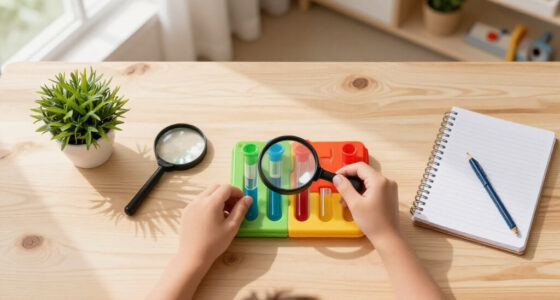
This checklist is for students and families gathering supplies for a science fair project. It covers basic measuring tools and materials, along with safety goggles and a display board that need to be chosen for the project at hand.

Prime made for students and young adults
- Fast, free delivery for dorm and study essentials
- Prime Video and Amazon Music included
- Member-only deals
The sections follow the supply list: safety, measuring, containers, testing, temperature, and presentation. Product picks are included where provided; the advice-only sections help you decide what to source based on your experiment.
Start with the project instructions, then check each item for fit and compatibility with the materials and methods you plan to use. Gather essentials first, confirm sizes and quantities, and leave time to assemble the display.
Safety Goggles
Eye protection belongs near the top of the checklist because some project activities may involve splashes, particles, or other eye hazards. Match goggles to the work your student will actually do, and follow the project directions and any adult or school guidance. The label and fit matter: choose protective eyewear intended for the relevant activity, with lenses that cover the eyes and a band or frame that stays in place during movement.A common mistake is treating ordinary glasses or sunglasses as a substitute for safety goggles. They may not provide the coverage the activity calls for. Another is buying a pair without checking whether it fits comfortably over prescription eyewear, if needed. Before project day, have the student try the goggles on and check that they do not slip, pinch, or block a clear view. Keep them accessible with the rest of the supplies, and use them whenever the project instructions call for eye protection. If the planned activity requires a type of protection you cannot identify, check with the teacher or project supervisor before proceeding.
What to look for:
- Eye protection suited to the planned activity
- Coverage around the eyes
- Secure, comfortable fit
- Room for prescription eyewear if needed
- Clear labeling and care instructions
Digital Kitchen Scale
A digital kitchen scale can help students measure ingredients consistently when a project calls for weighing materials. The listed pick is the OXO Good Grips 11 Pound Stainless Steel Food Scale with Pull-Out Displ. Before choosing it, confirm that the display, units, and weighing range suit the quantities and measurements in the project plan. A pull-out display can be useful when a large container might otherwise obscure the readout, but the working setup should still leave the scale stable and easy to use.A frequent buying mistake is assuming any kitchen scale will work for every experiment. Check whether the project needs a particular unit, precision, or container arrangement, and compare that need with the product details. Also consider where the scale will sit: a level, steady surface helps make readings easier to repeat. Avoid placing wet or messy materials directly on the scale; use a suitable container and account for its weight according to the scale’s instructions. Confirm the display is readable in the intended workspace, and make sure the scale can handle the largest planned sample. Keep the product name and project requirements together while checking specifications so the chosen tool supports the actual procedure.
What to look for:
- Units required by the project
- Capacity for the largest planned sample
- Readable display in the workspace
- Stable placement on a level surface
- Instructions for weighing with a container
OXO Good Grips 11 Pound Stainless Steel Food Scale with Pull-Out Display

This stainless steel food scale features a pull-out digital display, tare function, and unit conversion options. It is smudge- and fingerprint-resistant, with a removable platform for easy cleaning, and supports weights up to 11 pounds with high accuracy.
Pros:
- Large, easy-to-read digital display
- Pull-out display prevents shadowing from large plates or bowls
- Removable platform for convenient cleaning
- Supports multiple units of measurement
Cons:
- Limited to a maximum weight of 11 pounds
- Design may be bulky for small kitchens
- Requires batteries (not specified)
Best for: Projects that weigh ingredients or samples
Not ideal for: Work requiring measurement capabilities not confirmed in its specifications
Bottom line: Check units, capacity, and project requirements before relying on this scale for repeat measurements.
Glass Beakers
Beakers give students containers for holding, mixing, or observing materials when the project method calls for them. The listed pick is the Frienda 30 Pcs Lab Glassware Beaker Set. Its named set format may suit projects that need several containers, but check the product details for the included sizes and quantities before deciding it matches your plan. The right choice depends on the volume and type of material involved, along with the project’s handling and cleanup requirements.One common mistake is assuming all beakers in a set have the same capacity or that the set includes exactly the sizes needed. Compare the listed dimensions and capacities with the amounts in the experiment, and avoid filling containers beyond the directions. Confirm that glassware is appropriate for the substances and temperatures involved; the product name alone does not establish compatibility. Check whether a stable, protected workspace is available and how the glassware should be cleaned and stored. For student projects, review handling with an adult or teacher, especially if the activity involves heating, reactive substances, or breakage concerns. Select only the containers the procedure needs, and follow the product and project instructions for use.
What to look for:
- Included beaker sizes and capacities
- Quantity needed for the procedure
- Compatibility with materials and temperatures
- Stable base and suitable workspace
- Handling, cleaning, and storage directions
Frienda 30 Pcs Lab Glassware Beaker Set

This set includes 30 pieces of laboratory glassware such as beakers, graduated cylinders, glass stirring rods, droppers, and measuring cups in various sizes. Made of durable borosilicate glass, these tools are suitable for scientific experiments and laboratory use, featuring clear measurement scales for easy reading.
Pros:
- Complete set with multiple sizes for various experiments
- Made of durable, acid and alkali resistant borosilicate glass
- Clear measurement scales for easy reading
Cons:
- No individual item descriptions or specific use instructions
- Limited to laboratory and scientific use only
Best for: Projects that need several glass containers
Not ideal for: Experiments requiring size or material compatibility not confirmed in details
Bottom line: Verify each beaker’s capacity and suitability against the project’s materials before use.
pH Test Strips
pH strips let a student compare samples when a project involves acidity or alkalinity. The listed pick is pHydrion 9800 Plastic pH Indicator Strips, 0.0 to 14.0, Flip Top Vial. Its stated range spans 0.0 to 14.0, so compare that range with the readings the project expects. The flip-top vial format is also worth checking against how often the strips will be accessed and how they should be stored.A common mistake is treating a color result as an exact reading without following the product directions. Check the color chart, timing, and sample procedure, and make sure the planned samples can be tested as directed. Strip results can be difficult to interpret if the chart is not visible in the workspace or lighting makes color comparison challenging. Confirm how many strips are included and whether that amount covers practice readings and the planned trials. Keep strips dry and follow the vial’s storage guidance; mishandling can affect their usefulness. Record results promptly and consistently, including the method used, so comparisons across samples are meaningful for the project. If the project’s required method or precision is not covered by the product instructions, ask the teacher which tool is appropriate.
What to look for:
- Range that covers expected samples
- Included color chart and reading directions
- Strip quantity for planned trials
- Storage instructions for keeping strips usable
- A practical way to compare colors consistently
pHydrion 9800 Plastic pH Indicator Strips, 0.0 to 14.0, Flip Top Vial Packaging

These pH indicator strips provide immediate, accurate pH testing with bright, long-lasting colors. Packaged in a flip-top vial, each set contains 100 dip sticks with a matching color chart for easy reading.
Pros:
- Bright, long-lasting color indicators for easy reading
- Includes a matching color chart for accurate pH determination
- Convenient flip-top vial for storage and portability
- High quantity of strips per pack
Cons:
- Limited to pH testing only
- Color matching may vary slightly under different lighting conditions
Best for: Projects comparing sample pH
Not ideal for: Work requiring a method or precision not stated in the product details
Bottom line: Match the stated range and directions to the project, then interpret colors consistently.
Laboratory Thermometer
Temperature readings help students track conditions when a project compares warming, cooling, soil, or compost samples. The listed pick is the Garden Weasel Analog Soil & Composting Dial Thermometer – 36-Inch Prob. Its name identifies it for soil and composting, so check that the intended measurement surface and insertion depth fit the experiment. Confirm the scale and reading instructions in the product details before relying on it for a specific temperature range or level of precision.A buying mistake is choosing a thermometer based on the word “laboratory” in the checklist while overlooking the product’s stated use. This pick is described as a soil and composting thermometer, so it may not suit every liquid or indoor measurement. Check whether the probe length works for the sample depth, whether the dial can be read at the planned angle, and whether its materials and directions fit the project conditions. Avoid guessing about suitability when the experiment involves a different medium: compare the procedure with the product instructions or ask the teacher. Plan to take readings in a consistent place and manner, and record the conditions alongside each result. That makes the measurements easier to compare over the course of the project.
What to look for:
- Suitability for the project’s sample type
- Probe length that fits sample depth
- Scale and stated measurement range
- Readable dial from the measurement position
- Use and care directions
Garden Weasel Analog Soil & Composting Dial Thermometer – 36-Inch Probe

This durable analog thermometer measures soil and compost temperatures up to 220°F with a 36-inch probe, ideal for gardening and composting. It does not require batteries and features a large, easy-to-read dial for accurate readings in soil and compost piles.
Pros:
- Long 36-inch probe for deep soil and compost measurements
- Battery-free analog design for reliability
- Durable construction with lifetime guarantee
- Easy-to-read large dial
Cons:
- No digital features or backlit display
- Requires manual reading, which may be less precise than digital thermometers
Best for: Projects measuring soil or compost conditions
Not ideal for: Experiments needing a thermometer for a different medium
Bottom line: Confirm the sample type, probe reach, and measurement range match the procedure.
Tri-Fold Display Board
A display board gives the finished project a place for its question, method, observations, and conclusions. Since no product is specified, choose a board only after checking the fair’s instructions. Requirements may determine the permitted dimensions, orientation, or materials, so those details should guide the purchase. Also consider where the board will be displayed and how the student plans to arrange text, charts, and images across its panels.A common mistake is selecting a board before confirming the allowed size, then discovering that the finished display does not fit the rules or available space. Check the event guidance and measure the setup area if one is known. Think through the content layout before attaching anything: the project title, key steps, and results should be easy to find at a glance. Another practical issue is bringing materials that will not stay attached to the board surface; choose mounting supplies suited to the board and the school’s rules. Leave room for labels and captions, and rehearse folding, transporting, and setting it upright. A simple paper mockup can help test spacing before the final arrangement is assembled.
What to look for:
- Dimensions allowed by fair instructions
- Panel orientation and available display space
- A surface suited to the chosen mounting method
- Enough room for headings, visuals, and captions
- Easy transport and stable upright setup
Prioritize supplies in this order: follow project safety guidance first, then secure the tools and materials required to carry out the experiment, followed by containers and testing supplies that match the method. Confirm product specifications before buying, especially for measurement units, capacities, ranges, and sample compatibility. Choose the display board after checking the fair’s requirements.
With the checklist matched to the actual project, students can focus on careful observations and a clear explanation of what they learned. Review the directions together, organize supplies in advance, and make adjustments when the teacher or fair instructions call for them.
Fall Picks
fall essentials
As an affiliate, we earn on qualifying purchases.