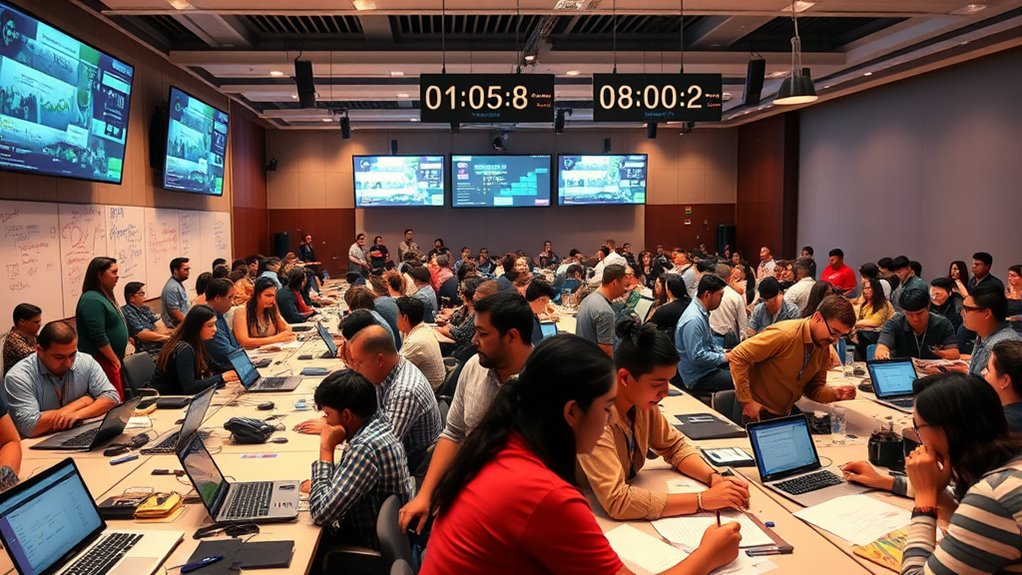

Hackathons for Humanity are intense 48-hour events where you team up with diverse individuals worldwide to develop innovative solutions for global issues like climate change or healthcare. During this time, you’ll work quickly, using your skills to create prototypes, share ideas, and collaborate on impactful projects. These events promote creativity, ethical thinking, and teamwork. If you want to discover how these short, powerful events can drive meaningful change, there’s more to explore ahead.
Key Takeaways
- Hackathons for Humanity are intensive 24-48 hour events focused on developing rapid solutions for global social and environmental challenges.
- They bring together diverse teams of programmers, designers, and domain experts to foster cross-disciplinary innovation.
- Participants create tangible prototypes or minimum viable products that address issues like climate change, healthcare, and education.
- These events accelerate technology development, encourage creative problem-solving, and promote sustainable, ethical solutions.
- Hackathons serve as platforms for scalable impact, inspiring major organizations to leverage collective effort for meaningful global change.

Hackathons for humanity are intense, collaborative events where diverse teams come together to solve pressing social and global challenges rapidly. You’ll find yourself immersed in a high-energy environment that typically lasts 24 to 48 hours, during which teamwork and quick thinking are essential. Participants include programmers, designers, product managers, and domain experts, all working toward creating innovative software or hardware solutions by the event’s end. While originally centered on coding, hackathons have expanded to cover fields like medicine, education, environment, and social issues, reflecting a broader commitment to addressing real-world problems. These events foster creativity, knowledge sharing, and diverse perspectives, which are *vital* for developing effective solutions to complex challenges. [Hackathons have evolved from niche coding events to global innovation gatherings involving diverse participants collaborating to develop solutions rapidly.] As you take part, you’ll notice the primary goal is to generate innovative ideas that tackle urgent global issues such as climate change, healthcare disparities, or resource scarcity. Hackathons for humanity are designed not just to produce products but to develop solutions that are technically sound, ethically responsible, and capable of making a sustainable impact. The collaborative spirit encourages you to connect with others who share a passion for social good, forming a community united by a common purpose. Beyond creating tangible solutions, these events are excellent opportunities to sharpen your skills—problem-solving, critical thinking, teamwork—and gain hands-on experience in fast-paced, real-world settings. The rapid pace pushes you to think creatively and adapt quickly, often leading to breakthroughs that might otherwise take months or years to develop. Additionally, incorporating predictive analytics into projects can greatly enhance the effectiveness of solutions by enabling data-driven decision-making. Diversity plays a fundamental role in hackathons for humanity. You’ll be working alongside people from different disciplines, backgrounds, and geographic locations, sometimes through remote participation. This cross-disciplinary collaboration enhances the richness of ideas and broadens problem-solving approaches. When technical skills combine with domain expertise, solutions become more innovative and applicable. The inclusive environment promotes knowledge sharing and mutual learning, encouraging participants to challenge assumptions and consider ethical and sustainability factors as central to their projects. This approach *guarantees* that solutions are not only technologically advanced but also socially responsible. Diversity fosters innovative thinking by bringing multiple perspectives to complex issues. Hackathons *considerably* impact technology and innovation by accelerating the development of breakthrough solutions. They serve as platforms where ideas can swiftly evolve into prototypes or minimum viable products, often with commercial or community-driven potential. Major corporations leverage hackathons to stay at the forefront of innovation, encouraging experimental approaches and pushing technological boundaries within tight deadlines. The outcomes can be scalable solutions that address global issues or open-source projects that benefit communities worldwide. Most hackathons follow an agile, sprint-like structure, emphasizing rapid iteration and teamwork, often focusing on specific themes like sustainability or healthcare. Ultimately, these events demonstrate how collective effort, diversity, and urgency can drive meaningful change in just a matter of hours or days.

Portable Small Dry Erase Board Whiteboard Notebook Handheld, Reusable White Board Dry Erase Notebook for Desk, At Home Office Study Essentials-9.5" x 6.6" (Blue)
Portable & Lightweight: Size (9.5×6.6 inches), perfect for home, office, and travel. Carry it anywhere with ease.
As an affiliate, we earn on qualifying purchases.
As an affiliate, we earn on qualifying purchases.
Frequently Asked Questions
How Are Hackathon Projects Implemented After the Event Ends?
After the event ends, you often face challenges in implementing hackathon projects. To succeed, you need ongoing support from your organization, regular monitoring, and stakeholder engagement. Reusing code, integrating diverse technologies, and fostering a culture of innovation boost project sustainability. Securing resources, aligning projects with organizational goals, and sharing knowledge help guarantee your hackathon outcomes evolve and make a lasting impact beyond the initial event.
What Criteria Are Used to Judge the Winning Solutions?
Did you know that over 60% of hackathon solutions are judged by their potential impact and innovation? When you’re evaluating winning solutions, you’ll focus on their ability to address real-world problems meaningfully, making a tangible difference. You’ll also consider creativity, technical feasibility, and how well the team communicates their idea. It’s about finding solutions that are not only innovative but practical, scalable, and aligned with the event’s focus.
Are There Opportunities for Remote or Virtual Participation?
You can definitely find opportunities for remote or virtual participation in hackathons. These events attract participants from around the world, allowing you to join without travel. You’ll work with diverse teams, access mentorship sessions, and contribute to solving global issues from your location. Plus, virtual formats often offer flexible schedules, making it easier for you to engage, collaborate, and develop innovative solutions while connecting with others worldwide.
How Do Hackathons Ensure Inclusivity and Diversity Among Participants?
You might think hackathons naturally attract diverse participants, but they often fall short without intentional efforts. To guarantee inclusivity, organizers target underrepresented communities, partner with DEI-focused groups, and promote inclusive messaging. They provide financial support, use virtual platforms, and design challenges that value different perspectives. By fostering respectful environments, offering accommodations, and building ongoing networks, you create a space where everyone feels valued and empowered to contribute meaningfully.
What Support Do Teams Receive for Project Development Post-Hackathon?
After the event, you can access ongoing mentorship from technical, business, and process experts to refine your project. You’ll also find resources like workspace, funding opportunities, and necessary tools to continue development. Networking opportunities through alumni groups, demo days, and social media help you connect with potential collaborators and investors. The organization offers recognition and feedback loops, ensuring you receive support and visibility to keep your project progressing beyond the initial hackathon.

Logitech Wireless Presenter R400, USB-A PowerPoint Clicker with Laser Pointer, Wireless Presentation Clicker Remote
Presenter mode, built-in Class 2 red laser pointer for presentations, intuitive touch-keys for easy slideshow control. AAA batteries…
As an affiliate, we earn on qualifying purchases.
As an affiliate, we earn on qualifying purchases.
Conclusion
By participating in hackathons for humanity, you have the power to create real change in just 48 hours. These events prove that innovative solutions can emerge when passionate minds come together with a common goal. So, aren’t you ready to harness your skills and make a difference? Every idea counts, and your contribution could be the key to solving some of the world’s biggest challenges. Will you step up and be part of the solution?

Amazon Basics Sturdy and Portable Ergonomic Laptop Stand for Desk, Height Adjustable Riser with Ventilated Cooling, Foldable, Fits all Laptops up to 15.6 Inch, Silver
Ergonomic Height Adjustment:Achieve personalized comfort with up to 7 inches of height adjustment, helping improve posture during extended…
As an affiliate, we earn on qualifying purchases.
As an affiliate, we earn on qualifying purchases.

Portable Charger,50000mAh Power Bank Built-in Cable, 22.5W PD USB C In & Out Fast Charging, External Battery Pack with 6 Output & 2 Input, Travel Phone Charger for iPhone 17/16/15/14/13/12(Black)
50000mAh Portable Charger With Built In Cables: No More Tangled Wires! Charge ANY device instantly with built-in 4…
As an affiliate, we earn on qualifying purchases.
As an affiliate, we earn on qualifying purchases.