

📊 Full opportunity report: Rack-by-Rack Deployment Tracking: A Must-Have For Data Centers on IdeaNavigator AI — validation score, market gap, and execution plan.

Prime made for students and young adults
- Fast, free delivery for dorm and study essentials
- Prime Video and Amazon Music included
- Member-only deals
TL;DR
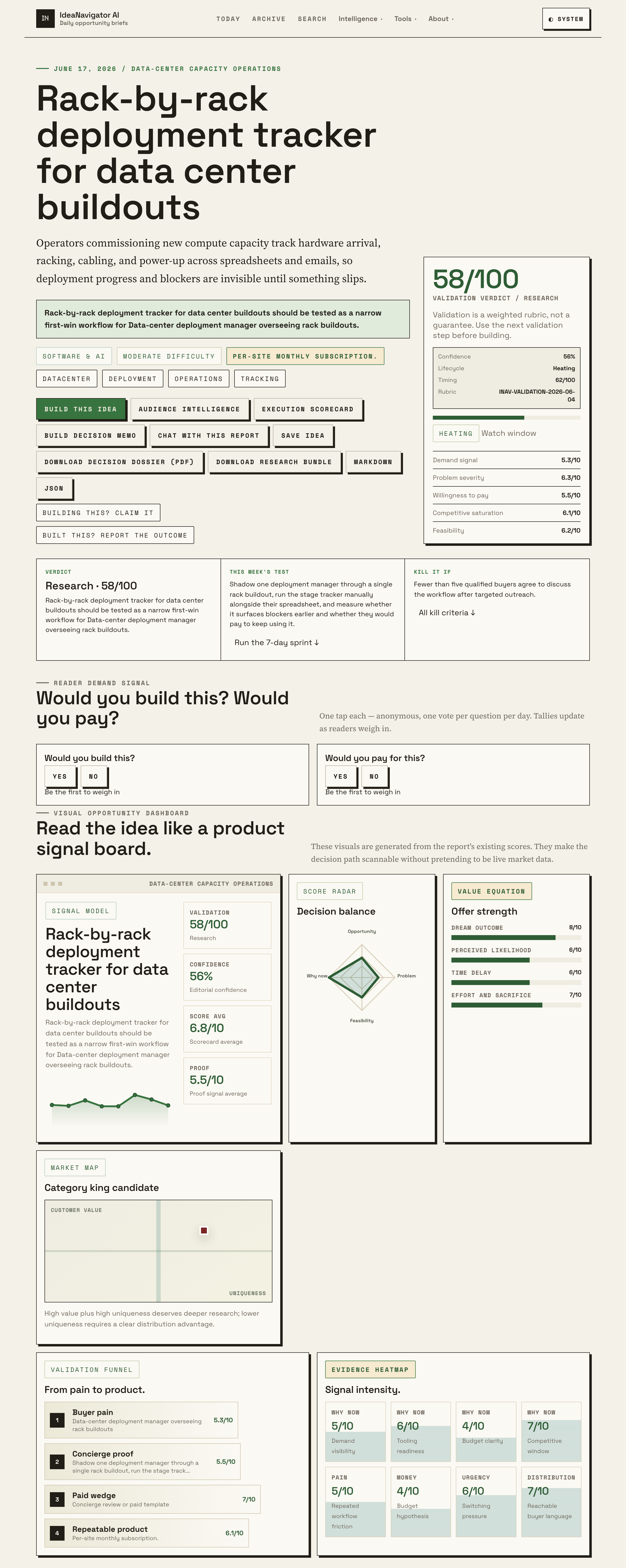
A prototype rack-by-rack deployment tracker is being tested to improve visibility during data center buildouts. This development aims to address current tracking challenges faced by deployment managers, especially during record-breaking capacity expansions, as discussed in The Power Bottleneck: AI Data Centers and the Grid Cliff Approaching 2027-2028.
A rack-by-rack deployment tracker for data center buildouts is being tested as a workflow tool for deployment managers. This system aims to improve visibility into hardware deployment stages, addressing a key challenge faced during rapid capacity expansions driven by AI demand.
The proposed deployment tracker allows managers to log each rack through fixed stages such as delivered, racked, cabled, powered, and validated. It provides a live percentage of completion and highlights stalled racks, offering a real-time overview of progress.
Currently, operators rely on spreadsheets and emails to track hardware deployment, which can obscure progress and delay identification of blockers. The new tracker is designed to be tested by shadowing a deployment manager during a single rack buildout, comparing its effectiveness against existing manual methods.
Market interest is driven by the surge in data center capacity needs, with operators racking thousands of GPUs per site on compressed timelines, which underscores the significance of the environmental impact of AI data centers. The tracker is intended as a subscription-based tool, with initial validation focused on whether it surfaces blockers earlier and whether deployment managers would pay for ongoing use, highlighting the importance of understanding the power bottleneck in AI data centers.
Potential Impact on Data Center Deployment Efficiency
This development could significantly improve the management of data center buildouts, especially as capacity demands accelerate. By providing real-time, rack-level visibility, it may reduce delays caused by unnoticed blockers, leading to faster deployment cycles and cost savings.
For operators overseeing large-scale AI infrastructure expansions, such a tool could become essential for maintaining control and avoiding costly errors. Its success could also influence how deployment workflows are managed industry-wide, encouraging the adoption of purpose-built tracking systems.
As an affiliate, we earn on qualifying purchases.
Current Challenges in Data Center Deployment Tracking
Data center operators currently depend heavily on manual tracking methods, including spreadsheets and email updates, which can be inefficient and prone to errors. During recent record-breaking buildouts driven by AI and cloud demand, these methods have become increasingly inadequate.
The rapid pace of deployment, often involving thousands of GPUs per site, has underscored the need for more precise, real-time tracking tools. Previous attempts at automation have been limited, leaving a gap for a simple, effective solution that can be quickly adopted without extensive integration.
“A dedicated rack-by-rack tracker could transform how deployment managers oversee large-scale data center expansions.”
— an anonymous researcher
data center hardware management tools
As an affiliate, we earn on qualifying purchases.
As an affiliate, we earn on qualifying purchases.
Uncertainties About Implementation and Adoption
It is not yet clear how quickly the tracker will be adopted at scale or how effectively it will integrate with existing workflows. The initial testing phase is limited, and broader industry validation is still needed to confirm its benefits and cost-effectiveness.
Further, questions remain about whether deployment managers will find the tool intuitive enough for daily use and whether it can be scaled across diverse data center environments.
As an affiliate, we earn on qualifying purchases.
Next Steps for Validation and Industry Adoption
The next step involves shadowing a deployment manager during a single rack buildout to compare the tracker’s performance against manual methods. Success in this phase could lead to broader pilot programs and eventual commercial rollout.
If initial results are positive, vendors may begin marketing the tool as a subscription service, with plans to refine features based on user feedback. Industry-wide adoption could follow if proven effective in reducing delays and increasing transparency.
data center buildout monitoring system
As an affiliate, we earn on qualifying purchases.
As an affiliate, we earn on qualifying purchases.
Key Questions
How does the rack-by-rack deployment tracker work?
The tracker logs each rack through fixed stages—delivered, racked, cabled, powered, and validated—providing real-time progress updates and highlighting stalled racks.
What are the main benefits of using this system?
It offers improved visibility into deployment progress, early detection of blockers, and potentially faster buildout times, especially during rapid capacity expansions.
Will deployment managers adopt this new tool?
Adoption depends on its effectiveness during initial testing and how well it integrates into existing workflows. Early validation aims to demonstrate its value to encourage broader use.
Is this system ready for widespread deployment?
Not yet. It is currently in a testing phase with limited scope. Broader industry validation and user feedback are needed before potential commercial rollout.
How much will the subscription service cost?
Pricing details are not yet finalized, but it is expected to be a per-site monthly fee aimed at data center operators managing large-scale buildouts.
Source: IdeaNavigator AI
Fall Picks
fall essentials
As an affiliate, we earn on qualifying purchases.