TL;DR
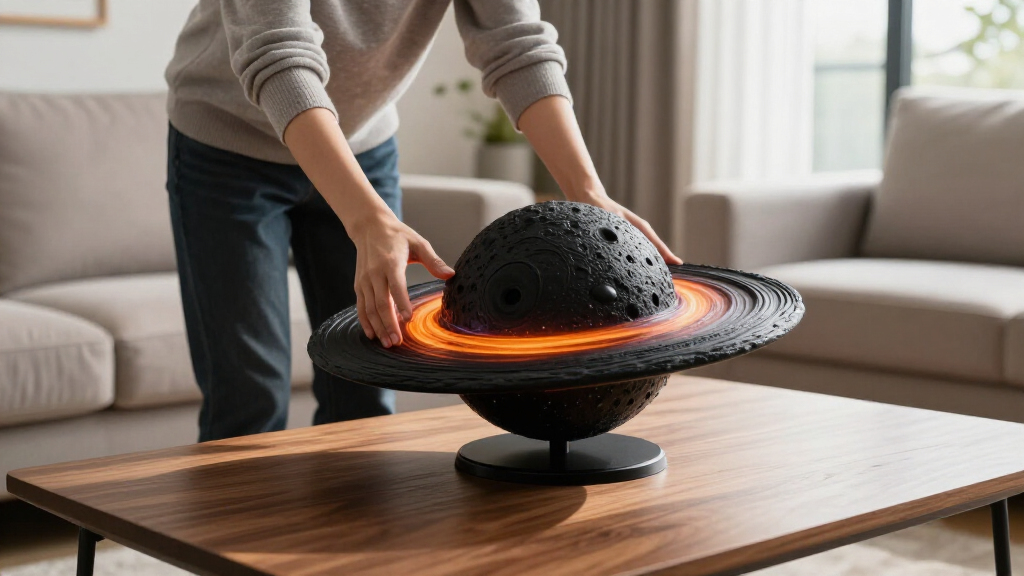
Harvard astrophysicist Sasha Plavin has created a small, physically accurate black hole model that users can place in their homes. The device simulates relativistic physics and is accessible via a web browser. This innovation offers a new way to experience black hole phenomena firsthand.
Harvard astrophysicist Sasha Plavin has developed a physically accurate black hole model that can be placed in a room and simulated live through a web browser. This device replicates relativistic physics phenomena associated with black holes, making complex astrophysical concepts accessible to the public and researchers alike.
The device, described by Plavin on the Show HN platform, uses advanced physics simulations to create a miniature black hole that exhibits phenomena such as gravitational lensing and event horizon effects. According to Plavin, the model is based on real Einsteinian physics and is capable of running in real-time, providing an interactive experience.
While the black hole is not physically destructive or dangerous, it visually and physically mimics the properties of a real black hole, including light bending and time dilation effects, through a combination of hardware and software. The project aims to serve educational purposes and facilitate research into relativistic phenomena.
Innovative Approach to Black Hole Education and Research
This development offers a new educational tool that makes complex astrophysical phenomena tangible for students, educators, and the public. It also opens avenues for experimental physics and simulation-based research at a personal scale, potentially accelerating understanding of relativistic effects and black hole dynamics.
Moreover, the project demonstrates the feasibility of integrating advanced physics simulations into accessible, home-based devices, bridging the gap between theoretical astrophysics and practical visualization.

Geometry of Black Holes (International Series of Monographs on Physics)
As an affiliate, we earn on qualifying purchases.
As an affiliate, we earn on qualifying purchases.
Advances in Black Hole Simulation and Public Engagement
Previous efforts to simulate black holes largely relied on computer graphics and virtual reality, often lacking physical accuracy. This new device builds on recent progress in physics-based simulation hardware and software, aiming to provide a more authentic experience.
Harvard’s Black Hole Initiative has been a leading center for astrophysics research, and Plavin’s project reflects ongoing efforts to make complex space phenomena accessible beyond academic circles. The concept of miniature black holes has been explored theoretically, but this is the first known attempt to create a physically accurate, real-time, home-scale model.
“This device demonstrates the real physics of black holes in a way that anyone can experience at home, making complex phenomena accessible and engaging.”
— Sasha Plavin

Physics Optics Experiment Kit for Lab – Light Refraction/Reflection, Convex Lens, Pinhole Imaging & Light Primary Colors Exploration Science Educational Set for Hands-On Learning
- Comprehensive Optical Experiments: Includes refraction, reflection, and imaging experiments
- Visualize Refraction & Reflection: Demonstrates light bending and surface reflection
- High-Quality & User-Friendly: Includes adjustable light sources and durable components
As an affiliate, we earn on qualifying purchases.
As an affiliate, we earn on qualifying purchases.
Technical Limitations and Safety Aspects Still Under Review
It is not yet clear how the device’s physical accuracy compares to real black holes beyond simulation, or how it handles extreme relativistic effects at different scales. The safety and long-term durability of the hardware are still being tested.
Additionally, the extent to which this device can contribute to scientific research or education remains to be evaluated as more users experiment with it.

Types of Black Holes Astronomy Chart Space Lovers T-Shirt
- Black Hole Types Illustration: Includes various black hole types
- Comprehensive Space Science Chart: Features astrophysics and cosmic objects
- Comfortable Classic Fit: Lightweight with durable double-needle hems
As an affiliate, we earn on qualifying purchases.
As an affiliate, we earn on qualifying purchases.
Upcoming Public Demonstrations and Research Collaborations
Plavin plans to release a series of public demos and educational modules over the next few months, aiming to gather feedback and refine the model. Collaborations with educational institutions are also being explored to integrate the device into science curricula.
Further technical details and open-source components are expected to be shared soon, enabling broader experimentation and development.

Beyond the Solar System: Exploring Galaxies, Black Holes, Alien Planets, and More; A History with 21 Activities (49) (For Kids series)
As an affiliate, we earn on qualifying purchases.
As an affiliate, we earn on qualifying purchases.
Key Questions
How does the black hole model simulate relativistic physics?
The device uses advanced software algorithms combined with hardware to mimic phenomena like gravitational lensing and time dilation, based on Einstein’s equations.
Is the black hole dangerous or harmful?
No. The model is a scaled, non-destructive simulation that does not emit harmful radiation or pose any physical threat.
Can I buy or build this black hole model myself?
Details about commercial availability or DIY kits are not yet available. Plavin plans to share technical specifications and collaborate with educational partners.
What practical uses does this device have?
Primarily educational, it helps visualize complex space phenomena. It may also serve as a research tool for studying relativistic effects in a controlled environment.
When will more information or a public release be available?
Plavin has announced upcoming demonstrations and intends to publish detailed technical information within the next few months.
Source: hn