The best digital microscope for most students is the TOMLOV DM301 Pro, which pairs a large screen with a practical setup for viewing and sharing specimens. The AmScope B120 is a stronger fit for students learning traditional slide microscopy, while the BMDSAE handheld microscope suits younger learners who need a portable, simple starting point. The main tradeoff is between quick, screen-based viewing and the optics, controls, and slide handling of a compound microscope. Some models are aimed at coins and other large objects rather than classroom biology, so magnification claims alone can mislead. Read on for how these nine options differ and which type of student each one serves best.

Prime made for students and young adults
- Fast, free delivery for dorm and study essentials
- Prime Video and Amazon Music included
- Member-only deals
Key Takeaways
- The TOMLOV DM301 Pro is the most balanced screen-based pick; its 7-inch display favors group viewing, while the smaller-screen models are easier to keep compact.
- The AmScope B120 and Woehrsh trinocular model serve a different learning goal from the digital-screen microscopes: they are compound instruments for students working with prepared slides and traditional viewing.
- The DM4W Max and Elikliv EDM4 are specialist coin microscopes, so their features make more sense for inspecting coins and other opaque objects than for general slide-based biology.
- The BMDSAE is the clearest beginner-oriented handheld option, but its portable format is not a substitute for the stage control and slide workflow of a lab microscope.
- Display size, camera, and stated magnification do not tell the whole story; students should match the optical design and specimen support to their actual assignments.
| BMDSAE 1000X Handheld Digital Microscope for Kids with 2-Inch IPS Screen |  | Best for Portable Exploration | Magnification: Up to 1000X | Screen: 2-inch IPS | Camera: 2MP | VIEW LATEST PRICE | See Our Full Breakdown |
| AmScope B120 Series LED Binocular Compound Microscope with 5MP Camera |  | Best for Serious Slide Study | Model: B120C-E5 | Magnification: 40X–2500X | Camera: 5MP USB microscope camera | VIEW LATEST PRICE | See Our Full Breakdown |
| Microscope 40X-2500X Magnification with 4.3-inch Display, Wide-Angle 10X and 25X Eyepieces, Built-in 5-Megapixel Camera for School Labs (Black) | 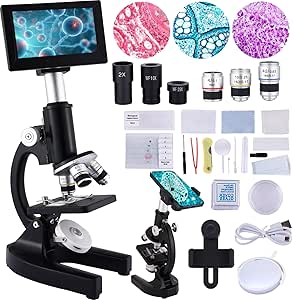 | Best for Screen-Based Classroom Viewing | Magnification: 40X–2500X | Display: 4.3 inches | Camera: 5MP | VIEW LATEST PRICE | See Our Full Breakdown |
| TOMLOV DM301 Pro Digital Microscope with 7-Inch Screen |  | Best for Classroom Sharing | Display: 7-inch IPS screen | Magnification: Up to 1200X | Lenses: Three achromatic lenses | VIEW LATEST PRICE | See Our Full Breakdown |
| TOMLOV DM4W Max Digital Coin Microscope with Weighing Scale, 7-Inch Screen |  | Best for Coin and Object-Based Projects | Screen: 7 inches; 800 × 480 resolution | Video: 2K | Photo resolution: Up to 5440 × 3060 (16MP) | VIEW LATEST PRICE | See Our Full Breakdown |
| Elikliv EDM4 Digital Coin Microscope with 4.3-Inch Display |  | Best for Portable Close-Up Inspection | Display: 4.3-inch LCD | Resolution: 720p HD | Magnification: Up to 1000x; actual magnification varies | VIEW LATEST PRICE | See Our Full Breakdown |
| OOZSTAR Digital Microscope with 4.3-Inch Display and 5 MP Camera |  | Best Starter Kit for Slide Activities | Display: 4.3-inch | Camera: 5 MP | Maximum magnification: Listed as 2500x | VIEW LATEST PRICE | See Our Full Breakdown |
| TOMLOV DM301 Max Digital Microscope |  | Best for Classroom Sharing | Display: 7-inch IPS screen | Magnification: Up to 1200X | Imaging: 8 MP | VIEW LATEST PRICE | See Our Full Breakdown |
| Woehrsh Trinocular Compound Microscope, 40X–5000X, with Mechanical Stage and USB Camera |  | Best for Traditional Compound-Microscope Study | Microscope type: Compound trinocular | Magnification: 40X–5000X | Objective lens: 195 achromatic | VIEW LATEST PRICE | See Our Full Breakdown |
| digital microscopes for student | Magnification | Lighting | Camera | Display |
|---|---|---|---|---|
| BMDSAE 1000X Handheld Digital | Up to 1000X | 8 adjustable LEDs; 3 brightness modes | 2MP | — |
| AmScope B120 Series LED Binocu | 40X–2500X | — | 5MP USB microscope camera | — |
| Microscope 40X-2500X Magnifica | 40X–2500X | LED | 5MP | 4.3 inches |
| TOMLOV DM301 Pro Digital Micro | Up to 1200X | Adjustable dual LED lighting | 8MP photos; 1080p videos | 7-inch IPS screen |
| TOMLOV DM4W Max Digital Coin M | — | — | — | — |
| Elikliv EDM4 Digital Coin Micr | Up to 1000x; actual magnification varies | 8 adjustable LED lights | — | 4.3-inch LCD |
| OOZSTAR Digital Microscope wit | — | — | 5 MP | 4.3-inch |
| TOMLOV DM301 Max Digital Micro | Up to 1200X | Adjustable top and bottom LED lights | — | 7-inch IPS screen |
| Woehrsh Trinocular Compound Mi | 40X–5000X | LED | — | — |
More Details on Our Top Picks
BMDSAE 1000X Handheld Digital Microscope for Kids with 2-Inch IPS Screen
The BMDSAE is the most portable student pick here: at 200 g, with a lanyard and built-in screen, it suits quick observations of leaves, fabric, or other objects around the home or outdoors. Its 2MP camera saves photos and AVI videos, so students can keep a simple record without connecting a computer. Compared with the TOMLOV DM301 Pro, it is easier to carry but gives up that model’s larger 7-inch display, broader classroom sharing options, and more substantial slide setup. The advertised up to 1000X magnification and manual focus offer flexibility, but focusing takes practice, and a 2-inch screen limits group viewing. The battery lasts up to two hours, making this better for short investigations than extended lab sessions.
Pros:- Lightweight 200 g body and included lanyard suit portable exploration
- Built-in 2MP camera stores photos and AVI videos
- Eight adjustable LEDs with three brightness modes help adapt lighting
- USB-C charging and data connection
Cons:- Battery life is up to two hours per charge
- Manual focus can take practice, especially for younger users
- Two-inch screen is small for detailed viewing or sharing with a group
Best for: Younger students who want a lightweight microscope for short, hands-on observations at home or outdoors.
Not ideal for: Students doing extended slide work or group demonstrations who need a larger display and longer sessions.
- Magnification:Up to 1000X
- Screen:2-inch IPS
- Camera:2MP
- Lighting:8 adjustable LEDs; 3 brightness modes
- Battery:600mAh; up to 2 hours
- Storage:32M; supports 200+ photos or AVI videos
- Weight:200 g
- Connectivity:USB-C
Our verdict“Choose the BMDSAE for portable, short student investigations; pick the TOMLOV DM301 Pro for a larger classroom-ready viewing setup.”
AmScope B120 Series LED Binocular Compound Microscope with 5MP Camera
For students whose work centers on prepared slides, the AmScope B120C-E5 is the most lab-oriented option in this group. Its 40X–2500X range, binocular viewing head, and daylight-balanced LED illumination suit sustained observation more than the handheld BMDSAE, which is designed for casual, portable exploration. The included 5MP USB camera and image-analysis software also give students a route from looking through the eyepieces to capturing and studying images on a computer. That makes it a stronger fit for structured assignments than the screen-based OOZSTAR 4.3-inch microscope, though the OOZSTAR provides direct display viewing without relying on a computer connection. The tradeoff is a less self-contained setup: the supplied details do not list a built-in screen or battery power. It makes most sense for a stable desk or classroom station.
Pros:- 40X–2500X magnification range supports a range of slide observations
- Binocular head supports viewing through eyepieces
- Included 5MP USB camera and software enable image capture and analysis
- Daylight-balanced LED illumination
Cons:- No built-in display is listed, so digital viewing depends on a connected computer
- No battery power is listed, making it less suited to portable use
- A compound microscope setup is less convenient for casual, on-the-go exploration than handheld models
Best for: Middle-school, high-school, or college students who regularly examine slides and need camera-based image capture for coursework.
Not ideal for: Families seeking a portable, self-contained microscope for outdoor use or children who prefer viewing on a built-in screen.
- Model:B120C-E5
- Magnification:40X–2500X
- Camera:5MP USB microscope camera
- Illumination:Daylight-balanced LED
- Head:Adjustable Siedentopf binocular
- Software:Image capture and analysis software included
- Warranty:5 years
Our verdict“Choose the AmScope for computer-assisted slide study and lab work, rather than portable viewing or a built-in-screen experience.”
Microscope 40X-2500X Magnification with 4.3-inch Display, Wide-Angle 10X and 25X Eyepieces, Built-in 5-Megapixel Camera for School Labs (Black)
The OOZSTAR gives students a useful middle ground between a traditional eyepiece microscope and a large-screen digital station. Its 4.3-inch display lets a student view specimens without staying at an eyepiece, while the built-in 5MP camera supports image capture. With 40X–2500X magnification, achromatic 4x/10x/40x objectives, and wide-angle 10X and 25X eyepieces, it offers more conventional microscope flexibility than the handheld BMDSAE. Compared with the TOMLOV DM301 Pro, it has a smaller screen and fewer stated sharing connections, but weighs 1.66 kg and can run from USB or batteries. That dual-power option helps when a desk outlet is not convenient; battery life is not specified, so long sessions may call for USB power. The screen is still modest for group demonstrations.
Pros:- 4.3-inch display supports direct viewing without relying solely on eyepieces
- 5MP built-in camera can capture observations
- Achromatic objectives and 40X–2500X range support varied slide work
- USB or battery power offers flexible placement
Cons:- The 4.3-inch display may be small for group viewing and fine detail
- Battery runtime is not specified
- At 1.66 kg, it is less convenient to carry than the handheld BMDSAE
Best for: Students who want both eyepiece and direct-screen viewing for home experiments or a small classroom workspace.
Not ideal for: Teachers who need a large shared display, or students who need confirmed battery runtime for long off-grid sessions.
- Magnification:40X–2500X
- Display:4.3 inches
- Camera:5MP
- Objectives:Achromatic 4x/10x/40x
- Eyepieces:Wide-angle 10X and 25X
- Lighting:LED
- Power:USB data cable or batteries
- Weight:1.66 kg
Our verdict“Pick the OOZSTAR for flexible screen-and-eyepiece use at a desk, while the DM301 Pro is better for group viewing on a larger display.”
TOMLOV DM301 Pro Digital Microscope with 7-Inch Screen
The DM301 Pro ranks as the strongest choice here for students who need to view and share observations together. Its 7-inch IPS screen is substantially larger than the OOZSTAR’s 4.3-inch display, making it easier for a teacher or classmates to follow what one student is examining. The microscope also captures 8MP photos and 1080p video, supports app-based wireless viewing, and connects to TVs, computers, or projectors. Those connections give it a clearer presentation role than the AmScope B120C-E5, whose supplied details emphasize a USB camera and software rather than a built-in screen. The DM301 Pro includes prepared and blank slides plus a carrying case, helping students get started with varied specimens. Its tradeoffs are a maximum stated magnification of 1200X, below the 2500X figures listed for the AmScope and OOZSTAR, and battery life of up to three hours.
Pros:- Large 7-inch IPS screen supports comfortable shared viewing
- 8MP photos and 1080p video record observations
- Wi-Fi app support plus USB and HD output allow multiple viewing options
- Includes prepared slides, blank slides, and a carrying case
Cons:- Up to 1200X magnification is lower than the stated ranges for the AmScope and OOZSTAR
- Battery life is up to three hours
- Larger screen-based design is less pocketable than the BMDSAE handheld microscope
Best for: Teachers, families, and student project teams who want a large screen and simple ways to share microscope observations.
Not ideal for: Students whose coursework calls for the listed 2500X range or who need to work for long stretches away from power.
- Display:7-inch IPS screen
- Magnification:Up to 1200X
- Lenses:Three achromatic lenses
- Camera:8MP photos; 1080p videos
- Lighting:Adjustable dual LED lighting
- Connectivity:Wi-Fi app support; USB and HD output
- Battery life:Up to 3 hours
- Included slides:5 prepared slides and 5 blank slides
Our verdict“Choose the DM301 Pro for student presentations and shared viewing, but choose a 2500X compound model for coursework that prioritizes higher listed magnification.”
TOMLOV DM4W Max Digital Coin Microscope with Weighing Scale, 7-Inch Screen
The DM4W Max serves a narrower student need than the other picks: inspecting and weighing coins, jewelry, gemstones, and other small objects. Its built-in scale measures in four units, while the 7-inch screen and high-resolution photo capture let students examine and document surface details. Compared with the TOMLOV DM301 Pro, it adds weighing rather than emphasizing prepared-slide activities and classroom projection connections. That makes it a better match for collecting, materials projects, or object-based investigations, but a weaker choice for biology lessons centered on thin slides. The scale’s stated ±0.5 g accuracy may not suit work requiring precise measurement, and coins larger than 32 mm may need repositioning for detailed inspection. Its listed screen resolution is 800 × 480, so the high-resolution photo specification should not be confused with the resolution of the live display.
Pros:- Combines digital inspection with a built-in scale
- Supports grams, ounces, carats, and troy ounces
- Captures 2K video and photos up to 16MP
- 7-inch screen and USB output support viewing and computer connection
Cons:- Scale accuracy is specified as ±0.5 g, limiting precision-sensitive measurements
- Coins larger than 32 mm may need repositioning for detailed inspection
- 800 × 480 screen resolution is lower than the maximum photo resolution
Best for: Students working on coin collecting, material identification, or projects that pair close-up inspection with approximate weight measurements.
Not ideal for: Students focused on biological slide study or projects requiring fine weighing precision and full-view inspection of larger coins.
- Screen:7 inches; 800 × 480 resolution
- Video:2K
- Photo resolution:Up to 5440 × 3060 (16MP)
- Weighing resolution:0.1 g
- Weighing accuracy:±0.5 g
- Weighing units:g, oz, ct, ozt
- Coin viewing size:Up to 32 mm in full view
- Connectivity:USB output; Win/Mac compatible
Our verdict“Pick the DM4W Max for object-focused student projects that benefit from weighing, not as a substitute for a compound microscope used for slide study.”
Elikliv EDM4 Digital Coin Microscope with 4.3-Inch Display
The Elikliv EDM4 suits students who want a simple screen-based way to inspect coins, insects, circuit boards, and other small objects without looking through an eyepiece. Its 4.3-inch 720p display makes shared viewing more comfortable than a handheld microscope with a smaller screen, while the adjustable LEDs help reveal surface details under different lighting. Unlike the classroom-oriented TOMLOV DM301 Max, it has no stated X-Y stage or prepared-slide bundle, so it is better for casual object inspection than systematic slide work. It connects to Windows and Mac computers and runs for up to three hours on its rechargeable battery. Magnification claims need perspective: actual results vary with viewing distance and screen size. Photo and video capture also requires a memory card, which is not included.
Pros:- 4.3-inch display allows comfortable viewing without an eyepiece.
- Eight adjustable LED lights help illuminate objects with different surface properties.
- Windows and Mac compatibility supports viewing on a computer.
- Rechargeable battery allows up to three hours of use away from an outlet.
Cons:- Memory card for photo and video capture is not included.
- Actual magnification varies with viewing distance and screen size, making the 1000x claim hard to compare directly.
- The listed kit is less prepared for slide-based lessons than the TOMLOV DM301 Max, which includes prepared and blank slides.
Best for: Students and families who want a portable display microscope for coins, leaves, and other larger specimens, with the option to connect to a Windows or Mac computer.
Not ideal for: Students focused on prepared slides or repeatable lab observations; it lacks a stated mechanical stage and does not include slides or a memory card.
- Display:4.3-inch LCD
- Resolution:720p HD
- Magnification:Up to 1000x; actual magnification varies
- Lighting:8 adjustable LED lights
- Battery life:Up to 3 hours
- Computer compatibility:Windows and Mac
- Media capture:Photos and videos; memory card not included
- Included items:Adjustable bracket, plastic base, USB cable, and English user manual
- Warranty:1 year
Our verdict“Choose the EDM4 for portable, screen-based inspection of small objects, but pick a slide-ready model if classroom specimen work is the priority.”
OOZSTAR Digital Microscope with 4.3-Inch Display and 5 MP Camera
The OOZSTAR is the most classroom-ready pick here for students who want to start making slides right away. Its 4.3-inch display and 5 MP camera combine live viewing with image capture, while the package adds specimens, slides, coverslips, and lab tools. That makes it a more complete beginner kit than the Elikliv EDM4, which is geared toward inspecting objects and does not include a slide bundle. The interchangeable WF10x and WF16x eyepieces and achromatic objectives also give students a more conventional compound-microscope setup. There is a catch: the listed magnification settings conflict with the stated maximum, so I would not choose it for assignments that depend on a precise magnification. It can run from a data cable or batteries, but the battery type and runtime are not specified.
Pros:- Includes five specimens, five slides, 100 coverslips, and laboratory tools for getting started.
- Built-in 4.3-inch display supports shared viewing without a separate monitor.
- Built-in 5 MP camera can capture specimen images.
- Can be powered by a data cable or batteries.
Cons:- Magnification settings and the stated 2500x maximum are inconsistent in the product details.
- Battery type and runtime are not specified.
- Unlike the TOMLOV DM301 Max, the supplied details do not identify a precision X-Y stage or image and video resolution beyond the camera’s 5 MP figure.
Best for: Students or families beginning slide-based activities who want specimens, slides, coverslips, and basic lab accessories in one kit.
Not ideal for: Students who need clearly documented magnification or predictable battery performance; the listed settings conflict, and battery type and runtime are unspecified.
- Display:4.3-inch
- Camera:5 MP
- Maximum magnification:Listed as 2500x
- Listed magnification settings:100x, 250x, 1000x, 200x, 500x, and 2000x
- Eyepieces:WF10x and WF16x wide-angle
- Objective lenses:4x, 10x, and 40x achromatic
- Power:Data cable or batteries; battery type and runtime not specified
- Included accessories:Cell phone holder, 5 specimens, 5 slides, 100 coverslips, and laboratory tools
Our verdict“Pick the OOZSTAR for an accessory-rich introduction to slide work, but skip it if your coursework requires dependable magnification figures or a known battery runtime.”
TOMLOV DM301 Max Digital Microscope
The TOMLOV DM301 Max is the strongest fit for students who need a stable, shareable setup for repeated observations. Its 7-inch IPS screen gives a group more room to view a specimen than the Elikliv EDM4’s 4.3-inch display, and the metal X-Y stage with 1.0 mm scale divisions supports controlled movement across a slide. Top and bottom LEDs help accommodate different specimens, while the included prepared and blank slides make it useful from the first lesson. It also captures 8 MP images and 1080P video, with Wi-Fi app viewing and USB or HD output for sharing. This added classroom flexibility comes with more setup choices than a basic display microscope, and some sharing functions depend on a compatible phone or external display. Battery life is up to three hours, so extended sessions may need power nearby.
Pros:- Large adjustable-angle 7-inch IPS screen makes group viewing easier.
- Metal X-Y stage with scale divisions supports controlled specimen positioning.
- Captures 8 MP images and 1080P video, with Wi-Fi app viewing and USB and HD output.
- Includes an 8GB Micro SD card, carrying case, and prepared and blank slides.
Cons:- Battery life is limited to up to three hours.
- Some viewing and sharing features require a compatible phone or external display.
- Its larger classroom-style setup is less compact than the Elikliv EDM4 for quick portable inspection.
Best for: Teachers, study groups, and students who want a large shared screen, controlled slide movement, and ready-to-use classroom accessories.
Not ideal for: Students who need a compact, eyepiece-first microscope or long untethered sessions; the unit is built around a large screen and has up to three hours of battery life.
- Display:7-inch IPS screen
- Magnification:Up to 1200X
- Imaging:8 MP
- Video:1080P
- Stage:Metal X-Y stage with 1.0 mm scale divisions
- Lighting:Adjustable top and bottom LED lights
- Connectivity:Wi-Fi app control, USB, and HD output
- Battery life:Up to 3 hours
- Included accessories:8GB Micro SD card, carrying case, power cable, TV cable, power adapter, 5 prepared slides, and 5 blank slides
Our verdict“Choose the DM301 Max when shared viewing and controlled slide movement matter more than a compact design or longer battery sessions.”
Woehrsh Trinocular Compound Microscope, 40X–5000X, with Mechanical Stage and USB Camera
The Woehrsh is the most traditional lab-style choice in this group: students look through binocular eyepieces while a third port accommodates the included USB electronic eyepiece. Its dual mechanical stage and coaxial coarse and fine focus suit careful slide work better than the Elikliv EDM4, which is designed around a built-in screen and close-up object inspection. The 40X–5000X range and supplied slides, coverslips, and specimens offer a broad starting point for classroom biology. But the high maximum figure should not be the sole reason to choose it; the listing does not provide enough imaging detail to judge the USB camera, including its resolution and compatibility. Compared with the screen-first TOMLOV DM301 Max, this model prioritizes eyepiece viewing and mechanical controls over a built-in display and clearly specified image capture.
Pros:- 40X–5000X stated magnification range covers a broad range of slide observations.
- Dual mechanical stage and coaxial coarse and fine focus support controlled positioning and focusing.
- Includes wide-angle eyepieces, a USB electronic eyepiece, slides, coverslips, and specimens.
- 306° swivel head can be adjusted for different viewing positions.
Cons:- USB camera resolution and compatibility are not specified.
- A wide accessory set may take more time to organize and set up than a screen-based unit such as the TOMLOV DM301 Max.
- The listing does not specify battery operation or a built-in display, so it is less suited to portable, shared-screen use.
Best for: Students with access to a lab or desk who want binocular eyepiece viewing, mechanical slide control, and a USB camera port for digital observation.
Not ideal for: Beginners seeking a simple all-in-one screen microscope or buyers who need confirmed USB camera resolution and computer compatibility before purchase.
- Microscope type:Compound trinocular
- Magnification:40X–5000X
- Objective lens:195 achromatic
- Eyepieces:2 WF10X and 2 WF25X
- Lighting:LED
- Stage:Dual mechanical, double-layer
- Focus:Dual coaxial coarse and fine
- Viewing head:306° swivel
- Included accessories:USB electronic eyepiece, slides, coverslips, specimens, cell phone holder, and other laboratory accessories
Our verdict“Choose the Woehrsh for conventional, controlled slide study, but favor the TOMLOV DM301 Max if a large built-in display and defined digital capture specs matter more.”

How We Picked
I ranked these digital microscopes for students by how well their design matches common learning tasks: examining prepared slides, exploring larger objects, viewing as a group, or capturing images. I weighed the usefulness of the optical setup and controls, screen or camera workflow, ease of setup, portability, and the likely fit for a student’s age and workspace. A model’s stated magnification was not treated as a stand-alone measure of educational value.
The order favors versatility for student work first, then gives specialist products credit when their focused purpose is useful to a particular learner. Compound microscopes rank well for slide-based science, while handheld and coin microscopes trade lab-style control for simpler or more task-specific viewing. Since the product list does not provide verified classroom performance or durability testing, I avoid claims about measured image quality and focus on design differences and practical tradeoffs.
Factors to Consider When Choosing Digital Microscopes For Students
Before choosing a model, start with the kind of specimen and assignment the student will actually encounter. A microscope’s workflow matters as much as its headline magnification: the right tool should make it easier to focus, view, and document the subject at hand.
Match the microscope to the specimen
Prepared slides and thin samples usually call for a compound microscope, where transmitted light and controlled focusing support closer study. Coins, leaves, insects, and small mechanical parts are often easier to inspect with a digital microscope designed for opaque objects. A common mistake is buying one tool for every task because its listing gives a very high magnification figure. Ask what the student’s classes and projects will require over the next year, not just what seems interesting today. If the answer includes both slides and larger objects, check whether the model can genuinely handle both workflows rather than assuming it can.
Choose a viewing setup the student will use
A built-in screen lets a student look without pressing an eye to an eyepiece and can make it easier for classmates or family to share a view. A microscope that relies on eyepieces has a more familiar lab-style experience, but the student may need time to learn comfortable positioning and focusing. Camera-based viewing can support documentation, though the usefulness of that workflow depends on how images are saved or shown. Before buying, check what connections and recording functions are actually included rather than assuming every digital model transfers images to a computer. A larger display may help collaborative lessons, while a smaller handheld unit can be easier to carry between home and school.
Treat magnification as one part of image usefulness
High stated magnification does not by itself promise a clear, useful image; illumination, focus control, optics, and specimen preparation all affect what a student can see. For many classroom tasks, steady focusing and suitable light matter more than reaching the largest number in a product name. Students examining very small structures need optics and a slide setup suited to that work, while a coin collector may value a broad, well-lit view instead. Look for a model whose controls let the student make repeatable adjustments, especially when lessons require comparing samples. If the product description emphasizes magnification but gives little information about specimen support or lighting, treat that as a reason to check compatibility carefully.
Consider age, setup, and independence
Younger students often benefit from a simple handheld design or an easy-to-view screen, since fewer setup steps can keep attention on the specimen. Older students doing lab work may need a mechanical stage and compound optics, even if those controls take longer to learn. Think about whether an adult will prepare slides and help with focus, or whether the student needs to set up independently. Portability can be useful for informal exploration, but a lightweight unit may not offer the stability needed for careful comparisons. Match the amount of control to the student’s current skills and the learning goals, not only to age.
Decide whether image capture is a real requirement
A camera can help students keep a record of observations, create project materials, or share findings with a teacher. It is less useful if saving or transferring images requires software, cables, or steps that are awkward for the student’s device. Check what file capture, storage, and connection methods the specific model supports before making documentation a deciding factor. A camera’s megapixel figure alone cannot tell you how convenient the workflow will be. If a class grades observation notes rather than photos, a stable and straightforward viewing experience may matter more than extra capture features.
Pay for fit and durability, not a longer feature list
Spending more can make sense when a student needs compound optics, a mechanical stage, or a shared viewing setup for regular coursework. Extra features aimed at coin inspection, such as an integrated scale, add little for a student whose main work is biology slides. For occasional exploration, a simpler unit may be easier to store and operate than a lab-oriented model. Consider where the microscope will live, how often it will be moved, and whether its controls suit repeated school use. The best choice is the one that supports the student’s actual work without paying for a specialized feature they will rarely use.
Frequently Asked Questions
Should a student choose a screen microscope or a traditional compound microscope?
Choose based on the work, not the word “digital.” A screen microscope is convenient for shared viewing and exploring larger objects, while a compound microscope is generally the more relevant format for prepared slides and traditional biology lessons. Some compound models in this roundup add camera capability, but they still retain an eyepiece-based lab workflow. If class assignments specify slide work, confirm the microscope supports that use before prioritizing a large display. When the student’s needs are mixed, decide which task will happen most often and make that the primary buying criterion.
Can one of these microscopes work for both coins and biology slides?
Some digital microscopes may show both kinds of subjects, but that does not mean they are equally suited to each. Coin-focused models are built around viewing opaque surfaces, while slide-based biology usually benefits from transmitted light and compound optics. Check the lighting arrangement, focusing controls, and whether the product is intended to hold slides. The DM4W Max and Elikliv EDM4 are more specifically oriented toward coins, so students buying mainly for biology should compare them carefully with the compound options. A general-purpose claim is less useful than a clear match to the student’s actual specimens.
Is a high magnification number the best way to compare student microscopes?
No. A stated magnification range does not tell you how clear or useful the view will be, and some listings combine optical magnification with digital enlargement. The specimen, lighting, focus stability, and optical design all affect what can be observed. For classwork, a microscope that makes it easy to focus on a slide and repeat an observation may be more useful than one advertising a larger maximum number. Check whether the model fits the assignment and specimen type before comparing magnification figures. When product details are unclear, avoid treating the largest number as proof of superior classroom performance.
Does a built-in camera make a microscope better for school assignments?
It helps when the student needs to save observations, prepare a report, or share findings, but a camera is not automatically a better fit for every class. Check how images are captured and whether they can be transferred or stored using the student’s available devices. A camera specification does not describe the full workflow, so look for clear information about connections and recording functions. If assignments focus on live observation, ease of focusing and a suitable viewing setup may matter more. For image-based projects, prioritize a model with a capture process the student can manage independently.
When is a compound microscope worth choosing over a handheld digital model?
A compound microscope is the better direction when coursework regularly involves prepared slides, fine structures, or learning standard lab techniques. Its stage and optical arrangement support a different kind of study than a handheld unit made for quick inspection of larger objects. A handheld model can still be a good choice for younger learners or portable exploration, especially when simplicity matters more than slide control. Consider how often the student will use the instrument and whether a teacher expects specific lab procedures. If the student’s course already provides microscopes, a portable digital option may add more value for home projects than another full-size lab setup.
Conclusion
For the best overall balance, choose the TOMLOV DM301 Pro if a large-screen digital format suits the student’s work. The AmScope B120 is my pick for slide-based coursework, while the Woehrsh trinocular model is the premium direction for students who need a more involved compound-microscope setup and camera support. For beginners, the BMDSAE handheld model offers a simpler, portable starting point; the OOZSTAR and other compact-screen options may appeal when a smaller display format better fits the workspace. For coin-focused projects, compare the TOMLOV DM4W Max and Elikliv EDM4 rather than paying for lab features the student will not use. Match the purchase to the student’s specimens and assignments first, then weigh screen size, camera workflow, and portability.
Fall Picks
fall essentials
As an affiliate, we earn on qualifying purchases.