
Science magic kits for kids pair hands-on experiments with tricks children can perform, but the balance between showmanship and science varies. My best overall pick is the National Geographic Epic Magic Kit, a strong fit for families seeking a magic-first experience with scientific themes. The Discovery Magic Science Lab Kit stands out for its 72 experiments, while the National Geographic Science Magic Kit with 100+ Experiments suits children who want a larger activity pool. The main tradeoff is between a focused set of stage-ready tricks and a broader collection of experiments that may take more setup or adult help. Read on for how all eight kits compare and which one fits your child.

Prime made for students and young adults
- Fast, free delivery for dorm and study essentials
- Prime Video and Amazon Music included
- Member-only deals
Key Takeaways
- The National Geographic Epic Magic Kit is the roundup’s best overall choice for shoppers who want a magic-centered kit with science as part of the appeal.
- Experiment counts point to different kinds of play. Discovery’s 72 experiments and National Geographic’s 100+ experiments favor activity variety, while the 10-trick Chemistry Set is a more focused option.
- National Geographic’s kits span several play styles: the 45-trick kit offers a more contained selection, while the Mega Magic Kit’s 75+ tricks support a larger magic repertoire.
- Age guidance matters as much as the activity count. The Doctor Jupiter and Discovery kits specify ages 8+, and the 100+ experiment kit specifies ages 8–12; match directions and task demands to the child’s independence.
- There is no single best format for every child. A young performer may prefer repeatable tricks, while a curious experimenter may get more from a kit organized around many activities.
| National Geographic Epic Magic Kit for Kids | 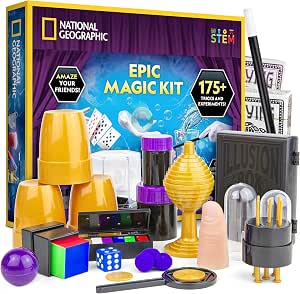 | Best Overall for Magic-and-Science Range | Brand: Blue Marble | Age range: 8 years and up | Magic tricks: 75+ | VIEW LATEST PRICE | See Our Full Breakdown |
| National Geographic Magic Chemistry Set for Kids, 10 Tricks |  | Best for Beginner Science-Magic Shows | Number of experiments: 10 | Recommended age: 8–12 years | Included accessories: Magic wand and white gloves | VIEW LATEST PRICE | See Our Full Breakdown |
| Smartivity Magic Science Kit for Kids |  | Best for Broad STEM Exploration | Brand: Smartivity | Model: SMRT1230 | Recommended age: 6–14 years | VIEW LATEST PRICE | See Our Full Breakdown |
| Doctor Jupiter Magic Science Experiments Kit for Kids Ages 8+ |  | Best for Independent Trick Practice | Brand: Doctor Jupiter | Age range: 8+ | Number of experiments: 10 | VIEW LATEST PRICE | See Our Full Breakdown |
| Discovery Magic Science Lab Kit, 72 STEM Experiments for Kids Ages 8+ |  | Best Value in Activity Variety | Brand: Discovery | Recommended age: 8 years and up | Total activities: 72 | VIEW LATEST PRICE | See Our Full Breakdown |
| National Geographic Mega Magic Kit with 75+ Tricks for Kids |  | Best for Building a Full Magic Show | Brand: Blue Marble | Age range: 8 years and up | Number of tricks: 75+ | VIEW LATEST PRICE | See Our Full Breakdown |
| National Geographic Kids Magic Kit with 45 Tricks |  | Best for Beginners | Brand: Blue Marble | Age range: 8 years and up | Number of tricks: More than 45 | VIEW LATEST PRICE | See Our Full Breakdown |
| National Geographic Science Magic Kit with 100+ Experiments for Kids Ages 8–12 |  | Best for Experiment-First Science Magic | Brand: National Geographic | Developer: Blue Marble | Experiments: 100+ | VIEW LATEST PRICE | See Our Full Breakdown |
| science magic kits for kid | Brand | Age range | Recommended age | Included components |
|---|---|---|---|---|
| National Geographic Epic Magic | Blue Marble | 8 years and up | — | — |
| National Geographic Magic Chem | — | — | 8–12 years | — |
| Smartivity Magic Science Kit f | Smartivity | — | 6–14 years | 58 parts, instructional manual, and mat |
| Doctor Jupiter Magic Science E | Doctor Jupiter | 8+ | — | — |
| Discovery Magic Science Lab Ki | Discovery | — | 8 years and up | Test tubes, mixing tools, slime mix, color tablets, pH strips, optical lenses, ingredients, and instruction guide |
| National Geographic Mega Magic | Blue Marble | 8 years and up | — | Cups and balls, illusion box, ball and vase, mysterious coin case, magic wand, and magic kit props |
| National Geographic Kids Magic | Blue Marble | 8 years and up | — | Magic trick props and specialized card deck |
| National Geographic Science Ma | National Geographic | — | 8–12 years | — |
More Details on Our Top Picks
National Geographic Epic Magic Kit for Kids
National Geographic Epic Magic Kit for Kids earns the broadest role here by pairing 75+ magic tricks with 100+ science experiments, giving kids room to alternate between performance and investigation. Its full-color guide and more than 75 video lessons add support for learning techniques and following experiments, a richer teaching setup than the printed illustrated guides in the smaller National Geographic Magic Chemistry Set and Doctor Jupiter kit. That breadth also brings a tradeoff: at 3.4 pounds and nearly 15 inches long, it takes more storage space, and the large activity count may suit a child who returns to projects over time better than someone seeking a quick starter set. I’d choose it for families who want both stage-style tricks and substantial STEM activity variety in one kit.
Pros:- Pairs 75+ magic tricks with 100+ science experiments, combining performance practice with STEM exploration.
- More than 75 video lessons provide demonstrations beyond the printed guide.
- Includes props and a full-color learning guide for both tricks and experiments.
- Covers physics and chemistry through a wide range of activities.
Cons:- Its 14.75-inch length and 3.4-pound weight make it less compact than the smaller experiment kits.
- The extensive activity selection may feel like too much for a child looking for only a few quick tricks.
Best for: Families with children 8 and up who want a large mix of performable tricks, guided lessons, and hands-on science activities to revisit over time.
Not ideal for: Shoppers seeking a small, simple starter kit or a compact gift; its broad activity count and 3.4-pound package take more space and may be more than a casual beginner needs.
- Brand:Blue Marble
- Age range:8 years and up
- Magic tricks:75+
- Science experiments:100+
- Video lessons:75+
- Included learning materials:Props and full-color learning guide
- Dimensions:14.75 x 3 x 12 inches
- Weight:3.4 pounds
- Model number:NGEPICMAGIC
Our verdict“Choose this for a child who wants a substantial, lesson-supported mix of magic performance and science rather than a short set of experiments.”
National Geographic Magic Chemistry Set for Kids, 10 Tricks
For a child’s first science tricks, National Geographic Magic Chemistry Set for Kids keeps the assignment clear: learn 10 experiments, then present them with a wand and white gloves. Activities such as floating a coin and changing water color make the science visible in a way that can help a new performer explain what appears to be magic. Its illustrated guide includes science explanations, while the much larger National Geographic Epic Magic Kit for Kids adds video lessons and far more activities for children ready for a longer-running project. This smaller scope is the point, but it also limits replay variety; kids who quickly master the ten experiments may want more. The recommended age is 8–12, and some activities may need adult supervision, so it is not a fully hands-off choice for younger children.
Pros:- Ten experiments give beginners a focused set of tricks to learn and present.
- Wand and white gloves help frame activities as a performance.
- Illustrated instructions explain the science behind the demonstrations.
- Tools for the experiments are included.
Cons:- Ten activities offer less long-term variety than the National Geographic Epic Magic Kit for Kids.
- Recommended for ages 8–12, so it may not fit younger children.
- Some experiments may require adult supervision.
Best for: First-time performers ages 8–12 who want a manageable set of science demonstrations with simple show accessories and explanations.
Not ideal for: Children seeking a large, long-term activity collection or younger kids who need an age range below 8; some experiments may also call for adult help.
- Number of experiments:10
- Recommended age:8–12 years
- Included accessories:Magic wand and white gloves
- Instructions:Illustrated experiment guide with science explanations
- Experiment examples:Floating coin, color-changing water, and creating snow
- Included tools:Tools for the experiments
Our verdict“Pick this as a focused first science-magic set for an 8–12-year-old who wants to perform a small collection of explainable tricks.”
Smartivity Magic Science Kit for Kids
Smartivity Magic Science Kit for Kids is the strongest fit here for a child whose interest extends beyond showy chemistry tricks. Its 50+ guided experiments cover topics including magnetism, electricity, air pressure, density, and optics, giving it a wider physics emphasis than the ten-experiment National Geographic Magic Chemistry Set. The 58 parts and learning mat support hands-on work, and the kit needs no batteries, so activities do not depend on powered components. The tradeoff is that its listing emphasizes broad STEM exploration rather than a set of named stage-ready tricks; for a child who mainly wants to perform magic, Doctor Jupiter’s explicit magic-trick framing may be a closer match. Its stated age range is 6–14, which is broad, so the child’s independence and interest level matter more than the number alone.
Pros:- More than 50 guided experiments span chemistry and varied physics concepts.
- Includes 58 parts, an instructional manual, and a mat for hands-on activity.
- No batteries are required.
- The 6–14 age range can suit a range of school-age children, depending on their readiness.
Cons:- The broad age recommendation does not clarify which experiments best suit younger versus older children.
- Its description emphasizes STEM experiments rather than a dedicated collection of performance-ready magic tricks.
- The included parts and mat require a place to set up and store activities.
Best for: Families seeking a reusable-feeling activity set for children ages 6–14 who enjoy exploring several physics and chemistry topics, not just performing tricks.
Not ideal for: Kids focused mainly on learning a short stage routine; Doctor Jupiter Magic Science Experiments Kit for Kids more directly frames its activities as magic tricks.
- Brand:Smartivity
- Model:SMRT1230
- Recommended age:6–14 years
- Experiments:50+
- Included components:58 parts, instructional manual, and mat
- Educational objective:STEM
- Material:MDF
- Battery requirement:No batteries required
- Dimensions and weight:12.56 x 11.81 x 2.52 inches; 770 g
Our verdict“Choose Smartivity for broad, hands-on science exploration, and choose a more performance-focused kit if stage tricks are the main goal.”
Doctor Jupiter Magic Science Experiments Kit for Kids Ages 8+
Doctor Jupiter Magic Science Experiments Kit suits kids who want to follow illustrated steps and then show the result to an audience. Its 10 experiments include magic snow, color-changing reactions, and secret messages, so the activities have a clear demonstration angle without the much larger commitment of National Geographic Epic Magic Kit for Kids. The illustrated instructions are intended to support independent use, which can help a child take ownership of each trick; adult supervision may still be needed for some experiments. Compared with the National Geographic Magic Chemistry Set, it offers a similar compact activity count but names secret messages and magic snow among its examples rather than focusing on accessories like a wand and gloves. It is a focused option, not the best match for families seeking dozens of projects or extensive video instruction.
Pros:- Ten hands-on experiments are explicitly presented as magic tricks.
- Examples include magic snow, color-changing reactions, and secret messages.
- Illustrated step-by-step instructions support independent practice.
- Activities introduce chemistry and physics while encouraging problem-solving.
Cons:- Ten experiments provide less variety than larger kits such as National Geographic Epic Magic Kit for Kids.
- Some activities may require adult supervision.
- The product data lists one item and does not specify separate performance accessories.
Best for: Children ages 8 and up who enjoy learning a handful of visual science tricks and practicing how to present them with limited step-by-step help.
Not ideal for: Families wanting a high activity count, video lessons, or a broad science curriculum; its ten experiments are more focused than the National Geographic Epic Magic Kit for Kids.
- Brand:Doctor Jupiter
- Age range:8+
- Number of experiments:10
- Educational objective:STEM
- Safety standard:ASTM F963-23
- Number of items:1
- Instruction format:Illustrated step-by-step instructions
- Experiment examples:Magic snow, color-changing reactions, and secret messages
Our verdict“Choose Doctor Jupiter for an 8-and-up child who wants a focused set of illustrated, audience-friendly science tricks rather than a large experiment library.”
Discovery Magic Science Lab Kit, 72 STEM Experiments for Kids Ages 8+
Discovery Magic Science Lab Kit stands out for the way its 72 activities split between in-kit experiments and household-material projects: 32 use included materials, while 40 more rely on items at home. That format stretches the range across slime, crystals, pH, density, and optical illusions, but the total count does not mean every activity is ready to start from the box. Compared with National Geographic Epic Magic Kit for Kids, Discovery offers a strong spread of science topics but does not list a comparable collection of professional video lessons or a large magic-trick count. The test tubes, mixing tools, pH strips, lenses, and other supplies give the included projects a lab feel; adult supervision is recommended, and the bonus activities may require extra gathering. It suits curious kids more than children focused on polished stage routines.
Pros:- Includes materials for 32 experiments plus instructions for 40 additional activities.
- Explores chemistry, physics, crystals, slime, and optical illusions.
- Supplies include test tubes, mixing tools, pH strips, and optical lenses.
- Activities introduce concepts such as pH, density, and light refraction.
Cons:- The 40 bonus activities require household materials, so the full set is not ready to use from the box.
- Adult supervision is recommended.
- The science-lab emphasis is a better fit for experiments than for children seeking a dedicated magic performance kit.
Best for: Families with children 8 and up who enjoy varied lab-style projects and are comfortable supplying household materials for some activities.
Not ideal for: Buyers who want every activity’s materials included or who mainly want performance-ready magic tricks; 40 activities use household items and adult supervision is recommended.
- Brand:Discovery
- Recommended age:8 years and up
- Total activities:72
- Included-material experiments:32
- Bonus DIY activities:40; use household items
- Included components:Test tubes, mixing tools, slime mix, color tablets, pH strips, optical lenses, ingredients, and instruction guide
- Educational objective:STEM
- Model number:1019072
- Manufacturer:Merchsource
Our verdict“Choose Discovery for broad experiment variety if you are willing to gather household supplies; pick a trick-focused kit for a child primarily interested in performing magic.”
National Geographic Mega Magic Kit with 75+ Tricks for Kids
For kids who want to move beyond a handful of quick tricks, the Mega Magic Kit offers a broad mix of classic props, two specialized card decks, and 75+ tricks. Its professional-led video lessons cover basic techniques as well as harder variations, giving children material to practice and shape into a show. Compared with the National Geographic Kids Magic Kit with 45 Tricks, this set offers more listed tricks and a second deck, which better suits a child who wants variety in card routines. The tradeoff is that it remains a one-player kit, and a larger trick selection can mean more practice before a performance feels smooth. It leans toward performance skills and sleight of hand rather than hands-on science experiments, so families seeking experiment-led science magic may prefer the National Geographic Science Magic Kit.
Pros:- 75+ tricks provide more material for repeat practice and show planning.
- Classic props cover several styles of illusion, including cups and balls and an illusion box.
- Two specialized decks give card-focused learners more options than a single-deck set.
- Video instruction includes technique guidance and performance tips.
Cons:- Designed for one player, so it offers limited built-in participation for siblings or friends.
- Some tricks require practice, which may frustrate children looking for instant performance results.
- Its focus is magic performance rather than a broad set of science experiments.
Best for: Children ages 8 and up who want enough classic illusions and card routines to develop a varied solo magic show.
Not ideal for: Families looking for science experiments, group activities, or tricks that need little practice before a performance.
- Brand:Blue Marble
- Age range:8 years and up
- Number of tricks:75+
- Number of players:1
- Included components:Cups and balls, illusion box, ball and vase, mysterious coin case, magic wand, and magic kit props
- Card decks:2 specialized decks
- Instruction format:Step-by-step videos
- Educational objective:STEM
- Set name:Mega Magic
Our verdict“Choose this for an aspiring young performer who wants a large repertoire of classic and card tricks, not an experiment-first kit.”
National Geographic Kids Magic Kit with 45 Tricks
The National Geographic Kids Magic Kit is a straightforward starting point for children who want to learn classic tricks without taking on the Mega kit’s larger collection. It includes more than 45 tricks, a specialized card deck, and step-by-step video instruction from a professional magician. That combination can help a beginner learn both how a trick works and how to present it. Compared with the Mega Magic Kit, this set has fewer tricks and one deck, but its smaller scope may feel easier to tackle for a first-time performer. It is still designed for one player, and the product is specified for indoor use, which limits where children can practice or perform. For buyers prioritizing experiments over stage-style illusions, the separate National Geographic Science Magic Kit is the closer fit.
Pros:- More than 45 tricks offer a broad introduction to classic magic.
- Professional-led video instructions teach techniques and presentation tips.
- Includes a specialized card deck for learning card routines.
- Manual play requires no batteries.
Cons:- Designed for one player, limiting shared play without taking turns.
- Indoor-use design is less suited to outdoor performances or practice.
- Has fewer tricks and only one specialized deck compared with the Mega Magic Kit.
Best for: First-time magicians ages 8 and up who want guided instruction and a manageable collection of classic tricks for indoor practice.
Not ideal for: Families seeking outdoor play, multi-child activities, or a science-experiment kit rather than performance-focused magic.
- Brand:Blue Marble
- Age range:8 years and up
- Number of tricks:More than 45
- Number of players:1
- Included components:Magic trick props and specialized card deck
- Instruction format:Step-by-step video instructions
- Power source:Manual
- Batteries required:No
- Dimensions:7.24 x 2.37 x 10 inches
Our verdict“Pick this as a guided first magic set for an indoor beginner who does not need the Mega kit’s larger repertoire.”
National Geographic Science Magic Kit with 100+ Experiments for Kids Ages 8–12
Unlike the Mega and 45-trick kits, which center on classic illusions and performance technique, the National Geographic Science Magic Kit puts 100+ experiments at the heart of its appeal. It is the clearest match here for families who want magic-style surprises tied to science exploration for children ages 8–12. The number of experiments suggests more variety for ongoing activity sessions than a narrowly focused trick set, though the supplied product details do not list specific experiments, components, or instruction format. That makes it harder to judge how much adult help or repeat-use material the kit provides. Compared with the National Geographic Kids Magic Kit with 45 Tricks, it is the stronger science-led choice, but less clearly suited to children who want to rehearse card tricks and build a stage routine.
Pros:- More than 100 experiments provide a wide activity count.
- Designed for the stated 8–12 age range.
- Science-led format aligns more closely with experiment-based magic than the classic illusion kits.
- Developed by Blue Marble, identified as a Toy Association Toy of the Year Award winner, with U.S.-based customer support.
Cons:- Product details do not identify the individual experiments or included components.
- Instruction format and level of adult assistance are not specified in the supplied information.
- Less clearly suited to children focused on card sleight of hand and assembling a performance routine.
Best for: Families with children ages 8–12 who want a science-centered activity collection with magic-style effects rather than a card-and-illusion performance kit.
Not ideal for: Young performers mainly seeking classic props, detailed performance coaching, or a clearly listed set of specific tricks and components.
- Brand:National Geographic
- Developer:Blue Marble
- Experiments:100+
- Recommended age:8–12 years
- Educational focus:Science magic experiments
- Customer support:U.S.-based support
Our verdict“Choose this for ages 8–12 when experiment variety matters more than classic props and performance-focused magic lessons.”

How We Picked
I compared these eight kits through the lens of a family choosing science-themed magic for a child: how strongly each option supports performing tricks, how much hands-on science it offers, and whether the stated activity count suggests a focused or broad experience. I also weighed age guidance and the likely value of choosing a kit for a child’s interests, since a large experiment count is only useful when the activities suit the child and household.
The ranking favors balance, clarity of purpose, and fit over the biggest number on the box. The National Geographic Epic Magic Kit leads as the broadest magic-first recommendation; the Discovery and 100+ Experiments kits rank higher for children who prioritize activity variety. More focused options, including the 10-trick Chemistry Set and 45-trick kit, can make sense for narrower interests, but offer less breadth on paper. Product details supplied for this roundup do not establish setup time, refill needs, or the amount of adult supervision required, so I treat those as questions for shoppers to check before buying rather than assume.
| science magic kits for kid | Brand |
|---|---|
| National Geographic Epic Magic | Blue Marble |
| National Geographic Magic Chem | — |
| Smartivity Magic Science Kit f | Smartivity |
| Doctor Jupiter Magic Science E | Doctor Jupiter |
| Discovery Magic Science Lab Ki | Discovery |
| National Geographic Mega Magic | Blue Marble |
| National Geographic Kids Magic | Blue Marble |
| National Geographic Science Ma | National Geographic |
Factors to Consider When Choosing Science Magic Kits For Kids
Before choosing among science magic kits for kids, decide what you want the child to do after opening the box: perform a few polished tricks, explore many activities, or move between both. These broader checks can help prevent a high activity count or a familiar brand from deciding the purchase on its own.
Choose Between Performing and Experimenting
A magic-first kit is a better match for a child who likes practicing a reveal and entertaining an audience. An experiment-first kit may suit a child who would rather repeat activities, change variables, and ask why a result happened. Some kits combine both, but the balance can vary even when they share the science-magic label. Ask whether the child tends to repeat favorite activities or move quickly to something new. If performance is the draw, prioritize clear, repeatable tricks over a large activity count. If curiosity drives the purchase, look for activities that invite observation rather than focusing only on the final effect.
Treat Activity Counts as a Starting Point
Counts such as 10 tricks, 45 tricks, 72 experiments, or 100+ experiments do not measure how long a child will stay engaged. One activity might be quick and repeatable, while another may need more materials or preparation. A larger collection can offer more choice, but it can also feel scattered if the child prefers a clear sequence. Check whether the listed count refers to distinct experiments, variations, or performance effects. Think about how often the child is likely to use the kit, not just how many activities it claims to include. A smaller, well-matched selection can get more use than a bigger box that does not fit the child’s interests.
Match the Kit to the Child’s Independence
Age labels provide a useful starting point, but they do not tell the whole story about reading instructions, measuring materials, or following steps safely. A child may be ready to perform a trick alone but still need help preparing it. Before buying, check the manufacturer’s age guidance and the instruction format, especially if the child will use the kit without an adult beside them. For a shared activity, adult involvement can be part of the appeal; for an independent gift, it may be a source of frustration. Avoid assuming that a higher activity count means a better fit for a younger child. Choose for the child’s current skills, not the age you hope they will reach soon.
Check What the Box Requires Beyond Its Contents
Some activities may rely on household supplies or need a workspace that can handle spills, drying time, or cleanup. The product name and activity count alone do not reveal which extras are needed. Read the materials list and instructions, where available, before purchase so a first activity does not stall over a missing item. Consider where the child will work and whether the setup suits a kitchen table, classroom, or travel bag. Also check whether parts are reusable or consumable if the child is likely to repeat favorites. These details can matter more to long-term use than a small difference in the number of listed tricks.
Pay More for Fit, Not Just a Bigger Collection
A larger or more elaborate kit is a better choice only when its activities match the child’s attention span and interests. If the child is new to science magic, a focused set can make it easier to finish an activity and feel ready to perform it. A child who regularly asks for new projects may appreciate a broader collection, provided the instructions and materials support that variety. For siblings, consider whether activities can be shared or whether each child will need a turn with limited components. Compare the likely repeat value, age fit, and preparation needs before choosing a more expansive kit. The right upgrade is the one that adds experiences the child will actually use.
Frequently Asked Questions
Should I choose a kit with tricks or one with more experiments?
Choose based on what the child wants to do with the result. A child who enjoys performing for family may get more out of a smaller set of tricks they can practice and repeat. A child who likes testing ideas may prefer a kit with a larger range of experiments. The roundup’s 10-trick Chemistry Set is more focused by its stated count, while Discovery’s 72 experiments and National Geographic’s 100+ Experiments emphasize breadth. If the child likes both, a balanced magic-first option may be a safer starting point than choosing solely by the largest number.
Is a kit marked ages 8+ suitable for a child who has not turned eight yet?
The age label is a useful guide, not a guarantee that a younger child can follow every activity independently. Check the instructions and safety information for reading, measuring, or supervision demands, then consider the child’s experience with similar activities. An adult working alongside the child may make a kit more accessible, but it does not replace the manufacturer’s guidance. In this roundup, Doctor Jupiter and Discovery specify ages 8+, while National Geographic’s 100+ Experiments kit specifies ages 8–12. If the child is younger, confirm suitability with the product details before buying.
Does a higher number of tricks or experiments mean the kit will last longer?
Not necessarily: the printed count does not explain the length, complexity, or repeat value of each activity. Children who enjoy practicing a few tricks may return to a focused kit many times, while a broad experiment collection may appeal to a child who wants frequent variety. Some activities may also require materials or setup that affect how readily a child can start another one. Check what the count includes and whether the activities use reusable components. Think about the child’s play habits rather than treating the largest number as a promise of longer engagement.
What should I check before buying a science magic kit as a gift?
Start with the child’s age, interest in performing versus experimenting, and willingness to follow instructions. Then check the box contents and whether any household materials are needed, since an incomplete first activity can spoil the gift moment. Consider where the child will use it and whether an adult will be available to help with setup or cleanup. If you do not know the child’s preferences, a balanced magic-first kit is often a less specialized choice than a large collection aimed mainly at experiments. Read the manufacturer’s safety and age information before making the final choice.
Which kind of kit works best for siblings who want to play together?
Look beyond the total activity count and check whether the activities allow more than one child to take part at once. A performance-focused kit can give one sibling the role of magician and another the role of audience, then let them switch. Experiment collections can support teamwork when children can share observation or take turns, but limited tools or materials may create waiting. Choose a kit that matches the siblings’ ages and reading abilities, and plan for adult help if their skills differ. Product descriptions may not spell out how many children can work at once, so inspect the component list before buying.
Conclusion
For most families, I’d start with the National Geographic Epic Magic Kit as the best overall choice because it leads with magic while retaining a science angle. For a child drawn to experiments, the Discovery Magic Science Lab Kit is my best value-style pick for its 72 listed experiments, while the National Geographic 100+ Experiments kit is the best premium-style choice for shoppers seeking the broadest stated activity range. A beginner who would rather learn a contained set of effects may prefer the National Geographic Magic Chemistry Set with 10 tricks; the 45-trick kit is another option for a more limited magic collection. For a child who wants an extensive magic repertoire, consider the National Geographic Mega Magic Kit with 75+ tricks. Check age guidance, materials, and supervision needs before deciding, especially if the kit is intended for independent use.
Halloween Picks
halloween
As an affiliate, we earn on qualifying purchases.