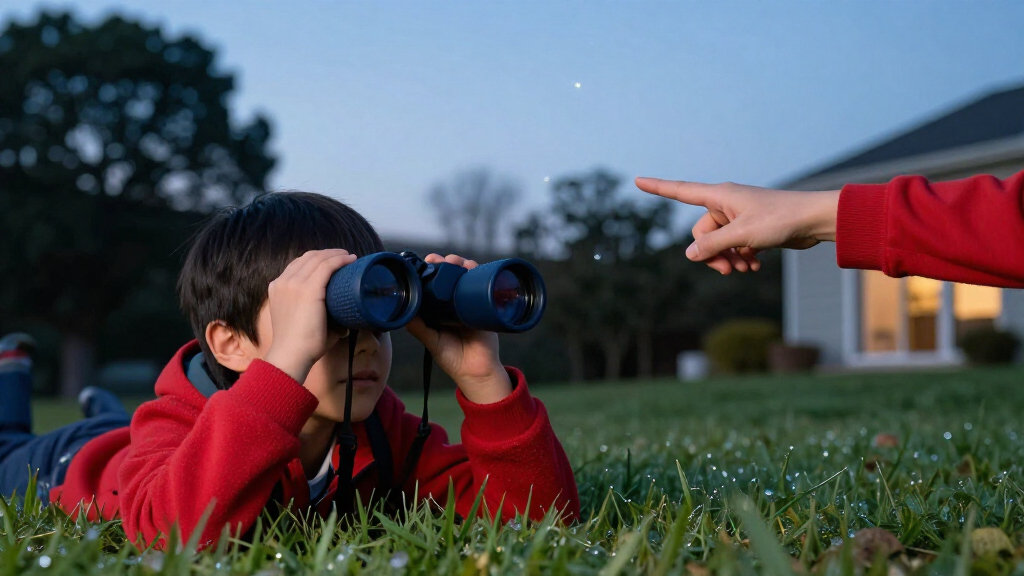
For a child’s first look at the night sky, the best binoculars are not always the ones with the highest magnification. Celestron Cometron 7×50 is my strongest all-around astronomy pick because its wide view makes it easier to find the Moon and scan star fields. The SkyMaster 15×70 brings more reach and larger lenses, but its size makes a tripod and adult help much more important. For younger children who need something they can carry and focus themselves, Living Squad 8×21 is the lightest, most child-oriented choice, with a clear tradeoff: its smaller lenses are less suited to dim night-sky viewing.

Prime made for students and young adults
- Fast, free delivery for dorm and study essentials
- Prime Video and Amazon Music included
- Member-only deals
This comparison focuses on the practical differences a family will notice: how easy the view is to hold steady, how much sky each pair shows at once, whether a child can manage the weight and focusing, and how well each model suits evening use rather than general outdoor activity. I rank the Cometron first for its balance of sky coverage and light gathering, the SkyMaster second for families ready to use a mount, and the Living Squad third for portability and simple daytime learning. The right choice depends on whether your priority is stargazing performance, higher magnification, or kid-friendly handling.
Key Takeaways
- The Celestron Cometron 7×50 offers the most balanced entry point for sky watching, combining a 6.8° field of view with 50 mm objective lenses.
- The Celestron SkyMaster 15×70 gathers more light and shows more magnification, but its heavier format is best used on a tripod rather than held by a child for long sessions.
- The Living Squad 8×21 weighs just 7.2 oz and is designed for children, but its 21 mm lenses make it a better all-purpose outdoor pair than a dedicated astronomy choice.
- For beginners, lower magnification can make it easier to locate a target and keep it in view; higher magnification is more demanding when the binoculars are handheld.
- None of these options includes a tripod: the Cometron and SkyMaster accept tripod mounting, while the SkyMaster’s 15x power makes support especially useful.
| Celestron Cometron 7×50 Astronomy Binoculars |  | Best Overall for Beginner Stargazing | Magnification: 7x | Objective lens diameter: 50 mm | Field of view: 6.8° | VIEW LATEST PRICE | See Our Full Breakdown |
| Celestron SkyMaster 15×70 Astronomy Binoculars |  | Best for Higher Magnification with a Tripod | Magnification: 15x | Objective lens diameter: 70 mm | Field of view: 4.4° | VIEW LATEST PRICE | See Our Full Breakdown |
| Living Squad Kids 8×21 Compact Binoculars with Case and Neck Strap |  | Best Lightweight Pick for Kids | Magnification: 8x | Objective lens diameter: 21 mm | Field of view: 7.1° | VIEW LATEST PRICE | See Our Full Breakdown |
| beginner astronomy binoculars for kid | Magnification | Objective lens diameter | Field of view | Focus type |
|---|---|---|---|---|
| Celestron Cometron 7×50 Astron | 7x | 50 mm | 6.8° | Individual focus |
| Celestron SkyMaster 15×70 Astr | 15x | 70 mm | 4.4° | Center focus |
| Living Squad Kids 8×21 Compact | 8x | 21 mm | 7.1° | Manual |
More Details on Our Top Picks
Celestron Cometron 7×50 Astronomy Binoculars
The Cometron 7×50 is my top pick for a child and adult learning the night sky together. Its 7x magnification is modest compared with the SkyMaster’s 15x, but that is an advantage when the binoculars are held by hand: aiming is less demanding, and small movements are less disruptive. Its 6.8° field of view is also substantially wider than the SkyMaster’s 4.4°, giving beginners more sky to work with while they search for the Moon or sweep along a familiar star pattern.
The 50 mm objective lenses and multi-coated optics give this model a stronger astronomy case than the child-sized Living Squad 8×21. Those larger lenses gather more light, which helps when observing bright night-sky targets, though they do not make every faint object easy to see. The Cometron’s broad, simple viewing experience is a better match for exploratory stargazing than trying to magnify a small patch of sky before a child can reliably point the binoculars.
There are real limitations. At 774 g, it is much heavier than the Living Squad, and that weight can tire a younger child during a long session. The individual-focus design is also less convenient than center focus when switching quickly between objects at different distances, especially for daytime use. It accepts a tripod, but an adapter is not included, so families seeking a mounted setup need to plan for that separately. For a first astronomy pair used with adult guidance, though, the Cometron offers the lineup’s most approachable combination of wide sky coverage and substantial light-gathering lenses.
Pros:- Wide 6.8° field of view helps beginners scan and locate targets.
- 50 mm multi-coated objective lenses are better suited to dim evening viewing than the Living Squad’s 21 mm lenses.
- Lower 7x magnification is easier to aim and hold steady by hand than the SkyMaster 15×70.
- Tripod-adaptable design supports steadier viewing when used with a compatible adapter.
Cons:- At 774 g, it may be tiring for a child to hold for extended sessions.
- Individual focus is less convenient when changing quickly between near and distant viewing.
- Tripod adapter is not included.
Best for: Families who want one binocular for introductory stargazing and daytime observation, with an adult available to help younger children hold and focus it.
Not ideal for: Very young children who need a lightweight pair they can carry independently, or buyers who want high magnification and a tripod-ready setup without sourcing an adapter.
- Magnification:7x
- Objective lens diameter:50 mm
- Field of view:6.8°
- Prism type:Porro prism
- Coating:Multi-coated
- Focus type:Individual focus
- Eye relief:13 mm
- Weight:774 g
- Mount compatibility:Tripod adaptable; adapter not included
Our verdict“I recommend the Cometron 7×50 as the best balanced first astronomy binocular here, provided an adult can help a child manage its weight.”
Celestron SkyMaster 15×70 Astronomy Binoculars
The SkyMaster 15×70 is the specialist choice in this group: it is for families who want more magnification and larger objective lenses, and who are willing to mount the binoculars for a steadier view. Its 15x magnification gives distant targets a larger appearance than either the Cometron or Living Squad. The 70 mm lenses, BaK-4 prisms, and multi-coated optics are also the strongest stated light-gathering setup here, making this the most astronomy-oriented option by specification.
Those strengths bring a learning curve. Compared with the Cometron’s 7x power and broad 6.8° view, the SkyMaster’s 4.4° field of view shows a narrower patch of sky. That tighter view and greater magnification can make a target harder to locate, while hand movement is more noticeable. Although a built-in tripod adapter is included, the tripod itself is not; families will need a suitable support if they want to observe comfortably for longer periods. This is not the pair I would hand to a young child for unsupported sky scanning.
The rubber-armored, water-resistant housing and supplied case, lens caps, rainguard, neck strap, and cloth make it better equipped for transport and care than a bare-bones setup. Center focus also offers a more familiar adjustment than the Cometron’s individual-focus arrangement when shifting between viewing distances. Still, its larger format is harder for a child to manage, and a mount adds setup and portability considerations. I rank it below the Cometron for beginners because more magnification does not automatically mean an easier first view. Choose it when an adult can help set it up and the goal is a more powerful, supported observation session.
Pros:- 15x magnification brings distant targets into a larger view than the other two options.
- 70 mm objectives, BaK-4 prisms, and multi-coated optics make it the strongest astronomy-focused optical setup in this comparison.
- Built-in tripod adapter supports stable extended observation when paired with a tripod.
- Rubber-armored, water-resistant housing and included carrying and lens-care accessories support transport.
Cons:- High magnification and a 4.4° field of view make locating objects harder for beginners.
- Its size and weight make a tripod advisable for extended use, and the tripod is not included.
- Less suitable for a child to hold and aim independently than the Cometron or Living Squad.
Best for: Families with an adult observer who can provide a tripod and help a child use a higher-magnification binocular for deliberate viewing.
Not ideal for: Children who want to point and scan the sky on their own, or families looking for a lightweight pair for casual handheld use.
- Magnification:15x
- Objective lens diameter:70 mm
- Field of view:4.4°
- Prism type and material:Porro prism; BaK-4
- Coating:Multi-coated
- Focus type:Center focus
- Eye relief:18 mm
- Exit pupil diameter:4.7 mm
- Mount compatibility:Built-in tripod adapter; tripod not included
Our verdict“I would choose the SkyMaster 15×70 for a supported, adult-guided astronomy setup, not as the easiest first pair for a child to use handheld.”
Living Squad Kids 8×21 Compact Binoculars with Case and Neck Strap
Living Squad’s 8×21 is the easiest option in this lineup for a child to carry and use during everyday outdoor activities. At 7.2 oz, it is far lighter than the Cometron and avoids the large, mount-oriented format of the SkyMaster. The 8x magnification is a little higher than the Cometron’s, but the binocular remains compact and includes manual focus, a wide eyepiece, a hand strap, a breakaway neck strap, a case, an instruction manual, and a cleaning cloth. That package makes it a practical first pair for learning how binoculars work.
For astronomy, the main compromise is its 21 mm objective lens diameter. The Cometron’s 50 mm lenses and SkyMaster’s 70 mm lenses are much larger, so both are more appropriate when the goal is gathering light for night-sky viewing. Living Squad’s stated 7.1° field of view is the broadest of the three, which helps with finding objects, but a wide view cannot replace the light-gathering capacity of larger objectives. I see this as a child’s all-purpose outdoor binocular that can be brought outside to look at the Moon or bright objects, rather than a dedicated stargazing instrument.
Its child-oriented design is the reason to pick it, not its astronomy performance. The light weight is easier for small hands to manage than the Cometron’s 774 g body, and the supplied straps and case help keep the set together. But the plastic enclosure is a less reassuring choice for rough handling than the SkyMaster’s rubber-armored housing, and water resistant does not mean waterproof. I rank it third for this astronomy-specific roundup because its portability is excellent while its small lenses narrow its usefulness after the novelty of casual sky watching fades.
Pros:- At 7.2 oz, it is much easier for children to carry than either Celestron model.
- 8x magnification and a 7.1° field of view suit casual scanning and outdoor observation.
- Includes a case, breakaway neck strap, hand strap, instruction manual, and cleaning cloth.
- Water-resistant design is suited to ordinary outdoor outings, subject to normal care.
Cons:- 21 mm objective lenses are much smaller than those on the Cometron and SkyMaster for astronomy use.
- Plastic enclosure may be less suited to rough handling than the SkyMaster’s rubber-armored housing.
- Water resistant is not the same as waterproof.
Best for: Children who need a lightweight, easy-to-carry pair for hiking, bird watching, and occasional looks at bright night-sky objects.
Not ideal for: Families whose main purpose is regular astronomy viewing or who want larger lenses for low-light use.
- Magnification:8x
- Objective lens diameter:21 mm
- Field of view:7.1°
- Prism type:Roof prism
- Focus type:Manual
- Eye relief:10 mm
- Weight:7.2 oz
- Water resistance:Water resistant; not described as waterproof
- Included items:Breakaway neck strap, hand strap, case, manual, cleaning cloth
Our verdict“I recommend the Living Squad 8×21 when child-friendly weight matters more than dedicated night-sky performance.”
How We Picked
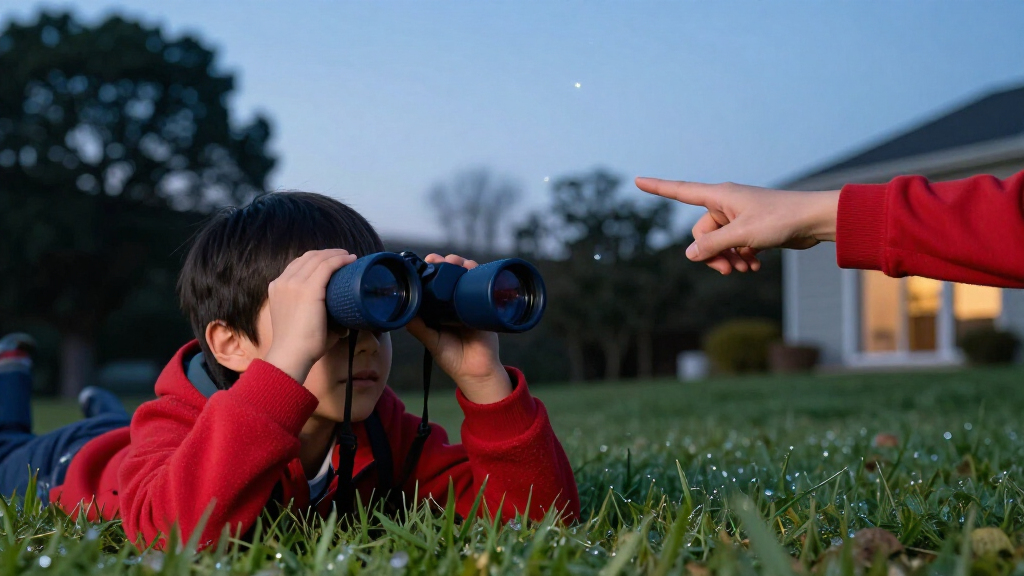
I ranked these three binoculars by how well they fit beginner astronomy for children, not by magnification alone. A young observer needs to find a target, get both eyes comfortably positioned, and keep the view steady long enough to enjoy it. A specification that sounds impressive on paper can work against that experience if the binoculars are heavy or difficult to aim.
My comparison gives particular weight to field of view, objective lens size, magnification, weight, focusing style, and mount compatibility. A wider field makes it easier to sweep across the sky and find a bright object; larger objective lenses collect more light, while greater magnification can make handheld shake more visible. I also distinguish a child-sized general-purpose pair from binoculars built more specifically for astronomy. The Living Squad is the lightest and most child-focused, but its small lenses limit its night-sky role. The Cometron is less powerful than the SkyMaster yet more approachable for casual scanning. The SkyMaster can show more, but asks families to manage its size and use a stable support.
I use the supplied product details to compare the stated features and included accessories. I do not treat water resistance as waterproofing, assume that a tripod is included when it is not, or promise views of faint objects based on specifications alone. The ranking reflects ease of use, sky suitability, and the compromises a family must accept with each pair.
| beginner astronomy binoculars for kid | Prism type | Focus type | Mount compatibility |
|---|---|---|---|
| Celestron Cometron 7×50 Astron | Porro prism | Individual focus | Tripod adaptable; adapter not included |
| Celestron SkyMaster 15×70 Astr | — | Center focus | Built-in tripod adapter; tripod not included |
| Living Squad Kids 8×21 Compact | Roof prism | Manual | — |
Factors to Consider When Choosing Beginner Astronomy Binoculars For Kids
For children’s astronomy, I would start with the kind of viewing session your family expects. A child who wants to carry binoculars independently has different needs from a child who will observe beside an adult and use a tripod. The differences among these three models are especially clear in magnification, lens size, weight, and ease of aiming.
Choose magnification for steadiness, not just detail
Higher magnification makes distant objects appear larger, but it also magnifies movement from your hands. That matters when a child is trying to follow the Moon or locate an object against a dark sky. The 7x Cometron is the least demanding of the three to aim by hand, and its broad 6.8° view gives beginners more sky in which to find a target. The 15x SkyMaster can offer a closer-looking view, but its narrower 4.4° field makes locating objects trickier and handheld shake more noticeable. The 8x Living Squad sits between them in magnification, though its small lenses make it less capable for dimmer night-sky use. If your child is new to binoculars, a stable, easy-to-find view is often more enjoyable than extra power.
Objective lens size matters after sunset
The objective lens is the larger lens at the front of the binocular. Larger objectives can collect more light, which is useful in evening conditions. In this group, the Cometron has 50 mm objectives, the SkyMaster has 70 mm objectives, and the Living Squad has 21 mm objectives. That specification helps explain why the first two are more focused on astronomy, while the Living Squad is aimed at children’s general outdoor use. Lens size is not a guarantee that every star or faint object will be visible, and it also brings a practical cost: larger binoculars are usually bulkier and harder for small hands to hold. The SkyMaster has the largest lenses, but it is the pair most likely to benefit from adult setup and tripod support.
Match weight and mounting to the child
Consider how long your child will hold the binoculars and whether there is a place to mount them. The Living Squad’s 7.2 oz weight makes it the easiest to take on walks and outings. The Cometron weighs 774 g, so a child may need help holding it steadily for a long session. The SkyMaster’s size and power make a tripod advisable for extended observation. Both Celestron models support tripod mounting, but their accessories differ: the Cometron’s tripod adapter is not included, while the SkyMaster has a built-in adapter but no tripod. A tripod is an additional item either way. If a child will mostly observe from a patio or backyard, a mounted option may be manageable; for spontaneous handheld use, the lightest pair has a clear handling advantage.
Check focusing style and eye comfort
Focus controls influence how easily a child can switch between targets. The Cometron uses individual focus, which may take more adjustment when changing between near and distant objects. The SkyMaster uses center focus, while Living Squad lists manual focus. The supplied information does not describe all control dimensions or adjustment ranges for every model, so families should be ready to help a child position the binoculars and make small adjustments. Eye relief also varies: the Cometron lists 13 mm, the SkyMaster 18 mm, and the Living Squad 10 mm. Children who wear glasses may find eye positioning more particular, so comfortable fit should matter as much as magnification. Fold-down eyecups are listed on the Cometron, but I would not assume that feature appears on the other models.
Treat water resistance as a limit, not a promise
The Celestron binoculars and Living Squad are described as water resistant, not waterproof. That wording does not promise protection from submersion or heavy exposure, so keep the binoculars sheltered in wet conditions and dry them according to the care instructions. The SkyMaster adds rubber armor, which may help protect its exterior during normal handling, while the Living Squad uses a plastic enclosure. Lens caps and a case help protect optics in storage, but they do not remove the need for supervision. For children, a neck strap can help keep binoculars from being dropped; the Living Squad includes a breakaway neck strap, which is designed with child use in mind.
Set expectations for what binoculars show
Binoculars can make bright objects and broad star fields more engaging, but they are not a shortcut to seeing every detail in the universe. Children can begin by observing the Moon and exploring bright regions of the sky, learning how to point, focus, and hold the view. A wider field can make that first search less frustrating, which favors the Cometron for beginner astronomy. The SkyMaster is better for a family prepared for a more deliberate, mounted session, and Living Squad is a convenient introduction to outdoor optics with occasional sky viewing. I would choose based on the child’s ability to hold and aim the pair, then add magnification only when the setup can remain stable.
Frequently Asked Questions
Are binoculars a good way for a child to start astronomy?
Yes. Binoculars offer a simple way to learn how to point at a target and explore a broad area of sky without the setup of a telescope. For beginners, a wide field of view can make objects easier to locate. Among these options, the Cometron’s 6.8° view and 7x magnification give it the most balanced astronomy starting point, while Living Squad is easier for a child to carry but has much smaller objectives.
Which of these binoculars is easiest for a child to hold?
The Living Squad 8×21 is the lightest listed option at 7.2 oz, so it is easiest to carry and manage during general outdoor activities. The Cometron weighs 774 g and may need adult support during longer viewing. The SkyMaster is the most demanding to hold steadily because its 15x magnification makes hand movement more apparent; a tripod is advisable for extended sessions.
Should I choose the 15×70 SkyMaster over the 7×50 Cometron?
Choose the SkyMaster if higher magnification and larger objective lenses are priorities and your family is prepared to use a tripod. Choose the Cometron if the child is new to the sky and you value a wider view that is easier to scan and aim. The SkyMaster’s 4.4° field is narrower than the Cometron’s 6.8°, and the higher power can make handheld viewing more difficult.
Can the Living Squad 8×21 be used for stargazing?
It can be used for casual views of bright night-sky objects, but its 21 mm objectives are much smaller than the 50 mm and 70 mm lenses on the Celestron models. That makes it a better fit for daytime activities such as hiking and bird watching, with occasional astronomy, than for a family whose primary goal is regular night-sky observation.
Do these binoculars include a tripod?
No tripod is listed as included with any of the three pairs. The SkyMaster has a built-in tripod adapter, while the Cometron is tripod adaptable but requires an adapter that is not included. The Living Squad is presented as a compact handheld pair and is not listed with tripod mounting. If you plan long viewing sessions, check the required mounting hardware before buying a separate tripod.
Conclusion
For most families choosing a first pair specifically for astronomy, I recommend the Celestron Cometron 7×50. Its wide field and lower magnification make it easier to scan the sky than the SkyMaster, while its 50 mm objectives offer a more astronomy-suited setup than the Living Squad’s compact 21 mm lenses. It is not lightweight, so an adult may need to help a child hold it.
Choose the Celestron SkyMaster 15×70 if an adult will help with setup and you want higher magnification for deliberate, tripod-supported viewing. Pick the Living Squad 8×21 if carrying comfort and child-friendly outdoor use matter more than dedicated night-sky performance. My short version: Cometron for a balanced first astronomy pair, SkyMaster for supported higher-power sessions, and Living Squad for a lightweight all-purpose introduction to binoculars.
Fall Picks
fall essentials
As an affiliate, we earn on qualifying purchases.