
📊 Full opportunity report: Albany Faces Stormy Weather: Changes In Trade And Supply Chain Operations on IdeaNavigator AI — validation score, market gap, and execution plan.

Prime made for students and young adults
- Fast, free delivery for dorm and study essentials
- Prime Video and Amazon Music included
- Member-only deals
TL;DR
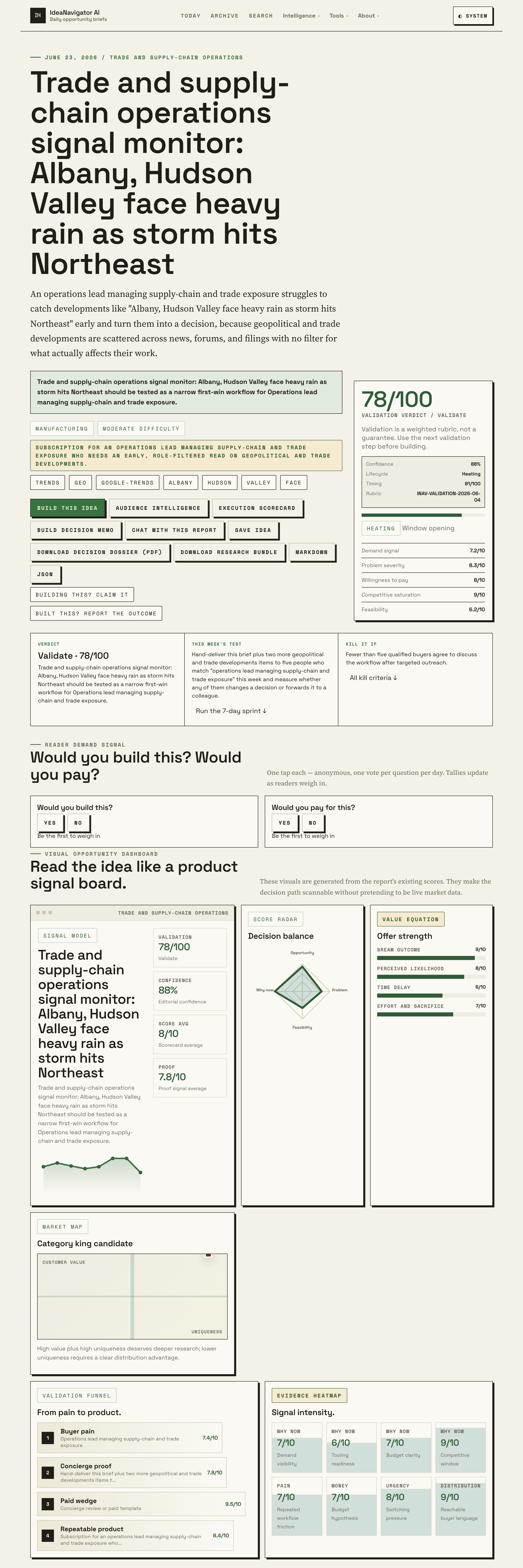
A severe storm hitting the Northeast is causing heavy rain in Albany and Hudson Valley, disrupting trade and supply chain activities. Authorities and businesses are assessing immediate impacts, with ongoing uncertainty about the full extent of disruptions.
Heavy rainfall caused by a storm in the Northeast has significantly impacted Albany and Hudson Valley, disrupting trade and supply chain operations in the region. Authorities and businesses are actively assessing the extent of the disruptions, which could influence regional logistics and trade flows.
According to local weather agencies, a storm system has brought heavy rain to Albany and Hudson Valley, with rainfall levels exceeding 2 inches in some areas. The storm prompted the closure of several transportation routes, including key highways and rail lines, affecting regional trade activities.
Trade officials and logistics providers report delays in freight movement, with some shipments diverted or held at ports and warehouses. The storm’s impact is expected to persist through at least the next 24 hours, with officials warning of potential further disruptions if weather conditions worsen.
Implications for Regional Trade and Supply Chains
This storm’s impact on Albany and Hudson Valley underscores the vulnerability of supply chains to weather events, especially in a context where rapid geopolitical and trade developments require swift operational responses. Disruptions could lead to delays in goods delivery, increased costs, and logistical bottlenecks that ripple through regional and national markets.
weather-resistant shipping containers
As an affiliate, we earn on qualifying purchases.
As an affiliate, we earn on qualifying purchases.
Recent Weather Events and Supply Chain Vulnerabilities
Heavy storms and weather-related disruptions have become more frequent in the Northeast, affecting ports, transportation hubs, and logistics networks. Recent incidents have highlighted the need for real-time monitoring and agile response strategies in supply chain management, especially amid heightened geopolitical tensions and trade uncertainties.
Officials and industry experts have emphasized that weather disruptions, combined with geopolitical risks, create complex challenges for operational planning and risk mitigation in trade logistics.
“The storm system is bringing heavy rainfall that could persist for the next 24 hours, with potential for further weather-related disruptions.”
— Local weather agency spokesperson
As an affiliate, we earn on qualifying purchases.
Unclear Extent of Long-Term Disruptions
It is not yet confirmed how long the storm will impact trade and logistics operations, or whether further weather events will compound the disruptions. The full economic impact remains uncertain as assessments are ongoing.
As an affiliate, we earn on qualifying purchases.
Monitoring and Response Plans for Ongoing Disruptions
Authorities and logistics companies will continue to monitor weather updates and assess infrastructure status. Emergency response measures, route adjustments, and contingency planning are expected to be prioritized over the next 48 hours to mitigate ongoing impacts.
As an affiliate, we earn on qualifying purchases.
Key Questions
How long are the disruptions expected to last?
Disruptions are expected to persist at least through the next 24 hours, with ongoing assessments to determine longer-term effects.
Which transportation routes are affected?
Major highways and rail lines in Albany and Hudson Valley have been affected, with some routes closed or experiencing delays.
What should businesses do to prepare?
Businesses should monitor weather updates, adjust delivery schedules, and coordinate with logistics providers to manage delays and reroute shipments if necessary.
Is there a risk of further weather events?
While current forecasts suggest the storm will continue for the next day, additional weather events cannot be ruled out, and authorities are closely monitoring the situation.
Source: IdeaNavigator AI
Fall Picks
fall essentials
As an affiliate, we earn on qualifying purchases.