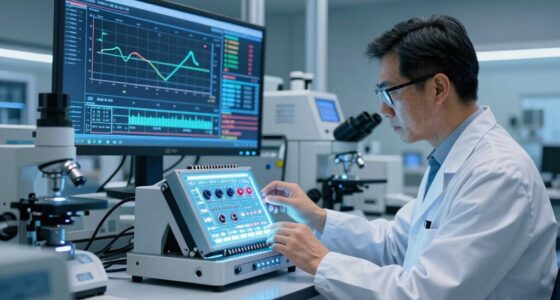

Before the headlines, scientists guarantee their discovery is solid by subjecting it to peer review, where experts scrutinize their methods, data, and conclusions. They also focus on reproducibility, having others independently verify results with detailed methods and raw data. Maintaining high scientific standards through precise measurement techniques and strict protocols helps prevent errors and bias. When all these steps are complete, the discovery is validated and ready to be shared. To understand how this process guarantees trustworthy breakthroughs, keep exploring.

Prime made for students and young adults
- Fast, free delivery for dorm and study essentials
- Prime Video and Amazon Music included
- Member-only deals
Key Takeaways
- Conduct rigorous peer review to scrutinize methodology, data integrity, and conclusions before publication.
- Ensure reproducibility by independent scientists replicating experiments with detailed methods and raw data.
- Utilize precise measurement techniques to maintain consistency and accuracy across experiments.
- Follow established scientific standards and protocols to prevent bias and contamination.
- Achieve final validation through successful peer review, reproducibility, and adherence to rigorous scientific criteria.

Scientists have recently confirmed groundbreaking discoveries that could reshape our understanding of the natural world. But before you hear about these breakthroughs in the headlines, a rigorous process unfolds behind the scenes to validate their accuracy. This process guarantees that what’s being claimed isn’t just a fluke or a passing anomaly but a dependable addition to scientific knowledge. The first vital step involves peer review, a system where other experts in the field meticulously examine the research. When you submit your findings for publication, they scrutinize your methodology, data, and conclusions. This step acts as a quality control, filtering out errors, biases, or unsupported claims. Peer review isn’t perfect, but it’s indispensable in maintaining the integrity of scientific progress. It prompts you to clarify your work, defend your assumptions, and sometimes even redo experiments or analyses to strengthen your findings. Ensuring scientific standards are met is crucial for maintaining the credibility of the research.
Once your research clears peer review, the next challenge is reproducibility. As you might guess, reproducibility means that other scientists can independently repeat your experiments and obtain similar results. This step is vital because it confirms that your discovery isn’t a one-time fluke or influenced by uncontrolled variables. You’ll need to provide detailed methods, data sets, and sometimes even raw data to enable others to replicate your work accurately. When multiple teams independently reproduce your results, it validates your discovery and guarantees that it stands on solid ground. Reproducibility is the backbone of scientific credibility, and without it, even the most exciting claims can crumble under scrutiny. Additionally, employing precise measurement techniques ensures that results are consistent and reliable across different experiments and laboratories. These techniques help reduce measurement errors and improve confidence in the findings. The entire process is often guided by established scientific standards and methodological rigor, which ensure consistency and objectivity.
Throughout this validation process, you’re constantly questioning and testing your work. You understand that a single successful experiment isn’t enough to claim a discovery; it must hold up under peer review and withstand the test of reproducibility. It’s also essential to adhere to scientific protocols to prevent contamination or bias from influencing results. These steps act as gatekeepers, preventing false claims from reaching the public eye prematurely. When your research finally passes these hurdles, you gain confidence that your findings are trustworthy and worthy of dissemination. Only then do you see your work published, gaining recognition and contributing to the ongoing quest for knowledge. So, before the headlines hit, you’ve already gone through a rigorous vetting process — one that guarantees the discoveries you’re sharing are not just groundbreaking but genuinely reliable.
As an affiliate, we earn on qualifying purchases.
Frequently Asked Questions
How Long Does the Validation Process Typically Take?
The validation process usually takes several months to years. You’ll find that scientists rely heavily on experimental replication, where others repeat the study to confirm results. Peer review is also essential, as experts scrutinize the findings for accuracy and validity before publication. This thorough process guarantees the discovery is credible, which is why it can take quite a while before the research makes headlines.
What Are Common Challenges Faced During Validation?
Imagine steering a stormy sea; the biggest challenge is guaranteeing your ship’s data reproducibility. You face unpredictable waves of errors and doubts, making peer review essential to steady your course. Sometimes, conflicting results from other researchers threaten your findings’ credibility. Overcoming these challenges requires meticulous checks, transparent methods, and patience, but it’s crucial to confirm your discovery truly withstands scrutiny before the world hears about it.
Who Oversees the Validation Procedures in Research Labs?
In research labs, peer review and reproducibility standards oversee validation procedures. You guarantee your findings meet these standards by thoroughly documenting your methods and results. Peer reviewers, often experts in your field, scrutinize your work to confirm its accuracy and validity. Reproducibility standards require you to provide enough detail so others can replicate your experiments. This process guarantees your discovery is reliable before it makes headlines.
Can Discoveries Be Validated Differently Across Scientific Fields?
Discoveries can indeed be validated differently across scientific fields, as you’ll find varied methods like interdisciplinary approaches and cultural influences shaping validation. In biology, replication and peer review are key, while in social sciences, cultural context and qualitative analysis matter more. You’ll notice that disciplines adapt validation techniques to their unique questions, reflecting diverse perspectives. Recognizing these differences helps you appreciate the richness and complexity behind scientific validation processes worldwide.
What Happens if a Discovery Fails Validation?
If a discovery fails validation, you face replication challenges that cast doubt on its reliability. False positives often emerge, making it seem like you’ve found something significant when you haven’t. To address this, scientists typically re-examine the data, repeat experiments, or seek independent verification. This process helps prevent false positives from spreading and guarantees only robust, validated findings make it to the scientific community and headlines.
As an affiliate, we earn on qualifying purchases.
Conclusion
So, while headlines race to share your discovery, true validation quietly unfolds behind the scenes. It’s the meticulous experiments, peer reviews, and repeated tests that give your breakthrough its lasting power. Without this rigorous process, your discovery is just a fleeting headline, not a scientific truth. Remember, the real impact lies not in the rush to publish, but in the patience of validation—where genuine knowledge is built, not just announced.
precise measurement instruments for labs
As an affiliate, we earn on qualifying purchases.
As an affiliate, we earn on qualifying purchases.
As an affiliate, we earn on qualifying purchases.
Halloween Picks
halloween
As an affiliate, we earn on qualifying purchases.