

The most important difference between observation and proof is that observation is simply noticing and recording facts, while proof involves analyzing those facts with systematic evidence and logical reasoning. Observation alone may be biased or incomplete, but proof combines experimental results and careful thinking to establish certainty. To truly understand causality and draw valid conclusions, you need more than just observing — you need to support your facts with solid evidence and reasoning. Keep exploring to learn how this process builds stronger conclusions.
Key Takeaways
- Observation involves noticing facts; proof requires establishing certainty through evidence and reasoning.
- Observation is initial data collection; proof combines evidence and logical analysis to confirm conclusions.
- Observation alone is insufficient; proof demands systematic testing and evaluation of evidence.
- Proof is the result of consistent, reproducible evidence supported by logical reasoning.
- The key difference is that observation is noticing, while proof is demonstrating certainty.
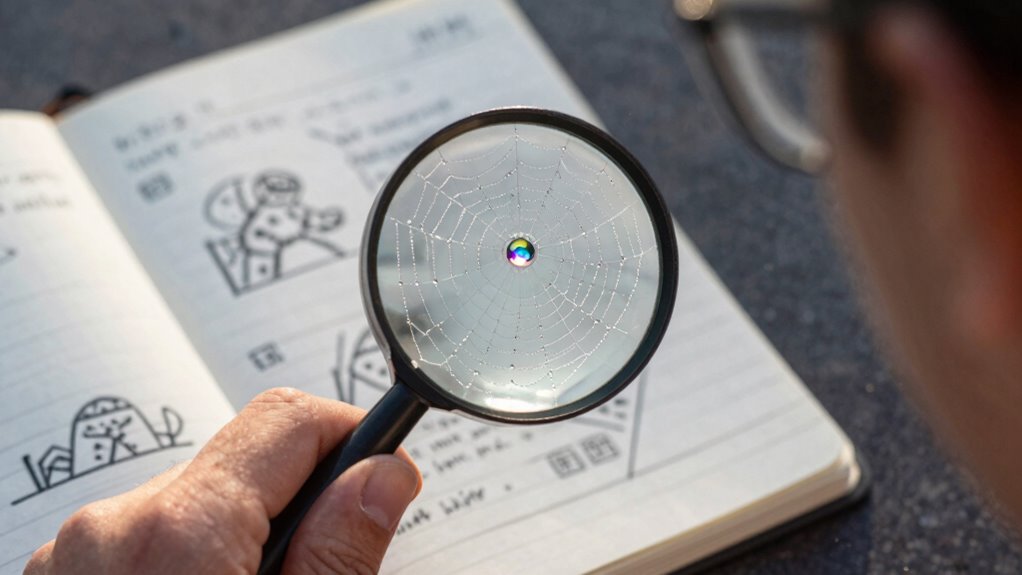
Understanding the difference between observation and proof is crucial, especially when evaluating claims or making decisions. Observation involves noticing and recording facts or events as they happen, often through your senses or instruments. It’s a fundamental step in gathering data, but it doesn’t automatically guarantee that what you observe is conclusive. For example, you might notice that the sky appears darker before a storm, but that observation alone doesn’t prove a storm is imminent. It’s simply a recorded fact. To turn observation into proof, you need to build a strong case through additional reasoning and evidence.
Observation is just noticing facts; turning it into proof requires reasoning and supporting evidence.
This is where experimental evidence and logical reasoning come into play. Experimental evidence involves conducting tests or experiments designed to verify or falsify a hypothesis. It’s a structured way to gather data that can support or challenge your initial observations. When you perform repeated experiments under controlled conditions, you reduce the influence of chance or bias. For instance, if you observe that a certain plant grows faster in sunlight, you can test this by growing identical plants in different lighting conditions. The results from these experiments offer more reliable evidence than a single observation. Furthermore, understanding the scientific method helps in designing experiments that produce valid and repeatable results.
Logical reasoning ties everything together. It’s the process of analyzing your experimental evidence and observations to draw valid conclusions. It helps you distinguish between mere observations and proof by requiring that your conclusions follow logically from the evidence. It is also important to recognize that empirical evidence—gathered through systematic testing—strengthens the process of turning observations into proof. When you use logical reasoning, you avoid jumping to conclusions based on a handful of observations. Instead, you critically analyze the data, consider alternative explanations, and ensure your reasoning is sound. To improve your understanding of critical thinking, it’s essential to evaluate how well your evidence supports your claims. For example, if multiple experiments consistently show that a drug improves health outcomes, and your reasoning supports that the drug causes the improvement, then you’re approaching proof. Recognizing the difference between correlation and causation is also vital in this process.
The key difference lies in the strength and certainty of the conclusion. Observation alone is often insufficient for proof because it can be influenced by misinterpretation or coincidence. Experimental evidence, combined with logical reasoning, transforms raw data into proof by systematically testing hypotheses and ensuring conclusions follow logically from the evidence. When you understand this distinction, you become better at evaluating claims, whether they’re scientific, everyday, or even personal. You learn to ask not just what you observe, but how well that observation stands up to testing and reasoning, ultimately leading you to more accurate, well-founded conclusions.

UNGLINGA 150 Experiments Science Kits for Kids Chemistry Lab S.T.E.MToys
- Number of Experiments: 150 science experiments for kids
- Educational Topics: Earth, surface tension, chemistry, physics
- Instruction Manual: Well-illustrated, step-by-step guide
As an affiliate, we earn on qualifying purchases.
As an affiliate, we earn on qualifying purchases.
Frequently Asked Questions
Can Observation Alone Establish Scientific Proof?
No, observation alone can’t establish scientific proof. While observations provide valuable empirical evidence, you need theoretical validation to interpret them correctly. Scientific proof requires consistent, repeatable results that support a hypothesis, not just a single observation. You must analyze and test your observations rigorously, combining empirical evidence with sound theory, to build a strong case for scientific proof. Observations are just the starting point.
How Do Biases Affect Observation and Proof Differently?
Biases act like filters, distorting what you see and interpret. Perception distortions and cognitive biases lead you to favor certain observations over others, skewing the evidence you gather. While observation can be influenced, proof demands objectivity. Your biases might taint initial perceptions but shouldn’t alter the logical process of establishing proof. Recognizing these biases helps you aim for clearer, more accurate evidence, making your scientific conclusions more trustworthy.
Is Proof Always More Reliable Than Observation?
Proof isn’t always more reliable than observation because it depends on perception accuracy and data interpretation. While proof aims to verify facts, it can be influenced by biases or flawed data interpretation, making it less trustworthy. Observation provides firsthand perception, but if your perception accuracy is off or you misinterpret data, the resulting proof may be flawed. Always scrutinize how perception and data interpretation shape your understanding.
Can Observation Be Subjective or Objective?
Imagine your senses as a camera trying to capture a vast, intricate landscape. Your observation can be subjective, tinted by perception inaccuracies and sensory limitations, like fog blurring the view. Objective observation, however, seeks clear, unbiased images. While personal perception influences your interpretation, aiming for objectivity involves recognizing biases, ensuring your observation reflects reality as accurately as possible. Still, complete objectivity remains a challenging, ongoing pursuit.
How Do Experiments Transform Observation Into Proof?
Experiments transform observation into proof through experimental validation and careful data interpretation. When you conduct an experiment, you systematically test your observations under controlled conditions, reducing biases. By analyzing the resulting data objectively, you can confirm whether your initial observations hold true consistently. This process provides strong evidence, turning subjective or preliminary observations into reliable proof that supports or refutes your hypotheses.

Logic Puzzle Brain Teaser Game for Kids & Adults, 88 Challenges 4 Difficulty Levels, Portable Design for Brain Training (1pcs)
- Suitable for All Ages: Engages children and adults alike
- 88 Challenging Levels: Progress from beginner to master
- 4 Difficulty Levels: Gradually increase mental challenge
As an affiliate, we earn on qualifying purchases.
As an affiliate, we earn on qualifying purchases.
Conclusion
So, now that you know the key difference—observation is simply noticing, while proof is confirming with evidence—it’s clear why proof holds more weight. Are you ready to rely on solid evidence rather than just what you see? Remember, observation is the first step, but proof is what truly convinces others. Keep questioning, stay curious, and always seek the proof behind what you observe. After all, isn’t that the true path to understanding?

CRITICAL THINKING TRAINING WORKBOOK: Over 60 Questions Worked Examples & Answer Key to Help Students Master Problem Solving Critical Thinking and Analysis (APTITUDE & REASONING EXAM PRACTICE SERIES)
As an affiliate, we earn on qualifying purchases.
As an affiliate, we earn on qualifying purchases.

Evidence! Citation & Analysis for the Family Historian
As an affiliate, we earn on qualifying purchases.
As an affiliate, we earn on qualifying purchases.