

🔍 Read the full analysis: The Future Is AI: Top Mobile Workstation Laptops For 2026 on ThorstenMeyerAI.com

Prime made for students and young adults
- Fast, free delivery for dorm and study essentials
- Prime Video and Amazon Music included
- Member-only deals
TL;DR
In 2026, high-performance mobile workstations are integrating AI capabilities, with models like HP ZBook X G1i, Dell Precision 7780, and Lenovo ThinkPad P16s leading the market. These laptops balance power, portability, and expandability for demanding professionals.
Major laptop manufacturers are releasing new mobile workstation models in 2026 that integrate advanced AI features, targeting professionals requiring powerful, portable computing solutions. For an overview, see the original analysis. These models, including the HP ZBook X G1i, Dell Precision 7780, and Lenovo ThinkPad P16s Gen 3, are designed to meet the demands of AI-driven workloads, 3D rendering, CAD, and video editing, all while emphasizing portability and expandability. The development reflects a broader industry shift towards AI-optimized hardware for professional users on the move. Learn more in Leading AI Mobile Workstation Laptops For 2026 Professionals.
Leading the market, the HP ZBook X G1i offers a balanced combination of high-end processing power and mobility, featuring options for up to 128GB RAM and professional-grade GPUs. The Dell Precision 7780 stands out with its exceptional specifications, including the latest RTX PRO 3000 series GPU, making it suitable for demanding tasks like AI model training and complex simulations. Meanwhile, the Lenovo ThinkPad P16s Gen 3 provides a more budget-conscious option, delivering solid performance with a focus on durability and support.
These laptops face tradeoffs: lighter models tend to have less upgrade potential and lower specs, while heavier machines offer better thermal management and expandability. Price points also vary significantly; premium models with top-tier GPUs and large RAM capacities come at a premium, while more affordable options may sacrifice some performance and upgradeability. All models emphasize build quality and durability, essential for frequent travel and demanding environments. The integration of AI-specific hardware accelerators is a key trend, aiming to boost performance for AI workloads directly on portable devices. This trend is detailed in The Top AI-Driven Mobile Workstation Laptops To Buy In 2026.
The 10 picks
- 1
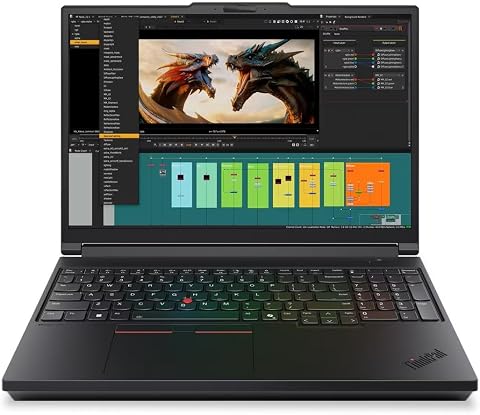 Lenovo ThinkPad P16 Gen 3 Mobile Workstation, Core Ultra 7 255HX, 64GB RAM, 2…View on Amazon →
 - 2
 Dell Precision 7780 Mobile Workstation 17.3" FHD Laptop (Intel Core i9-13950H…View on Amazon →
 - 3
 HP ZBook X G1i Mobile Workstation Laptop (Intel Core Ultra 7 265H, NVIDIA RTX…View on Amazon →
 - 4
 Dell Precision 7680 Mobile Workstation LaptopView on Amazon →
 - 5
 Dell Precision 7680 Mobile Workstation Laptop (Intel i7-13850HX, NVIDIA RTX 2…View on Amazon →
 - 6
 Lenovo ThinkPad P16s Gen 4 16-inch OLED Touchscreen Mobile WorkstationView on Amazon →
 - 7
 Lenovo ThinkPad P16s Gen 3 16" FHD+ Laptop, Intel Core Ultra 7 165H, 32GB DDR…View on Amazon →
 - 8
 Lenovo ThinkPad P14s Gen 6 14-inch Mobile Workstation, Ryzen AI 7 PRO 350, 32…View on Amazon →
 - 9
 Dell Precision 3480 14" Mobile Workstation, Intel Core i7-1370P, 32GB RAM, 51…View on Amazon →
 - 10
 HP ZBook Fury 17 G7 17.3" Mobile Workstation (Renewed)View on Amazon →
Implications of AI-Enhanced Mobile Workstations in 2026
The introduction of AI-optimized mobile workstations in 2026 marks a significant shift for professionals across industries such as design, engineering, and data science. These laptops enable on-the-go AI model training, real-time data processing, and complex simulations, previously limited to desktop environments. This trend enhances productivity, reduces dependency on fixed workstations, and accelerates workflows that rely heavily on AI-driven tasks. For users, this means greater flexibility, faster project turnaround, and access to cutting-edge computational tools in a portable form factor. The development also signals that hardware manufacturers are prioritizing AI acceleration as a core feature, potentially influencing software development and industry standards.
Industry Shift Toward AI-Integrated Mobile Workstations
Over the past few years, the demand for portable yet powerful computing devices has surged, driven by the needs of professionals working remotely or in hybrid environments. Leading brands like HP, Dell, and Lenovo have continuously upgraded their mobile workstation lines, incorporating high-performance CPUs, professional GPUs, and more recently, AI acceleration hardware. The 2026 model releases are the culmination of this trend, with a focus on integrating AI-specific features such as hardware tensor cores and dedicated AI accelerators. Historically, mobile workstations have prioritized CPU and GPU power, but the current shift emphasizes AI capabilities as a key differentiator. This evolution aligns with broader industry trends where AI workloads are becoming central to creative, scientific, and engineering tasks, demanding hardware that can keep pace without sacrificing portability.
Unconfirmed Aspects of AI Hardware Integration in 2026 Models
While manufacturers are emphasizing AI hardware features, the exact specifications, such as the presence of dedicated AI accelerators or tensor cores, are still not fully confirmed across all models. It is also unclear how widespread AI-specific hardware will be in mid-range versus premium models, and whether software optimization will keep pace with hardware advancements. Additionally, the long-term durability and battery life impacts of these AI features are still under evaluation, with early reports suggesting potential tradeoffs in power consumption and thermal management.
Upcoming Model Launches and Industry Adoption Milestones
Manufacturers are expected to announce new models throughout 2026, with initial releases focusing on high-end configurations for AI workloads. Industry analysts anticipate that AI hardware integration will become standard in most premium mobile workstations by mid-2026, with mid-range options gradually adopting similar features. Software developers are also working on optimizing AI frameworks to leverage new hardware efficiently. For users, the next steps involve evaluating these models based on actual AI performance, battery endurance, and thermal management in real-world scenarios. Long-term, the industry aims to establish AI-optimized mobile workstations as the new standard for professional portable computing.
Key Questions
What makes AI-optimized mobile workstations different from traditional models?
AI-optimized workstations include dedicated hardware such as tensor cores or AI accelerators, which enable faster AI model training, inference, and data processing directly on the device, enhancing performance for AI-heavy workloads.
Will AI features significantly increase the cost of mobile workstations?
Premium AI hardware integration may raise prices, especially in high-end models, but mid-range options are expected to adopt scaled-down AI features without substantial cost increases, balancing performance and affordability.
How does AI hardware impact battery life and thermal management?
AI accelerators can increase power consumption and heat output, potentially reducing battery life and requiring improved cooling solutions. Manufacturers are working to mitigate these issues through hardware efficiency improvements.
Are AI-optimized laptops suitable for all professional tasks?
While ideal for AI workloads, 3D rendering, and data science, these laptops also excel in general high-performance tasks. However, users with moderate needs may find standard models sufficient and more cost-effective.
When can professionals expect widespread availability of AI-enabled mobile workstations?
Industry sources suggest that by mid-2026, most premium mobile workstations will feature AI hardware, with mid-range models following later in the year as software and hardware integration matures.
Source: ThorstenMeyerAI.com
Fall Picks
fall essentials
As an affiliate, we earn on qualifying purchases.