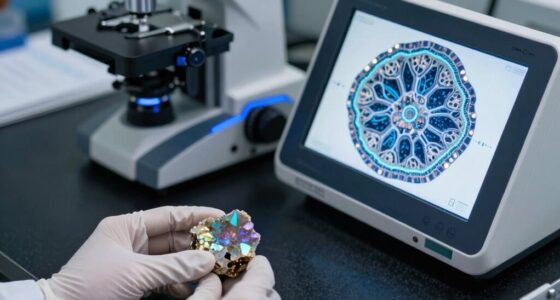
Scientists have created the world’s first synthetic cell capable of reproducing itself, marking a huge milestone in artificial life. This cell, called JCVI-syn1.0, contains a fully synthesized genome that governs its functions and allows it to grow and divide like natural cells. It’s a major breakthrough in synthetic biology, showing that we can design life from scratch. If you want to explore how this advances science and its future impacts, keep exploring.

Prime made for students and young adults
- Fast, free delivery for dorm and study essentials
- Prime Video and Amazon Music included
- Member-only deals
Key Takeaways
- JCVI-syn1.0 is the first synthetic cell with a fully synthesized genome capable of reproduction.
- It successfully replicated and divided, demonstrating autonomous reproduction of a synthetic organism.
- The cell was created by transplanting a chemically synthesized genome into a recipient cell.
- This achievement proved that synthetic genomes can support self-replication in living cells.
- The process marked a significant milestone in creating reproducible, artificially designed life forms.

The synthetic cell, JCVI-syn1.0, contains a chemically made genome that governs all cellular processes. It exhibits properties typical of its donor species, including the ability to grow and divide under laboratory conditions. Importantly, after genome transplantation, no DNA from the original recipient remained—only the synthetic chromosome. The design aimed to make a fully functional, minimally altered genome capable of supporting life. This breakthrough demonstrates that genomes can be designed digitally, synthesized chemically, and transplanted successfully into living cells. This achievement opens new avenues for creating organisms tailored for specific purposes, such as producing biofuels, pharmaceuticals, and vaccines more efficiently. It also provides a platform for studying the fundamental requirements of life and exploring the potential of synthetic genomes. The development of synthetic biology tools like this is influenced by ongoing advancements in automation that streamline complex processes. However, it raises ethical and societal questions about the boundaries of creating artificial life forms and the need for regulation. As ongoing research refines minimal genomes and expands to more complex organisms, the possibilities for synthetic biology continue to grow, promising transformative impacts across multiple fields.
Frequently Asked Questions
What Are the Potential Ethical Implications of Creating Synthetic Life?
When you create synthetic life, you face ethical questions about its intrinsic value and our moral responsibilities. You might worry about disrupting ecosystems, risking unintended harm, or creating organisms with dangerous capabilities. It also challenges your views on what it means to be alive, blurring lines between natural and artificial. You must consider societal impacts, fairness in access, and the moral status of these new life forms, shaping future ethical standards.
How Long Can the Synthetic Cell Survive and Reproduce in Natural Environments?
Imagine playing a game where your moves depend on external supplies—your synthetic cell’s survival in nature works the same way. You can expect it to last thousands of generations in controlled environments, but outside, its longevity is limited by dependence on nutrients and environmental stability. Without adaptive responses, it struggles to survive long-term, especially if conditions fluctuate. So, its natural lifespan remains uncertain, tethered tightly to the environment you provide.
What Safety Measures Are in Place to Prevent Unintended Consequences?
You should know that safety measures are vital to prevent unintended consequences in synthetic biology. You’re protected by strict DNA screening protocols that restrict access to harmful genetic material. Genetic biocontainment strategies, like kill switches and nutrient dependencies, stop synthetic cells from surviving outside controlled environments. Additionally, risk assessments and containment protocols are in place to evaluate hazards and implement appropriate safety measures, ensuring responsible research and minimizing risks to humans and the environment.
Could This Technology Be Used to Create Harmful Biological Agents?
Think of synthetic biology as a double-edged sword—you could harness it for cures or release chaos. Yes, this technology could be used to create harmful biological agents with increased toxicity and infectivity. Your concern is valid; with careful oversight, strict regulations, and ethical governance, we can minimize risks. But the potential for misuse remains, making it vital to stay vigilant and responsible as this field advances.
How Does This Development Impact Our Understanding of the Origin of Life?
This development deepens your understanding of life’s origins by showing that entire genomes can be designed, synthesized, and transplanted into cells, creating living organisms from scratch. It suggests that early life might have formed through modular genome assembly rather than gradual mutation. By demonstrating how minimal genomes sustain life, you see how primitive life could have emerged from simple genetic components, offering insights into the evolutionary processes that led to complex life forms.
Conclusion
You’re witnessing a fascinating step forward, where science gently treads into uncharted territory. This synthetic cell’s ability to reproduce hints at endless possibilities, sparking both wonder and cautious curiosity. As we explore these new horizons, it’s important to remember that each discovery carries a delicate balance. Embrace the excitement of innovation, knowing that with careful guidance, such breakthroughs could softly shape the future, offering hope and new opportunities for generations to come.
Fall Picks
fall essentials
As an affiliate, we earn on qualifying purchases.