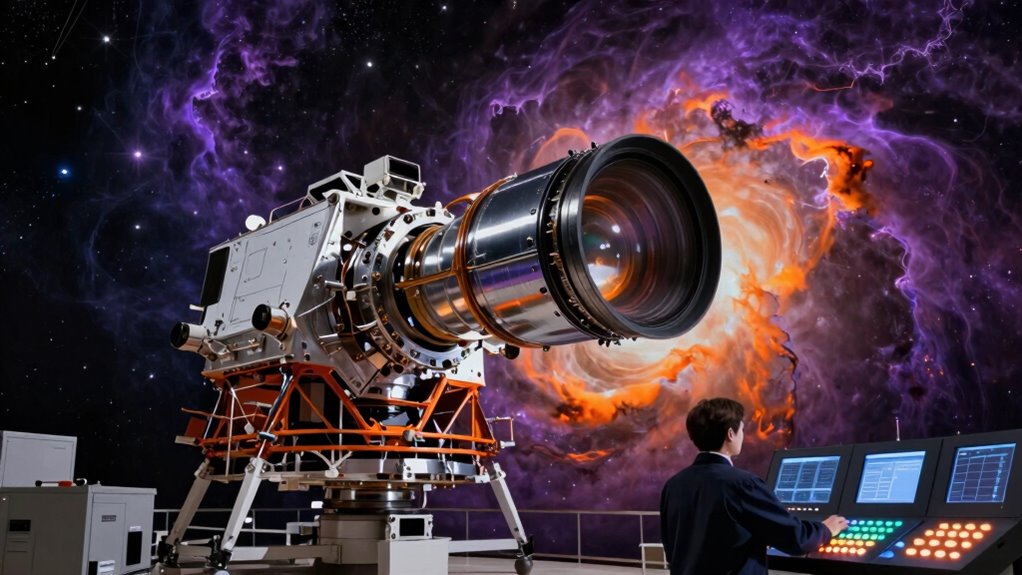

Scientists today search for extraterrestrial life by analyzing atmospheric gases, like oxygen and methane, to identify potential biosignatures. They use space telescopes to examine exoplanet atmospheres remotely and deploy robotic probes and landers to collect samples from moons like Europa and Enceladus. Advances in miniaturized sensors and autonomous drones help explore extreme environments. If you’re curious about how these cutting-edge methods uncover the universe’s secrets, keep exploring what’s happening beyond Earth.
Key Takeaways
- Analyzing atmospheric gases on exoplanets through remote sensing and spectral analysis for biosignatures.
- Using robotic probes, rovers, and landers to collect surface and subsurface samples from moons with potential habitats.
- Employing advanced sensors and autonomous drones for in situ analysis of celestial environments.
- Developing computational models to simulate planetary conditions and guide exploration efforts.
- Combining space technology with biosignature detection to assess the habitability of distant worlds.
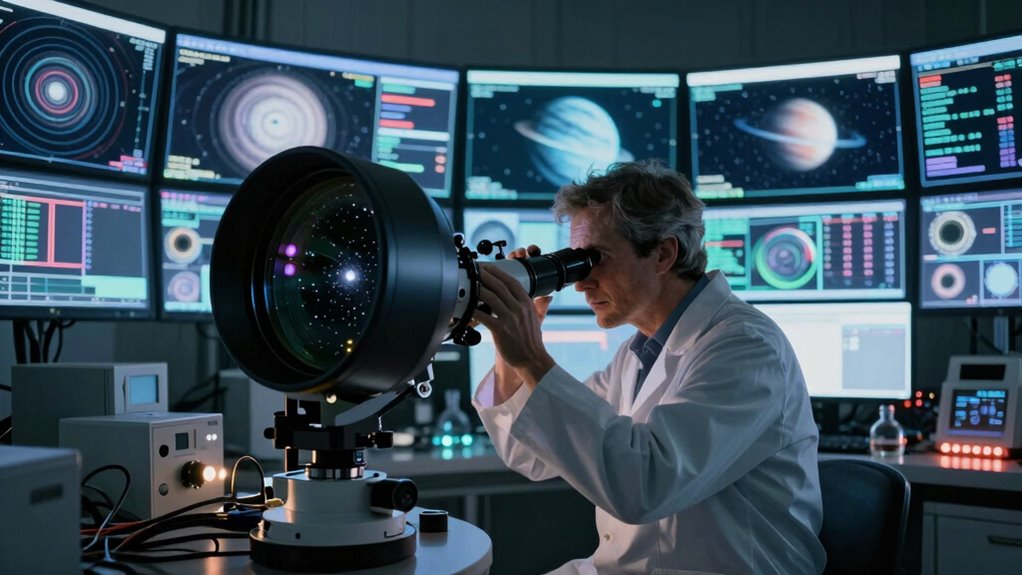
Scientists today use a combination of advanced technology and innovative methods to search for life beyond Earth. You’re at the forefront of this quest, relying heavily on detecting extraterrestrial biosignatures—signs of life or conditions that could support life—embedded in distant planets, moons, and even asteroids. These biosignatures include specific atmospheric gases, surface chemicals, or other markers that suggest biological processes might be occurring or have occurred there. To identify these clues, scientists utilize cutting-edge space exploration technologies, like sophisticated telescopes and robotic probes, which allow you to analyze planets’ atmospheres and surfaces from afar. These tools help you detect subtle variations in atmospheric composition, such as the presence of oxygen, methane, or other gases typically associated with living organisms.
Scientists use advanced technology to detect biosignatures on distant planets, moons, and asteroids.
You also depend on space exploration technologies to gather direct samples from celestial bodies. Rovers and landers equipped with scientific instruments are sent to moons like Europa or Enceladus, where subsurface oceans might harbor life. These robotic explorers drill into ice shells or analyze soil and water samples, searching for chemical signatures or microbial life. The data you collect from these missions feeds into models that assess the habitability of these environments, narrowing down promising targets for future exploration.
Furthermore, advancements in remote sensing enable you to scan exoplanets—planets orbiting stars beyond our solar system—for potential biosignatures. Using powerful space telescopes, you analyze the light passing through their atmospheres, hunting for specific spectral signatures that indicate the presence of life-supporting chemicals. This process involves interpreting faint signals from thousands or millions of miles away, demanding precision and innovation in your analytical techniques.
You’re also constantly developing new space exploration technologies to improve your search. For example, miniaturized sensors and autonomous drones are being designed to operate in extreme environments, providing more detailed in situ analysis. Meanwhile, computational models help you simulate planetary conditions and predict where extraterrestrial biosignatures might be most detectable, guiding your exploration efforts more efficiently. Additionally, you rely on the detection of extraterrestrial biosignatures, which serve as crucial indicators of potential life-supporting environments beyond Earth.
Ultimately, your quest to find life beyond Earth hinges on a combination of detecting extraterrestrial biosignatures and leveraging the latest space exploration technologies. Each discovery, no matter how small, brings you closer to answering the profound question: Are we alone in the universe? Your work is driven by curiosity and the relentless pursuit of knowledge, pushing the boundaries of science and technology to uncover the secrets of distant worlds.

So You Want To Be An Astronomer & Exoplanet Hunter: A Kids' Guide to Astronomy, Telescopes, Stars and Galaxies, and the Curious Scientists Who Search the Universe for New Worlds
As an affiliate, we earn on qualifying purchases.
As an affiliate, we earn on qualifying purchases.
Frequently Asked Questions
What Are the Most Promising Exoplanets for Finding Life?
You should focus on exoplanets with atmospheres that show signs of water vapor or other potential biosignatures, as these suggest habitability factors conducive to life. Planets in the habitable zone of their stars, especially around M-dwarfs, are promising. By studying their exoplanet atmospheres, scientists can identify conditions similar to Earth’s, increasing the chances of finding life beyond our planet. Keep an eye on these promising worlds for future discoveries.
How Do Scientists Detect Biosignatures Remotely?
Spotting signs of life, scientists scan spectral analysis results for atmospheric markers like oxygen, methane, and carbon dioxide. They detect biosignatures remotely by analyzing light from exoplanets, looking for specific absorption patterns that indicate biological activity. This technique, called spectroscopy, helps identify chemical clues in a planet’s atmosphere, revealing potential habitats for life. By studying these spectral signatures, you can uncover the universe’s hidden hints of life beyond Earth.
What Role Do Robotic Probes Play in Searching for Extraterrestrial Life?
Robotic probes play a crucial role in exploring extraterrestrial life through robotic exploration and probe technology. You rely on these advanced devices to travel to distant planets and moons, collecting samples and data that would be impossible for humans to gather directly. These probes analyze surface compositions, atmospheres, and potential biosignatures remotely, helping scientists detect signs of life. Their autonomous operations and sophisticated instruments make them indispensable in the search for extraterrestrial life.
Are There Any Recent Discoveries Indicating Possible Life Beyond Earth?
Recent discoveries, like the detection of phosphine in Venus’s atmosphere, suggest possible signs of life, though debates continue. As you explore astrobiology challenges, you realize ethical considerations become essential, especially regarding potential contamination or interference with extraterrestrial environments. These findings motivate scientists to carefully balance curiosity with responsibility, emphasizing that continued research must respect planetary protection protocols to avoid harming potential ecosystems beyond Earth.
How Do Scientists Differentiate Between Living and Non-Living Signals?
You can differentiate between living and non-living signals through biosignature detection, which identifies signs of life like specific gases, organic molecules, or patterns unique to biological activity. Scientists analyze data for these biosignatures, distinguishing them from non-living signals, which lack such complex or specific markers. By carefully studying the characteristics and context of the signals, they determine whether they originate from living organisms or are merely non-living phenomena.

Robotic Exploration of the Solar System: Part I: The Golden Age 1957-1982 (Springer Praxis Books)
As an affiliate, we earn on qualifying purchases.
As an affiliate, we earn on qualifying purchases.
Conclusion
Today, scientists are like explorers charting a cosmic ocean, scanning distant worlds for signs of life. With telescopes as their lighthouse and instruments as their compass, they sift through the stars’ secrets, hoping to find that one spark of life amid the vast darkness. Every discovery is a ripple in the universe’s endless pond, reminding us that the search for life beyond Earth is a voyage filled with wonder, curiosity, and the promise of new horizons.

Drones with Camera for Adults 4k HD FPV, Foldable Remote Control Drone, Quadcopter Toys Gifts for Boys Girls with Altitude Hold Headless Mode and Led Flash Bar, One Key Start Speed Adjustment, 3D Flips (2xBattery)
- Foldable and Portable Design: Compact, easy to carry with foldable arms
- High-Quality 4K Camera: Wide-angle HD photos and videos
- Stable Flight with Altitude Hold: Maintains altitude for steady shots
As an affiliate, we earn on qualifying purchases.
As an affiliate, we earn on qualifying purchases.
Strategies of Life Detection (Space Sciences Series of ISSI, 25)
As an affiliate, we earn on qualifying purchases.
As an affiliate, we earn on qualifying purchases.