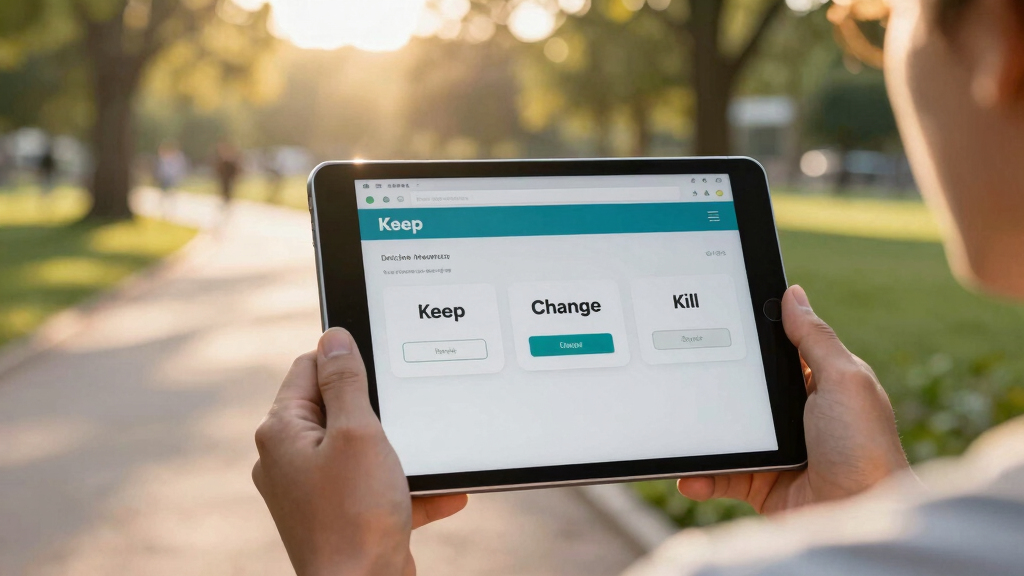

📊 Full opportunity report: Outcome-First Decisions: Keep, Change, or Kill on ThorstenMeyerAI.com — validation score, market gap, and execution plan.

Prime made for students and young adults
- Fast, free delivery for dorm and study essentials
- Prime Video and Amazon Music included
- Member-only deals
TL;DR
Outcome-First Decisions introduce a framework to assess whether to keep, modify, or end projects based on current results. It aims to improve portfolio management by focusing on outcomes rather than sunk costs. The approach emphasizes regular pruning to optimize resource allocation.
A new decision framework called Outcome-First Decisions is gaining traction among operators and managers, emphasizing the importance of evaluating ongoing projects solely based on their current outcomes rather than past investments or emotional attachments.
Outcome-First Decisions is a structured approach that helps organizations determine whether to keep, change, or kill initiatives based on a single question: what outcome is this producing right now, and is it worth its ongoing cost? Developed as an open-source framework under the AGPL-3.0 license, it aims to combat the tendency to continue projects due to sunk costs, identity, or effort justification. The core mechanism, called the Worth Filter, eliminates backward-looking biases and promotes forward-looking judgments focused on results. This method seeks to address the common problem of portfolios accumulating long tails of underperforming or dead projects that drain attention and resources without clear accountability or benefit. The framework is designed to be provider-agnostic and runs locally, allowing frequent reviews without additional cost or dependence on specific models or platforms. Its proponents argue that it institutionalizes a critical discipline—stopping—by making kill decisions more straightforward and justified, thereby freeing capacity for more productive initiatives.Outcome-First Decisions — keep, change, or kill
The hardest decision isn’t what to start — it’s what to stop. Judge every initiative by the outcome it produces now, not the effort already spent.
Independent commentary, produced with AI assistance under human editorial oversight. The views are the author’s own and may change. Outcome-First Decisions is open source under AGPL-3.0, provided “as is” without warranty; see the repository LICENSE. The framework’s verdicts are reasoning aids based on the inputs given and may be wrong — decision support, not decisions; verify independently before acting. Product and company names are trademarks of their respective owners; mention does not imply endorsement.
Impact of Outcome-First Decisions on Portfolio Management
This framework matters because it offers a disciplined method for organizations to prune unproductive initiatives, which can otherwise silently drain resources and attention. By focusing on current outcomes, it helps prevent the accumulation of dead projects that contribute to organizational inertia. Implementing Outcome-First Decisions could lead to more agile, efficient portfolios, enabling organizations to reallocate resources toward initiatives with real potential. However, it also raises questions about the accuracy of outcome measurement and the emotional difficulty of killing projects, which may challenge adoption and effectiveness.
project portfolio management software
As an affiliate, we earn on qualifying purchases.
As an affiliate, we earn on qualifying purchases.
Background and Development of the Outcome-First Framework
The challenge of managing multiple projects and initiatives has long been recognized as a source of organizational inefficiency. Traditional decision-making often relies on backward-looking metrics such as past investments or effort, which can bias decisions toward continuation. The Outcome-First approach was developed to shift the focus to real-time results, promoting regular pruning of the portfolio. It was introduced by Thorsten Meyer and others as an open-source tool designed to be provider-agnostic and run locally, emphasizing honesty and frequent review. The framework builds on the understanding that silent continuation of underperforming projects is a significant drain on organizational capacity and that disciplined stopping is a high-leverage activity for improving overall performance.
“The hardest decision in any portfolio isn’t what to start. It’s what to stop.”
— Thorsten Meyer
decision-making tools for business
As an affiliate, we earn on qualifying purchases.
As an affiliate, we earn on qualifying purchases.
Challenges and Risks in Applying Outcome-First Decisions
It remains unclear how organizations will accurately measure outcomes, especially for slow-start or long-term initiatives. There is also concern about the potential for premature killing if outcomes are misjudged or gamed. Additionally, the framework does not inherently provide the emotional courage needed to make tough decisions, which may hinder its practical adoption.
outcome-based project evaluation tools
As an affiliate, we earn on qualifying purchases.
As an affiliate, we earn on qualifying purchases.
Next Steps for Adoption and Validation of the Framework
Organizations are beginning to pilot the Outcome-First Decisions framework, with ongoing evaluations of its impact on portfolio health. Further refinement and case studies are expected to clarify best practices and limitations. The open-source nature allows for community contributions, which may improve outcome measurement techniques and decision protocols. Widespread adoption will depend on organizations’ willingness to embrace regular pruning and confront emotional barriers to killing projects.
As an affiliate, we earn on qualifying purchases.
Key Questions
How does Outcome-First Decisions differ from traditional portfolio management?
It shifts the focus from past investments and effort to current outcomes, promoting regular pruning of underperforming initiatives based on real-time results.
Can Outcome-First Decisions be applied to all types of projects?
While designed to be provider-agnostic and flexible, its effectiveness depends on accurate outcome measurement and organizational willingness to kill projects when justified.
What are the main challenges in implementing this framework?
Measuring true outcomes, overcoming emotional resistance to killing projects, and avoiding premature or unjustified termination are key challenges.
Is the framework open for modification?
Yes, it is open source under the AGPL-3.0 license, allowing organizations to adapt and improve it as needed.
Will this approach improve organizational agility?
Potentially, by reducing portfolio clutter and focusing resources on high-value initiatives, but success depends on disciplined application and cultural acceptance.
Source: ThorstenMeyerAI.com
Fall Picks
fall essentials
As an affiliate, we earn on qualifying purchases.