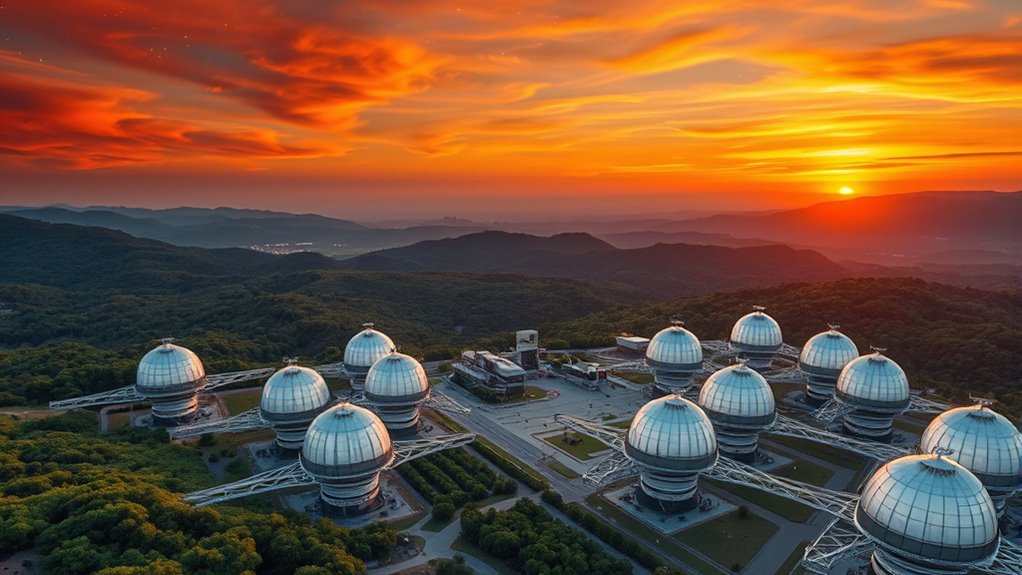

Gravitational wave astronomy is transforming how you understand the universe through exciting discoveries and new observatories. With future facilities like the space-based LISA, you’ll be able to detect a wider range of cosmic events, including ones we can’t currently observe. These advancements will incorporate AI for better data analysis, leading to groundbreaking insights into black holes and neutron stars. Keep exploring to find out what other secrets the universe has in store for you.
Key Takeaways
- Upcoming observatories like the space-based LISA will detect a wider range of gravitational waves, enhancing our understanding of cosmic events.
- New technologies, including AI, will improve data analysis and interpretation in gravitational wave astronomy.
- Gravitational wave detections from black hole mergers challenge existing theories and reveal insights into their properties and evolution.
- Neutron star collisions provide multi-messenger observations, combining gravitational signals with electromagnetic radiation for groundbreaking discoveries.
- The evolving field of gravitational wave astronomy promises to uncover new secrets about the universe’s fabric and cosmic phenomena.
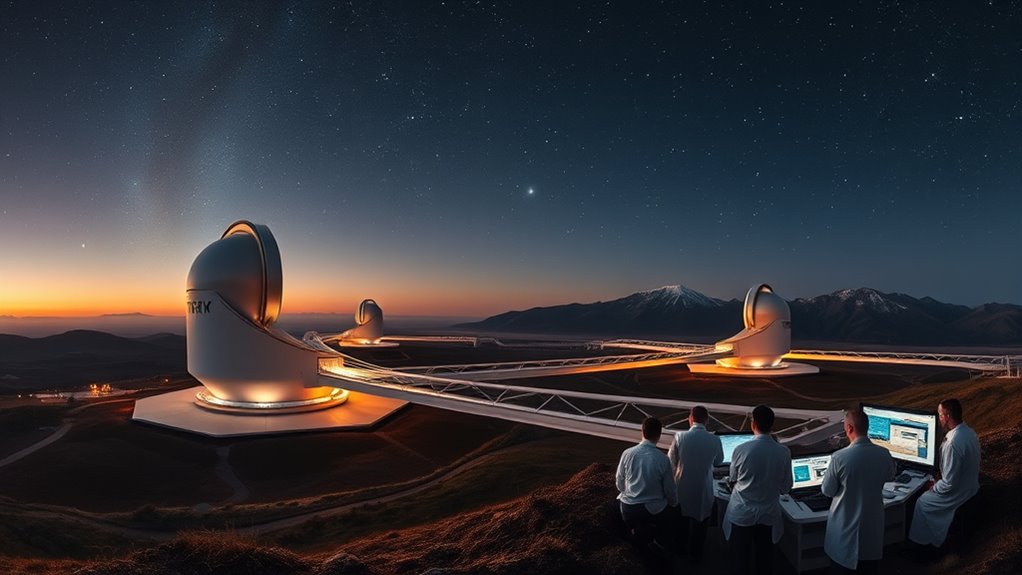
Have you ever wondered how we can “hear” the universe? It might seem strange, but gravitational waves allow us to do just that. These ripples in spacetime are generated by some of the most violent and energetic events in the cosmos, like black hole mergers and neutron star collisions. When massive objects accelerate, they create disturbances that travel across the universe, much like how a stone thrown into a pond creates ripples. Scientists have developed observatories specifically designed to detect these waves, opening up an entirely new way of understanding the universe.
When two black holes spiral toward each other and eventually merge, they produce gravitational waves that can be detected billions of light-years away. You might imagine this as an echo traveling through the fabric of spacetime, and this echo can reveal critical information about the properties of the black holes involved. By analyzing the waves, scientists can learn about their masses, spins, and the dynamics of the merger itself. These discoveries have transformed our understanding of black holes, challenging previous theories and presenting new questions regarding their formation and evolution.
Neutron star collisions are another source of gravitational waves that have captured the attention of astronomers. When two neutron stars collide, they create a massive explosion known as a kilonova, which releases not only gravitational waves but also electromagnetic radiation across the spectrum. This dual output allows you to see the event in different lights, enriching our knowledge of the universe. The combination of gravitational waves and light from these collisions has led to groundbreaking discoveries about heavy elements like gold and platinum, which are formed in these cataclysmic events.
With new observatories coming online, the future of gravitational wave astronomy looks bright. Facilities like the upcoming space-based LISA (Laser Interferometer Space Antenna) will expand our capability to detect waves across a broader frequency range. This means you’ll be able to “hear” more cosmic events than ever before, including those that are currently beyond our reach. As we continue to refine our techniques and expand our knowledge, the universe will reveal its secrets, inviting you to explore the mysteries that lie within. Gravitational wave astronomy is just beginning, and the discoveries on the horizon promise to reshape our understanding of the cosmos. The integration of AI technology in observational techniques may also enhance data analysis and interpretation, leading to even more profound insights.
Frequently Asked Questions
What Are the Main Sources of Gravitational Waves?
The main sources of gravitational waves are black hole mergers and neutron star collisions. When two black holes spiral together and merge, they release immense energy, creating ripples in spacetime. Similarly, when neutron stars collide, they also generate gravitational waves and can produce heavy elements like gold. You’ll find that these cosmic events offer insights into the universe’s most violent processes, expanding our understanding of astrophysics and fundamental physics.
How Do Gravitational Waves Affect Space-Time?
They say, “What goes up must come down,” but with gravitational waves, it’s more about how they ripple through space-time. When black hole mergers occur, they create waves that stretch and squeeze the fabric of the universe. These disturbances can reveal secrets about cosmic inflation, helping you understand the universe’s early moments. So, every time you ponder these waves, remember they’re reshaping reality as you know it, linking past and present.
Can Gravitational Waves Be Detected by Regular Telescopes?
No, you can’t detect gravitational waves with regular telescopes. They operate on electromagnetic signals, while gravitational waves interact with space-time itself. Regular telescopes face optical limitations that prevent them from observing these subtle ripples. Additionally, electromagnetic interference can hinder detection, making it impossible for traditional methods to capture gravitational wave events. Instead, specialized observatories using laser interferometry are required to pick up these faint signals from cosmic events.
What Technology Is Used to Detect Gravitational Waves?
To detect gravitational waves, you use advanced interferometry techniques, which measure tiny changes in distance caused by passing waves. Laser measurement plays a vital role here; lasers are fired down long, perpendicular arms of detectors like LIGO. When a gravitational wave passes, it alters the lengths of these arms, and the interference pattern of the laser beams changes. By analyzing these patterns, you can identify the signature of gravitational waves with incredible precision.
How Do Gravitational Waves Contribute to Our Understanding of the Universe?
Gravitational waves help you grasp the universe’s mysteries by revealing events like black hole mergers and neutron star collisions. These phenomena offer insights into quantum gravity, a theory that seeks to unify quantum mechanics and general relativity. Additionally, studying these waves can shed light on cosmic inflation, the rapid expansion of the universe after the Big Bang. By analyzing gravitational waves, you’re discovering a deeper understanding of the cosmos and its fundamental laws.
Conclusion
As you explore deeper into the domain of gravitational wave astronomy, remember that each new observatory could reveal secrets of the universe we’ve yet to imagine. With every pulse and ripple detected, the potential for groundbreaking discoveries looms ever closer. What mysteries lie hidden within these cosmic whispers? As technology advances, you might just be on the brink of witnessing revelations that could redefine our understanding of existence itself. Stay tuned; the universe has stories yet to tell.