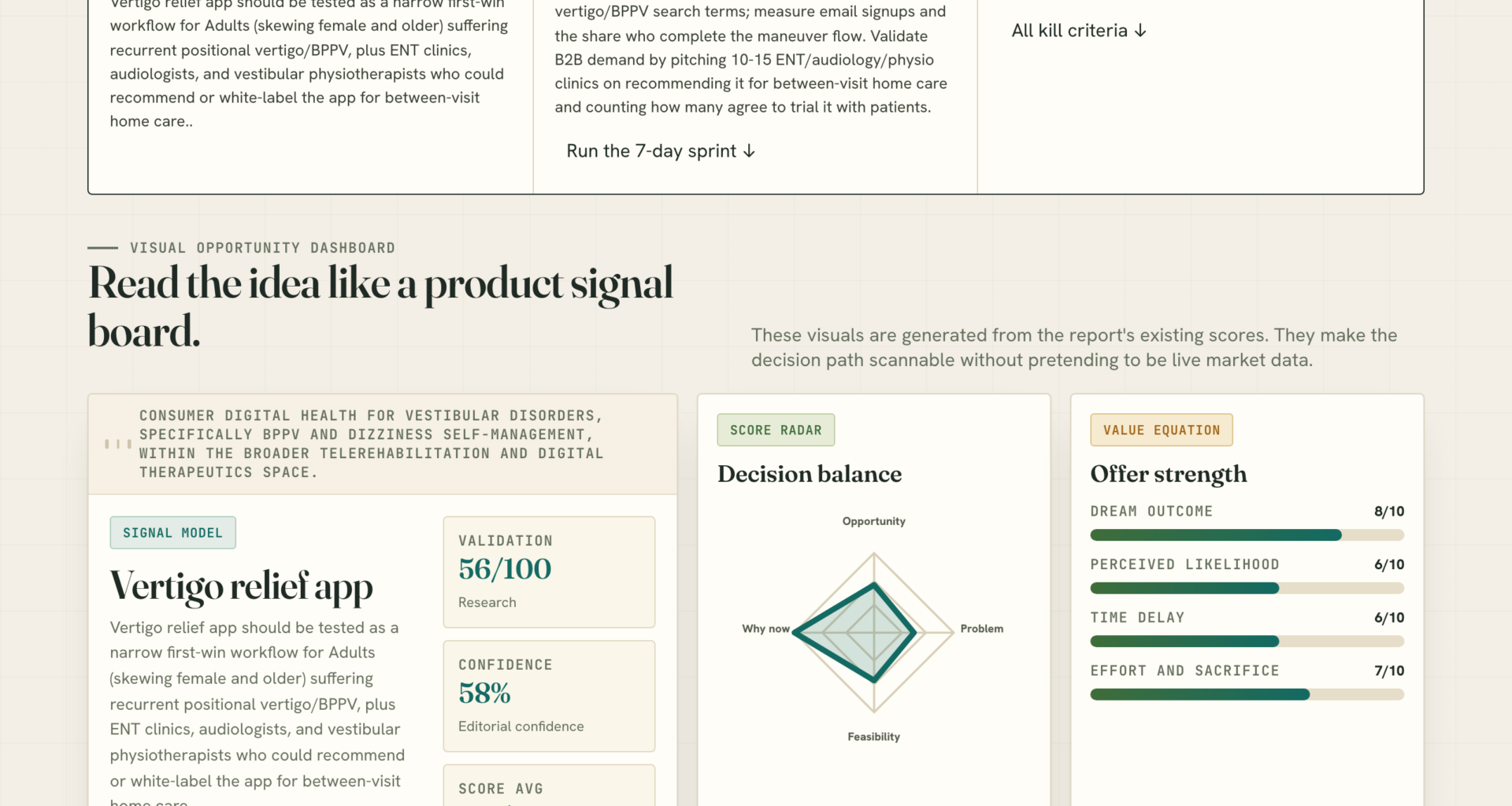

📊 Full opportunity report: Vertigo relief app on IdeaNavigator AI — validation score, market gap, and execution plan.
TL;DR

A vertigo relief app is in testing to assist adults with benign paroxysmal positional vertigo (BPPV) in managing their condition at home. It offers guided maneuvers, episode tracking, and clinician support, with potential for clinic licensing.
A vertigo relief app is currently being tested to aid adults suffering from recurrent positional vertigo, specifically benign paroxysmal positional vertigo (BPPV). The app aims to guide users through repositioning maneuvers like the Epley, offering real-time head-angle feedback via smartphone gyroscopes. This development could provide a new tool for home management, supplementing clinical care and reducing wait times for specialist treatment.
The app targets adults, primarily women and older individuals, who experience recurrent BPPV episodes. It is designed to be recommended by ENT clinics, audiologists, and vestibular physiotherapists, who could also white-label it for patient use. The core features include screening for BPPV candidacy through a safety survey, guided step-by-step animation and audio cues for repositioning maneuvers, and gyroscope-based head position feedback. Patients can log dizziness episodes, triggers, and symptom severity over time, enabling better symptom tracking and recurrence management.
Developers plan to launch a freemium model, offering basic maneuver guidance free of charge, with premium features like detailed tracking, history export, and reminders available via subscription. They also aim to license the app to clinics for patient home programs, integrating it into existing vestibular care pathways. The market for digital vestibular rehabilitation platforms was estimated at nearly USD 498 million in 2024, with expected growth driven by increased telehealth adoption and reimbursement maturity. For related healthcare innovation, see this recent international case.
Potential Impact on Vertigo Self-Management
This app could significantly improve self-treatment for BPPV, a common vestibular disorder affecting millions, especially older adults. By providing guided, real-time feedback, it may reduce incorrect self-treatment and recurrence rates, which affect roughly half of cases. The integration into clinical workflows could enhance patient adherence, decrease unnecessary clinic visits, and support remote care models increasingly favored in the post-pandemic healthcare landscape.
As an affiliate, we earn on qualifying purchases.
Rise of Digital Tools in Vestibular Care
Benign paroxysmal positional vertigo (BPPV) is the most prevalent vestibular disorder, often requiring repositioning maneuvers like the Epley. Traditionally, patients rely on static diagrams or in-person therapy, but long wait times and difficulty performing maneuvers correctly at home pose challenges. COVID-19 accelerated the shift toward telehealth and home-based rehabilitation, opening opportunities for digital therapeutics. The market for such platforms is expanding, with estimates near USD 498 million in 2024 and a projected compound annual growth rate of 13.5% through 2033.
Previous efforts have included instructional videos and basic apps, but few integrate real-time motion tracking or clinician oversight. This new app aims to fill that gap by combining guided instructions with smartphone sensors, making self-treatment more accurate and accessible.
“The app aims to empower patients to perform repositioning maneuvers correctly at home, potentially reducing recurrence and improving quality of life.”
— an anonymous researcher
As an affiliate, we earn on qualifying purchases.
Unconfirmed Efficacy and Adoption Readiness
It is not yet clear how effective the app will be in real-world use, as validation studies are still underway. The actual impact on recurrence rates and patient adherence remains to be tested through clinical trials or user studies. Additionally, the level of adoption by clinics and patient acceptance of the technology are still uncertain, pending pilot results and stakeholder feedback.
As an affiliate, we earn on qualifying purchases.
Next Steps Include Pilot Testing and Clinical Validation
The developers plan to launch a lightweight landing page and conduct targeted advertising to measure interest and usability. They will also seek to partner with 10-15 ENT, audiology, and physiotherapy clinics to trial the app with patients, assessing its integration into existing care pathways. Validation of clinical effectiveness and user satisfaction will be key milestones before broader release and commercialization.
As an affiliate, we earn on qualifying purchases.
Key Questions
How does the vertigo relief app guide users through maneuvers?
The app provides animated step-by-step instructions and audio cues, with real-time head-angle feedback from smartphone gyroscopes to ensure correct positioning during maneuvers like the Epley.
Can the app replace in-person treatment for BPPV?
No, the app is designed as a supplementary tool for home management and should be used alongside medical advice. It includes disclaimers and prompts to see a clinician if red-flag symptoms occur.
Is the app available to the public now?
The app is currently in testing and validation phases, with plans for early validation in 2024. It is not yet available for general download.
How will clinics benefit from licensing the app?
Clinics can use the app to provide patients with guided home treatment, potentially reducing appointment frequency, improving patient adherence, and enhancing overall care outcomes.
What is the market potential for digital vertigo management tools?
The digital vestibular rehabilitation market was estimated near USD 498 million in 2024, with growing acceptance among payers and providers, driven by telehealth trends and reimbursement reforms.
Source: IdeaNavigator AI