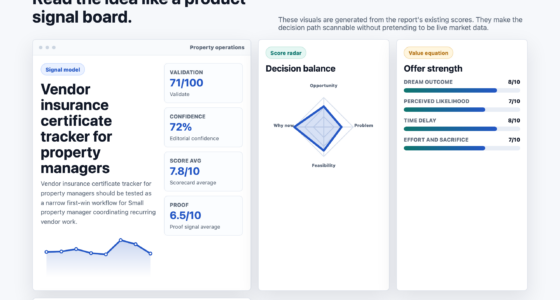
📊 Full opportunity report: The unbundling of the budget app. Why a conversational finance surface absorbs what the personal-finance apps charge for, and what survives the absorption. on ThorstenMeyerAI.com — validation score, market gap, and execution plan.

Get school and study supplies delivered free — and shop member deals
- Fast, free delivery on millions of items
- Access to Prime Big Deal Days deals on October 6–7
- Prime Video, Amazon Music and more included
TL;DR
OpenAI introduced a personal-finance feature inside ChatGPT, absorbing core functions of traditional budget apps. This development shifts the landscape, favoring conversational surfaces over standalone apps for passive data insights, while high-friction, trust-based functions remain separate.
OpenAI has launched a personal-finance surface within ChatGPT, allowing users to connect their financial accounts and receive insights without using dedicated budgeting apps. This move signifies a major shift in personal finance management, as it absorbs the core data and insight functions of traditional apps, fundamentally changing the competitive landscape.
On May 15, 2026, OpenAI introduced a new feature inside ChatGPT that connects to over 12,000 financial institutions through Plaid, enabling users to view spending, subscriptions, portfolios, and upcoming payments directly within the chatbot interface. This feature leverages AI to provide real-time, personalized financial insights grounded in actual user data, with over 200 million monthly queries related to finance already occurring within ChatGPT, according to OpenAI.
This development follows the absorption of Hiro Finance’s team by OpenAI, signaling a strategic shift from standalone apps to integrated conversational surfaces. The core thesis is that a personal-finance app’s functions—such as aggregation, categorization, and basic insights—are now effectively provided for free via AI chat interfaces, undercutting the traditional app model.
While passive functions are being absorbed, high-friction, trust-dependent activities like behavior change, household collaboration, and privacy protection are less susceptible to this shift. Experts note that this unbundling does not eliminate the category but splits it into parts that AI surfaces can handle and parts that require human trust and engagement.
The unbundling
of the budget app.
Why a conversational finance
surface absorbs what the apps
charge for, and what
survives the absorption.
three survive the absorption
before the surface even launched
the pattern’s first demonstration
broad category, not the defensible one
- Aggregation · same Plaid integration, 12,000+ institutions
- Categorization · performed at the shared aggregator layer
- Net-worth & dashboard · generated as a side effect of connection
- Insight & explanation · the surface’s native strength, tuned to a finance benchmark
- Behavior change · requires friction the surface is built to remove
- Collaboration · multi-person workflow, not a single-user query
- Trust / privacy · the surface’s structurally weakest flank
- Action jobs · surface is read-only — for now
The category does not collapse into the chatbot. It splits into the part the surface absorbs and the part it cannot. The passive-dashboard middle hollows out. What survives is the behavior, the relationship, and the privacy promise a general-purpose surface can least credibly make.Thorsten Meyer · The Unbundling of the Budget App · Agentic Commerce 02
Impact on Personal Finance App Ecosystem
This shift signifies a fundamental change in how consumers access financial management tools. The integration of AI chat surfaces into everyday interactions means that passive data aggregation and insight functions are likely to migrate away from standalone apps, reducing their relevance and market share. Meanwhile, apps that focus on behavior change, privacy, and relationship management—areas requiring trust and friction—are poised to remain vital.
For consumers, this could mean more seamless, integrated financial insights within platforms they already use, potentially lowering the need for dedicated finance apps. For developers and incumbents, it raises questions about how to differentiate and sustain value in a landscape increasingly dominated by AI-driven interfaces.
financial account aggregator device
As an affiliate, we earn on qualifying purchases.
As an affiliate, we earn on qualifying purchases.
Evolution of the Personal-Finance Category Post-Mint
The personal-finance app market was largely shaped by Mint’s rise and subsequent shutdown by Intuit in early 2024, which left millions of users seeking alternatives. This vacuum led to rapid growth in apps like Monarch Money, YNAB, and Rocket Money, each targeting different segments of the market—behavior change, household management, and mass-market accessibility.
Meanwhile, OpenAI’s strategic move to embed financial insights into ChatGPT, following the acqui-hire of Hiro Finance’s team, marks a pivotal moment. It reflects a broader trend where AI surfaces are displacing traditional standalone apps by offering passive, aggregated insights at near-zero marginal cost, reshaping the competitive landscape. Learn more about the implications of conversational finance surfaces.
Historically, the category was built around apps that bundled multiple jobs—aggregation, insight, behavior change—yet recent developments suggest the middle layer, the “good-enough dashboard,” is most vulnerable to being absorbed by conversational AI interfaces.
“The structural argument I want to make: a personal-finance app is a bundle of seven distinct jobs, and a conversational AI surface with aggregator rails absorbs the commodity ones — aggregation, categorization, and insight — essentially for free.”
— Thorsten Meyer
As an affiliate, we earn on qualifying purchases.
Remaining Uncertainties in AI’s Impact on Finance Apps
It remains unclear how quickly and extensively consumers will adopt the AI financial surface over dedicated apps, and whether trust and privacy concerns will limit its reach. The durability of high-friction, trust-dependent functions like behavior change and household management in this new context is also still uncertain.
Additionally, the full competitive response from established app providers and how they will differentiate themselves in an AI-dominated landscape is yet to be seen.
As an affiliate, we earn on qualifying purchases.
Next Steps for Personal-Finance Ecosystem
Expect further integration of AI features into financial platforms, with traditional apps focusing on high-trust functions. Monitoring user engagement and trust levels will be crucial, as will observing how incumbents adapt their strategies to the AI-driven shift. Understanding the regulatory landscape for AI in finance.
Developers of standalone apps may pivot toward emphasizing behavioral change and trust-building features to differentiate from AI chat surfaces, which excel at passive insights but struggle with friction-heavy, trust-dependent functions.
As an affiliate, we earn on qualifying purchases.
Key Questions
Will standalone budget apps become obsolete?
Not necessarily. Apps focusing on behavior change, privacy, and household collaboration are likely to remain relevant, as these functions require trust and friction that AI surfaces cannot easily replicate.
How will consumers benefit from AI-driven financial insights?
Consumers may enjoy more seamless, integrated, and real-time financial insights within platforms they already use, reducing the need for separate budgeting apps for passive data monitoring.
What risks does this shift pose for privacy?
As AI surfaces aggregate and analyze sensitive financial data, privacy concerns could increase, especially if data is used for monetization beyond the user’s control. Trust will be key to adoption.
Are there regulatory implications for AI financial surfaces?
Potentially. As AI-driven finance tools become more widespread, regulators may scrutinize data privacy, security, and transparency, influencing how these tools evolve and are adopted.
Source: ThorstenMeyerAI.com
Halloween Picks
halloween
As an affiliate, we earn on qualifying purchases.